



GLP Receptor
GLP Receptor
The GLP receptors contain two family members, GLP-1 receptor (GLP1R, or GLP-1R) and GLP-2 receptor (GLP2R or GLP-1R), activated by the glucagon-like peptides (GLPs). GLPs are s secreted by intestinal cells; causes insulin release; inhibits glucagon secretion, appetite, and energy intake; and delays gastric emptying because GLP receptors are located on the gut, pancreas, brainstem, hypothalamus, and vagal-afferent nerves. GLP-1 has only one known receptor, GLP1R, and regulates gut motility, appetite, islet function, and glucose homeostasis, whereas GLP-2, the agonist of GLP2R, enhances intestinal nutrient absorption. GLP-1R agonists are used to treat diabetes and obesity, and a GLP-2R agonist is approved to treat short bowel syndrome. An investigation of the actions of GLP receptor activation on gallbladder motility has demonstrated that GLP-2 receptor activation increases gallbladder volume in vivo and decreases spontaneous activity in GBSM bundles ex vivo. Like the inhibitory transmitters, which elicit their actions via an adenylate cyclase-protein kinase A-KATP channel pathway, the GLP-2 receptor signals through this same pathway.
All Product Categories
-
GLP Receptor Inhibitors
(17)
View all products
-
GLP Receptor Agonists
(148)
View all products
-
GLP Receptor Antagonists
(9)
View all products
-
GLP Receptor Activators
(14)
View all products
-
GLP Receptor Modulators
(8)
View all products
-
GLP Receptor Inducer
(1)
View all products
-
GLP Receptor Degrader
(1)
View all products
-
GLP Receptor Controls
(2)
View all products
-
GLP Receptor Ligands
(2)
View all products
-
GLP Receptor Related Products (232)
Related Products (232)

-
Antibodies (1)
-
GLP-1R agonist 34
 0 ImagesCat. No.: HY-176770CAS No.: 3074089-99-6GLP-1R agonist 34 (Compound 1) is an orally active small molecule glucagon-like peptide-1 receptor (GLP-1R) agonist. GLP-1R agonist 34 promotes insulin secretion, inhibits glucagon release, and delays gastric emptying, thereby effectively lowering blood glucose levels. GLP-1R agonist 34 is promising for research of metabolic diseases, including type 2 diabetes, obesity, and non-alcoholic steatohepatitis (NASH).
-
Antitumor agent-101
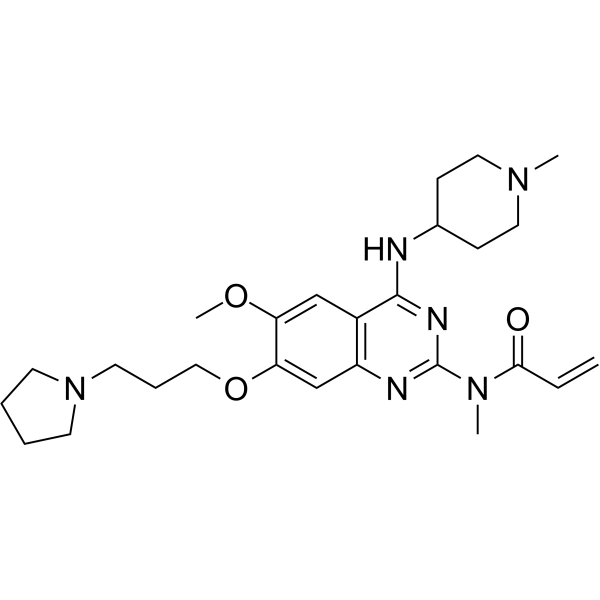 0 ImagesCat. No.: HY-155020CAS No.: 2848632-52-8Antitumor agent-101 is a selective covalent inhibitor of lysine methyltransferases G9a/GLP, with IC50s of 8.5 nM and 5.5 nM for G9a and GLP, respectively. Antitumor agent-101 shows antitumor efficacy in the PANC-1 xenograft model.
-
GLP-1R agonist 35
 0 ImagesCat. No.: HY-178768CAS No.: 3092875-81-2GLP-1R agonist 35 (Compound 111-2) is a GLP-1R agonist with an EC50 of 0-10 nM. GLP-1R agonist 36 can be used for the studies of diabetes and obesity.
-
LX2761
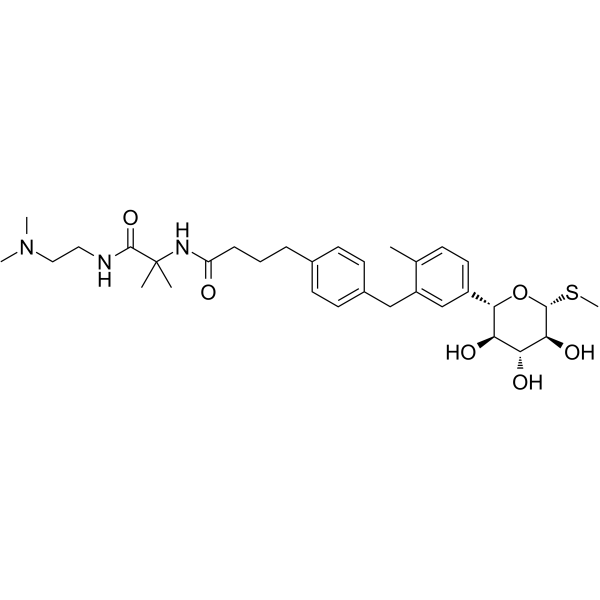 0 ImagesLX2761 is an orally active, dual SGLT1/SGLT2 inhibitor with IC50 values of 2.2 nM and 2.7 nM against human SGLT1 and SGLT2, respectively. LX2761 locks human SGLT1 in an outward-open conformation and blocks its putative water permeation pathway. After oral administration, LX2761 is confined exclusively to the intestinal lumen, delays intestinal glucose absorption, regulates intestinal glucose metabolism, increases cecal glucose levels, reduces cecal pH, improves glycemic control and elevates plasma total GLP-1 levels. However, LX2761 induces diarrhea in a dose-dependent manner. LX2761 can be used in diabetes-related research.
-
Skim Milk powder
 0 ImagesCat. No.: HY-182832Synonyms: Dry skim milk; Non-fat milk solids; Skimmed milk powderSkim Milk powder (Dry skim milk) is an orally effective, dairy-derived non-fat milk solid powder. Skim Milk powder serves as a nutrient source in microbial culture media and can also be used for blocking procedures in WB assays. Skim Milk powder protects zebrafish sperm from oxidative stress, DNA damage, membrane disruption and morphological abnormalities during cryopreservation, and improves their survival rate. After undergoing high Maillard reaction during moist-heat storage, Skim Milk powder exhibits negative metabolic activities such as inhibiting GLP-1/GIP and promoting intestinal inflammation. Skim Milk powder can be used in studies related to intestinal inflammation, diabetes and obesity.
-
Bilpatide
 0 ImagesCat. No.: HY-P12137CAS No.: 2869056-74-4Synonyms: RAY1225Bilpatide (RAY1225) is a dual agonist of glucagon-like peptide-1 receptor (GLP-1R) and glucose-dependent insulinotropic polypeptide receptor (GIPR). Bilpatide is applicable to research related to obesity and diabetes.
-
GLP-1R/GIPR agonist-2
 0 ImagesCat. No.: HY-171302CAS No.: 2766799-78-2GLP-1R/GIPR agonist-2 is a GIPR agonist. GLP-1R/GIPR agonist-2 potentiates GIP(1-42)-induced intracellular cAMP production in cells expressing human GIPR. GLP-1R/GIPR agonist-2 can be used for the research of type II diabetes mellitus.
-
Carmegliptin
 0 ImagesCat. No.: HY-10289CAS No.: 813452-18-5Synonyms: RO-4876904Carmegliptin (RO-4876904) is an orally active and potent DPP IV inhibitor with a human DPP IV IC50 of 6.8 nM. Carmegliptin binds to the S1 pocket of DPP IV, blocks the degradation of GLP 1, potentiates endogenous GLP 1, increases plasma insulin levels, alleviates hyperglycemia, improves glucose tolerance. Carmegliptin acts as a substrate for human P glycoprotein without inhibiting the transporter, shows low in vitro cell permeability. Carmegliptin can be used for the research of type 2 diabetes, non insulin dependent diabetes mellitus.
-
(Asp28)-Exenatide
 0 ImagesCat. No.: HY-P4386CAS No.: 1678417-24-7(Asp28)-Exenatide is a degradation product of exenatide (HY-13443). (Asp28)-Exenatide can be used as a GLP-1R agonist.
-
GLP-1R agonist 44
 0 ImagesCat. No.: HY-182849CAS No.: 2810807-65-7GLP-1R agonist 44 is a glucagon-like peptide-1 receptor (GLP-1R) agonist. GLP-1R agonist 44 can be used for the research of diseases related to GLP-1R, such as type 2 diabetes, obesity, non-alcoholic fatty liver disease, non-alcoholic steatohepatitis, nephropathy, gout, hematuria, cardiovascular disease.
-
Vensemaglutide
 0 ImagesCat. No.: HY-P10910CAS No.: 2919344-88-8Vensemaglutide is the agonist for glucagon-like peptide 1 (GLP-1) receptor. Vensemaglutide can be used in research of diabetes or other metabolic disorders.
-
Taspoglutide acetate
 0 ImagesCat. No.: HY-P0165BCAS No.: 1022150-16-8Synonyms: ITM077 acetate; R1583 acetate; BIM51077 acetateTaspoglutide (R1583) acetate is an agonist of the glucagon-like peptide 1 receptor (GLP-1R) with an Ki value of 1.1 nM. Taspoglutide acetate induces cAMP accumulation in CHO-K1 cells expressing human GLP-1R (EC50 = 0.06 nM). Taspoglutide acetate decreases blood levels of glucose and increases blood levels of insulin in a glucose tolerance test in Zucker diabetic obese rats. Taspoglutide acetate reduces blood levels of gastric inhibitory polypeptide (GIP), plasma levels of triglycerides, and body weight in the same model.

-
AZ13581837
 0 ImagesCat. No.: HY-115643CAS No.: 2896777-27-6AZ13581837 is an orally active GPR120 agonist with an EC50 of 5.2 nM for human GPR120. AZ13581837 signals through Gαq, Gαs, and β-arrestin pathways, reduces cAMP production, stimulates GLP-1 secretion, induces glucose lowering, and increases insulin secretion. AZ13581837 can be used for the research of type 2 diabetes.
-
FE 999011
 0 ImagesCat. No.: HY-182300CAS No.: 171092-64-1FE 999011 is an orally active dipeptidyl peptidase IV (DPP-IV) inhibitor with IC50 values of 7 nM and 3 nM against human and rat sources, respectively. FE 999011 acts as a glucose tolerance-improving agent and a GLP-1 receptor activator, which reduces blood glucose fluctuation, promotes GLP-1 release and decreases the insulin-glucose ratio. FE 999011 regulates lipid metabolism, delays the onset of diabetes, stabilizes food and water intake, reduces hypertriglyceridemia, prevents the elevation of free fatty acids, and delays the progression of impaired glucose tolerance to disease. FE 999011 can be used in relevant studies of type 2 diabetes.
-
Glyceollin III
 0 ImagesCat. No.: HY-N18033CAS No.: 61080-23-7Glyceollin III is a glyceollin found in soybeans. Glyceollin III enhances insulin-stimulated glucose uptake and increases glucagon-like peptide-1 (GLP-1) secretion. Glyceollin III can be used for the research of type 2 diabetes.
-
Anvoglutide
 0 ImagesCat. No.: HY-P11664CAS No.: 3091730-40-1
-
H-Trp-Tyr-OH
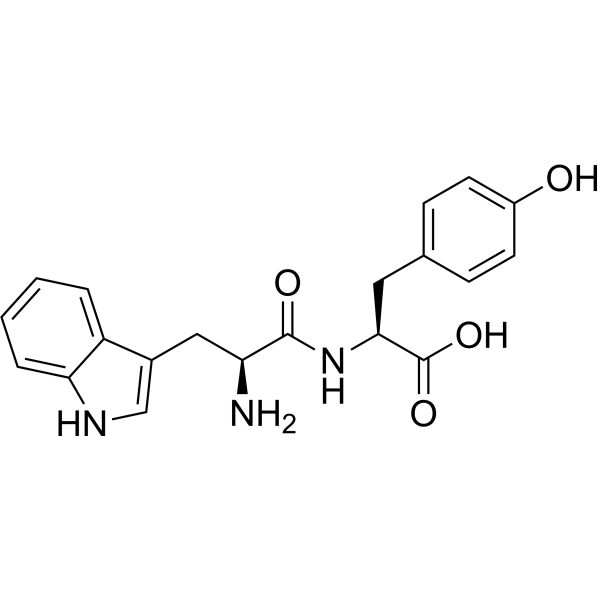 0 ImagesH-Trp-Tyr-OH is an orally active tryptophan-tyrosine dipeptide with blood-brain barrier permeability. H-Trp-Tyr-OH exerts physiological regulatory effects by stimulating enteroendocrine cells to secrete glucagon-like peptide GLP-1. In mouse models of tauopathies, H-Trp-Tyr-OH inhibits tau phosphorylation, reduces the level of neurofibrillary tangles, increases dopamine turnover, upregulates synapsin expression, and elevates cecal short-chain fatty acid levels, thereby improving behavioral deficits and extending lifespan. H-Trp-Tyr-OH can be used in research related to impaired glucose tolerance and tauopathies.
-
Tirzepatide sodium
 0 ImagesCat. No.: HY-P1731CSynonyms: LY3298176 sodiumTirzepatide sodium (LY3298176 sodium) is a dual glucose-dependent insulinotropic polypeptide (GIP) and glucagon-like peptide-1 (GLP-1) receptor agonist. Tirzepatide sodium exerts anti-apoptotic and pro-differentiation effects via the pAkt/CREB/BDNF cascade and miRNA in neurons; in the heart, it promotes BCAA catabolism and inhibits the mTOR pathway by mediating the dephosphorylation of BCKDHA; meanwhile, it effectively reduces insulin and leptin levels and suppresses inflammatory responses at the systemic level. Tirzepatide sodium can be used for research on myocardial infarction, colon cancer, diabetes, diabetic cognitive impairment, neurodegeneration, diabetes-related neuropathy, and obesity.
-
GLP-1R modulator-1
 0 ImagesCat. No.: HY-171850CAS No.: 2978244-71-0GLP-1R modulator-1 (Compound 384) is an orally active, potent selective glucagon-like peptide-1 receptor (GLP-1R) agonist. GLP-1R modulator-1 activates G-protein coupled signaling, elevates intracellular cAMP levels, promotes insulin secretion, delays gastric emptying and suppresses appetite. GLP-1R modulator-1 is promising for research of type 2 diabetes, obesity, and non-alcoholic steatohepatitis (NASH).




