



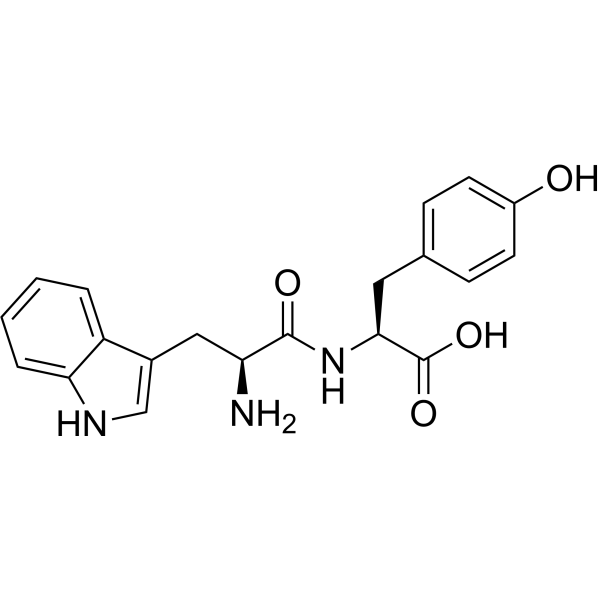
H-Trp-Tyr-OH

Based on 1 Customer Validation
H-Trp-Tyr-OH is an orally active tryptophan-tyrosine dipeptide with blood-brain barrier permeability. H-Trp-Tyr-OH exerts physiological regulatory effects by stimulating enteroendocrine cells to secrete glucagon-like peptide GLP-1. In mouse models of tauopathies, H-Trp-Tyr-OH inhibits tau phosphorylation, reduces the level of neurofibrillary tangles, increases dopamine turnover, upregulates synapsin expression, and elevates cecal short-chain fatty acid levels, thereby improving behavioral deficits and extending lifespan. H-Trp-Tyr-OH can be used in research related to impaired glucose tolerance and tauopathies.
For research use only. We do not sell to patients.
- Purity : 99.43%
- CAS No.: 19653-76-0
- Formula: C20H21N3O4
- Molecular Weight:367.40
-
Storage:
Sealed storage, away from moisture.
Powder -80°C, 2 years , -20°C, 1 year* In solvent : -80°C, 6 months; -20°C, 1 month (sealed storage, away from moisture)

To place orders, for customer services and technical support, please contact: MedChemExpress USA
Tel: 609-228-6898 E-mail: [email protected] [email protected]


-
 Biological Activity
-
Chemical Information
-
Solvent & Solubility
- Protocols
- Purity & Documentation
- References
-
 Help & FAQs




Biological Activity
Description
Cellular Effect
|
Cell Line

|
Type | Value | Description | References |
|---|---|---|---|---|
| MDCK | IC50 |
0.08 mM
Compound: 69
|
Binding affinity to human PEPT1 assessed as inhibition of [14C]Gly-Sar uptake in MDCK cells
Binding affinity to human PEPT1 assessed as inhibition of [14C]Gly-Sar uptake in MDCK cells
|
[PMID: 16759105] |
In Vitro
H-Trp-Tyr-OH (1-5 mg/mL; 60 min) potently stimulates GLP-1 secretion from GLUTag cells, with the highest activity observed at 5 mg/mL (the induced GLP-1 level is approximately 6-fold higher than that of the blank control), and exhibits no cytotoxicity against GLUTag cells[2].
MedChemExpress (MCE) has not independently confirmed the accuracy of these methods. They are for reference only. Further protocols information, click here.
-
Cell Line:murine enteroendocrine GLUTag cells
-
Concentration:1 mg/mL; 2 mg/mL; 5 mg/mL; 1.85 mg/mL
-
Incubation Time:60 min
-
Result:Induced a GLP-1 secretion level ~6-fold relative to blank control at 5 mg/mL.
Induced a GLP-1 level ~1-fold relative to blank control at 1 mg/mL.
Induced a GLP-1 level ~2-fold relative to blank control at 2 mg/mL.
Induced a GLP-1 level ~1.2-fold relative to blank control at 1.85 mg/mL.
Remained at baseline LDH release levels, showing no cytotoxicity.
In Vivo
MedChemExpress (MCE) has not independently confirmed the accuracy of these methods. They are for reference only.
-
Animal Model:B6;C3-Tg mice (Prnp-MAPT*P301S)PS19Vle/J (PS19 transgenic; male and female, 2.5 months old, tauopathy model); wild-type littermates (male and female, 2.5 months old)[3]
-
Dosage:0.05% w/w
-
Administration:p.o.; continuous dietary intake; 6.5 months (male); until 53 weeks of age (female)
-
Result:Reduced total distance traveled in the open field test at 5 and 7 months of age, normalizing locomotor hyperactivity.
Increased the number of NeuN-positive cells in the entorhinal cortex and elevated cortical synaptophysin levels in male mice.
Increased dopamine turnover (DOPAC/dopamine ratio and (DOPAC + HVA)/dopamine ratio) in the frontal cortex of male mice.
Reduced hippocampal pTau levels (113.1 vs control 162.2) and cortical pTau/tTau ratio (0.02 vs control 0.04) in male mice; reduced pTau-positive region in the spinal cord.
Achieved a 67% survival ratio at 53 weeks of age in female mice, significantly higher than control's 38%.
Increased cecal acetic acid and total short-chain fatty acid levels in male mice.


Chemical Information
-
CAS No. 19653-76-0
-
Appearance Solid
-
Molecular Weight 367.40
-
Formula C20H21N3O4
-
Color White to off-white
-
Sequence
Trp-Tyr
-
Sequence Shortening
WY
-
Shipping
Room temperature in continental US; may vary elsewhere.
-
Storage
Sealed storage, away from moisture
Powder -80°C 2 years -20°C 1 year * In solvent : -80°C, 6 months; -20°C, 1 month (sealed storage, away from moisture)


Solvent & Solubility
In Vitro:
H2O : 25 mg/mL (68.05 mM; Need ultrasonic)
Please refer to the solubility information to select the appropriate solvent. Once prepared, please aliquot and store the solution to prevent product inactivation from repeated freeze-thaw cycles.
Storage method and period of stock solution: -80°C, 6 months; -20°C, 1 month (sealed storage, away from moisture). When stored at -80°C, please use it within 6 months. When stored at -20°C, please use it within 1 month.
* Note: If you choose water as the stock solution, please dilute it to the working solution, then filter and sterilize it with a 0.22 μm filter before use.
Please refer to the solubility information to select the appropriate solvent. Once prepared, please aliquot and store the solution to prevent product inactivation from repeated freeze-thaw cycles.
Storage method and period of stock solution: -80°C, 6 months; -20°C, 1 month (sealed storage, away from moisture). When stored at -80°C, please use it within 6 months. When stored at -20°C, please use it within 1 month.
* Note: If you choose water as the stock solution, please dilute it to the working solution, then filter and sterilize it with a 0.22 μm filter before use.
Concentration (start) × Volume (start) = Concentration (final) × Volume (final)

Protocols
-
Kinase activity and phosphorylation assays
Kinase activity assays measure the ability of kinases to transfer phosphate groups from ATP to specific substrates, while phosphorylation assays detect the presence and levels of phosphorylated proteins. Common methods include radiolabeled ATP incorporation (e. g. ,), ADP release detection via bioluminescence (e. g. ,[3]), enzyme-linked immunosorbent assays (ELISA) for phospho-specific epitopes (e. g. ,[6]), and microtiter-based formats for high-throughput screening (e. g. ,[8]). The ADP-Glo assay quantifies kinase activity by measuring ADP produced during phosphorylation using a luciferase-based system. Radiometric assays involve autoradiography or scintillation counting after incorporation of 32P-labeled ATP into substrate proteins. ELISA-based approaches rely on phospho-specific antibodies to detect activated kinases in cell lysates or purified samples.
-
Western Blot
Western blotting (WB) is a commonly used experimental method in molecular biology, biochemistry, and immunogenetics for identifying and quantifying target proteins. It combines gel electrophoresis with immunoassay, enabling researchers to analyze protein expression, post-translational modifications, and molecular weight.
-
RNA extraction experimental
By lysing cells, releasing RNA, and removing impurities such as proteins and DNA, high-purity RNA products are finally obtained. The commonly used traditional method is the guanidine isothiocyanate/phenol/chloroform method (Trizol), which is suitable for a variety of animal materials including animal tissues, microorganisms, cultured cells, etc., and most plant materials.
-
Transepithelial/transendothelial electrical resistance assay
TEER measures electrical resistance across epithelial or endothelial monolayers cultured on permeable supports, and the readout reflects ionic conductance through the cell barrier, especially the paracellular pathway regulated by junctional integrity. TEER can be measured without destroying the monolayer and is commonly used before or during transport, permeability, barrier-disruption, and barrier-maturation experiments. TEER values are influenced by biological maturation and technical conditions; reported factors include temperature, medium formulation, passage number, electrode geometry, membrane properties, and junctional length during early monolayer maturation. Therefore, TEER should be interpreted with blank-insert subtraction, area normalization, repeated readings, and, when possible, orthogonal barrier readouts such as FITC-dextran flux or tight-junction staining.
-
Protocol for Kinase activity and phosphorylation assays
Kinase activity assays measure transfer of phosphate from ATP to a protein or peptide substrate, generating phosphorylated substrate, ADP, or incorporated radiolabeled phosphate as the readout; phosphorylation assays measure site-specific phosphorylation in cells or tissues as a proxy for kinase-pathway activation, inhibition, or substrate regulation. Phosphorylation can be detected by phospho-specific Western blot, immunoprecipitation kinase assay, phospho-immunofluorescence, phospho-flow cytometry, luminescent ADP detection, radiolabeled ATP incorporation, or reporter-based pathway assays, and these readouts can be applied to cancer cells, primary neurons, mouse tumors, organoids, inflammatory macrophages, ferroptosis studies, and mitophagy studies when the kinase target is biologically relevant.
-
Alzheimer’s Disease Modeling
Alzheimer’s Disease (AD) is a neurodegenerative disorder characterized by a progressive decline in cognitive functions and loss of specific types of neurons and synapses. Alzheimer's symptoms can be simulated in mice by injecting drugs (such as Aβ) or genetically modified.


Purity & Documentation
-
Data Sheet (276 KB)
-
SDS (393 KB)
- English - EN (393 KB)
- Français - FR (393 KB)
- Deutsch - DE (393 KB)
- Norwegian - NO (393 KB)
- Español - ES (393 KB)
- Swedish - SV (393 KB)
- Italian - IT (393 KB)
- Korean - KR (393 KB)
- Portuguese - PT (393 KB)
-
Handling Instructions (2659 KB)
References
[1]. Wu L, et al. Geometry and efficacy of cross-strand Trp/Trp, Trp/Tyr, and Tyr/Tyr aromatic interaction in a beta-hairpin peptide. Biochemistry. 2010;49(22):4705-4714. [Content Brief]
[3]. Ano Y, et al. Tryptophan-tyrosine dipeptide improves tau-related symptoms in tauopathy mice. Nutr Neurosci. 2023;26(8):766-777. [Content Brief]


Complete Stock Solution Preparation Table
Please refer to the solubility information to select the appropriate solvent. Once prepared, please aliquot and store the solution to prevent product inactivation from repeated freeze-thaw cycles.
Storage method and period of stock solution: -80°C, 6 months; -20°C, 1 month (sealed storage, away from moisture). When stored at -80°C, please use it within 6 months. When stored at -20°C, please use it within 1 month.
| Optional Solvent | Concentration Solvent Mass | 1 mg | 5 mg | 10 mg | 25 mg |
|---|---|---|---|---|---|
| H2O | 1 mM | 2.7218 mL | 13.6091 mL | 27.2183 mL | 68.0457 mL |
| 5 mM | 0.5444 mL | 2.7218 mL | 5.4437 mL | 13.6091 mL | |
| 10 mM | 0.2722 mL | 1.3609 mL | 2.7218 mL | 6.8046 mL | |
| 15 mM | 0.1815 mL | 0.9073 mL | 1.8146 mL | 4.5364 mL | |
| 20 mM | 0.1361 mL | 0.6805 mL | 1.3609 mL | 3.4023 mL | |
| 25 mM | 0.1089 mL | 0.5444 mL | 1.0887 mL | 2.7218 mL | |
| 30 mM | 0.0907 mL | 0.4536 mL | 0.9073 mL | 2.2682 mL | |
| 40 mM | 0.0680 mL | 0.3402 mL | 0.6805 mL | 1.7011 mL | |
| 50 mM | 0.0544 mL | 0.2722 mL | 0.5444 mL | 1.3609 mL | |
| 60 mM | 0.0454 mL | 0.2268 mL | 0.4536 mL | 1.1341 mL |
* Note: If you choose water as the stock solution, please dilute it to the working solution, then filter and sterilize it with a 0.22 μm filter before use.


H-Trp-Tyr-OH Related Classifications
HY-P4610 Related Classifications
 Powered by Bioz