



(Asp28)-Glucagon (1-29) (human, rat, porcine)
(Asp28)-Glucagon (1-29) (human, rat, porcine) is a glucagon analog and a GCGR agonist, with the Asn at position 28 replaced by Asp. (Asp28)-Glucagon (1-29) (human, rat, porcine) activates GCGR-mediated cAMP signaling, with EC50 values of 0.067 nM and 0.09 nM, respectively, and an EC50 of 7.99 nM for GLP-1R. (Asp28)-Glucagon (1-29) (human, rat, porcine) is useful for studies on glucagon receptor signaling, carbohydrate metabolism, and hypoglycemia.
For research use only. We do not sell to patients.
- CAS No.: 1037751-81-7
- Formula: C153H224N42O50S
- Molecular Weight:3483.73
-
Storage:
Please store the product under the recommended conditions in the Certificate of Analysis.

To place orders, for customer services and technical support, please contact: MedChemExpress USA
Tel: 609-228-6898 E-mail: [email protected] [email protected]


-
 Biological Activity
-
Chemical Information
- Purity & Documentation
- References
-
 Help & FAQs




Biological Activity
Description
|
GLP-1 7.99 nM (EC50) |
GCGR 0.09 nM (EC50) |
GCGR 0.067 nM (EC50) |
Cellular Effect
|
Cell Line

|
Type | Value | Description | References |
|---|---|---|---|---|
| HEK293 | EC50 |
0.067 nM
|
Stimulation of glucagon receptor-mediated cAMP production in HEK293 cells co-transfected with GCGR cDNAs and a cAMP response element-linked luciferase reporter gene, incubated for 5 h before adding LucLite luminescence substrate and measuring light output after 10 min in the dark.
Stimulation of glucagon receptor-mediated cAMP production in HEK293 cells co-transfected with GCGR cDNAs and a cAMP response element-linked luciferase reporter gene, incubated for 5 h before adding LucLite luminescence substrate and measuring light output after 10 min in the dark.
|
24749059 |
| HEK293 | EC50 |
0.09 nM
|
Stimulation of cAMP production via the human glucagon receptor in HEK293 cells overexpressing the human glucagon receptor with a cAMP response element-linked luciferase reporter gene, following 16 h serum deprivation and 5 h incubation at 37 °C in 5% CO2, measured by luciferase reporter assay.
Stimulation of cAMP production via the human glucagon receptor in HEK293 cells overexpressing the human glucagon receptor with a cAMP response element-linked luciferase reporter gene, following 16 h serum deprivation and 5 h incubation at 37 °C in 5% CO2, measured by luciferase reporter assay.
|
21129326 |
| HEK293 | EC50 |
7.99 nM
|
Stimulation of cAMP production via the human GLP-1 receptor in HEK293 cells overexpressing the human GLP-1 receptor with a cAMP response element-linked luciferase reporter gene, following 16 h serum deprivation and 5 h incubation at 37 °C in 5% CO2, measured by luciferase reporter assay.
Stimulation of cAMP production via the human GLP-1 receptor in HEK293 cells overexpressing the human GLP-1 receptor with a cAMP response element-linked luciferase reporter gene, following 16 h serum deprivation and 5 h incubation at 37 °C in 5% CO2, measured by luciferase reporter assay.
|
21129326 |
In Vitro
(Asp28)-Glucagon (1-29) (human, rat, porcine) activates GCGR-mediated cAMP signaling in HEK293 cells expressing GCGR and a cAMP-responsive element luciferase reporter, with an EC50 of 0.067 nM[1].
(Asp28)-Glucagon (1-29) (human, rat, porcine) activates GCGR in HEK293 cells overexpressing human GCGR and carrying a cAMP response element luciferase reporter gene, with an EC50 of 0.09 nM[2].
(Asp28)-Glucagon (1-29) (human, rat, porcine) exhibits lower GLP-1R activity in HEK293 cells overexpressing human GLP-1R and carrying a cAMP response element luciferase reporter gene, with an EC50 of 7.99 nM[2].
The water solubility of (Asp28)-Glucagon (1-29) (human, rat, porcine) (1 mg/mL; 24 h; 25 °C; 50 mM triethanolamine, pH 7.0) is approximately 5-fold higher than that of native glucagon[1].
(Asp28)-Glucagon (1-29) (human, rat, porcine) (1 mg/mL; pH 8.6; 0.1% SDS) shows no significant loss of integrity after 1 month at ambient temperature and 4 °C in long-term stability studies, whereas the parent peak declines by more than 20% at 30 °C and 40 °C; after 2 months at 40 °C, only about half remains intact[1].
(Asp28)-Glucagon (1-29) (human, rat, porcine) (1 mg/mL; 24 h; 10 mM Tris) reduces the calculated pI from 6.7 to 5.4 via the Asn28→Asp substitution, and exhibits approximately 2-fold higher solubility than native glucagon at pH 7.4[2].
(Asp28)-Glucagon (1-29) (human, rat, porcine) (1 mg/mL; PBS, pH 7.4; 25 °C) maintains high stability during the 5-month stability study, with no clear aspartyl peptide bond cleavage observed[2].
MedChemExpress (MCE) has not independently confirmed the accuracy of these methods. They are for reference only.
In Vivo
MedChemExpress (MCE) has not independently confirmed the accuracy of these methods. They are for reference only.
-
Animal Model:Beagle dogs (8-12 kg, 8-16 months of age, healthy, fasted)[1]
-
Dosage:1.5 μg/kg; 5 μg/kg; 15 μg/kg
-
Administration:i.m.; Days 1 and 5
-
Result:Demonstrated comparable time action for glucose elevation relative to native glucagon, with slightly lower potency than native glucagon.


Chemical Information
-
CAS No. 1037751-81-7
-
Molecular Weight 3483.73
-
Formula C153H224N42O50S
-
Sequence
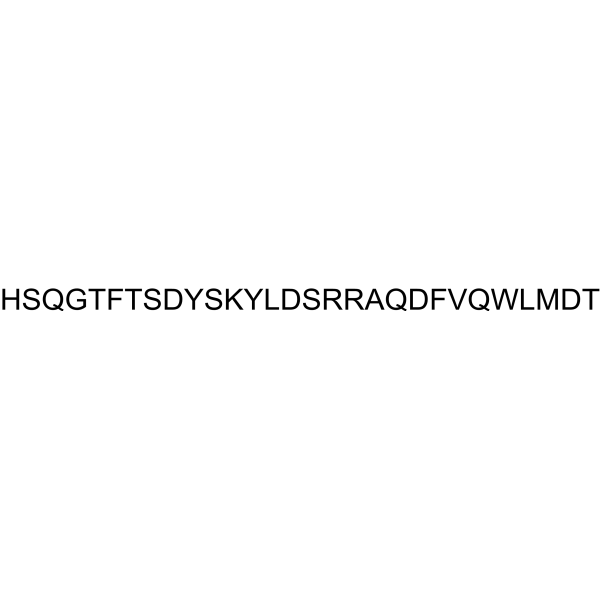
His-Ser-Gln-Gly-Thr-Phe-Thr-Ser-Asp-Tyr-Ser-Lys-Tyr-Leu-Asp-Ser-Arg-Arg-Ala-Gln-Asp-Phe-Val-Gln-Trp-Leu-Met-Asp-Thr
-
Sequence Shortening
HSQGTFTSDYSKYLDSRRAQDFVQWLMDT
-
Shipping
Room temperature in continental US; may vary elsewhere.
-
Storage
Please store the product under the recommended conditions in the Certificate of Analysis.


Purity & Documentation
References

Calculators
Concentration (start) × Volume (start) = Concentration (final) × Volume (final)


(Asp28)-Glucagon (1-29) (human, rat, porcine) Related Classifications
HY-P4389 Related Classifications
 Powered by Bioz