



Hypoglycemia
-
Hypoglycemia (7)

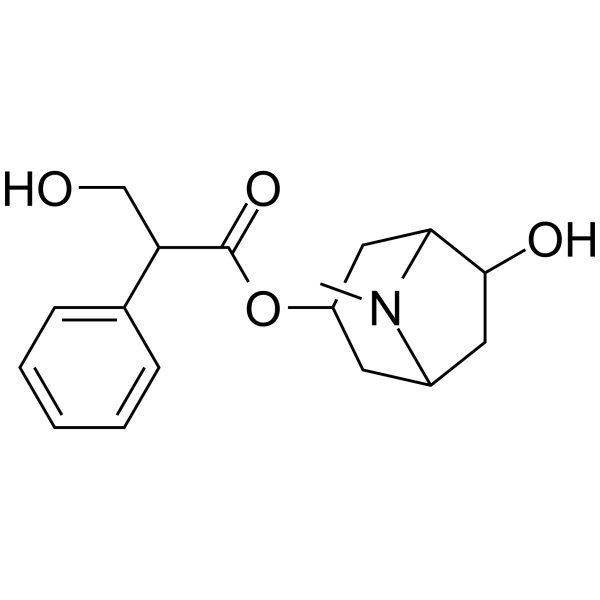
- Formula: C17H23NO4
- Molecular Weight: 305.37
Racanisodamine is an orally active, non-selective Muscarinic Acetylcholine Receptor (mAChR) antagonist. Racanisodamine is a racemate of Anisodamine, and the two share similar pharmacological effects. Racanisodamine is an active ingredient of eye drops for myopia control. Racanisodamine can be used in research on myopia and late dumping syndrome.

- Formula: C4H8N2O
- Molecular Weight: 100.12
3,3-Azo-1-butanol is an orally active hypoglycemic agent. 3,3-Azo-1-butanol increases liver weight and induces fat infiltration.
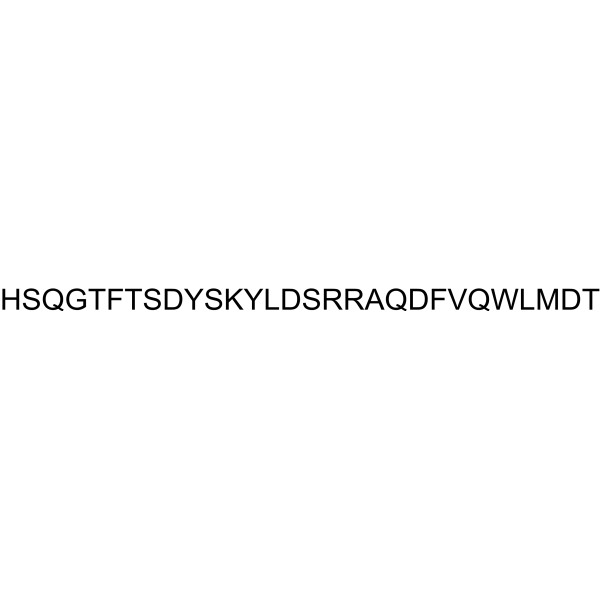
- Formula: C153H224N42O50S
- Molecular Weight: 3483.73
(Asp28)-Glucagon (1-29) (human, rat, porcine) is a glucagon analog and a GCGR agonist, with the Asn at position 28 replaced by Asp. (Asp28)-Glucagon (1-29) (human, rat, porcine) activates GCGR-mediated cAMP signaling, with EC50 values of 0.067 nM and 0.09 nM, respectively, and an EC50 of 7.99 nM for GLP-1R. (Asp28)-Glucagon (1-29) (human, rat, porcine) is useful for studies on glucagon receptor signaling, carbohydrate metabolism, and hypoglycemia.

- Formula: C36H58O8
- Molecular Weight: 618.84
Cyclocarioside K is a triterpene glycoside compound that can be naturally extracted from the dried leaves of Cyclocarya paliurus (Batal.) Iljinsk (Chinese wingnut) from Bozhou, Anhui, China. The leaves of this plant are traditionally used to lower blood sugar and blood pressure.

- Formula: C17H23NO4
- Molecular Weight: 305.37
Racanisodamine Standard is the analytical standard of Racanisodamine (HY-N2064). This product is intended for research and analytical applications. Racanisodamine is an orally active, non-selective Muscarinic Acetylcholine Receptor (mAChR) antagonist. Racanisodamine is a racemate of Anisodamine, and the two share similar pharmacological effects. Racanisodamine is an active ingredient of eye drops for myopia control. Racanisodamine can be used in research on myopia and late dumping syndrome.

- Formula: C21H13FN4
- Molecular Weight: 340.35
Glucagon receptor antagonist-11 (Compound 14) is a glucagon receptor antagonist with a pIC50 of 6.677. Glucagon receptor antagonist-10 can be used in studies of glucose homeostasis.

- Formula: C20H15FN4
- Molecular Weight: 330.36
Glucagon receptor antagonist-10 (Compound 11) is a glucagon receptor antagonist with a pIC50 of 7.154. Glucagon receptor antagonist-10 can be used in studies of glucose homeostasis.



