



PACAP Receptor
Pituitary adenylyl cyclase activating polypeptide receptor
Pituitary adenylate cyclase-activating polypeptide (PACAP) is a 38-amino acid, C-terminally alpha-amidated peptide that can be isolated from an ovine hypothalamic extract based on its ability to stimulate cAMP formation in anterior pituitary cells. PACAP belongs to the vasoactive intestinal polypeptide (VIP)-secretin-growth hormone-releasing hormone-glucagon superfamily. The sequence of PACAP has been remarkably well conserved during evolution, from protochordates to mammals. PACAP is widely distributed in the brain and peripheral organs, notably in the endocrine pancreas, gonads, and the respiratory and urogenital tracts. Two types of PACAP binding sites have been characterized: type I binding sites exhibit a high affinity for PACAP and a much lower affinity for VIP, whereas type II binding sites have a similar affinity for both PACAP and VIP.
Molecular cloning of PACAP receptors has shown the existence of three distinct receptor subtypes: the PACAP-specific PAC1-R, which is coupled to several transduction systems, and the PACAP/VIP-indifferent VPAC1-R and VPAC2-R, which are primarily coupled to adenylyl cyclase. PAC1-Rs are particularly abundant in the brain, pituitary, and adrenal gland, whereas VPAC receptors are expressed mainly in the lung, liver, and testis[1].
Molecular cloning of PACAP receptors has shown the existence of three distinct receptor subtypes: the PACAP-specific PAC1-R, which is coupled to several transduction systems, and the PACAP/VIP-indifferent VPAC1-R and VPAC2-R, which are primarily coupled to adenylyl cyclase. PAC1-Rs are particularly abundant in the brain, pituitary, and adrenal gland, whereas VPAC receptors are expressed mainly in the lung, liver, and testis[1].
PACAP Receptor Isoform Specific Products
All Product Categories
-
PACAP Receptor Related Products (35)
Related Products (35)

-
Antibodies (2)
-
PACAP Receptor Isoform Comparison
- 1
- 2
-
PACAP (1-38), human, ovine, rat
 0 ImagesSynonyms: Pituitary Adenylate Cyclase Activating Polypeptide 38PACAP (1-38), human, ovine, rat is a PAC1 receptor agonist. PACAP (1-38), human, ovine, rat binds to PACAP type I receptor, PACAP type II receptor VIP1, and PACAP type II receptor VIP2 with IC50s of 4 nM, 2 nM, and 1 nM, respectively. PACAP (1-38), human, ovine, rat increases the α-secretase activity. PACAP (1-38), human, ovine, rat elevates cytosolic Ca2+, increases proliferation and increases phosphorylation of extracellular regulates kinase (ERK) and the epidermal growth factor receptor (EGFR). PACAP (1-38), human, ovine, rat demonstrates potent, efficacious, and sustained stimulatory effects on sympathetic neuronal NPY and catecholamine production. PACAP (1-38), human, ovine, rat can be used for neurotrophic and neuroprotective research.
-
PACAP (6-38), human, ovine, rat TFA
 0 ImagesCat. No.: HY-P0220APurity: 99.89%PACAP (6-38), human, ovine, rat TFA is a potent PACAP receptor antagonist with IC50s of 30, 600, and 40 nM for PACAP type I receptor, PACAP type II receptor VIP1, and PACAP type II receptor VIP2, respectively.
-
PACAP (1-27), human, ovine, rat
 0 ImagesSynonyms: PACAP 1-27PACAP (1-27), human, ovine, rat (PACAP 1-27) is the N-terminal fragment of PACAP-38, and is a potent PACAP receptor agonist with IC50s of 3 nM, 2 nM and 5 nM for rat PAC1, rat VPAC1 and human VPAC2, respectively.
-
PACAP (1-38) free acid
 0 ImagesPACAP (1-38) free acid is a desamido-PACAP (1-38), human, ovine, rat (HY-P0221). PACAP (1-38) free acid can activate the human PAC1 receptor. PACAP (1-38) free acid induces cyclic AMP (cAMP) generation in both NS-1 neuroendocrine cells and non-neuroendocrine HEK293 cells.
-
KS-133 TFA
 0 ImagesCat. No.: HY-P6292APurity: 98.95%KS-133 TFA is a highly selective and potent antagonist of the vascular active enteropeptide receptor 2 (VIPR2) with IC50 values for Ca influx measurement and cAMP measurement of 24.8 nM and 500 nM, respectively. KS-133 TFA reverses the tumor-promoting M2 phenotype of tumor-associated macrophages to the anti-tumor M1 phenotype, alters the tumor immune microenvironment, and inhibits tumor growth. KS-133 TFA can be used for research on schizophrenia and cancer immune regulation.
-
Ro 25-1553 acetate
 0 ImagesCat. No.: HY-P10768BPurity: 98.17%Ro 25-1553 acetate is a selective VIP2 receptor (VPAC2 receptor) agonist. Ro 25-1553 acetate exhibits bronchodilatory effects on tracheal smooth muscle contractions induced by nerve stimulation or Carbachol (HY-B1208). Ro 25-1553 acetate produces a superimposed effect when combined with Formoterol and Salmeterol (HY-14302). Ro 25-1553 acetate can be used for the study of bronchoconstriction.
-
PACAP (1-38), human, ovine, rat-13C5,15N TFA
 0 ImagesCat. No.: HY-P0221SSynonyms: Pituitary Adenylate Cyclase Activating Polypeptide 38-13C5,15N TFAPACAP (1-38), human, ovine, rat-13C5,15N (Pituitary Adenylate Cyclase Activating Polypeptide 38-13C5,15N) TFA is the 13C, 15N-labeled PACAP (1-38), human, ovine, rat (TFA) (HY-P0221A). PACAP (1-38), human, ovine, rat TFA is a PAC1 receptor agonist. PACAP (1-38), human, ovine, rat TFA binds to PACAP type I receptor, PACAP type II receptor VIP1, and PACAP type II receptor VIP2 with IC50s of 4 nM, 2 nM, and 1 nM, respectively. PACAP (1-38), human, ovine, rat TFA increases the α-secretase activity. PACAP (1-38), human, ovine, rat TFA elevates cytosolic Ca2+, increases proliferation and increases phosphorylation of extracellular regulates kinase (ERK) and the epidermal growth factor receptor (EGFR). PACAP (1-38), human, ovine, rat TFA demonstrates potent, efficacious, and sustained stimulatory effects on sympathetic neuronal NPY and catecholamine production. PACAP (1-38), human, ovine, rat TFA can be used for neurotrophic and neuroprotective research.
-
Maxadilan TFA
 0 ImagesCat. No.: HY-P3483AMaxadilan TFA is a specific irreversible PAC1 receptor agonist and a potent vasodilator peptide present in the salivary glands of sand flies. Maxadilan TFA exhibits anti-apoptotic activity in hADSCs. Maxadilan TFA inhibits pro-inflammatory cytokines (TNF-α) and enhances anti-inflammatory mediators (IL-10). Maxadilan TFA can activate leukocytes and inhibit vascular permeability through PAC1 receptors. Maxadilan TFA promotes neural differentiation of human adipose-derived stem cells. Maxadilan TFA can be used to study endotoxin shock, atherosclerosis, and neurodegenerative diseases[1][2][3][4][5].
-
PA-8
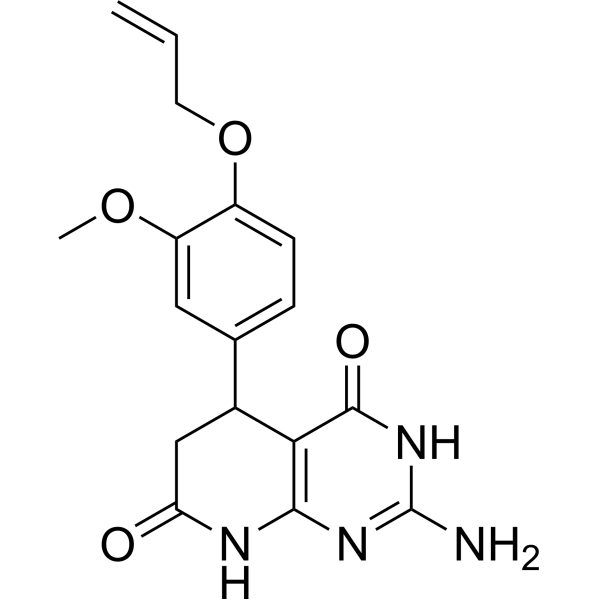 0 ImagesCat. No.: HY-133529CAS No.: 878437-15-1PA-8 is a potent, selective and orally active PACAP type I (PAC1) receptor antagonist. PA-8 inhibits the phosphorylation of CREB induced by PACAP in PAC1-, but not VPAC1- or VPAC2-receptor. PA-8 also inhibits PACAP-induced cAMP elevation with an IC50 of 2 nM.
-
PA-915
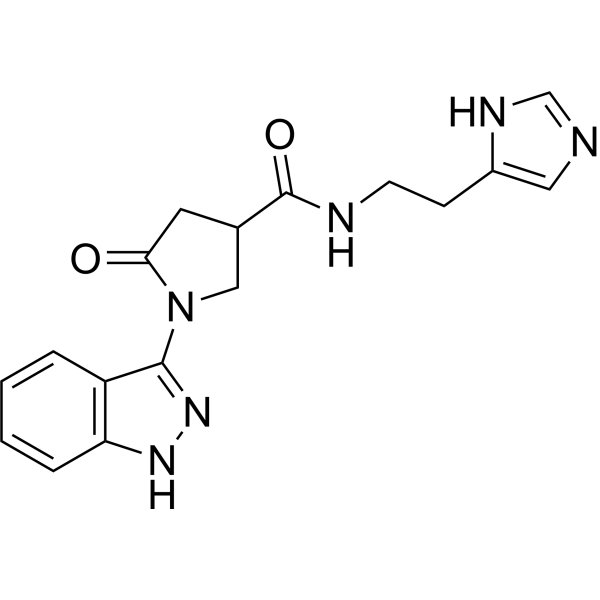
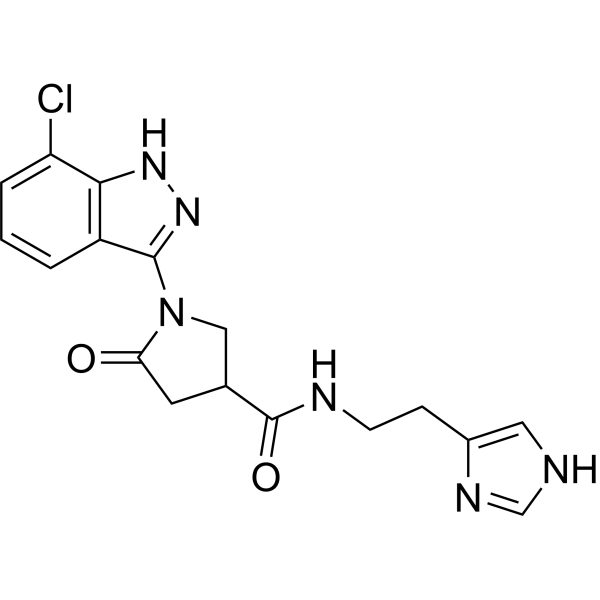 0 ImagesSynonyms: PAC1R antagonist 1PA-915 (PAC1R antagonist 1) is a potent and orally active antagonist of PAC1 receptor. PA-915 inhibits pituitary adenylate cyclase-activating polypeptide (PACAP)-induced CREB phosphorylation. PA-915 can inhibit PACAP- and nerve injury-induced allodynia. PA-915 can be used for the research of neuropathic pain.
-
PACAP (6-38), human, ovine, rat
 0 ImagesPACAP (6-38), human, ovine, rat is a potent PACAP receptor antagonist with IC50s of 30, 600, and 40 nM for PACAP type I receptor, PACAP type II receptor VIP1, and PACAP type II receptor VIP2, respectively.


-
Acetyl-(D-Phe2,Lys15,Arg16,Leu27)-VIP (1-7)-GRF (8-27)
 0 ImagesAcetyl-(D-Phe2,Lys15,Arg16,Leu27)-VIP (1-7)-GRF (8-27) is a high-affinity, selective VPAC1 receptor antagonist, with IC50 values of 10 nM and 2000 nM for binding to human VPAC1 and VPAC2, respectively. Acetyl-(D-Phe2,Lys15,Arg16,Leu27)-VIP (1-7)-GRF (8-27) inhibits VIP-induced VPAC1/Gs/adenylate cyclase signaling with a Ki of 2 nM, and its VPAC1 selectivity is mainly determined by the N-terminal extracellular domain of the receptor. Acetyl-(D-Phe2,Lys15,Arg16,Leu27)-VIP (1-7)-GRF (8-27) can be used in studies related to VPAC1 receptor pharmacology, VIP signaling, and the structure and function of class B GPCRs.
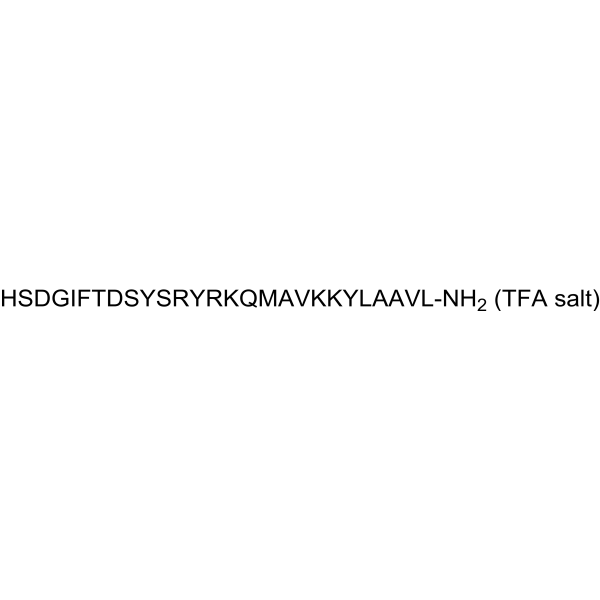
![[D-p-Cl-Phe6,Leu17]-VIP TFA](https://file.medchemexpress.com/product_pic/hy-p1159a.gif "Click to View [D-p-Cl-Phe6,Leu17]-VIP TFA Product Detail")
-
VIP(Guinea pig)
 0 ImagesSynonyms: Vasoactive Intestinal Peptide, guinea pigVIP Guinea pig (Vasoactive intestinal peptide), a trophic and mitogenic factor, stimulates growth in whole cultured embryos. VIP Guinea pig functions as a simple gastrointestinal hormone and suggest a possible neurotransmitter function.
-
ANT308 TFA
 0 ImagesCat. No.: HY-P11288APurity: 99.57%ANT308 TFA is a vasoactive intestinal polypeptide (VIP receptor) antagonist. ANT308 TFA significantly enhances the activation and proliferation of T cells. ANT308 TFA inhibits the migration and metastasis, induces apoptosis of melanoma tumor cells by inhibiting VIP-VPAC2 signaling and reducing the expression of MCAM and N-cadherin. ANT308 TFA can be used for the study of acute myeloid leukemia (AML) and uveal melanoma (UVM).
-
Ro 25-1553 TFA
 0 ImagesCat. No.: HY-P10768APurity: 99.17%Ro 25-1553 TFA is a 31 amino acid vasoactive intestinal peptide (VIP) analog, that acts as an agonist for VIP2 receptor (VPAC2 receptor). Ro 25-1553 TFA exhibits a bronchodilator effect in nerve-induced or Carbachol (HY-B1208)-induced tracheal smooth muscle contraction in guinea pig model.
- 1
- 2




