



Pyroptosis
Pyroptosis is a type of programmed cell death that features pore formation on the plasma membrane, cell swelling and plasma membrane disruption. Pyroptosis is a form of lytic programmed cell death initiated by inflammasomes, which detect cytosolic contamination or perturbation.
Gasdermin D (GSDMD), as the executive protein of pyroptosis, is activated and transferred to the membrane to induce glial rupture, resulting in the release of more inflammatory mediators.
Inflammasome is an intracellular signaling complex of the innate immune system. Activation of inflammasomes promotes the secretion of IL-1β/IL-18 and triggers pyroptosis. The proinflammatory effect of IL-1β/IL-18 and pyroptosis contributes to the development of autoimmune and inflammatory diseases.
All Product Categories
-
Pyroptosis Related Products (154)
Related Products (154)

-
Antibodies (1)
-
Related Compound Screening Libraries (1)
-
Pyroptosis Signaling Pathway
-
Polyphyllin VI (Standard)
 0 ImagesPolyphyllin VI (Standard) is the analytical standard of Polyphyllin VI. This product is intended for research and analytical applications. Polyphyllin VI, an active saponin, possess anti-cancer activities. Polyphyllin VI induces G2/M cell cycle arrest and triggers apoptosis. Polyphyllin VI induces caspase-1-mediated pyroptosis via the induction of ROS/NF-κB/NLRP3/GSDMD signal axis in non-small cell lung cancer.
-
NLRP3-IN-61
 0 ImagesCat. No.: HY-170529CAS No.: 3060585-94-3NLRP3-IN-61 (Compound 1) is an inhibitor for NLRP3. NLRP3-IN-61 inhibits pyroptosis in THP-1 cell with an IC50 of 12.6 nM, inhibits IL-β release with an IC50 of 25.3 nM.

-
ABT-546
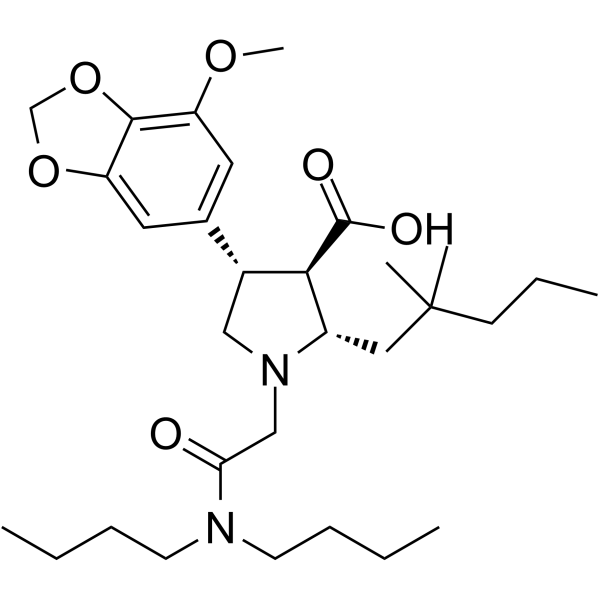 0 ImagesCat. No.: HY-135283CAS No.: 212481-66-8Synonyms: A-216546ABT-546 (A-216546) is an orally active ETA receptor antagonist, with Ki values of 0.46 nM and 13000 nM for human ETA and ETB receptors, respectively, and exhibits >25000-fold selectivity over the ETB receptor. ABT-546 effectively inhibits ET-1 (HY-P0202)-induced phosphoinositide hydrolysis (IC50 = 0.59 nM) and arachidonic acid release (IC50 = 3.03 nM), and antagonizes ET-1-induced contraction in isolated vascular rings. ABT-546 crosses the placental barrier but shows extremely low fetal exposure, with a favorable safety profile. ABT-546 inhibits ET-1-induced pressor response and downregulates the NLRP3/ROS/GSDMD-mediated pyroptosis pathway. ABT-546 can be used for research on abdominal aortic aneurysm.
-
ACT001 hydrochloride
 0 ImagesCat. No.: HY-128861BCAS No.: 1403357-80-1Synonyms: Dimethylaminomicheliolide hydrochloride; DMAMCL hydrochlorideACT001 (Dimethylaminomicheliolide; DMAMCL) hydrochloride is an orally active, blood-brain barrier-permeable anti-inflammatory and anti-tumor agent. ACT001 hydrochloride exerts microglia-mediated neuroanti-inflammatory effects by inhibiting the AKT/NF-κB/NLRP3 axis and suppressing apoptosis (apoptosis). ACT001 hydrochloride inhibits tumor proliferation by upregulating NKTR and inhibiting AKT. ACT001 hydrochloride alleviates metabolic-associated fatty liver disease by regulating gut microbiota and inhibiting ileal FXR. ACT001 hydrochloride inhibits pyroptosis (pyroptosis) and pro-inflammatory cytokine release by activating PPAR-γ and inhibiting NF-κB/NLRP3.
-
4,4′-Secalonic acid D
 0 ImagesCat. No.: HY-N15380CAS No.: 2265910-52-74,4′-Secalonic acid D (Compound 12) is a PARP1 inhibitor. 4,4′-Secalonic acid D induces the accumulation of ROS and DNA damage, activates the caspase-3/GSDME pathway, and triggers apoptosis and pyroptosis of tumor cells by inhibiting PARP1. 4,4′-Secalonic acid D has anti-tumor activity.
-
rac-Lenalidomide-13C5
 0 ImagesCat. No.: HY-W777286CAS No.: 1219332-91-8Synonyms: CC-5013-13C5rac-Lenalidomide-13C5 (CC-5013-13C5) is the 13C5-labeled Lenalidomide (HY-A0003). Lenalidomide (CC-5013) is an orally active immunomodulatory agent that binds CRBN as a molecular glue to alter substrate specificity, inducing ubiquitination and proteasome-dependent degradation of IKZF1, IKZF3 and CK1α. Lenalidomide induces apoptosis by degrading IKZF1/3, and activates p53 by degrading CK1α. Lenalidomide promotes IL-2 release and effector functions of CD8+ T/NK cells, while inhibiting TNF-α secretion and M1-type pyroptosis. Lenalidomide can be used in research related to hematological malignancies, acute liver failure and acute kidney injury.
-
Ac-DEVDD-TPP
 0 ImagesCat. No.: HY-P10656CAS No.: 2950171-24-9Ac-DEVDD-TPP is a porphyrin derivative that can be converted into D-TPP by caspase-3 cleavage and laser irradiation. The formed porphyrin nanofibers can effectively induce Apoptosis and Pyroptosis. Ac-DEVDD-TPP has antitumor activity.
-
HDAC1/6-IN-3
 0 ImagesCat. No.: HY-175176CAS No.: 3038691-85-6HDAC1/6-IN-3 is a potent HDAC inhibitor. HDAC1/6-IN-3 shows excellent inhibitory activities against HDAC1 (IC50 = 1.1 nM) and HDAC6 (IC50 = 2.7 nM). HDAC1/6-IN-3 significantly arrests HepG2 cells at the G0/G1 phase and induces apoptosis and pyroptosis. HDAC1/6-IN-3 exhibits significant antitumor activity in the HepG2 xenograft mode. HDAC1/6-IN-3 can be used for the study of cancers such as liver cancer, lung cancer, colon cancer and breast cancer.
-
Inclisiran sodium scrambled negative control
 0 ImagesCat. No.: HY-132591CInclisiran sodium scrambled negative control is the sequence scrambled negative control of Inclisiran sodium.
-
Lb54
 0 ImagesCat. No.: HY-181168Lb54 is a caspase-3 and caspase-7 activator with an EC50 of 660.9 nM for human procaspase-3. Lb54 activates caspase-3/7, which cleaves Gasdermin D (GSDMD) at aspartic acid residue 87 to generate a p10 fragment, preventing formation of the pore-forming p30 fragment of GSDMD. Lb54 suppresses GSDMD-mediated pyroptosis through caspase-3/7 activation, thereby attenuating inflammatory responses and conferring protection against sepsis. Lb54 alleviates acute lung injury, and inhibited systemic inflammation by restraining the maturation of monocyte-derived dendritic cells. Lb54 can be used for the research of sepsis.
-
NLRP3-IN-86
 0 ImagesCat. No.: HY-180830CAS No.: 2361570-54-7NLRP3-IN-86 (Compound 8a), a derivative of Songorine (HY-N2080), is a potent and selective NLRP3 inflammasome inhibitor. NLRP3-IN-86 can reduce LPS (HY-D1056)- and Nigericin (HY-127019)-stimulated lactate dehydrogenase (LDH) release (IC50 = 2.69 μM in THP-1 cells and 1.75 μ M in J774A.1 cells). NLRP3-IN-86 can inhibit gasdermin D (GSDMD) cleavage and IL-1β secretion. NLRP3-IN-86 can inhibit cell pyroptosis. NLRP3-IN-86 can be used for research of inflammation.
-
Morroniside (Standard)
 0 ImagesCat. No.: HY-N0532RCAS No.: 25406-64-8Morroniside (Standard) is the analytical standard of Morroniside. This product is intended for research and analytical applications. Morroniside has neuroprotective effect by inhibiting neuron apoptosis and MMP2/9 expression.
-
MNP2
 0 ImagesCat. No.: HY-P11581MNP2 is a NLRP3-ASC interaction inhibitor. MNP2 selectively binds to the PYD domain of ASC (Ka=149 nM) and blocks ASC-PYM binding (Ka=58 nM), thereby inhibiting the interaction between ASC and NLRP3 and suppressing the formation of the NLRP3 inflammasome. MNP2 inhibits IL-1β release and caspase-1 maturation, and reduces the efflux of potassium and chloride ions. MNP2 prevents mitochondrial damage and reactive oxygen species production, and significantly decreases NLRP3 inflammasome formation in neurodegenerative pathologies induced by β-amyloid, Tau protein and α-synuclein. MNP2 is applicable for the research of neurodegenerative diseases.
-
Apoptosis inducer 36
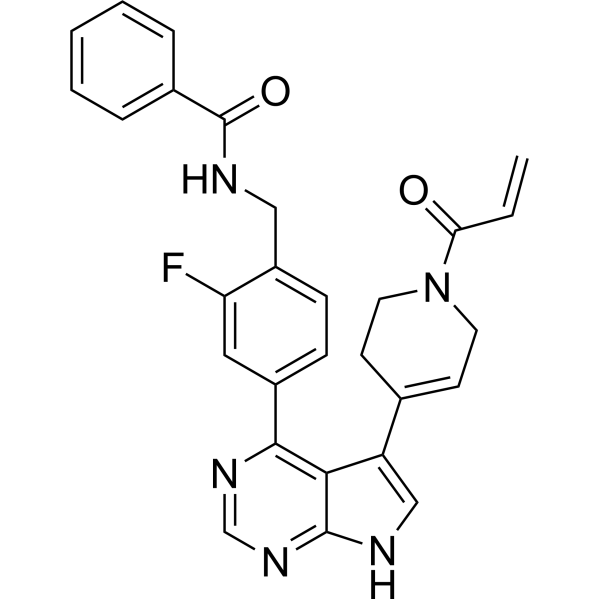
 0 ImagesCat. No.: HY-168927CAS No.: 2831492-41-0Apoptosis inducer 36 (Compound 42) exhibits anti-leukemic activity through reduction of leukemia stem cells (LSCs) and induction of differentiation. Apoptosis inducer 36 inhibits the proliferation of AML cells, arrests cell cycle at G1 phase, and induces PANoptosis including apoptosis, pyroptosis and necrosis. Prodrug of apoptosis inducer 36 exhibits orally active antitumor efficacy in mouse model.
-
NLRP3-IN-78
 0 ImagesCat. No.: HY-172788CAS No.: 477546-27-3NLRP3-IN-78 (compound 21) is a NLRP3 inhibitor with the inhibition rate of 46.72% in GSDMD-induced pyroptosis at 5 μM. NLRP3-IN-78 binds to the NLRP3 protein and inhibits GSDMD-NT oligomerization. NLRP3-IN-78 also inhibits GSDMD cleavage, and upstream NF-κB signaling, demonstrating its anti-inflammatory activity.
-
NLRP3/AIM2-IN-1
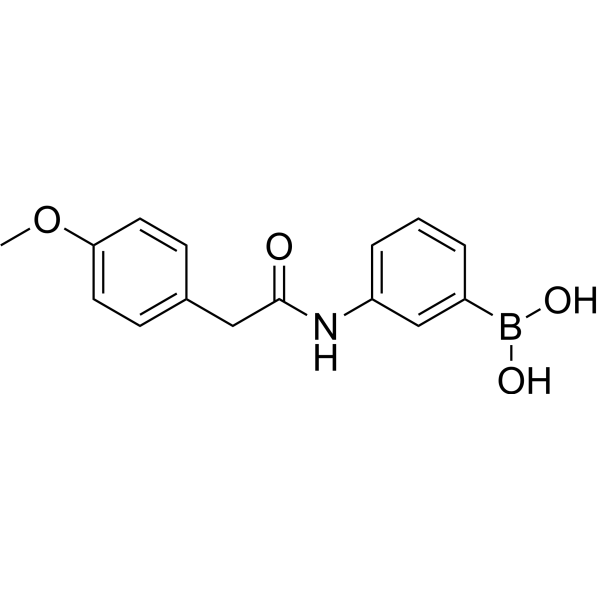 0 ImagesCat. No.: HY-144220CAS No.: 3033386-91-0NLRP3/AIM2-IN-1 is an NLRP3/AIM2 inhibitor with an IC50 of 3.136 μM against NLRP3-dependent pyroptosis. NLRP3/AIM2-IN-1 inhibits IL-1β secretion triggered by NLRP3 inflammasome activation. NLRP3/AIM2-IN-1 exhibits moderate anti-pyroptotic activity. NLRP3/AIM2-IN-1 does not inhibit NLRC4 inflammasome activation. NLRP3/AIM2-IN-1 can be used for studying inflammasome-mediated inflammatory diseases.
-
YTB53
 0 ImagesCat. No.: HY-184431YTB53 is a MNK1 and MNK2 inhibitor with IC50s of 37 nM and 9 nM, respectively. YTB53 inhibits PDGFRα, TRKB and FLT3 in leukemia cells. YTB53 induces cell cycle arrest, apoptosis, pyroptosis, and mitochondrial dysfunction. YTB53 exhibits antiangiogenic effects. YTB53 can be used for the study of acute myeloid leukemia (AML).
-
Nigericin sodium salt (Standard)
 0 ImagesNigericin (sodium salt) (Standard) is the analytical standard of Nigericin (sodium salt). This product is intended for research and analytical applications. Nigericin sodium salt is an antibiotic derived from Streptomyces hygroscopicus that act as a K+/H+ ionophore, promoting K+/H+ exchange across mitochondrial membranes. Nigericin sodium salt is a NLRP3 activator. Nigericin sodium salt shows promising anti-cancer activities through decreasing intracellular pH (pHi), and inactivation of Wnt/β-catenin signals. Nigericin sodium salt induces pyroptosis through caspase 1/GSDMD in TNBC.




