



AKT1/2/3 Antibody (YA633)
Based on 1 publication(s) in Google Scholar
AKT1/2/3 Antibody (YA633) is a Rabbit-derived and non-conjugated IgG monoclonal antibody, targeting to AKT1/2/3.
-
Host:
Rabbit
-
Isotype:
IgG
-
Application:
WB, ICC/IF, IHC-P, IP, FC
-
Reactivity :
Human, Mouse
-
Formulation:
Supplied in 1*TBS (pH7.4), 0.05% BSA and 40% Glycerol. Preservative: 0.05% Sodium Azide.
-
Conjugation:
Non-conjugated


To place orders, for customer services and technical support, please contact: MedChemExpress USA
Tel: 609-228-6898 E-mail: [email protected] [email protected]



-

HY-P80788
Phospho-AKT1 (Ser473) Antibody (YA228) -
HY-P80276
Phospho-AKT1(Ser473) Antibody (YA227) -
HY-P80846
Phospho-PI3 Kinase p85/p55 (Tyr467/Tyr199) Antibody -

HY-D1056A1
Lipopolysaccharides, from E. coli O111:B4 -
HY-P81211
phospho-PI3 Kinase p110 beta (Ser1070) Antibody -
HY-P80028
Bax Antibody (YA591) -
HY-P80566
Bcl-2 Antibody (YA590) -
HY-P80137
GAPDH Antibody (YA418) -
HY-P80393
ERK1/2 Antibody (YA453) -
HY-P81162
PI3 Kinase p110 alpha/PIK3CA Antibody (YA3537)
Publications Citing Use of MedChemExpress (MCE) AKT1/2/3 Antibody (YA633)
More

Applications
| Application |
WB

WB: Western Blot
|
ICC/IF
ICC/IF: Immunocytochemistry/
Immunofluorescence |
IHC-P
IHC-P: Immunohistochemistry-Paraffin
|
FC
FC: Flow Cytometry
|
IP
IP: Immunoprecipitation
|
|---|---|---|---|---|---|
| Dilution Ratio | 1:500-1:5000 | 1:50-1:200 | 1:50-1:200 | 1:50-1:100 | Use at an assay dependent concentration. |


Product Details
AKT1/2/3 Antibody (YA633) is a Rabbit-derived and non-conjugated IgG monoclonal antibody, targeting to AKT1/2/3.
-
Host Rabbit

-
Clonality Recombinant, Monoclonal

-
Species ReactivityHuman, Mouse
-
Observed Molecular WeightObserved band size: 56 kDa
Note: Due to possible protein modifications or aggregation, the molecular weight should be confirmed by actual measurement, and the predicted value is for reference only.

-
Calculated Molecular Weight Predicted band size: 56 kDa

Entrez Gene: 207 Human ; 11651 Mouse ; 24185 Rat
SwissProt: P31749 Human ; P31751 Human ; Q9Y243 Human ; P31750 Mouse ; Q60823 Mouse ; Q9WUA6 Mouse ; P47196 Rat ; P47197 Rat ; Q63484 Rat
OMIM: 114480 Human
Synthetic peptide corresponding to Human AKT3.AA range:300-479.
Endogenous
Protein A affinity purified.
Non-conjugated
Unmodified
IgG


Product Properties
-
Appearance
Liquid
-
Formulation
Supplied in 1*TBS (pH7.4), 0.05% BSA and 40% Glycerol. Preservative: 0.05% Sodium Azide.
-
Concentration
Batch-dependent, Please check the COA for the concentration of each lot. Check Lot Concentration
-
Storage & Stability
Stored at -20°C for 1 year. Avoid repeated freeze / thaw cycles.
-
Shipping
Shipping with blue ice.


Publications (1)
-
Journal Impact Factor
-
Most Recent
-
J Inflamm Res
CCL20 Expression via AKT-ERK1/2-AP1 Pathway in Mycoplasma Pneumoniae Infection: Implications for EMT and Cell Migration. [Abstract]2025 Apr 28:18:5727-5739. PMID: 40322529


Verification Images
-
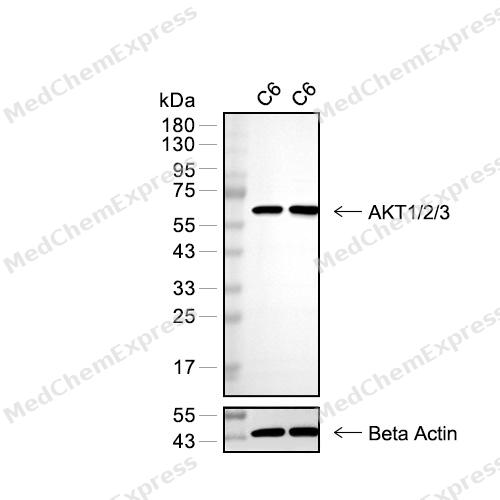 Western blot analysis of extracts from C6 (lane 2(20μg) and C6 (lane 3(40μg)using AKT1/2/3 (HY-P80009) Rabbit mAb. Proteins were transferred to a PVDF membrane and blocked with 5% defatted milk powder in TBST for 2 hour at room temperature. The primary antibody (HY-P80009, 1/1000) and Loading control antibody (Beta Actin, HY-P80438, 1/3000) was used in 5% defatted milk powder in TBST at 4°C overnight. Goat Anti-Mouse/Rabbit IgG-HRP Secondary Antibody (HY-P8004/HY-P8001, 1/10,000) was used for 1 hour at room temperature.
 -
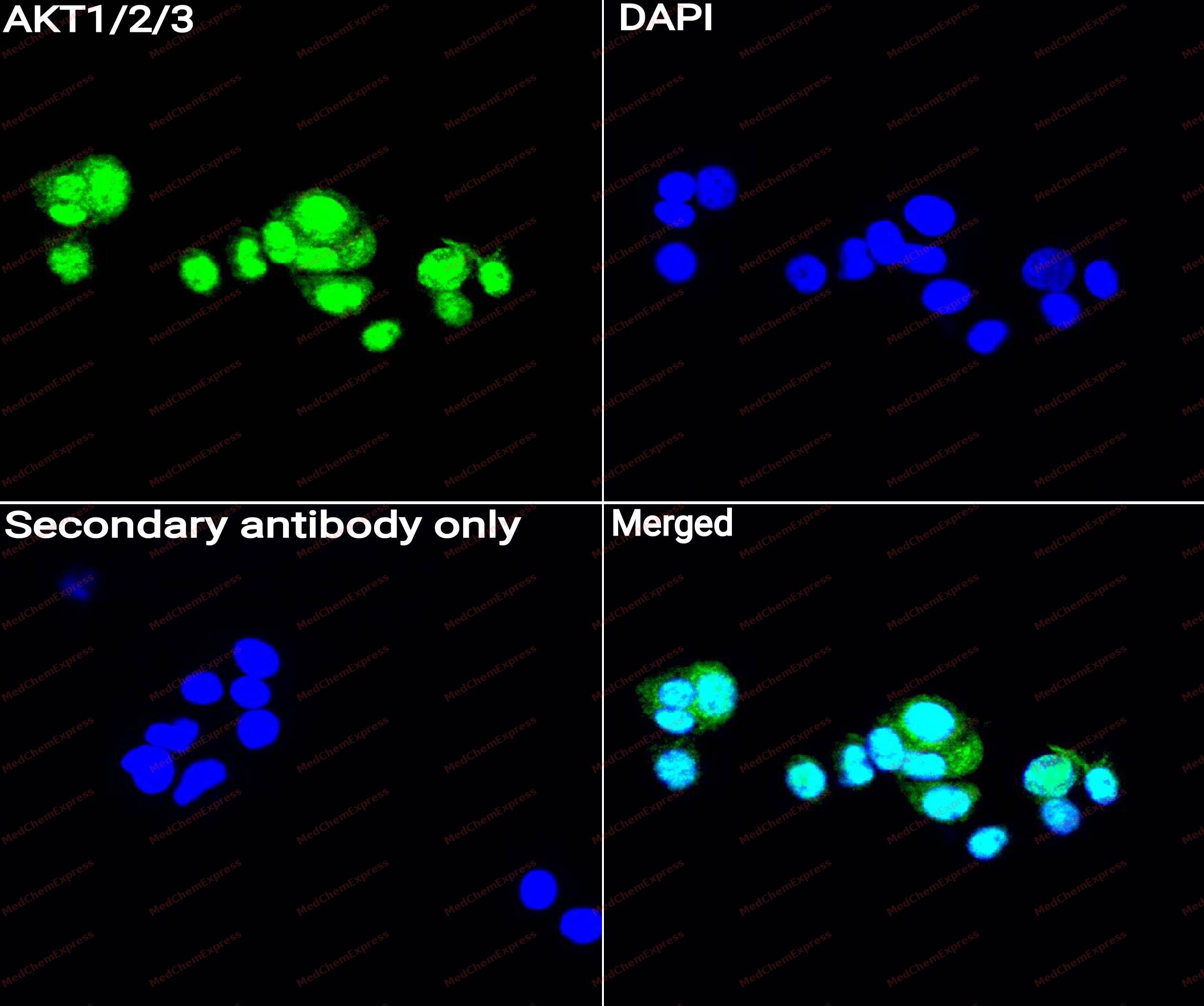 Immunocytochemistry analysis of MCF-7 cells labeling AKT1/2/3 with AKT1/2/3 Antibody (YA633) (HY-P80009)at 1/50 dilution. Cells were fixed in 4% paraformaldehyde for 15 minutes at room temperature, permeabilized with 0.1% Triton X-100 for 10 minutes at room temperature, then blocked with QuickBlock™ Blocking Buffer for Immunol Staining for 10 min at room temperature. Cells were then incubated with AKT1/2/3 Antibody (YA633) (HY-P80009) at 1/50 dilution in QuickBlock™ Blocking Buffer for Immunol Staining at 4 ℃. Alexa Fluor® 488-conjugated AffiniPure Goat Anti-Rabbit IgG H&L(HY-P8002, Green) was used as the secondary antibody at 1/1,000 dilution. PBS instead of the primary antibody was used as the secondary antibody only control. The Nuclear counterstain was DAPI (Blue).
 -
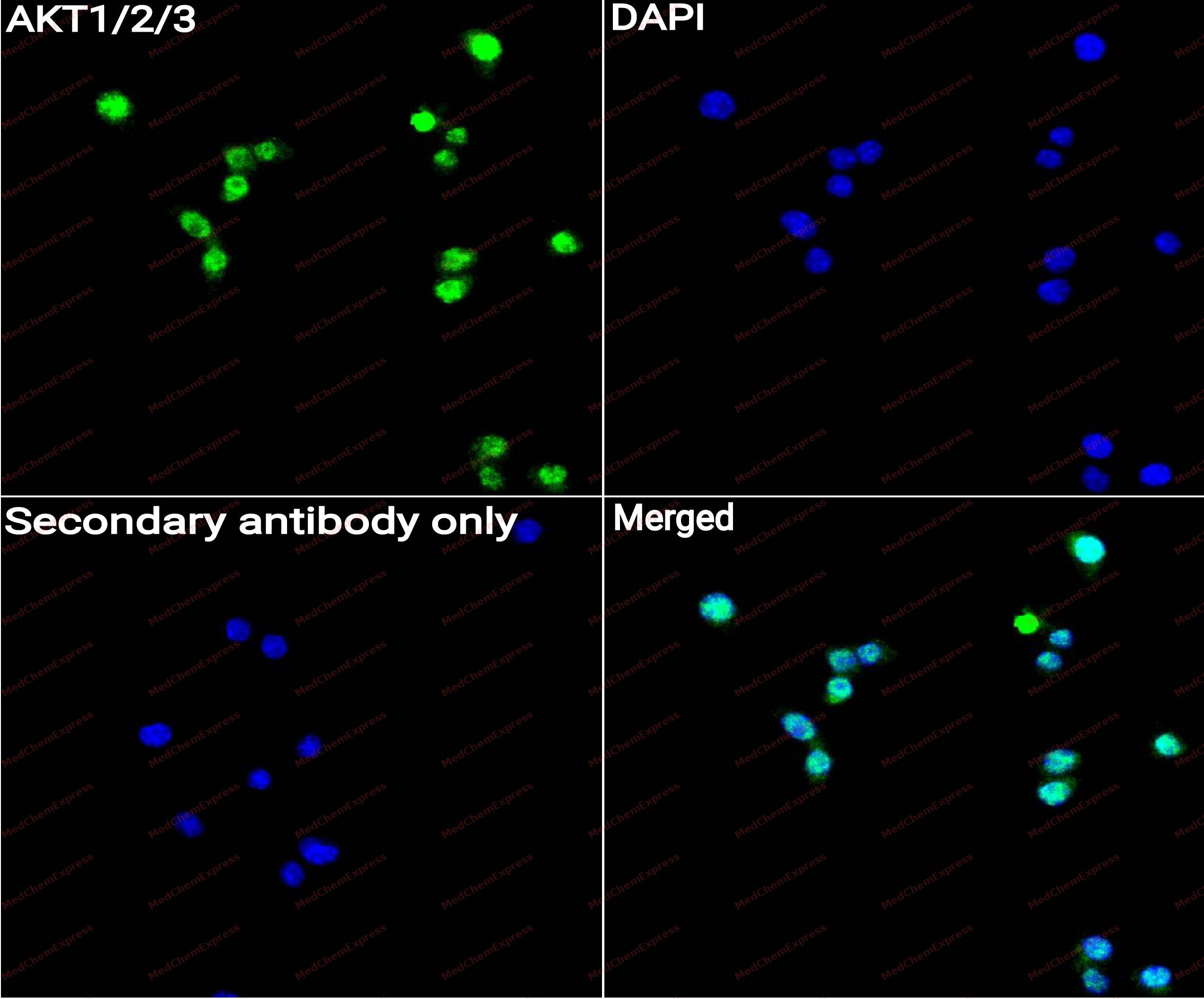 Immunocytochemistry analysis of RAW264.7cells labeling AKT1/2/3 with AKT1/2/3 Antibody (YA633) (HY-P80009) at 1/50 dilution. Cells were fixed in 4% paraformaldehyde for 15 minutes at room temperature, permeabilized with 0.1% Triton X-100 for 10 minutes at room temperature, then blocked with QuickBlock™ Blocking Buffer for Immunol Staining for 10 min at room temperature. Cells were then incubated with AKT1/2/3 Antibody (YA633) (HY-P80009)at 1/50 dilution in QuickBlock™ Blocking Buffer for Immunol Staining at 4 ℃. Alexa Fluor® 488-conjugated AffiniPure Goat Anti-Rabbit IgG H&L(HY-P8002, Green) was used as the secondary antibody at 1/1,000 dilution. PBS instead of the primary antibody was used as the secondary antibody only control. The Nuclear counterstain was DAPI (Blue).
 -
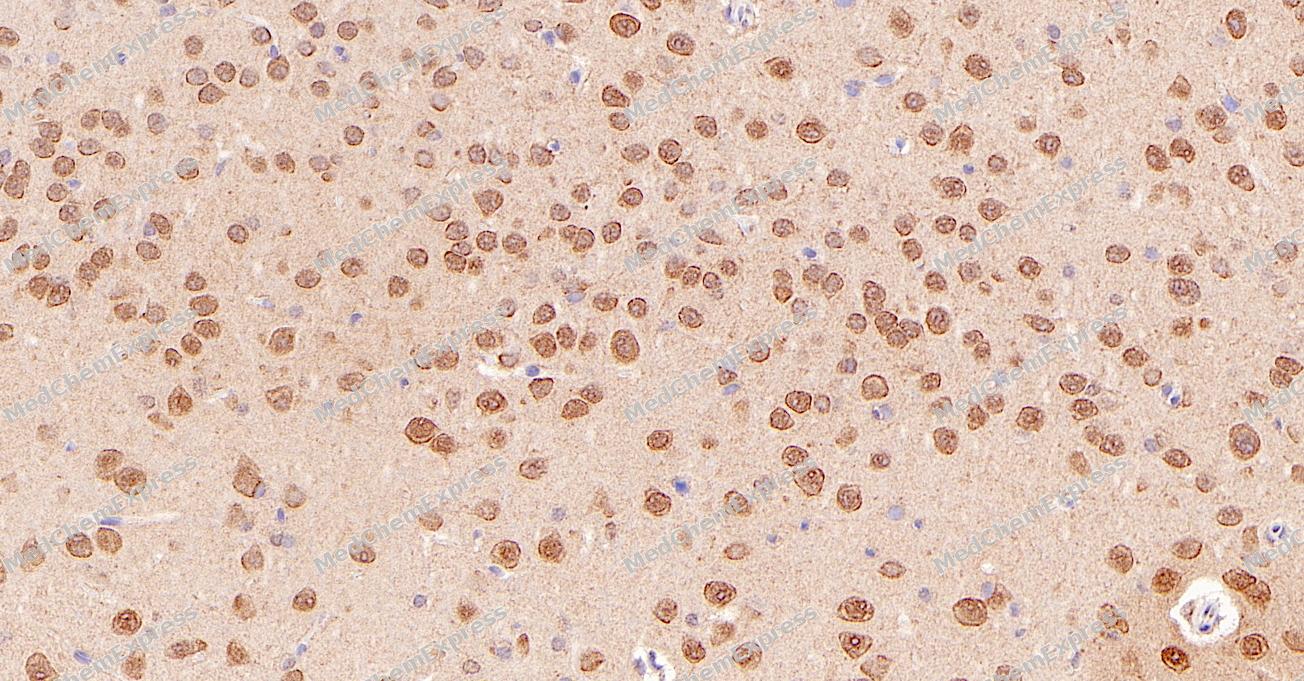 Immunohistochemical analysis of paraffin-embedded Mouse brain tissue using AKT1/2/3 Antibody (YA633). The section was pre-treated using heat mediated antigen retrieval with Tris-EDTA buffer (pH 9.0) for 8 minutes. The tissues were blocked in QuickBlock for 20 minutes at room temperature, washed with ddH2O and PBS, and then probed with the primary antibody (HY-P80009, 1/2000) in 4℃ overnight. The detection was performed using an HRP conjugated compact polymer system. DAB was used as the chromogen. Tissues were counterstained with hematoxylin and mounted with DPX.
 -
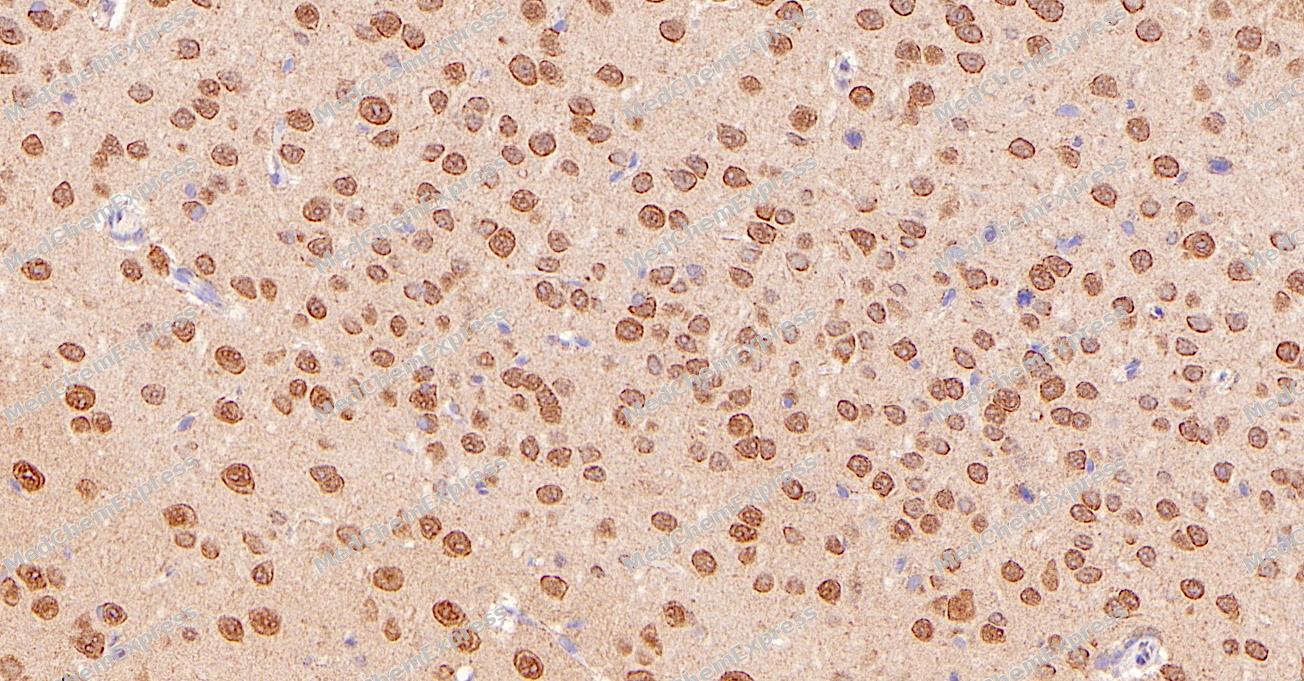 Immunohistochemical analysis of paraffin-embedded Mouse brain tissue using AKT1/2/3 Antibody (YA633). The section was pre-treated using heat mediated antigen retrieval with Tris-EDTA buffer (pH 9.0) for 8 minutes. The tissues were blocked in QuickBlock for 20 minutes at room temperature, washed with ddH2O and PBS, and then probed with the primary antibody (HY-P80009, 1/2000) in 4℃ overnight. The detection was performed using an HRP conjugated compact polymer system. DAB was used as the chromogen. Tissues were counterstained with hematoxylin and mounted with DPX.
 -
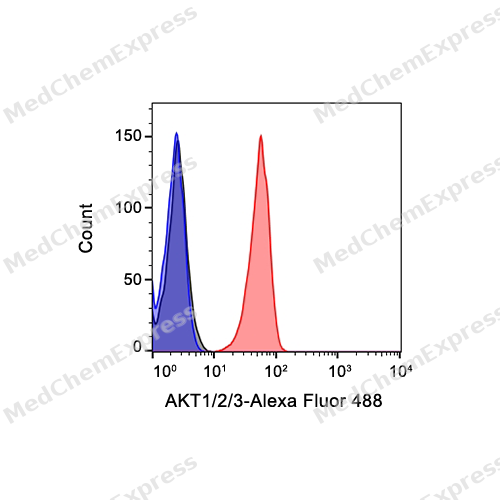 Flow cytometric analysis of 1X10^6 RAW264.7 cells labeling AKT1/2/3 Antibody (HY-P80009, red). Cells were fixed with 4% paraformaldehyde and permeabilised with 90% methanol. Then stained with the primary antibody at 1/1000 dilution for an hour at 4℃. Alexa Fluor® 488-conjugated AffiniPure Goat Anti-Rabbit IgG H&L (HY-P8002) was used as the secondary antibody at 1/1,000 dilution for 30 minutes at 4℃. Rabbit IgG Isotype Control (HY-P80879, blue) was used as the isotype control, cells without incubation with primary antibody were used as the unlabeled control (black).


Background
-
Function
AKT1/2/3 is an AKT3 is one of 3 closely related serine/threonine-protein kinases (AKT1, AKT2 and AKT3) called the AKT kinase, and which regulate many processes including metabolism, proliferation, cell survival, growth and angiogenesis. This is mediated through serine and/or threonine phosphorylation of a range of downstream substrates. Over 100 substrate candidates have been reported so far, but for most of them, no isoform specificity has been reported. AKT3 is the least studied AKT isoform. It plays an important role in brain development and is crucial for the viability of malignant glioma cells. AKT3 isoform may also be the key molecule in up-regulation and down-regulation of MMP13 via IL13. Required for the coordination of mitochondrial biogenesis with growth factor-induced increases in cellular energy demands. Down-regulation by RNA interference reduces the expression of the phosphorylated form of BAD, resulting in the induction of caspase-dependent apoptosis
-
Subcellular Localization
Nucleus; Cytoplasm; Membrane; Peripheral membrane protein
-
Expression
Tissue_specificity:In human tissues, this gene is highly expressed in the brain, lungs, and kidneys, but lowly expressed in the heart, testes, and liver. In fetal tissues, this gene is highly expressed in the heart, liver, and brain, but not in the kidneys. -
Isoforms & Post-Translational Modification
Q9Y243 has 2 isomers: Q9Y243-1: 55775 Da (predicted); Q9Y243-2: 54032 Da (predicted).
Phosphorylation on Thr-305 and Ser-472 is required for full activity (PubMed:12162751, PubMed:9512493). Phosphorylation of the activation loop at Thr-305 by PDPK1/PDK1 is a prerequisite for full activation (PubMed:9512493). Phosphorylation at Ser-472 by mTORC2 in response to growth factors plays a key role in AKT1 activation by facilitating subsequent phosphorylation of the activation loop by PDPK1/PDK1 (By similarity);Ubiquitinated. When fully phosphorylated and translocated into the nucleus, undergoes 'Lys-48'-polyubiquitination catalyzed by TTC3, leading to its degradation by the proteasome;O-GlcNAcylation at Thr-302 and Thr-309 inhibits activating phosphorylation at Thr-305 via disrupting the interaction between AKT and PDPK1/PDK1 -
Subunit
Interacts (via PH domain) with TCL1A; this enhances AKT3 phosphorylation and activation. Interacts with TRAF6.
-
SwissProt ID
-
Research Field
Signal Transduction
Documentation
-
Data Sheet (236 KB)
-
SDS (251 KB)
- English - EN (251 KB)
- Français - FR (251 KB)
- Deutsch - DE (251 KB)
- Norwegian - NO (251 KB)
- Español - ES (251 KB)
- Swedish - SV (251 KB)
- Italian - IT (251 KB)
- Korean - KR (251 KB)
- Portuguese - PT (251 KB)
-
User Guide for Antibodies (1077 KB)

 Powered by Bioz
