



Cullin 3 Antibody (YA2578)
(Synonyms: CUL3; KIAA0617; Cullin-3; CUL-3)
Based on 1 Customer Validation
Cullin 3 Antibody (YA2578) is a Rabbit-derived and non-conjugated IgG monoclonal antibody, targeting to Cullin 3.
-
Host:
Rabbit
-
Isotype:
IgG
-
Application:
WB, IP
-
Reactivity :
Human, Mouse, Rat
-
Formulation:
Supplied in 50mM Tris-Glycine(pH 7.4), 0.15M NaCl, 40% Glycerol, 0.01% Sodium azide and 0.05% BSA
-
Conjugation:
Non-conjugated


To place orders, for customer services and technical support, please contact: MedChemExpress USA
Tel: 609-228-6898 E-mail: [email protected] [email protected]





Applications
| Application |
WB

WB: Western Blot
|
IP
IP: Immunoprecipitation
|
|---|---|---|
| Dilution Ratio | 1:500-1:1000 | 1:20 |


Product Details
Cullin 3 Antibody (YA2578) is a Rabbit-derived and non-conjugated IgG monoclonal antibody, targeting to Cullin 3.
-
Host Rabbit

-
Clonality Recombinant,Monoclonal

-
Species ReactivityHuman, Mouse, Rat
-
Observed Molecular WeightObserved band size: 89 kDa
Note: Due to possible protein modifications or aggregation, the molecular weight should be confirmed by actual measurement, and the predicted value is for reference only.

-
Calculated Molecular Weight Predicted band size: 89 kDa

Entrez Gene: 8452 Human ; 26554 Mouse ; 301555 Rat
SwissProt: Q13618 Human ; Q9JLV5 Mouse ; B5DF89 Rat
OMIM: 614496 Human
A synthetic peptide of human Cullin 3
Endogenous
Affinity Purified
Non-conjugated
Unmodified
IgG


Product Properties
-
Appearance
Liquid
-
Formulation
Supplied in 50mM Tris-Glycine(pH 7.4), 0.15M NaCl, 40% Glycerol, 0.01% Sodium azide and 0.05% BSA
-
Concentration
Batch-dependent, Please check the COA for the concentration of each lot. Check Lot Concentration
-
Storage & Stability
Stored at -20°C for 1 year. Avoid repeated freeze / thaw cycles.
-
Shipping
Shipping with blue ice.


Verification Images
-
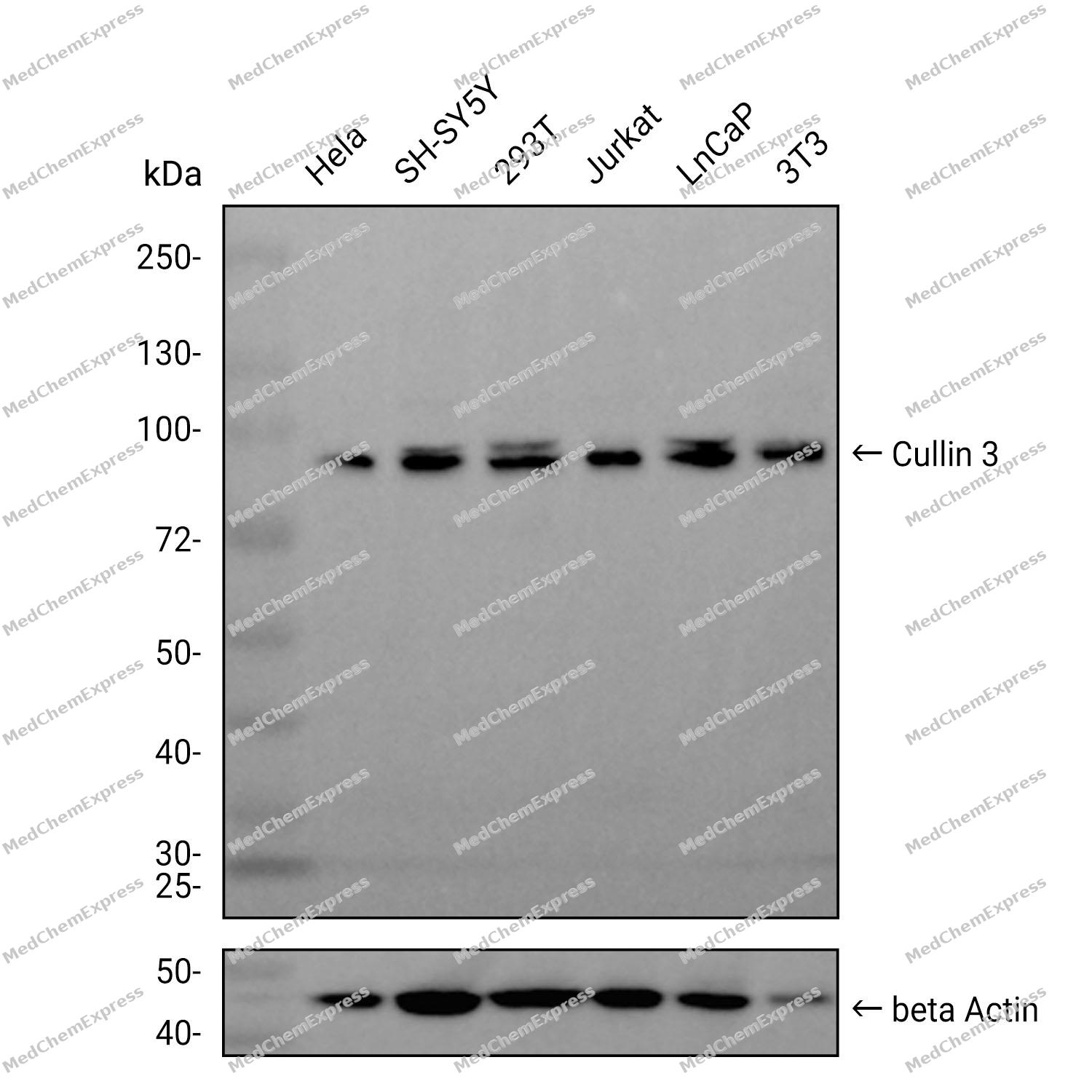
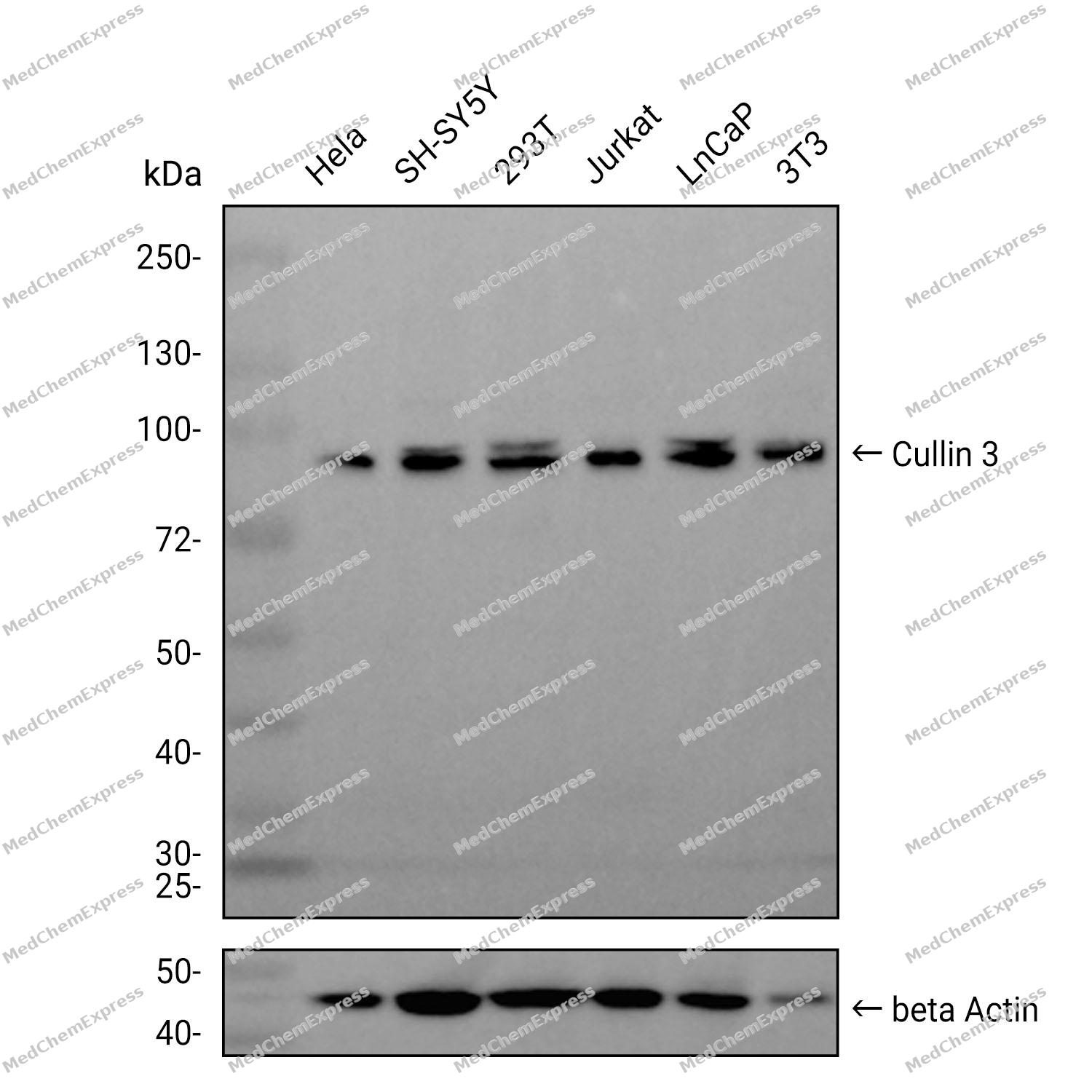 Western blot analysis was performed on extracts from Hela (lane 1, 15 μg), SH-SY5Y (lane 2, 15 μg), 293T (lane 3, 15 μg), Jurkat (lane 4, 15 μg), LnCaP (lane 5, 15 μg), and 3T3 (lane 6, 15 μg) using Cullin 3 Rabbit mAb.Proteins were transferred to a PVDF membrane and blocked with 5% non-fat milk in TBST at 4°C overnight.The primary antibody (1:1000 dilution) and the loading control antibody (beta-Actin, HY-P80438, 1:20000 dilution) were incubated in 5% non-fat milk in TBST for 1 hour at 37°C.Goat Anti-Rabbit IgG-HRP Secondary Antibody (1:20000 dilution) was then applied for 40 minutes at 37°C.
 -
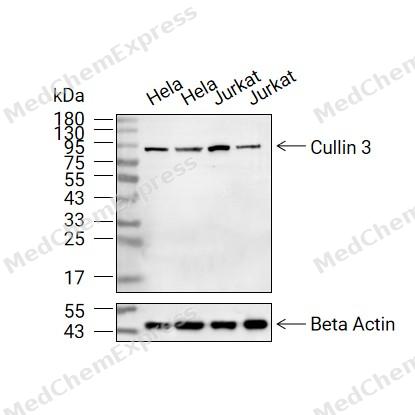 Western blot analysis of extracts from Hela (lane 2(20μg) and Hela (lane 3(40μg), Jurkat (lane 4(20μg) and Jurkat (lane 5(40μg) using Cullin 3 (HY-P82833) Rabbit mAb. Proteins were transferred to a PVDF membrane and blocked with 5% non-fat milk in TBST for 2 hour at room temperature. The primary antibody (1/1000) and Loading control antibody (Beta Actin, HY-P80438, 1/10000) was used in 5% non-fat milk in TBST at 4°C overnight. Goat Anti-Mouse/Rabbit IgG-HRP Secondary Antibody (1/10000) was used for 1 hour at room temperature.


Background
-
Function
Cullin 3 core component of multiple cullin-RING-based BCR (BTB-CUL3-RBX1) E3 ubiquitin-protein ligase complexes which mediate the ubiquitination and subsequent proteasomal degradation of target proteins. BCR complexes and ARIH1 collaborate in tandem to mediate ubiquitination of target proteins. As a scaffold protein may contribute to catalysis through positioning of the substrate and the ubiquitin-conjugating enzyme. The E3 ubiquitin-protein ligase activity of the complex is dependent on the neddylation of the cullin subunit and is inhibited by the association of the deneddylated cullin subunit with TIP120A/CAND1. The functional specificity of the BCR complex depends on the BTB domain-containing protein as the substrate recognition component. BCR(KLHL42) is involved in ubiquitination of KATNA1. BCR(SPOP) is involved in ubiquitination of BMI1/PCGF4, BRMS1, MACROH2A1 and DAXX, GLI2 and GLI3. Can also form a cullin-RING-based BCR (BTB-CUL3-RBX1) E3 ubiquitin-protein ligase complex containing homodimeric SPOPL or the heterodimer formed by SPOP and SPOPL; these complexes have lower ubiquitin ligase activity. BCR(KLHL9-KLHL13) controls the dynamic behavior of AURKB on mitotic chromosomes and thereby coordinates faithful mitotic progression and completion of cytokinesis. BCR(KLHL12) is involved in ER-Golgi transport by regulating the size of COPII coats, thereby playing a key role in collagen export, which is required for embryonic stem (ES) cells division: BCR(KLHL12) acts by mediating monoubiquitination of SEC31 (SEC31A or SEC31B). BCR(KLHL3) acts as a regulator of ion transport in the distal nephron; by mediating ubiquitination of WNK4. The BCR(KLHL20) E3 ubiquitin ligase complex is involved in interferon response and anterograde Golgi to endosome transport: it mediates both ubiquitination leading to degradation and 'Lys-33'-linked ubiquitination. The BCR(KLHL21) E3 ubiquitin ligase complex regulates localization of the chromosomal passenger complex (CPC) from chromosomes to the spindle midzone in anaphase and mediates the ubiquitination of AURKB. The BCR(KLHL22) ubiquitin ligase complex mediates monoubiquitination of PLK1, leading to PLK1 dissociation from phosphoreceptor proteins and subsequent removal from kinetochores, allowing silencing of the spindle assembly checkpoint (SAC) and chromosome segregation. The BCR(KLHL22) ubiquitin ligase complex is also responsible for the amino acid-stimulated 'Lys-48' polyubiquitination and proteasomal degradation of DEPDC5. Through the degradation of DEPDC5, releases the GATOR1 complex-mediated inhibition of the TORC1 pathway. The BCR(KLHL25) ubiquitin ligase complex is involved in translational homeostasis by mediating ubiquitination and subsequent degradation of hypophosphorylated EIF4EBP1 (4E-BP1). The BCR(KLHL25) ubiquitin ligase complex is also involved in lipid synthesis by mediating ubiquitination and degradation of ACLY. The BCR(KBTBD8) complex acts by mediating monoubiquitination of NOLC1 and TCOF1, leading to remodel the translational program of differentiating cells in favor of neural crest specification. Involved in ubiquitination of cyclin E and of cyclin D1 (in vitro) thus involved in regulation of G1/S transition. Involved in the ubiquitination of KEAP1, ENC1 and KLHL41. In concert with ATF2 and RBX1, promotes degradation of KAT5 thereby attenuating its ability to acetylate and activate ATM. The BCR(KCTD17) E3 ubiquitin ligase complex mediates ubiquitination and degradation of TCHP, a down-regulator of cilium assembly, thereby inducing ciliogenesis. The BCR(KLHL24) E3 ubiquitin ligase complex mediates ubiquitination of KRT14, controls KRT14 levels during keratinocytes differentiation, and is essential for skin integrity. The BCR(KLHL18) E3 ubiquitin ligase complex mediates the ubiquitination of AURKA leading to its activation at the centrosome which is required for initiating mitotic entry. The BCR(KEAP1) E3 ubiquitin ligase complex acts as a key sensor of oxidative and electrophilic stress by mediating ubiquitination and degradation of NFE2L2/NRF2, a transcription factor regulating expression of many cytoprotective genes. As part of the CUL3(KBTBD6/7) E3 ubiquitin ligase complex functions mediates 'Lys-48' ubiquitination and proteasomal degradation of TIAM1. By controlling the ubiquitination of that RAC1 guanine exchange factors (GEF), regulates RAC1 signal transduction and downstream biological processes including the organization of the cytoskeleton, cell migration and cell proliferation. The BCR(KBTBD4) E3 ubiquitin ligase complex targets CoREST corepressor complex components RCOR1, KDM1A/LSD1 and HDAC2 for proteasomal degradation with RCOR1 likely to be the primary target while degradation of KDM1A and HDAC2 is likely due to their association with RCOR1. It also targets RCOR3, MIER2 and MIER3 for proteasomal degradation as well as associated proteins ZNF217 and RREB1 with degradation being dependent on the presence of an ELM2 domain in the target proteins. The BCR(ARMC5) complex mediates premature transcription termination of transcripts that are unfavorably configured for transcriptional elongation by mediating ubiquitination of Pol II subunit POLR2A. Required for 'Lys-63'-linked ubiquitination of large ribosomal subunit protein MRPL12[1][2][3][4][5][6][7][8][9][10][11][12][13][14][15][16][17][18][19][20][21][22][23][24][25][26][27][28][29][30].
-
Subcellular Localization
Nucleus; Golgi apparatus; Cell projection, cilium, flagellum; Cytoplasm, cytoskeleton, spindle; Cytoplasm; Cytoplasm, cytoskeleton, microtubule organizing center, centrosome; Cytoplasm, cytoskeleton, spindle pole
-
Expression
Tissue_specificity:Brain, spermatozoa, and testis (at protein level) . Widely expressed -
Isoforms & Post-Translational Modification
Q13618 has 3 isomers: Q13618-1: 88930 Da (predicted); Q13618-2: 86234 Da (predicted); Q13618-3: 81093 Da (predicted).
Neddylated. Attachment of NEDD8 is required for the E3 ubiquitin-protein ligase activity of the BCR complex. Deneddylated via its interaction with the COP9 signalosome (CSN) complex -
Subunit
Forms neddylation-dependent homodimers. Component of multiple BCR (BTB-CUL3-RBX1) E3 ubiquitin-protein ligase complexes formed of CUL3, RBX1 and a variable BTB domain-containing protein acting as both, adapter to cullin and substrate recognition subunit.
-
SwissProt ID
-
Synonyms
CUL3; KIAA0617; Cullin-3; CUL-3
-
Research Field
Cell Biology


Documentation
-
Data Sheet (236 KB)
-
SDS (251 KB)
- English - EN (251 KB)
- Français - FR (251 KB)
- Deutsch - DE (251 KB)
- Norwegian - NO (251 KB)
- Español - ES (251 KB)
- Swedish - SV (251 KB)
- Italian - IT (251 KB)
- Korean - KR (251 KB)
- Portuguese - PT (251 KB)
-
User Guide for Antibodies (1077 KB)

 Powered by Bioz
