



RhoA/B/C Antibody
(Synonyms: ARH12; ARH6; ARH9; ARHA; ARHA2; H12; RHO12; Transforming protein RhoA; RHOA; RHOB; RHOC)
Based on 1 Customer Validation
RhoA/B/C Antibody is a Rabbit-derived and non-conjugated IgG polyclonal antibody, targeting to RhoA/B/C.
-
Host:
Rabbit
-
Isotype:
IgG
-
Application:
WB, IHC-P, ICC/IF, FC
-
Reactivity :
Human, Mouse, Rat
-
Formulation:
Supplied in 50mM Tris-Glycine(pH 7.4), 0.15M NaCl, 40%Glycerol, 0.01% sodium azide and 0.05% BSA.
-
Conjugation:
Non-conjugated


To place orders, for customer services and technical support, please contact: MedChemExpress USA
Tel: 609-228-6898 E-mail: [email protected] [email protected]





Applications
| Application |
WB

WB: Western Blot
|
IHC-P
IHC-P: Immunohistochemistry-Paraffin
|
ICC/IF
ICC/IF: Immunocytochemistry/
Immunofluorescence |
FC
FC: Flow Cytometry
|
|---|---|---|---|---|
| Dilution Ratio | 1:500-1:1000 | 1:50-1:100 | 1:50-1:200 | 1:50-1:100 |


Product Details
RhoA/B/C Antibody is a Rabbit-derived and non-conjugated IgG polyclonal antibody, targeting to RhoA/B/C.
-
Host Rabbit

-
Clonality Polyclonal

-
Species ReactivityHuman, Mouse, Rat
-
Observed Molecular WeightObserved band size: 22 kDa
Note: Due to possible protein modifications or aggregation, the molecular weight should be confirmed by actual measurement, and the predicted value is for reference only.

-
Calculated Molecular Weight Predicted band size: 22 kDa

Entrez Gene: 387 Human ; 388 Human ; 389 Human ; 11848 Mouse ; 11852 Mouse ; 11853 Mouse ; 117273 Rat 295342
SwissProt: P08134 Human ; P61586 Human ; P62745 Human ; P62746 Mouse ; Q62159 Mouse ; Q9QUI0 Mouse ; P61589 Rat P62747
OMIM: 165380 Human
Synthetic peptide corresponding to Human Rho A + B + C.The exact sequence is proprietary to MCE.
Endogenous
affinity purified
Non-conjugated
Unmodified
IgG


Product Properties
-
Appearance
Solution
-
Formulation
Supplied in 50mM Tris-Glycine(pH 7.4), 0.15M NaCl, 40%Glycerol, 0.01% sodium azide and 0.05% BSA.
-
Concentration
Batch-dependent, Please check the COA for the concentration of each lot. Check Lot Concentration
-
Storage & Stability
Stored at -20°C for 1 year. Avoid repeated freeze / thaw cycles.
-
Envío
Shipping with blue ice.


Verification Images
-
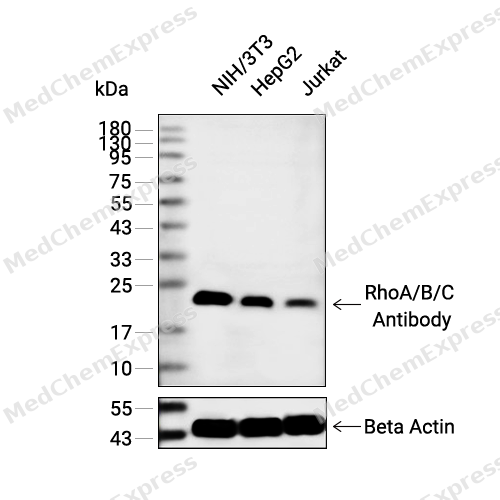 Western blot analysis of extracts from NIH/3T3(lane 2(20ug) ,HepG2(lane 3(20ug) and Hela(lane 4(20ug) using RhoA/B/C Antibody (HY-P80882) Rabbit mAb. Proteins were transferred to a PVDF membrane and blocked with 5% non-fat milk in TBST for 2 hour at room temperature. The primary antibody (1/1000) and Loading control antibody (Beta Actin, HY-P80438, 1/10000) was used in 5% non-fat milk in TBST at 4°C overnight. Goat Anti-Mouse/Rabbit IgG-HRP Secondary Antibody (1/10000) was used for 1 hour at room temperature.
 -
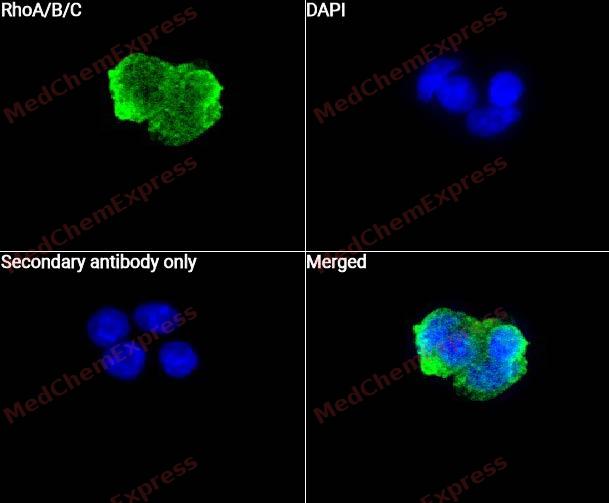 Immunocytochemistry analysis of HepG2 cells labeling RhoA/B/C with RhoA/B/C Antibody (HY-P80882) at 1/50 dilution. Cells were fixed in 4% paraformaldehyde for 15 minutes at room temperature, permeabilized with 0.1% Triton X-100 for 10 minutes at room temperature, then blocked with QuickBlock™ Blocking Buffer for Immunol Staining for 10 min at room temperature. Cells were then incubated with RhoA/B/C Antibody (HY-P80882) at 1/50 dilution in QuickBlock™ Blocking Buffer for Immunol Staining at 4 ℃. Alexa Fluor® 488-conjugated AffiniPure Goat Anti-Rabbit IgG H&L(HY-P8002, Green) was used as the secondary antibody at 1/1,000 dilution. PBS instead of the primary antibody was used as the secondary antibody only control. The Nuclear counterstain was DAPI (Blue).
 -
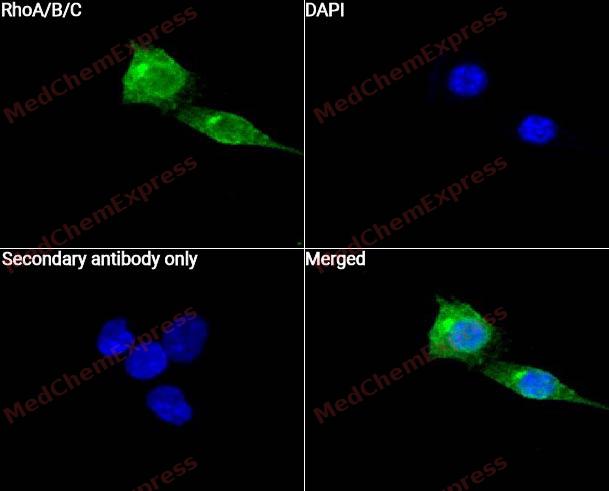 Immunocytochemistry analysis of NIH3T3 cells labeling RhoA/B/C with RhoA/B/C Antibody (HY-P80882) at 1/50 dilution. Cells were fixed in 4% paraformaldehyde for 15 minutes at room temperature, permeabilized with 0.1% Triton X-100 for 10 minutes at room temperature, then blocked with QuickBlock™ Blocking Buffer for Immunol Staining for 10 min at room temperature. Cells were then incubated with RhoA/B/C Antibody (HY-P80882) at 1/50 dilution in QuickBlock™ Blocking Buffer for Immunol Staining at 4 ℃. Alexa Fluor® 488-conjugated AffiniPure Goat Anti-Rabbit IgG H&L(HY-P8002, Green) was used as the secondary antibody at 1/1,000 dilution. PBS instead of the primary antibody was used as the secondary antibody only control. The Nuclear counterstain was DAPI (Blue).
 -
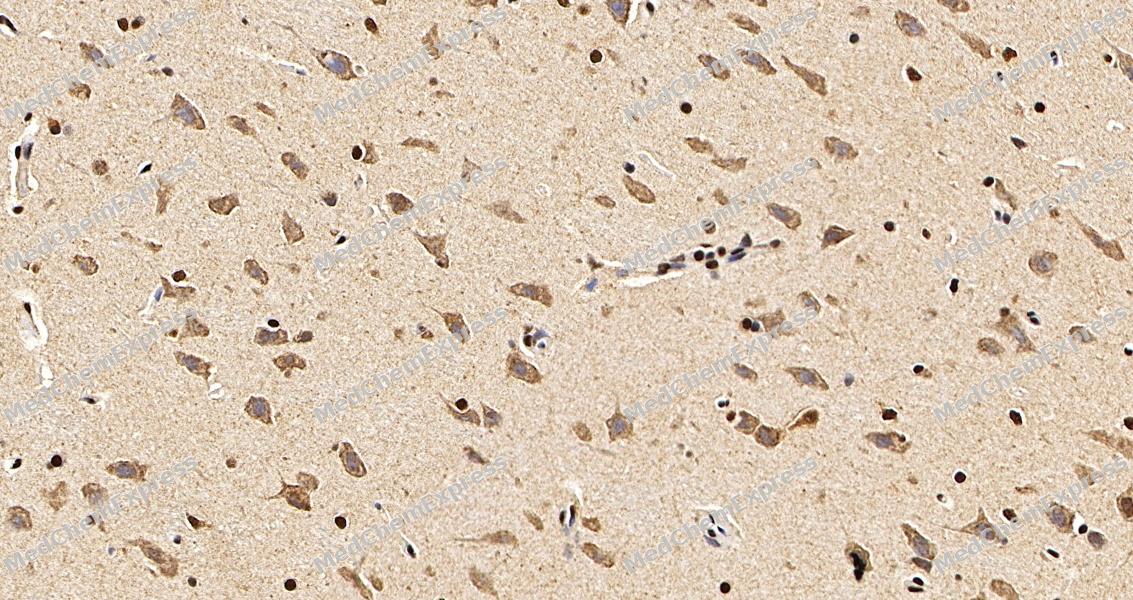 Immunohistochemical analysis of paraffin-embedded rat pancreas tissue using Collagen VI alpha 123 Antibody. The section was pre-treated using heat mediated antigen retrieval with sodium citrate buffer (pH 6.0) for 8 minutes. The tissues were blocked in QuickBlock for 20 minutes at room temperature, washed with ddH2O and PBS, and then probed with the primary antibody at 1/100 dilution in 4℃ overnight. The detection was performed using an HRP conjugated compact polymer system. DAB was used as the chromogen. Tissues were counterstained with hematoxylin and mounted with DPX.
 -
Immunohistochemical analysis of paraffin-embedded rat pancreas tissue using Collagen VI alpha 123 Antibody. The section was pre-treated using heat mediated antigen retrieval with sodium citrate buffer (pH 6.0) for 8 minutes. The tissues were blocked in QuickBlock for 20 minutes at room temperature, washed with ddH2O and PBS, and then probed with the primary antibody at 1/100 dilution in 4℃ overnight. The detection was performed using an HRP conjugated compact polymer system. DAB was used as the chromogen. Tissues were counterstained with hematoxylin and mounted with DPX.
-
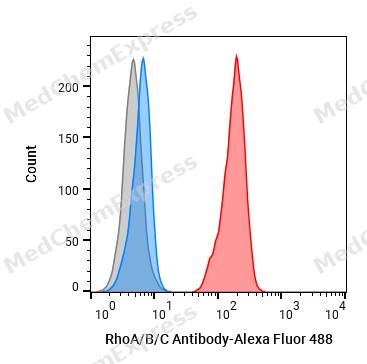 Flow cytometric analysis of 1X10^6 NIH-3T3 cells labeling RhoA/B/C Antibody (HY-P80882, red). Cells were fixed with 4% paraformaldehyde and permeabilised with 90% methanol. Then stained with the primary antibody at 1/50 dilution for an hour at 4℃. Alexa Fluor® 488-conjugated AffiniPure Goat Anti-Rabbit IgG H&L (HY-P8002) was used as the secondary antibody at 1/1,000 dilution for 30 minutes at 4℃. Rabbit IgG Isotype Control (HY-P80879, blue) was used as the isotype control, cells without incubation with primary antibody were used as the unlabeled control (black).


Background
-
Function
RhoA/B/C is a P61586: Small GTPase which cycles between an active GTP-bound and an inactive GDP-bound state. Mainly associated with cytoskeleton organization, in active state binds to a variety of effector proteins to regulate cellular responses such as cytoskeletal dynamics, cell migration and cell cycle. Regulates a signal transduction pathway linking plasma membrane receptors to the assembly of focal adhesions and actin stress fibers. Involved in a microtubule-dependent signal that is required for the myosin contractile ring formation during cell cycle cytokinesis. Plays an essential role in cleavage furrow formation. Required for the apical junction formation of keratinocyte cell-cell adhesion. Essential for the SPATA13-mediated regulation of cell migration and adhesion assembly and disassembly.
P62745: Mediates apoptosis in neoplastically transformed cells after DNA damage. Not essential for development but affects cell adhesion and growth factor signaling in transformed cells. Plays a negative role in tumorigenesis as deletion causes tumor formation. Involved in intracellular protein trafficking of a number of proteins. Targets PKN1 to endosomes and is involved in trafficking of the EGF receptor from late endosomes to lysosomes. Also required for stability and nuclear trafficking of AKT1/AKT which promotes endothelial cell survival during vascular development. Serves as a microtubule-dependent signal that is required for the myosin contractile ring formation during cell cycle cytokinesis. Required for genotoxic stress-induced cell death in breast cancer cells
P08134: Regulates a signal transduction pathway linking plasma membrane receptors to the assembly of focal adhesions and actin stress fibers. Serves as a microtubule-dependent signal that is required for the myosin contractile ring formation during cell cycle cytokinesis. Regulates apical junction formation in bronchial epithelial cells
[1][2][3][4][5][6][7][8][9]. -
Subcellular Localization
P61586: Cell membrane; Lipid-anchor; Cytoplasmic side; Cytoplasm, cytoskeleton; Cleavage furrow; Cytoplasm, cell cortex; Midbody; Cell projection, lamellipodium; Cell projection, dendrite; Nucleus; Cytoplasm
P62745: Late endosome membrane; Lipid-anchor; Cell membrane; Lipid-anchor; Nucleus; Cleavage furrow
P08134: Cell membrane; Lipid-anchor; Cytoplasmic side; Cleavage furrow -
Expression
Induction: P62745: Up-regulated by DNA damaging agents like H2O2 or ionizing radiation (IR)
-
Subunit
P61586: Interacts with ARHGEF28 (By similarity). Interacts (via GTP-bound form) with RIPOR1 (via N-terminus) ; this interaction links RHOA to STK24 and STK26 kinases (PubMed:27807006).
P62745: Binds ROCK1 and ROCK2 (By similarity). Also binds PKN1/PRK1 (PubMed:9478917). Interacts with ARGGEF3 (PubMed:12221096). Interacts with RTKN (By similarity). Interacts with AKAP13 (PubMed:11546812). Interacts with RIPOR1 (PubMed:27807006)
P08134: Interacts with RTKN (By similarity). Interacts with AKAP13 (PubMed:11546812). Interacts with DIAPH1 (PubMed:15864301). Interacts with PKN2 (PubMed:20974804). Interacts with ROCK1 and ROCK2 (PubMed:8816443). Interacts with ARHGDIA (PubMed:20400958). Interacts with RIPOR1 (PubMed:27807006) -
Synonyms
ARH12; ARH6; ARH9; ARHA; ARHA2; H12; RHO12; Transforming protein RhoA; RHOA; RHOB; RHOC
-
Research Field
Signal Transduction


Documentación
-
Ficha de datos (262 KB)
-
SDS (251 KB)
- English - EN (251 KB)
- Français - FR (251 KB)
- Deutsch - DE (251 KB)
- Norwegian - NO (251 KB)
- Español - ES (251 KB)
- Swedish - SV (251 KB)
- Italian - IT (251 KB)
- Korean - KR (251 KB)
- Portuguese - PT (251 KB)
-
User Guide for Antibodies (1077 KB)
References
[1]. Wei J, et al. A new mechanism of RhoA ubiquitination and degradation: roles of SCF(FBXL19) E3 ligase and Erk2. Biochim Biophys Acta. 2013 Dec;1833(12):2757-2764. [Content Brief]
[2]. Vabres P, et al. Postzygotic inactivating mutations of RHOA cause a mosaic neuroectodermal syndrome. Nat Genet. 2019 Oct;51(10):1438-1441. [Content Brief]
[3]. Quilliam LA, et al. Isolation of a NCK-associated kinase, PRK2, an SH3-binding protein and potential effector of Rho protein signaling. J Biol Chem. 1996 Nov 15;271(46):28772-6. [Content Brief]
[4]. Vincent S, et al. The PRK2 kinase is a potential effector target of both Rho and Rac GTPases and regulates actin cytoskeletal organization. Mol Cell Biol. 1997 Apr;17(4):2247-56. [Content Brief]
[5]. Wing MR, et al. Direct activation of phospholipase C-epsilon by Rho. J Biol Chem. 2003 Oct 17;278(42):41253-8. [Content Brief]
[6]. Kamijo K, et al. Dissecting the role of Rho-mediated signaling in contractile ring formation. Mol Biol Cell. 2006 Jan;17(1):43-55. [Content Brief]
[7]. Wallace SW, et al. The Rho target PRK2 regulates apical junction formation in human bronchial epithelial cells. Mol Cell Biol. 2011 Jan;31(1):81-91. [Content Brief]
[8]. Dubash AD, et al. The GEF Bcr activates RhoA/MAL signaling to promote keratinocyte differentiation via desmoglein-1. J Cell Biol. 2013 Aug 19;202(4):653-66. [Content Brief]
[9]. Bristow JM, et al. The Rho-family GEF Asef2 activates Rac to modulate adhesion and actin dynamics and thereby regulate cell migration. J Cell Sci. 2009 Dec 15;122(Pt 24):4535-46. [Content Brief]

 Powered by Bioz
