



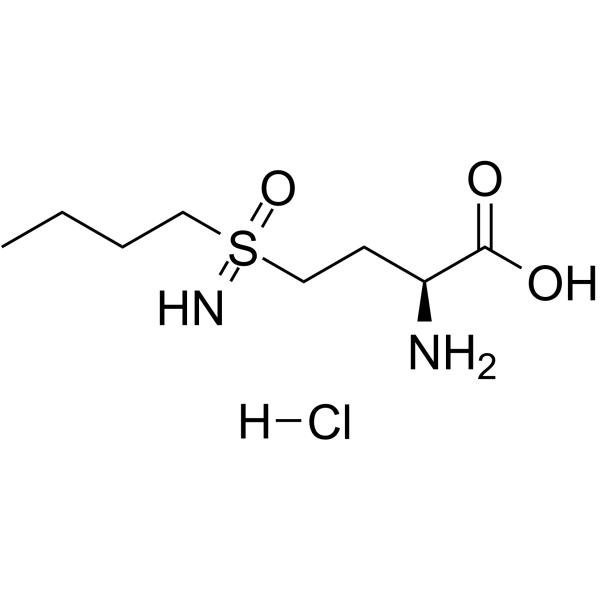
L-Buthionine-(S,R)-sulfoximine hydrochloride
Based on 21 publication(s) in Google Scholar
L-Buthionine-(S,R)-sulfoximine hydrochloride is a cell-permeable, potent, fast acting, orally active and irreversible inhibitor of g-glutamylcysteine synthetase and depletes cellular glutathione levels. The IC50 value of L-Buthionine-(S,R)-sulfoximine on melanoma, breast and ovarian tumor specimens are 1.9 μM, 8.6 μM, and 29 μM, respectively.
For research use only. We do not sell to patients.
- Purity : 98.39%
- Formula: C8H19ClN2O3S
- Molecular Weight:258.77
-
Storage:
-20°C, sealed storage, away from moisture
* In solvent : -80°C, 6 months; -20°C, 1 month (sealed storage, away from moisture)

To place orders, for customer services and technical support, please contact: MedChemExpress USA
Tel: 609-228-6898 E-mail: [email protected] [email protected]


-
 Biological Activity
-
Chemical Information
-
Solvent & Solubility
- Protocols
- Purity & Documentation
- References
-
 Help & FAQs


Publications Citing Use of MedChemExpress (MCE) L-Buthionine-(S,R)-sulfoximine hydrochloride
More- Nat Commun. 2022 Jul 11;13(1):4007. [Abstract]
- Redox Biol. 2026 Feb:89:103962. [Abstract]
- Theranostics. 2024 May 27;14(8):3339-3357. [Abstract]
- Acta Pharm Sin B. 2022 Apr;12(4):2074-2088. [Abstract]
- Adv Sci (Weinh). 2025 Jan;12(1):e2310308. [Abstract]
- J Control Release. 2026 Mar 10:391:114591. [Abstract]
- J Immunother Cancer. 2026 Jun 30;14(6):e014808.
- J Colloid Interface Sci. 2022 Dec 15;628(Pt B):189-203. [Abstract]
- Free Radic Biol Med. 2026 Aug 16:252:1-17. [Abstract]
- Fundam Res. 2025 Dec 16.
- Biochem Pharmacol. 2024 May:223:116194. [Abstract]
- EMBO Rep. 2025 Jun;26(12):3106-3137. [Abstract]
- Eur J Pharmacol. 2025 Aug 15:1001:177746. [Abstract]
- Expert Rev Clin Immunol. 2025 Aug;21(8):1171-1181. [Abstract]
- Vet Res. 2024 Dec 20;55(1):172. [Abstract]
- Immun Inflamm Dis. 2023 Sep;11(9):e1015. [Abstract]
- Discov Oncol. 2025 Oct 21;16(1):1934. [Abstract]
- J Obstet Gynaecol Res. 2023 Aug;49(8):2175-2184. [Abstract]
- bioRxiv. 2026 Jan 26.
- Temple University. 2025.
- Oxid Med Cell Longev. 2022 Jan 17;2022:8038857. [Abstract]
 Customer Validation & Images

-
In Vivo Efficacy Study
-
Histological Imaging/Staining
-
IF
-
Bio/Physico-chemical Assay
-
Cell Imaging/Staining


Biological Activity
Description
In Vitro
L-Buthionine-(S,R)-sulfoximine (BSO: 50 μM) treatment for 48 hr results in a 95% decrease in ZAZ and M14 melanoma cell line GSH levels, and a 60% decrease in GST enzyme activity. GST-π protein and mRNA levels are significantly reduced in both cell lines[1]. L-Buthionine-(S,R)-sulfoximine (BSO) induces oxidative stress in a cell by irreversibly inhibiting g-glutamylcysteine synthetase, an essential enzyme for the synthesis of glutathione (GSH)[2].
?
L-Buthionine-(S,R)-sulfoximine? (BSO) induces ferroptosis in cancer cells[3].
MedChemExpress (MCE) has not independently confirmed the accuracy of these methods. They are for reference only. Further protocols information, click here.
In Vivo
MedChemExpress (MCE) has not independently confirmed the accuracy of these methods. They are for reference only.
-
Animal Model:C57BL/6J pun/pun mice[2].
-
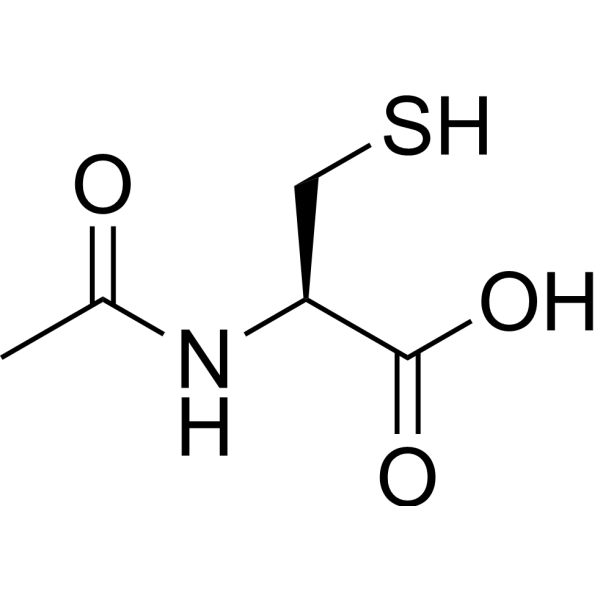
Dosage:2 mM L-Buthionine-(S,R)-sulfoximine (BSO), 20 mM BSO, 2 mM BSO and 20 mM NAC, 20 mM NAC or unsupplemented water for 18 days from 0.5 to 18.5 d.p.c. The pH of supplemented water is as follows: 6.88, 20 mM BSO; 3.37, 2 mM BSO; 2.65, 2 mM BSO plus 20 mM NAC; and 2.58, 20 mM NAC. The pH of regular water used in our facility is ~4.
-
Administration:Drinking water.
-
Result:The average number of eye-spots (mean±SEM) is 5.36±0.29 (n=46), 7.79±0.45 (n=34) and 8.78±0.61 (n=32) in untreated controls, 2 mM L-Buthionine-(S,R)-sulfoximine (BSO) and 20 mM BSO treated mice, respectively. The 2 mM BSO treatment results in ~30% more eye-spots, and the 20 mM treatment results in 40% more eye-spots compared with untreated mice.


Chemical Information
-
Appearance Solid
-
Molecular Weight 258.77
-
Formula C8H19ClN2O3S
-
Color White to off-white
-
SMILES
N[C@H](C(O)=O)CCS(CCCC)(=O)=N.[H]Cl
-
Synonyms
L-Buthionine sulfoximine hydrochloride; L-BSO hydrochloride
-
Shipping
Room temperature in continental US; may vary elsewhere.
-
Storage
-20°C, sealed storage, away from moisture
* In solvent : -80°C, 6 months; -20°C, 1 month (sealed storage, away from moisture)


Publications (21)
-
Journal Impact Factor
-
Most Recent
-
Nat Commun
Blocking glycine utilization inhibits multiple myeloma progression by disrupting glutathione balance. [Abstract]2022 Jul 11;13(1):4007. PMID: 35817773 -
Redox Biol
Protein CoAlation is regulated by and integrated with growth factor signalling and the cellular antioxidant response. [Abstract]2026 Feb:89:103962. PMID: 41371167 -
Theranostics
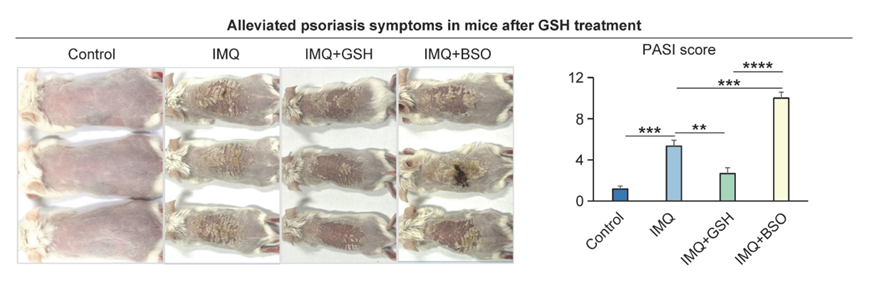
Energy competition remodels the metabolic glucose landscape of psoriatic epidermal cells. [Abstract]2024 May 27;14(8):3339-3357. PMID: 38855186
L-Buthionine-(S,R)-sulfoximine hydrochloride purchased from MedChemExpress. Usage Cited in: Theranostics. 2024 May 27;14(8):3339-3357. [Abstract]
Macroscopic feature and PASI scores of the back of mice in control, IMQ, IMQ+GSH, and IMQ+BS0(2 mg/kg, s.c., 7 d) groups.
L-Buthionine-(S,R)-sulfoximine hydrochloride purchased from MedChemExpress. Usage Cited in: Theranostics. 2024 May 27;14(8):3339-3357. [Abstract]
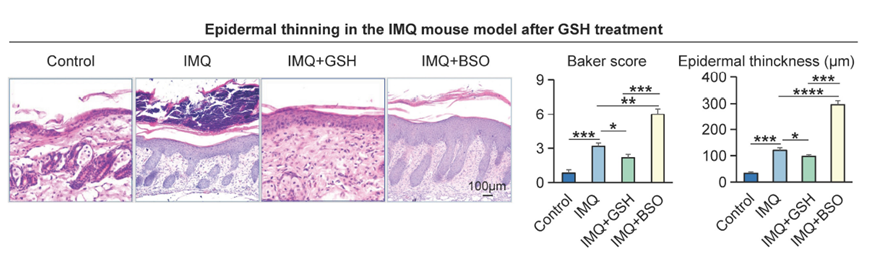
Statistical analysis of representative H&E staining, baker score, and epidermal thickness of the back of mice in control, IMQ, IMQ+GSH, and IMQ+BSO(2 mg/kg, s.c., 7 d) groups. Scale bar, 100 μm.
L-Buthionine-(S,R)-sulfoximine hydrochloride purchased from MedChemExpress. Usage Cited in: Theranostics. 2024 May 27;14(8):3339-3357. [Abstract]
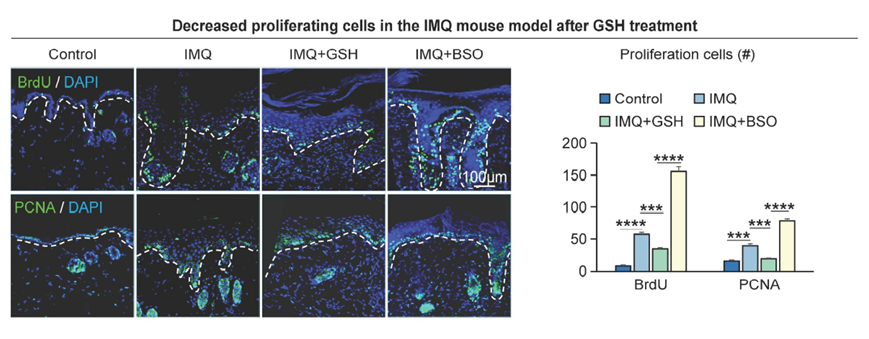
Immunofluorescence staining of BrdU, and PCNA shows proliferation of epidermal cells in mice in control, IMQ, IMQ+GSH, and IMQ+BSO(2 mg/kg, s.c., 7 d) groups. Scale bar, 100 μm.
-
Acta Pharm Sin B
"Pincer movement": Reversing cisplatin resistance based on simultaneous glutathione depletion and glutathione S-transferases inhibition by redox-responsive degradable organosilica hybrid nanoparticles. [Abstract]2022 Apr;12(4):2074-2088. PMID: 35847508
L-Buthionine-(S,R)-sulfoximine hydrochloride purchased from MedChemExpress. Usage Cited in: Acta Pharm Sin B. 2022 Apr;12(4):2074-2088. [Abstract]
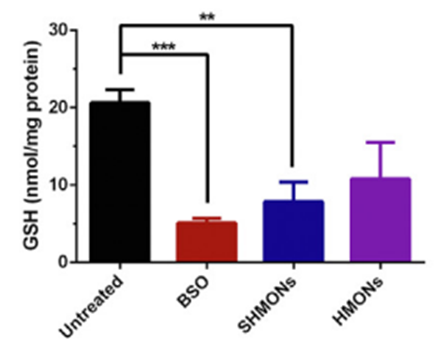
GSH levels of A375/DDP cells after incubation with BSO (200 mmol/L), SHMONs (120 mg/mL), and HMONs (120 mg/mL) for 6 h.
L-Buthionine-(S,R)-sulfoximine hydrochloride purchased from MedChemExpress. Usage Cited in: Acta Pharm Sin B. 2022 Apr;12(4):2074-2088. [Abstract]
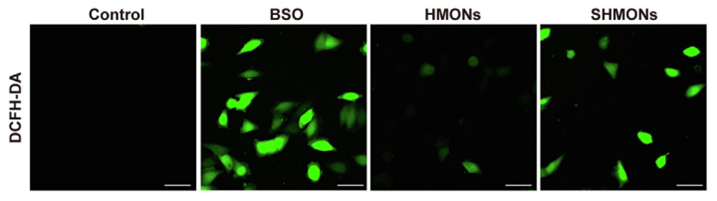
CLSM images of A375/DDP cells incubated with DCFH-DA for the observation of ROS generation after incubation with BSO (200 mmol/L), SHMONs (60 mg/mL), and HMONs (60 mg/mL) for 6 h. Scale bar = 50 mm.
-
Adv Sci (Weinh)
Inhibition of Glutamate-to-Glutathione Flux Promotes Tumor Antigen Presentation in Colorectal Cancer Cells. [Abstract]2025 Jan;12(1):e2310308. PMID: 39482885 -
J Control Release
2026 Mar 10:391:114591. PMID: 41478376 -
-
J Colloid Interface Sci
A spark to the powder keg: Microneedle-based antitumor nanomedicine targeting reactive oxygen species accumulation for chemodynamic/photothermal/chemotherapy. [Abstract]2022 Dec 15;628(Pt B):189-203. PMID: 35994900 -
Free Radic Biol Med
GCSH promotes MASH progression by regulating cuproptosis through the glycine-GSH metabolic pathway. [Abstract]2026 Aug 16:252:1-17. PMID: 42082057 -
-
Biochem Pharmacol
Jolkinolide B synergistically potentiates the antitumor activity of GPX4 inhibitors via inhibiting TrxR1 in cisplatin-resistant bladder cancer cells. [Abstract]2024 May:223:116194. PMID: 38583812 -
EMBO Rep
NRF2 supports non-small cell lung cancer growth independently of CBP/p300-enhanced glutathione synthesis. [Abstract]2025 Jun;26(12):3106-3137. PMID: 40369363 -
Eur J Pharmacol
Targeting eEF2K induces oxidative stress and sensitizes cancer cells to ferroptosis induction. [Abstract]2025 Aug 15:1001:177746. PMID: 40409701 -
Expert Rev Clin Immunol
TFDP1 activates SPC25-mediated glutamine metabolism to repress anti-tumor immunity of NK cells in lung adenocarcinoma. [Abstract]2025 Aug;21(8):1171-1181. PMID: 40552366 -
Vet Res
African swine fever virus enhances viral replication by increasing intracellular reduced glutathione levels, which suppresses stress granule formation. [Abstract]2024 Dec 20;55(1):172. PMID: 39707514 -
Immun Inflamm Dis
Effects of albiflorin on oxidative stress and inflammatory responses in rats with acute spinal cord injury. [Abstract]2023 Sep;11(9):e1015. PMID: 37773716 -
Discov Oncol
D-mannose suppresses HIF-1α mediated metabolic reprogramming in clear cell renal cell carcinoma. [Abstract]2025 Oct 21;16(1):1934. PMID: 41118022 -
J Obstet Gynaecol Res
ELK1/KIFC1 axis promotes breast cancer cell proliferation by regulating glutathione metabolism. [Abstract]2023 Aug;49(8):2175-2184. PMID: 37339943 -
-
-
Oxid Med Cell Longev
Clinical Relevance and Tumor Growth Suppression of Mitochondrial ROS Regulators along NADH:Ubiquinone Oxidoreductase Subunit B3 in Thyroid Cancer. [Abstract]2022 Jan 17;2022:8038857. PMID: 35087620


Solvent & Solubility
In Vitro:
H2O : 70 mg/mL (270.51 mM; Need ultrasonic)
Please refer to the solubility information to select the appropriate solvent. Once prepared, please aliquot and store the solution to prevent product inactivation from repeated freeze-thaw cycles.
Storage method and period of stock solution: -80°C, 6 months; -20°C, 1 month (sealed storage, away from moisture). When stored at -80°C, please use it within 6 months. When stored at -20°C, please use it within 1 month.
* Note: If you choose water as the stock solution, please dilute it to the working solution, then filter and sterilize it with a 0.22 μm filter before use.
Please refer to the solubility information to select the appropriate solvent. Once prepared, please aliquot and store the solution to prevent product inactivation from repeated freeze-thaw cycles.
Storage method and period of stock solution: -80°C, 6 months; -20°C, 1 month (sealed storage, away from moisture). When stored at -80°C, please use it within 6 months. When stored at -20°C, please use it within 1 month.
* Note: If you choose water as the stock solution, please dilute it to the working solution, then filter and sterilize it with a 0.22 μm filter before use.
Concentration (start) × Volume (start) = Concentration (final) × Volume (final)
In Vivo:
Select the appropriate dissolution method based on your experimental animal and administration route.
- For the following dissolution methods, please ensure to first prepare a clear stock solution using an In Vitro approach and then sequentially add co-solvents:
- To ensure reliable experimental results, the clarified stock solution can be appropriately stored based on storage conditions. As for the working solution for In Vivo experiments, it is recommended to prepare freshly and use it on the same day.
- The percentages shown for the solvents indicate their volumetric ratio in the final prepared solution. If precipitation or phase separation occurs during preparation, heat and/or sonication can be used to aid dissolution.
Add each solvent one by one: 10% DMSO 40% PEG300 5% Tween-80 45% Saline
Solubility: ≥ 2.08 mg/mL (8.04 mM); Clear solution
This protocol yields a clear solution of ≥ 2.08 mg/mL (saturation unknown).
Taking 1 mL working solution as an example, add 100 μL DMSO stock solution (20.8 mg/mL) to 400 μL PEG300, and mix evenly; then add 50 μL Tween-80 and mix evenly; then add 450 μL Saline to adjust the volume to 1 mL.
Preparation of Saline: Dissolve 0.9 g sodium chloride in ddH₂O and dilute to 100 mL to obtain a clear Saline solution.
Add each solvent one by one: 10% DMSO 90% (20% SBE-β-CD in Saline)
Solubility: ≥ 2.08 mg/mL (8.04 mM); Clear solution
This protocol yields a clear solution of ≥ 2.08 mg/mL (saturation unknown).
Taking 1 mL working solution as an example, add 100 μL DMSO stock solution (20.8 mg/mL) to 900 μL 20% SBE-β-CD in Saline, and mix evenly.
Preparation of 20% SBE-β-CD in Saline (4°C, storage for one week): 2 g SBE-β-CD powder is dissolved in 10 mL Saline, completely dissolve until clear.
In Vivo Dissolution Calculator
Please enter the basic information of animal experiments:
-
-
-
-
Recommended: Prepare an additional quantity of animals to account for potential losses during experiments.
Working solution concentration: 0.22 mg/mL
This product has good water solubility, please refer to the measured solubility data in water/PBS/Saline for details.

Protocols
-
Cell Cytotoxicity Assay
Cytotoxicity assays are usually based on the assessment of cell membrane damage, which can also be indirectly detected by measuring cell viability. Detection methods include MTT assay, CKK-8 assay, LDH assay and ATP assay, etc.


Purity & Documentation
-
Data Sheet (275 KB)
-
SDS (252 KB)
- English - EN (252 KB)
- Français - FR (252 KB)
- Deutsch - DE (252 KB)
- Norwegian - NO (252 KB)
- Español - ES (252 KB)
- Swedish - SV (252 KB)
- Italian - IT (252 KB)
- Korean - KR (252 KB)
- Portuguese - PT (252 KB)
-
Handling Instructions (2659 KB)
References
[1]. Fruehauf JP, et al. Selective and synergistic activity of L-S,R-buthionine sulfoximine on malignant melanoma is accompanied by decreased expression of glutathione-S-transferase. Pigment Cell Res. 1997 Aug;10(4):236-49. [Content Brief]
[2]. Reliene R, et al. Glutathione depletion by buthionine sulfoximine induces DNA deletions in mice. Carcinogenesis. 2006 Feb;27(2):240-4. [Content Brief]
[3]. Satoru Nishizawa, et al. Low tumor glutathione level as a sensitivity marker for glutamate-cysteine ligase inhibitors. Oncol Lett. 2018 Jun;15(6):8735-8743. [Content Brief]


Complete Stock Solution Preparation Table
Please refer to the solubility information to select the appropriate solvent. Once prepared, please aliquot and store the solution to prevent product inactivation from repeated freeze-thaw cycles.
Storage method and period of stock solution: -80°C, 6 months; -20°C, 1 month (sealed storage, away from moisture). When stored at -80°C, please use it within 6 months. When stored at -20°C, please use it within 1 month.
| Optional Solvent | Concentration Solvent Mass | 1 mg | 5 mg | 10 mg | 25 mg |
|---|---|---|---|---|---|
| H2O | 1 mM | 3.8644 mL | 19.3222 mL | 38.6444 mL | 96.6109 mL |
| 5 mM | 0.7729 mL | 3.8644 mL | 7.7289 mL | 19.3222 mL | |
| 10 mM | 0.3864 mL | 1.9322 mL | 3.8644 mL | 9.6611 mL | |
| 15 mM | 0.2576 mL | 1.2881 mL | 2.5763 mL | 6.4407 mL | |
| 20 mM | 0.1932 mL | 0.9661 mL | 1.9322 mL | 4.8305 mL | |
| 25 mM | 0.1546 mL | 0.7729 mL | 1.5458 mL | 3.8644 mL | |
| 30 mM | 0.1288 mL | 0.6441 mL | 1.2881 mL | 3.2204 mL | |
| 40 mM | 0.0966 mL | 0.4831 mL | 0.9661 mL | 2.4153 mL | |
| 50 mM | 0.0773 mL | 0.3864 mL | 0.7729 mL | 1.9322 mL | |
| 60 mM | 0.0644 mL | 0.3220 mL | 0.6441 mL | 1.6102 mL | |
| 80 mM | 0.0483 mL | 0.2415 mL | 0.4831 mL | 1.2076 mL | |
| 100 mM | 0.0386 mL | 0.1932 mL | 0.3864 mL | 0.9661 mL |
* Note: If you choose water as the stock solution, please dilute it to the working solution, then filter and sterilize it with a 0.22 μm filter before use.


L-Buthionine-(S,R)-sulfoximine hydrochloride Related Classifications
HY-106376C Related Classifications
 Powered by Bioz