



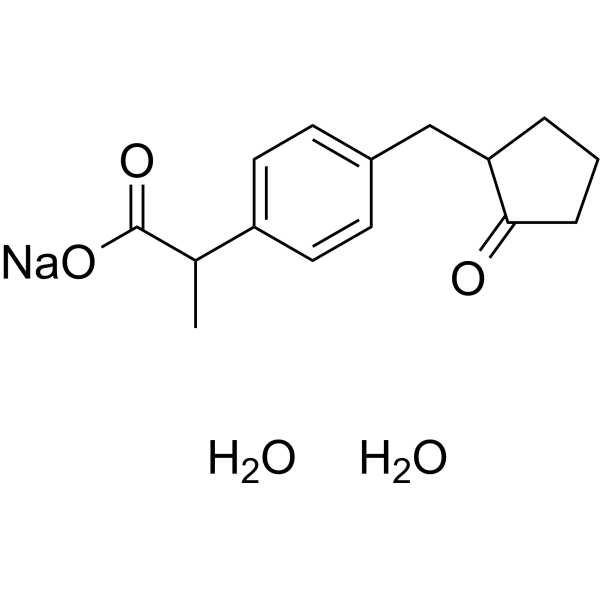
Loxoprofen sodium dihydrate
Based on 1 publication(s) in Google Scholar
Loxoprofen sodium dihydrate is a non-steroidal, orally active anti-inflammatory agent with analgesic and anti-pyretic properties. Loxoprofen sodium dihydrate is a nonselective COX inhibitor with IC50s of 6.5 and 13.5 μM for COX-1 and COX-2, respectively. Loxoprofen sodium dihydrate can reduce atherosclerosis and shows antitumor activity.
Para uso exclusivo en investigación. No vendemos a pacientes.
- No. CAS: 226721-96-6
- Fòrmula: C15H21NaO5
- Peso molecular:304.31
-
Almacenamiento:
Please store the product under the recommended conditions in the Certificate of Analysis.

To place orders, for customer services and technical support, please contact: MedChemExpress USA
Tel: 609-228-6898 E-mail: [email protected] [email protected]


-
 Actividad biológica
-
Chemical Information
- Protocolo
- Pureza y Documentación
- Referencias
-
 Help & FAQs


Publications Citing Use of MedChemExpress (MCE) Loxoprofen sodium dihydrate
More

Actividad biológica
Descripciòn
IC50 & Target
|
COX-1 6.5 μM (IC50, in human whole blood) |
COX-2 13.5 μM (IC50, in human whole blood) |
In Vitro
Loxoprofen sodium dihydrate, an anti-inflammatory prodrug (NSAID), is a nonselective COX inhibitor with IC50s of 6.5 and 13.5 μM for COX-1 and COX-2 in human whole blood assays, respectively[1].
Loxoprofen (LOX) sodium dihydrate is a non-selective cyclooxygenase inhibitor that is widely used for the reasearch of pain and inflammation caused by chronic and transitory conditions. Its alcoholic metabolites are formed by carbonyl reductase (CR) and they consist of trans-LOX, which is active, and cis-LOX, which is inactive. In addition, LOX sodium dihydrate can also be converted into an inactive hydroxylated metabolite (OH-LOXs) by cytochrome P450 (CYP)[2].
MedChemExpress (MCE) has not independently confirmed the accuracy of these methods. They are for reference only. Further protocols information, click here.
In Vivo
MedChemExpress (MCE) has not independently confirmed the accuracy of these methods. They are for reference only.
-
Animal Model:ApoE-/- mice (C57BL/6J-Apoetm1Unc) with high-fat diet (0.2% cholesterol, 21% saturated fat) from 8 to 16 weeks of age[3]
-
Dosage:4 mg/kg/day in drinking water
-
Administration:Oral dosing from 8 to 16 weeks of age or from 15 to 16 weeks of age
-
Result:Inhibited platelet thromboxane production and platelet aggregation. Reduced extent of atherosclerosis. Suppressed the production of PGE2, TxB2 and PGI2.
-
Animal Model:6-week-old male C57BL/6 and BDF1 mice, 100 μL suspensions (2 × 10⁶ cells/mL) of LLC cells and KLN205 cells were injected subcutaneously into C57BL/6 and BDF1 mice, respectively[4].
-
Dosage:60 μg/mL
-
Administration:Oral dosing in drinking water, every day for 24 days
-
Result:Suppressed tumor growth and angiogenesis, suppressed expression of VEGF in mice with LLC tumor, inhibited tubular formation of HUVECs.


Chemical Information
-
No. CAS 226721-96-6
-
Peso molecular 304.31
-
Fòrmula C15H21NaO5
-
SMILES
O=C1C(CCC1)CC2=CC=C(C(C)C(O[Na])=O)C=C2.O.O
-
Envío
Room temperature in continental US; may vary elsewhere.
-
Almacenamiento
Please store the product under the recommended conditions in the Certificate of Analysis.


Publications (1)
-
Journal Impact Factor
-
Most Recent
-
Eur J Med Chem
2024 Dec 5:279:116842. PMID: 39260319

Protocolo
-
Research Protocol for Cardiovascular Diseases
Cardiovascular disease can be modeled as maladaptive cardiac remodeling, where ischemic injury or pressure overload activates inflammatory signaling, fibroblast activation, extracellular-matrix deposition, cardiomyocyte hypertrophy, vascular remodeling, and progressive ventricular dysfunction. The TGF-β/SMAD axis is a central profibrotic pathway after myocardial injury and pressure overload, while innate immune and cytokine pathways regulate leukocyte recruitment, scar formation, and adverse remodeling. Key unresolved questions include which inflammatory signals are reparative versus harmful, when fibrosis is protective versus maladaptive, and whether pathway inhibition improves function without weakening necessary infarct healing or compensatory remodeling.
-
Research Protocol for Inflammation-related Diseases
The NLRP3 inflammasome is a cytosolic innate immune signaling platform that integrates priming signals and danger-signal activation to promote caspase-1 activation, maturation of IL-1β and IL-18, and gasdermin D-mediated pyroptotic cell death. The core experimental logic is to determine whether inflammatory disease phenotypes are driven by increased NLRP3 expression, ASC-containing inflammasome assembly, caspase-1 cleavage, GSDMD cleavage, and extracellular release of IL-1β/IL-18 rather than by nonspecific cell injury alone. The pathway is strongly linked to inflammation-related disease phenotypes because monosodium urate crystals activate NALP3/NLRP3 inflammasome signaling in gout-like crystal inflammation, cholesterol crystals activate NLRP3 inflammasomes in atherogenesis models, and DSS-induced intestinal inflammation has been reported to involve NLRP3 inflammasome activity. However, experimental colitis studies also show context-dependent protective effects of NLRP3 inflammasome co
-
Subcutaneous Cell-Line-Derived Xenograft
Subcutaneous cell-line-derived xenograft (CDX) models are established by implanting cultured human cancer cell lines into immunodeficient mice, where the injected cells form localized tumors that can be monitored in vivo as a measure of tumorigenic potential, growth kinetics, and treatment response. These models are widely used in oncology research because they allow reproducible tumor formation and enable comparative assessment of tumor growth between different cell lines or genetic manipulations in a controlled in vivo microenvironment. Subcutaneous implantation of cancer cells in immunodeficient mice is a standard approach for evaluating tumor growth behavior and therapeutic response across multiple cancer types, including prostate, esophageal, pancreatic, and colon cancer models.


Pureza y Documentación
Referencias
[1]. Riendeau D, et al. Evaluation of loxoprofen and its alcohol metabolites for potency and selectivity of inhibition of cyclooxygenase-2. Bioorg Med Chem Lett. 2004;14(5):1201-1203. [Content Brief]
[2]. Paudel S, et al. Assessing Drug Interaction and Pharmacokinetics of Loxoprofen in Mice Treated with CYP3A Modulators. Pharmaceutics. 2019;11(9):479. Published 2019 Sep 16. [Content Brief]
[3]. Hamaguchi M, et al. Loxoprofen Sodium, a Non-Selective NSAID, Reduces Atherosclerosis in Mice by Reducing Inflammation. J Clin Biochem Nutr. 2010 Sep;47(2):138-47. [Content Brief]
[4]. Kanda A, et al. Loxoprofen sodium suppresses mouse tumor growth by inhibiting vascular endothelial growth factor. Acta Oncol. 2003;42(1):62-70. [Content Brief]

Calculators
Concentration (start) × Volume (start) = Concentration (final) × Volume (final)


Loxoprofen sodium dihydrate Related Classifications
HY-B0578B Related Classifications
 Powered by Bioz