



Octreotide dihydrochloride
Based on 11 publication(s) in Google Scholar
Octreotide (SMS 201-995) hydrochloride is a somatostatin receptor agonist and synthetic octapeptide endogenous somatostatin analogue. Octreotide hydrochloride can bind to the somatostatin receptors which are mainly subtypes 2, 3 and 5. Octreotide hydrochloride increases Gi activity and reduces intracellular cAMP production. Octreotide hydrochloride has antitumor activity, mediates apoptosis and may also be used in disease studies in acromegaly.
For research use only. We do not sell to patients.
- CAS No.: 1607842-55-6
- Formula: C49H68Cl2N10O10S2
- Molecular Weight:1092.16
-
Storage:
Please store the product under the recommended conditions in the Certificate of Analysis.


To place orders, for customer services and technical support, please contact: MedChemExpress USA
Tel: 609-228-6898 E-mail: [email protected] [email protected]


-
 Biological Activity
-
Chemical Information
- Purity & Documentation
- References
-
 Help & FAQs


Publications Citing Use of MedChemExpress (MCE) Octreotide dihydrochloride
More- Mol Cancer. 2024 Sep 20;23(1):205. [Abstract]
- Eur J Nucl Med Mol Imaging. 2024 Nov;51(13):4099-4110. [Abstract]
- J Ethnopharmacol. 2026 Jun 12:364:121522. [Abstract]
- Int J Pharm. 2026 Mar 12:126768. [Abstract]
- Biomacromolecules. 2024 May 13;25(5):2749-2761. [Abstract]
- J Pharm Sci. 2022 Dec;111(12):3417-3423. [Abstract]
- Basic Clin Pharmacol Toxicol. 2022 Sep;131(3):174-188. [Abstract]
- Cell Mol Bioeng. 2022 Dec 22;16(1):55-67. [Abstract]
- J Pharm Biomed Anal. 2023 Feb 5:224:115156. [Abstract]
- J Pharm Biomed Anal. 2022 Mar 20:211:114518. [Abstract]
- University of Helsinki Finland. 2018 Dec.
 Customer Validation & Images

-
In Vivo Efficacy Study
-
Cell Proliferation/Viability Assay
-
WB
-
Cell Imaging/Staining
-
RT-PCR


Biological Activity
Description
In Vitro
Octreotide hydrochloride (10‑8mM, 6 hours) induces phosphorylated‑glycogen synthase kinase 3β (GSK3β) phosphorylation and increases glycogen synthase (GS) activity[3].
MedChemExpress (MCE) has not independently confirmed the accuracy of these methods. They are for reference only.
-
Cell Line:Human hepatoblastoma HepG2 cell line
-
Concentration:10‑8mM
-
Incubation Time:6 hours
-
Result:Increased the protein expression levels of phosphorylated‑Akt and GSK3β by 140.8% and 12.2%, respectively and the mRNA level of GS also increased.
In Vivo
Octreotide hydrochloride (intramuscular injection, 60 mg/kg, every 21 days, 42 days) inhibits serum insulin-like growth factor (IGF-I) without toxicity in dogs with appendicular osteosarcoma (OSA)[2].
Octreotide hydrochloride (subcutaneous injection, 40 μg/kg, Every 12 hours, 8 days) improves hepatic glycogen synthesis in obese male Sprague‑Dawley (SD) rats[3].
MedChemExpress (MCE) has not independently confirmed the accuracy of these methods. They are for reference only.
-
Animal Model:Female nude mice (nu/nu Balbc-A weighing 19-22 g)[1]
-
Dosage:30 mg/kg
-
Administration:Subcutaneous injection; once; 8 weeks
-
Result:Showed that the average volume of tumors treated was 25.8% of the control group and no effect on body weight.
-
Animal Model:Dogs with appendicular OSA[2]
-
Dosage:60 mg/kg
-
Administration:Intramuscular injection; Every 21 days; 42 days
-
Result:Resulted in a 43% decrease in mean serum IGF-I compared with mean baseline concentrations.
-
Animal Model:Male Sprague‑Dawley (SD) rats (3 weeks; 40-60 g)[3]
-
Dosage:40 μg/kg
-
Administration:Subcutaneous injection; Every 12 hours; 8 days
-
Result:Significantly improved fat deposition and reduced lipid infiltration.


Chemical Information
-
CAS No. 1607842-55-6
-
Molecular Weight 1092.16
-
Formula C49H68Cl2N10O10S2
-
Synonyms
SMS 201-995 dihydrochloride
-
Sequence
{d-Phe}-cyclo(Cys-Phe-{d-Trp}-Lys-Thr-Cys-{Threoninol}) (Disulfide bridge: Cys2-Cys7)
-
Sequence Shortening
{d-Phe}-cyclo(CF{d-Trp}-KTC)-{Threoninol} (Disulfide bridge: Cys2-Cys7)
-
Shipping
Room temperature in continental US; may vary elsewhere.
-
Storage
Please store the product under the recommended conditions in the Certificate of Analysis.


Publications (11)
-
Journal Impact Factor
-
Most Recent
-
Mol Cancer
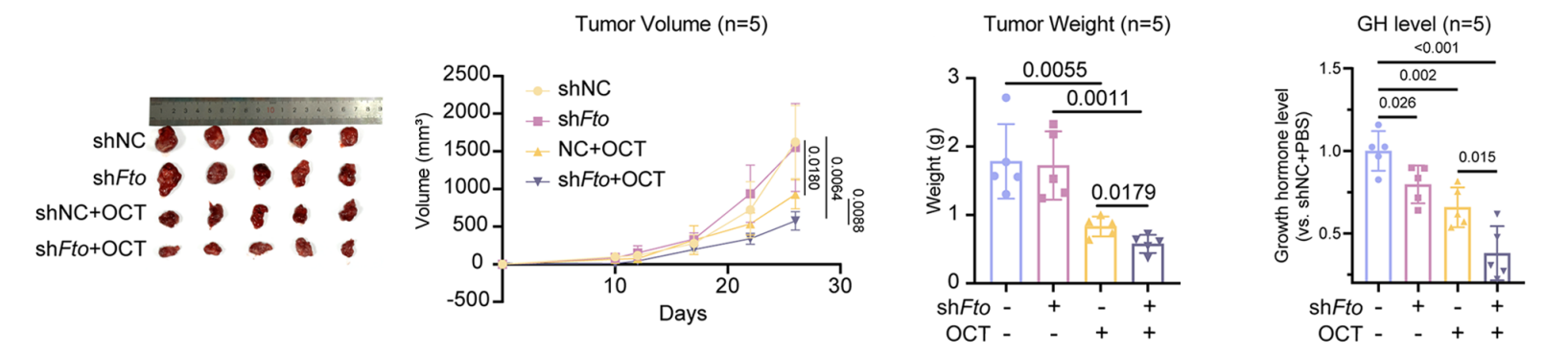
FTO-mediated DSP m6A demethylation promotes an aggressive subtype of growth hormone-secreting pituitary neuroendocrine tumors. [Abstract]2024 Sep 20;23(1):205. PMID: 39304899
Octreotide dihydrochloride purchased from MedChemExpress. Usage Cited in: Mol Cancer. 2024 Sep 20;23(1):205. [Abstract]
In vivo assessment of octreotide sensitivity in GH3 xenografts by injecting with or without Fto knockdown GH3 cells according to tumor volume, tumor weight and growth hormone level. Octreotide (OCT) (50 μg/kg; i.p.; once daily) inhibited the growth of FTO-knockdown cells effectively and further reduced the secretion of growth hormone.
-
Eur J Nucl Med Mol Imaging
Combining [177Lu]Lu-DOTA-TOC PRRT with PARP inhibitors to enhance treatment efficacy in small cell lung cancer. [Abstract]2024 Nov;51(13):4099-4110. PMID: 39023784 -
J Ethnopharmacol
Revealing the temporal metabolic trajectory and potential pharmacodynamic substances of Da-Cheng-Qi Decoction in treating patients with acute pancreatitis: A serum metabolomics-based study. [Abstract]2026 Jun 12:364:121522. PMID: 41825726 -
Int J Pharm
Comprehensive design and characterization of pH-gradient-loaded donkey-milk exosomes for oral octreotide delivery: A bench-to-in silico roadmap. [Abstract]2026 Mar 12:126768. PMID: 41831704 -
Biomacromolecules
Investigation of Basolateral Targeting Micelles for Drug Delivery Applications in Polycystic Kidney Disease. [Abstract]2024 May 13;25(5):2749-2761. PMID: 38652072 -
J Pharm Sci
Elucidating a Potential Mechanism of Permeability Enhancer Sodium N-[8-(2-hydroxybenzoyl) amino] caprylate in Rats: Evidence of Lymphatic Absorption of Cyanocobalamin Using the Mesenteric Lymph Duct Cannulated Rat. [Abstract]2022 Dec;111(12):3417-3423. PMID: 36228756 -
Basic Clin Pharmacol Toxicol
Somatostatin receptor ligands suppressed proliferation and lipogenesis in 3T3-L1 preadipocytes. [Abstract]2022 Sep;131(3):174-188. PMID: 35688794
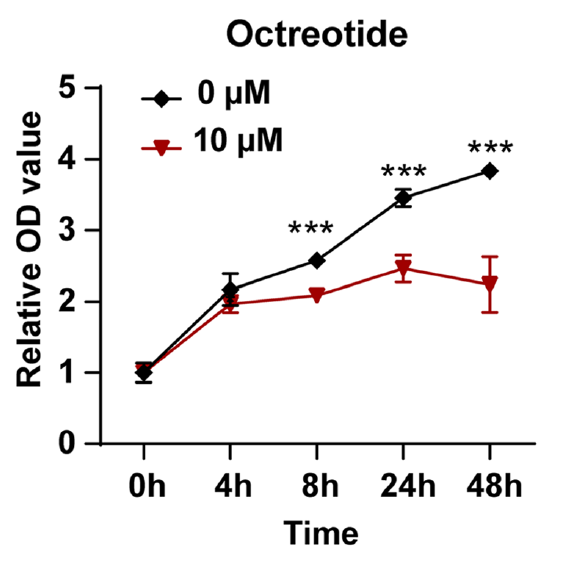
Octreotide dihydrochloride purchased from MedChemExpress. Usage Cited in: Basic Clin Pharmacol Toxicol. 2022 Sep;131(3):174-188. [Abstract]
Effects of 0ctreotide (10 μM; 4, 8, 24 and 48 h) on cell viability after treatments. 0ctreotide significantly inhibited 3T3-L1 cell viability after 8, 24 and 48 h but not 4 h.
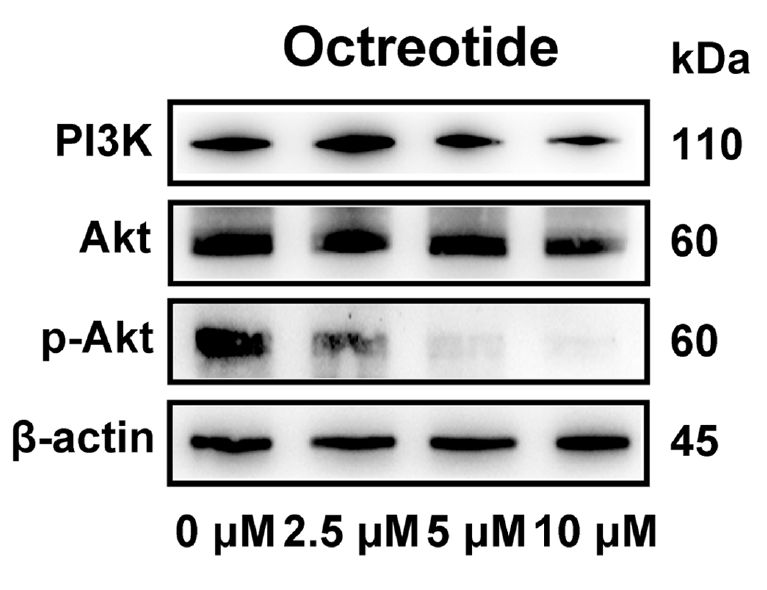
Octreotide dihydrochloride purchased from MedChemExpress. Usage Cited in: Basic Clin Pharmacol Toxicol. 2022 Sep;131(3):174-188. [Abstract]
Representative western blot brands of PI3K, Akt and p-Akt with or without Octreotide (2.5-10 μM) treatments. Octreotide suppressed the expression of PI3K and p-Akt in a dose-dependent manner but showed no effects on the total Akt expression in 3T3-L1 cells.
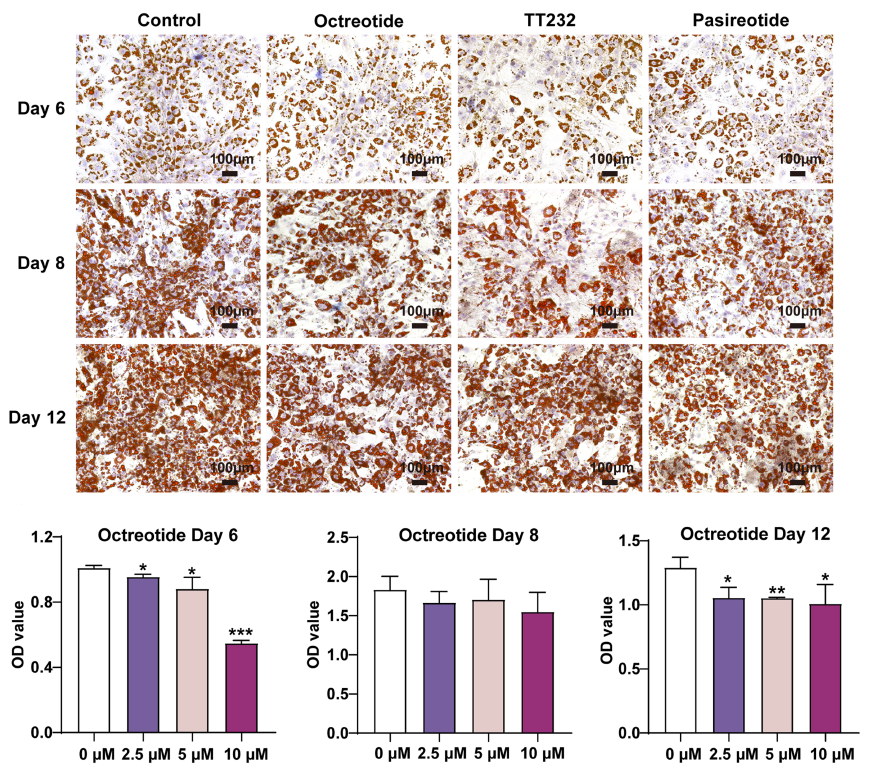
Octreotide dihydrochloride purchased from MedChemExpress. Usage Cited in: Basic Clin Pharmacol Toxicol. 2022 Sep;131(3):174-188. [Abstract]
Oil Red O staining was performed to illustrate lipid droplets and to determine the lipid contents. Octreotide (2.5-10 μM) treatments significantly reduced lipid contents in 3T3-L1 cells on Day 6 and Day 12 compared with the control.
Octreotide dihydrochloride purchased from MedChemExpress. Usage Cited in: Basic Clin Pharmacol Toxicol. 2022 Sep;131(3):174-188. [Abstract]
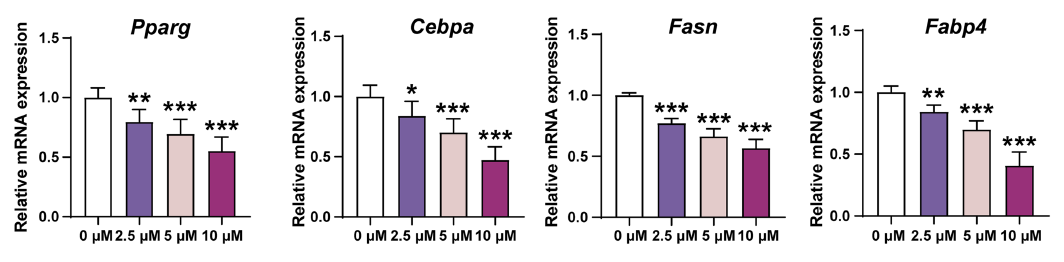
mRNA expression of Pparg, Cebpa, Fasn, and Fabp4 with or without Octreotide (2.5–10 μM; 12 d) treatments. Octreotide suppressed mRNA levels of Pparg, Cebpa, Fasn, and Fabp4 in 3T3-L1 preadipocytes in a dose-dependent manner.
-
Cell Mol Bioeng
Combining Metformin and Drug-Loaded Kidney-Targeting Micelles for Polycystic Kidney Disease. [Abstract]2022 Dec 22;16(1):55-67. PMID: 36660586 -
J Pharm Biomed Anal
Analyzing proteolytic stability and metabolic hotspots of therapeutic peptides in two rodent pulmonary fluids. [Abstract]2023 Feb 5:224:115156. PMID: 36463768 -
J Pharm Biomed Anal
Automated high-throughput in vitro assays to identify metabolic hotspots and protease stability of structurally diverse, pharmacologically active peptides for inhalation. [Abstract]2022 Mar 20:211:114518. PMID: 35124452 -


Purity & Documentation
References
[1]. Octreotide pamoate, OncoLAR, OP-LAR
[2]. Chand Khanna,et al. A randomized controlled trial of octreotide pamoate long-acting release and carboplatin versus carboplatin alone in dogs with naturally occurring osteosarcoma: evaluation of insulin-like growth factor suppression and chemotherapy. Clin Cancer Res. 2002 Jul;8(7):2406-12. [Content Brief]
[3]. Xiao-Xia Wang,et al. Effects of octreotide on hepatic glycogenesis in rats with high fat diet‑induced obesity. Mol Med Rep. 2017 Jul;16(1):109-118. [Content Brief]

Calculators
Concentration (start) × Volume (start) = Concentration (final) × Volume (final)


Octreotide dihydrochloride Related Classifications
HY-P0036A Related Classifications
 Powered by Bioz