



IL-23 Protein, Human (HEK293, C-His)
Based on 1 Customer Validation
IL-23 and IL12B together constitute the pro-inflammatory cytokine IL-23, which is crucial in innate and adaptive immunity. IL-23 is released by antigen-presenting cells such as dendritic cells or macrophages, binds to IL12RB1 and IL23R, and activates JAK2 and TYK2. IL-23 Protein, Human (HEK293, His) is a recombinant protein dimer complex containing human-derived IL-23 alpha & IL-12 beta protein, expressed by HEK293 , with C-6*His labeled tag.
- Species: Human
- Source: HEK293
-
Storage:Stored at -20°C for 2 years from date of receipt. After reconstitution, it is stable at 4°C for 1 week or -20°C for longer (with carrier protein). It is recommended to freeze aliquots at -20°C or -80°C for extended storage.


To place orders, for customer services and technical support, please contact: MedChemExpress USA
Tel: 609-228-6898 E-mail: [email protected] [email protected]


-
 Biological Activity
-
Technical Parameters
-
Product Properties
- Documentation
- Help & FAQs




Biological Activity
Description
IL-23 and IL12B together constitute the pro-inflammatory cytokine IL-23, which is crucial in innate and adaptive immunity. IL-23 is released by antigen-presenting cells such as dendritic cells or macrophages, binds to IL12RB1 and IL23R, and activates JAK2 and TYK2. IL-23 Protein, Human (HEK293, His) is a recombinant protein dimer complex containing human-derived IL-23 alpha & IL-12 beta protein, expressed by HEK293 , with C-6*His labeled tag.
Background
IL-23, in collaboration with IL12B, forms the pro-inflammatory cytokine IL-23, playing diverse roles in both innate and adaptive immunity. Released by antigen-presenting cells such as dendritic cells or macrophages, IL-23 binds to a heterodimeric receptor complex comprising IL12RB1 and IL23R, initiating a cascade involving JAK2 and TYK2 activation. These kinases phosphorylate the receptor, creating a docking site for the subsequent phosphorylation of STAT3 and STAT4. This process activates multiple pathways, including p38 MAPK or NF-kappa-B, fostering the production of pro-inflammatory cytokines, such as interleukin-17A/IL17A. Additionally, IL-23 actively participates in the early and effective clearance of intracellular bacteria. Notably, IL-23 promotes the expansion and survival of T-helper 17 cells, a CD4-positive helper T-cell subset known for producing IL-17, alongside other IL-17-producing cells. The heterodimeric association of IL-23 with IL12B, known as interleukin IL-23, is disulfide-linked. Furthermore, IL-23 interacts with IL23R, facilitating the recruitment of IL12RB1.
Verified Bioactivity
1. Measured by its ability to induce STAT reporter activity in 293F human embryonic kidney cells. The ED50 for this effect is 300-900 ng/mL.
2. Measured by its ability to induce IL17 secretion by mouse CTLL-2 cells. The ED50 for this effect is 2.324 ng/mL, corresponding to a specific activity is 4.3×10^5 U/mg.
3.Measured by its ability to induce IL17 secretion by mouse splenocytes. The ED50 for this effect is 0.1-1ng/mL.
4. Measured by its binding ability in a functional ELISA. Immobilized IL-23R at 10 μg/mL (100 μL/well) can bind IL-23 Protein. The ED50 for this effect is 67.04 ng/mL.
MCE Validation Data
-
Purity - SDS-PAGE
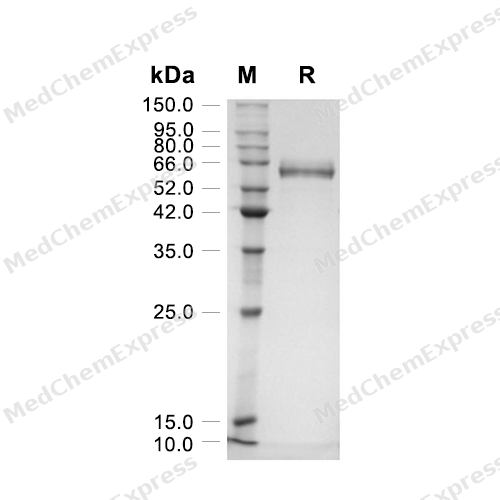
Purity - SDS-PAGE
-
Bioactivity - Cell-Based Assay
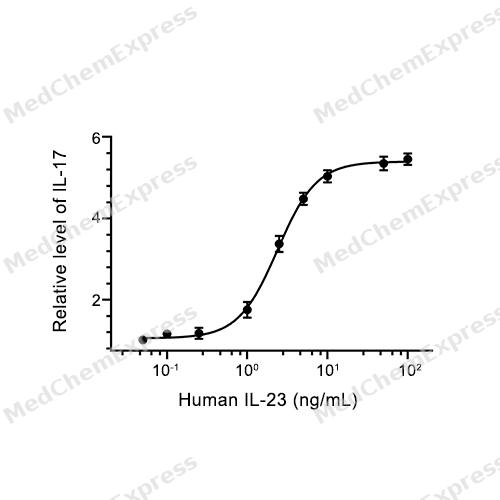
Bioactivity - Cell-Based Assay


Technical Parameters
-
Species Human
-
Source HEK293
-
Tag C-6*His
-
Synonyms
IL23A; Interleukin 23, Alpha Subunit P19; Interleukin 23 Subunit Alpha; Interleukin-23 Subunit Alpha; SGRF; Interleukin-23 Subunit P19; IL23P19; IL-23 Subunit Alpha; IL-23A; IL-23p19; IL-23; IL-23-A; P19; JKA3 Induced Upon T-Cell Activation; Interleukin-S
-
AA Sequence
IWELKKDVYVVELDWYPDAPGEMVVLTCDTPEEDGITWTLDQSSEVLGSGKTLTIQVKEFGDAGQYTCHKGGEVLSHSLLLLHKKEDGIWSTDILKDQKEPKNKTFLRCEAKNYSGRFTCWWLTTISTDLTFSVKSSRGSSDPQGVTCGAATLSAERVRGDNKEYEYSVECQEDSACPAAEESLPIEVMVDAVHKLKYENYTSSFFIRDIIKPDPPKNLQLKPLKNSRQVEVSWEYPDTWSTPHSYFSLTFCVQVQGKSKREKKDRVFTDKTSATVICRKNASISVRAQDRYYSSSWSEWASVPCS&RAVPGGSSPAWTQCQQLSQKLCTLAWSAHPLVGHMDLREEGDEETTNDVPHIQCGDGCDPQGLRDNSQFCLQRIHQGLIFYEKLLGSDIFTGEPSLLPDSPVGQLHASLLGLSQLLQPEGHHWETQQIPSLSPSQPWQRLLLRFKILRSLQAFVAVAARVFAHGAATLSP
-
Molecular Weight
Approximately 58-90 kDa, based on SDS-PAGE under reducing conditions, due to the glycosylation.
-
Glycosylation
Yes
-
Purity
≥ 90%, as determined by reducing SDS-PAGE.


Product Properties
Lyophilized powder
1.Lyophilized from a 0.22 μm filtered solution of 20 mM Tris-HCl, 15% trehalose, 0.05% Tween 80, pH 8.5.
2.Lyophilized from a 0.22 μm filtered solution of 20 mM PB, 150 mM NaCl, pH 7.4.
Please refer to the lot-specific COA for specific buffer information.
Note: For SPR assay, please replace the buffer. Primary amine components (e.g., Tris, imidazole) can affect protein-coupled chips.
<1 EU/μg, determined by LAL method.
It is not recommended to reconstitute to a concentration less than 100 μg/mL in ddH2O. For long term storage it is recommended to add a carrier protein (0.1% BSA, 5% HSA, 10% FBS or 5% Trehalose).
Stored at -20°C for 2 years from date of receipt. After reconstitution, it is stable at 4°C for 1 week or -20°C for longer (with carrier protein). It is recommended to freeze aliquots at -20°C or -80°C for extended storage.
Room temperature in continental US; may vary elsewhere.


Documentation
-
Data Sheet (240 KB)
-
SDS (252 KB)
- English - EN (252 KB)
- Français - FR (252 KB)
- Deutsch - DE (252 KB)
- Norwegian - NO (252 KB)
- Español - ES (252 KB)
- Swedish - SV (252 KB)
- Italian - IT (252 KB)
- Korean - KR (252 KB)
- Portuguese - PT (252 KB)
-
Handling Instructions (2659 KB)

Calculators
Concentration (start) × Volume (start) = Concentration (final) × Volume (final)


 Powered by Bioz

