



IL-9 Protein, Human (HEK293, His)
Based on 1 Customer Validation
IL-9 protein, secreted by T-helper 2 lymphocytes, mast cells, or NKT cells, regulates immune response against parasites, intestinal permeability, and adaptive immunity. It induces differentiation of TH17 cells and mast cell proliferation through IL9R and IL2RG receptor stimulation, activating JAK1, JAK3, STAT1, STAT3, and STAT5. IL-9's diverse effects are mediated by its interaction with IL9R subunit and IL2RG. IL-9 Protein, Human (HEK293, His) is the recombinant human-derived IL-9 protein, expressed by HEK293 , with C-6*His labeled tag.
- Species: Human
- Source: HEK293
-
Storage:Stored at -20°C for 2 years from date of receipt. After reconstitution, it is stable at 4°C for 1 week or -20°C for longer (with carrier protein). It is recommended to freeze aliquots at -20°C or -80°C for extended storage.


To place orders, for customer services and technical support, please contact: MedChemExpress USA
Tel: 609-228-6898 E-mail: [email protected] [email protected]


-
 Biological Activity
-
Technical Parameters
-
Product Properties
- Documentation
- Help & FAQs




Biological Activity
Description
IL-9 protein, secreted by T-helper 2 lymphocytes, mast cells, or NKT cells, regulates immune response against parasites, intestinal permeability, and adaptive immunity. It induces differentiation of TH17 cells and mast cell proliferation through IL9R and IL2RG receptor stimulation, activating JAK1, JAK3, STAT1, STAT3, and STAT5. IL-9's diverse effects are mediated by its interaction with IL9R subunit and IL2RG. IL-9 Protein, Human (HEK293, His) is the recombinant human-derived IL-9 protein, expressed by HEK293 , with C-6*His labeled tag.
Background
IL-9 protein, a multifunctional cytokine primarily secreted by T-helper 2 lymphocytes, mast cells, or NKT cells, plays crucial roles in the immune response against parasites. Its impact extends to intestinal epithelial permeability and adaptive immunity. IL-9 further contributes to the differentiation of specific T-cell subsets, including IL-17 producing helper T-cells (TH17), and promotes the proliferation and differentiation of mast cells. Functionally, IL-9 exerts its biological effects through a receptor composed of the IL9R subunit and the signal transducing subunit IL2RG. Receptor stimulation rapidly activates JAK1 and JAK3 kinase activities, leading to STAT1, STAT3, and STAT5-mediated transcriptional programs. While the induction of differentiation genes appears to be mediated by STAT1 alone, the protection of cells from apoptosis depends on STAT3 and STAT5. IL-9 interacts with the IL9R subunit and IL2RG, forming a molecular basis for its diverse cellular effects.
Verified Bioactivity
Measured in a cell proliferation assay using TF-1 human erythroleukemic cells. The ED50 for this effect is 0.05889 ng/mL, corresponding to a specific activity is 1.7×10⁷ units/mg.
MCE Validation Data
-
Purity - SDS-PAGE
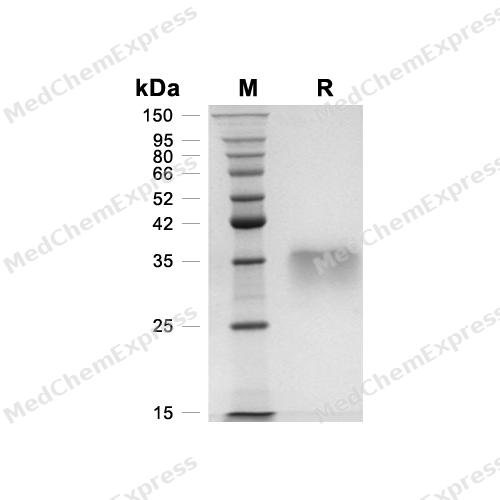
Purity - SDS-PAGE
-
Bioactivity - Cell-Based Assay
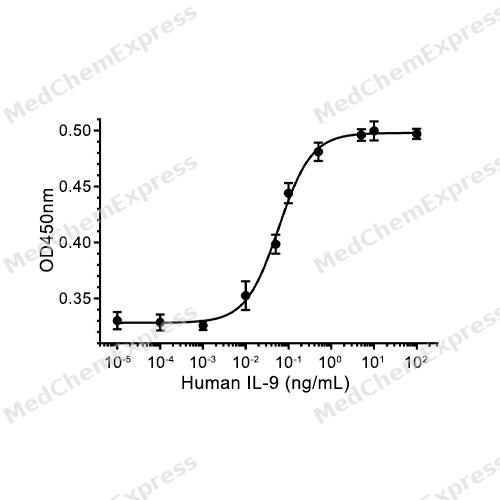
Bioactivity - Cell-Based Assay


Technical Parameters
-
Species Human
-
Source HEK293
-
Tag C-6*His
-
Accession
P15248 (Q19-I144)
-
Molecular Construction
-
N-term
-
IL-9 (Q19-I144)
Accession # P15248 -
6*His
-
C-term
-
-
Protein Length
Full Length of Mature Protein
-
Synonyms
IL9; Homolog Of Mouse T Cell And Mast Cell Growth Factor 40; Interleukin 9; P40 T-Cell And Mast Cell Growth Factor; IL-9; Interleukin-9; T-Cell Growth Factor P40; P40 Cytokine; HP40; Cytokine P40; P40
-
AA Sequence
QGCPTLAGILDINFLINKMQEDPASKCHCSANVTSCLCLGIPSDNCTRPCFSERLSQMTNTTMQTRYPLIFSRVKKSVEVLKNNKCPYFSCEQPCNQTTAGNALTFLKSLLEIFQKEKMRGMRGKI
-
Predicted Molecular Mass
15.2 kDa
-
Molecular Weight
Approximately 25-40 kDa, based on SDS-PAGE under reducing conditions, due to the glycosylation.
-
Glycosylation
Yes
-
Purity
≥ 95%, as determined by reducing SDS-PAGE.


Product Properties
Lyophilized powder
Lyophilized from a 0.22 μm filtered solution of 20 mM PB, 150 mM NaCl, pH 7.4.
<1 EU/μg, determined by LAL method.
It is not recommended to reconstitute to a concentration less than 100 μg/mL in ddH2O. For long term storage it is recommended to add a carrier protein (0.1% BSA, 5% HSA, 10% FBS or 5% Trehalose).
Stored at -20°C for 2 years from date of receipt. After reconstitution, it is stable at 4°C for 1 week or -20°C for longer (with carrier protein). It is recommended to freeze aliquots at -20°C or -80°C for extended storage.
Room temperature in continental US; may vary elsewhere.


Documentation
-
Data Sheet (236 KB)
-
SDS (251 KB)
- English - EN (251 KB)
- Français - FR (251 KB)
- Deutsch - DE (251 KB)
- Norwegian - NO (251 KB)
- Español - ES (251 KB)
- Swedish - SV (251 KB)
- Italian - IT (251 KB)
- Korean - KR (251 KB)
- Portuguese - PT (251 KB)
-
Handling Instructions (2659 KB)

Calculators
Concentration (start) × Volume (start) = Concentration (final) × Volume (final)


 Powered by Bioz

