
14 Results for "

Sarcina lutea ATCC 1001

" in MedChemExpress (MCE) Product Catalog:
Products (14)

14 Results for "Sarcina lutea ATCC 1001" in MCE Product Catalog:

Cat. No.: HY-N8305
CAS No.: 25954-44-3
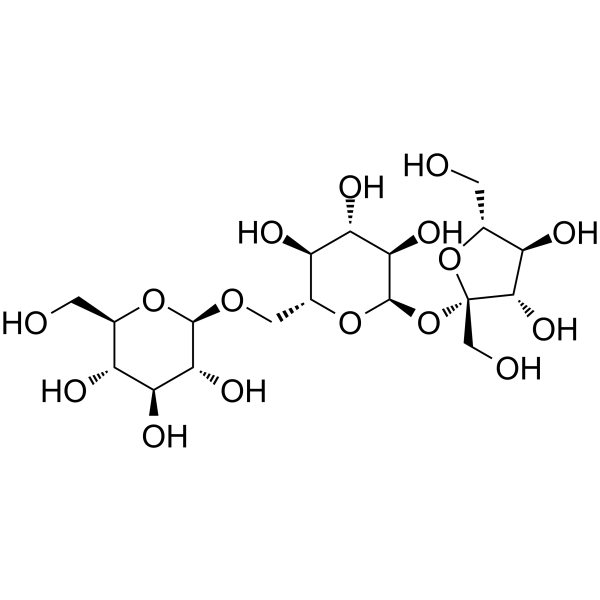
Gentianose is a predominant carbohydrate reserve found in the storage roots of perennial Gentiana lutea .
loading...
    loading...
Cat. No.: HY-128222
CAS No.: 21198-79-8
Purity:  ≥95.0%
Synonyms: Hydrazinecarboselenoamide
Target:  

Bacterial

Research Areas:  

Infection Cancer

Selenosemicarbazide (Hydrazinecarboselenoamide) exhibits antimicrobial activity, that inhibits B. subtilis, S. aureus, Klebsiella pneumoniae, Sarcina lutea and Mycobacterium tuberculosis. Selenosemicarbazide forms complex with metal ions, and exhibits antitumor efficacy against cancer cells
loading...
    loading...
Cat. No.: HY-W160679
CAS No.: 64700-15-8
Target:  

Bacterial Fungal

Research Areas:  

Infection

7-(Carboxymethoxy)-4-methylcoumarin (Compound VIIIa) is the antibacterial and antifungal agent that exhibits inhibitory activity against S. aureus, B. cereus, S. lutea, C. albicans, C. glabrata, and C. parapsilosis .
loading...
    loading...
Cat. No.: HY-N8401
CAS No.: 907583-51-1
Musellactone is a lactone that can be isolated from Musella lasiocarpa. Musellactone is an antibiotic, that exhibits antibacterial activity against Bacillus megaterium and Sarcina lutea .
loading...
    loading...
Cat. No.: HY-P5562
Target:  

Bacterial

Research Areas:  

Infection

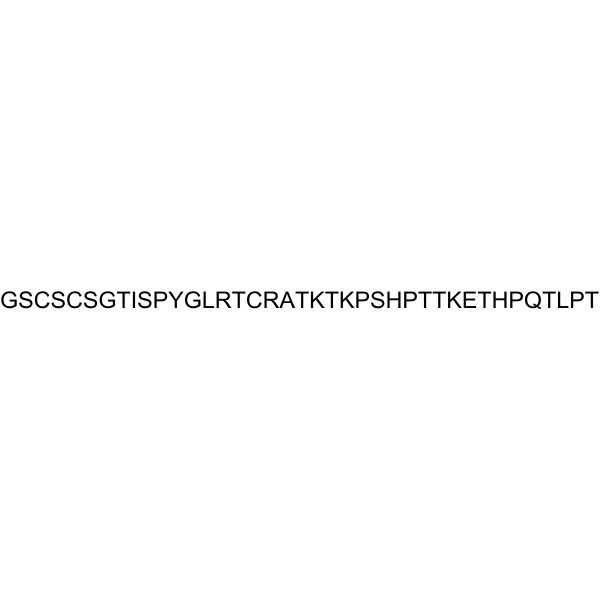
PP102 is an antimicrobial peptide is active against gram-positive B. subtilis (MIC: 25 uM), S. aureus (MIC: 13.3 uM), S. lutea (MIC: 63 uM), and B. pumilu (MIC: 23 uM) .
loading...
    loading...
Cat. No.: HY-P5563
Target:  

Bacterial

Research Areas:  

Infection

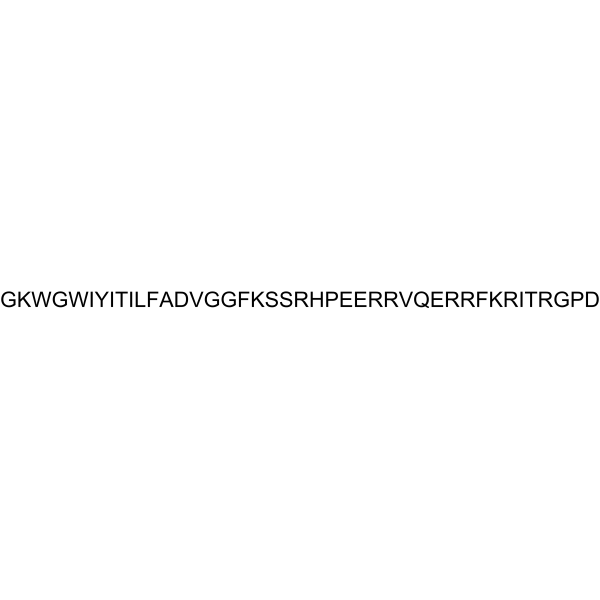
PP113 is an antimicrobial peptide is active against Gram-negative and Gram-positive bacteria, E.coli (MIC: 73.3 uM), B. subtilis (MIC: 23.3 uM), S. aureus (MIC: 13 uM), S. lutea (MIC: 16.7 uM), and B. pumilu (MIC: 23.3 uM) .
loading...
    loading...
Cat. No.: HY-P5560
CAS No.: 1099486-04-0
Target:  

Bacterial

Research Areas:  

Infection

PP13 is an antimicrobial peptide, and is active against Gram-negative and Gram-positive bacteria E.coli (MIC: 16.7 uM), B. subtilis (MIC: 13.3 uM), S. aureus (MIC: 23.3 uM), S. lutea (MIC: 8.0 uM), and B. pumilu (MIC: 9.0 uM) .
loading...
    loading...
Cat. No.: HY-165154
CAS No.: 35663-85-5
Synonyms: Desdanine; Pyracrimycin A
Cyclamidomycin (Desdanine) is an acrylamide antibiotic with antibacterial activity. Cyclamidomycin inhibits nucleoside diphosphate kinase and pyruvate kinase (in E. coli) and oxidative phosphorylation in rat liver mitochondria. Cyclamidomycin is active against S. aureus, M. flavus, S. lutea, B. subtilis, E. coli, S. flexneri, S. typhosa, P. vulgaris, and K. pneumoniae (MICs=3.12-25 mg/ml) .
loading...
    loading...
Cat. No.: HY-127020
CAS No.: 108605-51-2
Target:  

Bacterial

Research Areas:  

Infection

Deoxyenterocin is a bacterial metabolite originally isolated from Streptomyces that has diverse biological activities, including antibiotic, antiviral, and antioxidant properties. It inhibits the growth of S. lutea, S. aureus, K. pneumoniae, and V. percolans in vitro when used at a concentration of 500 μg/mL. Deoxyenterocin (50 μg/mL) inhibits the cytopathic effect of influenza A H1N1 virus by 60.6% in vitro. It also prevents hydrogen peroxide-induced decreases in glutathione (GSH) levels and in the mitochondrial membrane potential in mouse primary cortical neuronal cultures when used at a concentration of 1 μM.
loading...
    loading...
Cat. No.: HY-N19634
CAS No.: 19942-05-3
Betulatriterpene C is a dammarane triterpene found in the glandular trichome exudates of Ibicella lutea .
loading...
    loading...
Cat. No.: HY-N20675
CAS No.: 35536-70-0
Stachannin A is a 6-hydroxy-flavone glucoside that can be found in Paederota lutea .
loading...
    loading...
Cat. No.: HY-184800
CAS No.: 38115-21-8
Research Areas:  

Infection

Desacetyl cephapirin is the active metabolite of Cephapirin (HY-A0153). Desacetyl cephapirin retains bactericidal activity by disrupting bacterial cell wall synthesis, but exhibits reduced antimicrobial activity, longer in vivo residual time, and high tissue retention. Desacetyl cephapirin can be used in studies related to Gram-positive bacterial infections .
loading...
    loading...
Cat. No.: HY-122301
CAS No.: 11031-47-3
Sarcinaxanthin is a carotenoid present in various bacteria with antioxidant activity. Sarcinaxanthin scavenges singlet oxygen, thereby inhibiting oxidative degradation in the β-carotene/linoleic acid system. Sarcinaxanthin acts as a photoprotective agent against UVB radiation that induces erythema. Sarcinaxanthin can be applied in studies related to antioxidation and radiation resistance .
loading...
    loading...
Cat. No.: HY-182535
CAS No.: 33137-73-4
Target:  

Antibiotic Bacterial

Research Areas:  

Infection

Tuberactinomycin-O is a peptide antibiotic belonging to the tuberactinomycin family. Tuberactinomycin-O inhibits the growth of various bacteria, including Staphylococcus aureus, Escherichia coli, Pseudomonas aeruginosa and Mycobacterium ATCC 607. Tuberactinomycin-O exhibits acute toxicity in male mice when administered intravenously. Tuberactinomycin-O can be used in the research of tuberculosis .
loading...
    loading...
  • 1

