



1. Search Result
Search Result
Results for "

sialic acid residues

" in MedChemExpress (MCE) Product Catalog:

15

Inhibitors & Agonists

1

Fluorescent Dyes

4

Biochemical Assay Reagents

1

MCE Kits

Cat. No. Product Name Target Research Areas Chemical Structure
  • HY-P2988
    Neuraminidase, Microorganism
    1 Publications Verification

    Exo-α-sialidase

    Endogenous Metabolite Infection
    Neuraminidase, Microorganism (Exo-α-sialidase) is an exosialidase, is often used in biochemical studies. Neuraminidase cleaves α-ketosidic linkage between the sialic (N-acetylneuraminic) acid and an adjacent sugar residue. Neuraminidase, derived from mucosal pathogens, is a virulence factor that modifies the host's response to infection .
    Neuraminidase, Microorganism
  • HY-E70097

    Endogenous Metabolite Others
    Sialidase (α2-3-6-8-9) is a broadly specific sialidase that cuts linear and branched non-reducing terminal sialic acid residues from glycoproteins, glycopeptides, and oligosaccharides. Sialidase (α2-3-6-8-9) can be used for in vitro and in vivo polysaccharide analysis and characterization as well as complete glycoprotein remodeling .
    Sialidase (α2-3-6-8-9)
  • HY-NP0149

    SNA (Biotinylated)

    Biochemical Assay Reagents Others
    Sambucus Nigra Lectin (SNA) (Biotinylated) is a terminal sialic acid (SA) residue-binding lectin with biotinylation modification. Sambucus Nigra Lectin (Biotinylated) binds specifically to terminal sialic acid residues on captured IgG and its subclasses .
    Sambucus Nigra Lectin (Biotinylated)
  • HY-NP0147
    Wheat Germ Agglutinin (Fluorescein)
    1 Publications Verification

    WGA (Fluorescein)

    Fluorescent Dye Infection Neurological Disease
    Wheat Germ Agglutinin (WGA) Fluorescein is a classic fluorescent label that specifically binds to sugar residues such as N-acetylglucosamine, N-acetylneuraminic acid and sialic acid. Wheat Germ Agglutinin Fluorescein performs regionally differential fluorescent staining of the ocular surface epithelial glycocalyx to assess its integrity, and causes no damage to the eye at safe concentrations. Wheat Germ Agglutinin Fluorescein is also used for staining structures including red blood cells, cultured cells, bacteria and pine wood nematodes, and facilitates the isolation of wheat-associated plant-growth-promoting rhizobacterial strains. Wheat Germ Agglutinin Fluorescein can be applied to the detection of ocular glycocalyx integrity and the research of related diseases such as pine wilt disease .
    Wheat Germ Agglutinin (Fluorescein)
  • HY-P2988B

    Bacterial HIV Infection
    Neuraminidase, arthrobacter ureafaciens is a neuraminidase derived from Arthrobacter ureafaciens. Neuraminidase, arthrobacter ureafaciens catalyzes the removal of sialic acid residues from cell surfaces and viral glycoconjugates. Neuraminidase, arthrobacter ureafaciens enhances HIV-1-mediated syncytium formation and promotes the viral binding and entry steps in the HIV-1 replication cycle .
    Neuraminidase, arthrobacter ureafaciens
  • HY-D1991

    Fluorescent Dye Others
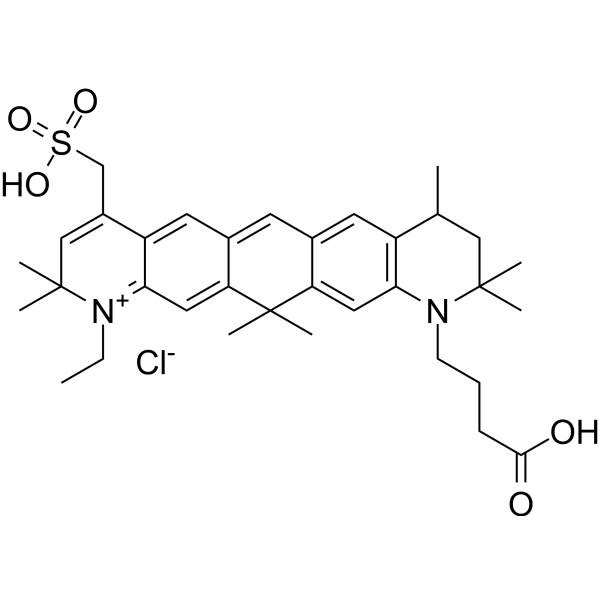
    ATTO 647 is a carborhodamine fluorophore and imaging tracer with photostable properties. ATTO 647 serves as a fluorescent probe to investigate cell membrane structure and diffusion characteristics. When conjugated with wheat germ agglutinin, ATTO 647 specifically binds to N-acetyl-β-D-glucosamine and sialic acid residues on membrane glycoproteins, enabling single-molecule tracing of glycoprotein diffusion. ATTO 647 exhibits highly stable fluorescence properties with significantly reduced blinking in mounting media such as ROXS (AA/MV) and ROXS (TX/TQ), whereas its brightness properties vary in Ibidi-MM and Vectashield. ATTO 647 can also be used to label histone H2B-GFP in fixed cells for confocal microscopy photobleaching experiments .
    ATTO 647
  • HY-W747597

    Disialoganglioside GD1b; Ganglioside C1; Ganglioside G2

    Endogenous Metabolite Cancer
    Ganglioside GD1b Disodium Salt (Bovine Brain) (Disialoganglioside GD1b; Ganglioside C1) is an acidic glycosphingolipid containing two sialic acid residues linked to an internal galactose unit. Ganglioside GD1b Disodium Salt tightly packs with cholesterol to form lipid microdomains that modulate intracellular and intercellular signaling events. Concentrations of Ganglioside GD1b Disodium Salt (Bovine Brain) in the human brain increase with age and are positively correlated with pilocytic astrocytoma tumor grade. Ganglioside GD1b Disodium Salt has been detected in various other gliomas, including primitive neuroectodermal tumors, glioblastomas, and anaplastic astrocytomas.
    Ganglioside GD1b Disodium Salt (Bovine Brain)
  • HY-P2988A

    Influenza Virus Metabolic Disease
    α2-3,6 Neuraminidase, Bifidobacterium infantis is a highly specific exoglycosidase that catalyzes the hydrolysis of non-reducing terminal α2-3 and α2-6 unbranched sialic acid residues from complex carbohydrates and glycoproteins. α2-3,6 Neuraminidase does not exhibit activity on α2-8 or branched sialic acids .
    α2-3,6 Neuraminidase, Bifidobacterium infantis
  • HY-E70132

    Endo D

    Glycosidase Metabolic Disease
    Endo-β-N-acetylglucosaminidase D (Endo D), isolated from Streptococcus pneumoniae. Endo-β-N-acetylglucosaminidase D hydrolyzes Fc N-glycan of intact IgG antibodies after sequential removal of the sialic acid, galactose, and internal GlcNAc residues in the N-glycan. Endo-β-N-acetylglucosaminidase D possesses transglycosylation activity with sugar oxazoline as the donor substrate .
    Endo-β-N-acetylglucosaminidase D
  • HY-E70039

    Others Others
    alpha-2-3,6,8-Sialidosidase (SpNanA) catalyses hydrolysis of alpha-(2->3)-, alpha-(2->6)-, alpha-(2->8)- glycosidic linkages of terminal sialic acid residues in oligosaccharides, glycoproteins, glycolipids, colominic acid and synthetic substrates .
    alpha-2-3,6,8-Sialidosidase (SpNanA)
  • HY-E70287

    ST6GALNAC5

    Glycosyltransferase Metabolic Disease
    ST6 Sialyltransferase 5 (EC:2.4.3.3, ST6GALNAC5, SIAT7E, ST6 N-acetylgalactosaminide alpha-2,6-sialyltransferase 5) transfers a sialic acid to N-acetylgalactosamine (GalNAc) residues. ST6 Sialyltransferase 5 is a bio-marker in cervical screening samples .
    ST6 Sialyltransferase 5
  • HY-E70150

    EC:2.4.3.3; Alpha-N-Acetylgalactosaminide alpha-2,6-sialyltransferase 1

    Sialyltransferase Cancer
    ST6 Sialyltransferase 1 (EC:2.4.3.3, ST6GALNAC1, SIAT7A, Alpha-N-acetylgalactosaminide alpha-2,6-sialyltransferase 1)? transfers a sialic acid, N-acetylneuraminic acid (NeuAc), in an alpha-2,6 linkage to O-linked GalNAc residues. ST6 Sialyltransferase 1 plays an important role in cancer .
    ST6 Sialyltransferase 1
  • HY-W127461

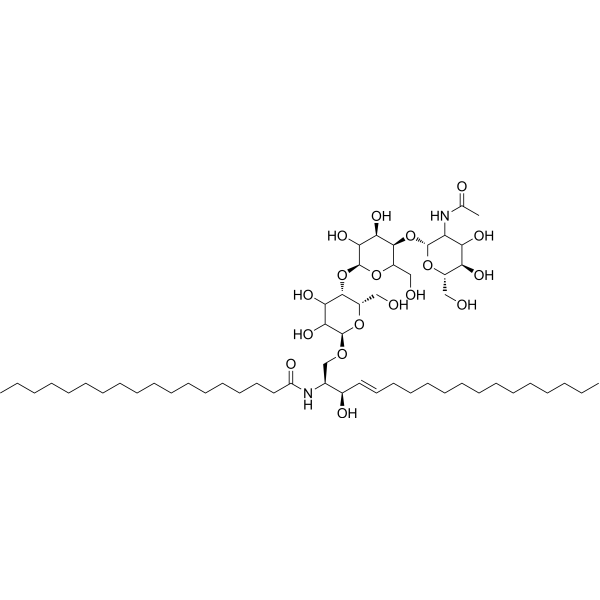
    Gangliotriosylceramide

    Biochemical Assay Reagents Others
    Ganglioside GM2 asialo (asialo-GM2) is a glycosphingolipid containing three monosaccharide residues and one fatty acid of variable chain length, but lacks the sialic acid residue present on ganglioside M2. Asialo-GM2 is found at low or undetectable levels in normal human brains, but it accumulates in the brains of patients with Tay-Sachs disease and Sandhoff disease, which are expressed as lysosomal β- A neurodegenerative disorder characterized by hexosaminidase A and B deficiency. It also binds to various bacteria, including Pseudomonas isolated from cystic fibrosis patients. The Asialo-GM2 mixture contains ganglioside GM2 asialo molecular species with fatty acyl chains of variable length.
    Ganglioside GM2, Asialo
  • HY-171936

    GM1 (d18:1/C18:0) ammonium; C18 Ganglioside GM1 (d18:1/18:0) ammonium

    Endogenous Metabolite Neurological Disease
    Ganglioside GM1 (ammonium) is a monosialylated ganglioside and the prototypic ganglioside for those containing one sialic acid residue. Ganglioside GM1 (ammonium) is one of the most abundant gangliosides in the brain which provides neuroprotection. Ganglioside GM1 (ammonium) exhibits anti-inflammatory property. Ganglioside GM1 (ammonium) has a well-balanced amphiphilic behavior. Ganglioside GM1 (ammonium) can reduce the fluidity of the plasma membrane that implies a retention and enrichment of the ganglioside in specific membrane domains that are called lipid rafts. Ganglioside GM1 (ammonium) can modify the process of differentiation, amplifies responses to neurotrophic factors, protects against excitatory amino acid-related neurotoxicity. Ganglioside GM1 (ammonium) can alleviate acute nerve cell damage through blocking cytotoxicity and potentiating neurotophic factors. Ganglioside GM1 (ammonium) can be studied in neurodegenerative diseases such as Alzheimer’s disease .
    Ganglioside GM1 ammonium
  • HY-P2988C

    Endogenous Metabolite Metabolic Disease
    α2-3,6,8,9 Neuraminidase, Arthrobacter ureafaciens (EC 3.2.1.18) catalyzes the hydrolysis of all linear and branched non-reducing terminal sialic acid residues from glycoproteins and oligosaccharides.
    α2-3,6,8,9 Neuraminidase, Arthrobacter ureafaciens

Inquiry Online

Your information is safe with us. * Required Fields.

Salutation


Country or Region *

Applicant Name *


Organization Name *

Department *


Email Address *


Product Name *

Cat. No.


Requested quantity *

Phone Number *


Remarks

Inquiry Online

Inquiry Information

Product Name:
Cat. No.:
Quantity:
MCE Japan Authorized Agent:

