13 Results for "

viral genome replication

" in MedChemExpress (MCE) Product Catalog:
Products (13)

13 Results for "viral genome replication" in MCE Product Catalog:

1
1 Cited Publications
Cat. No.: HY-N0620
CAS No.: 102841-43-0
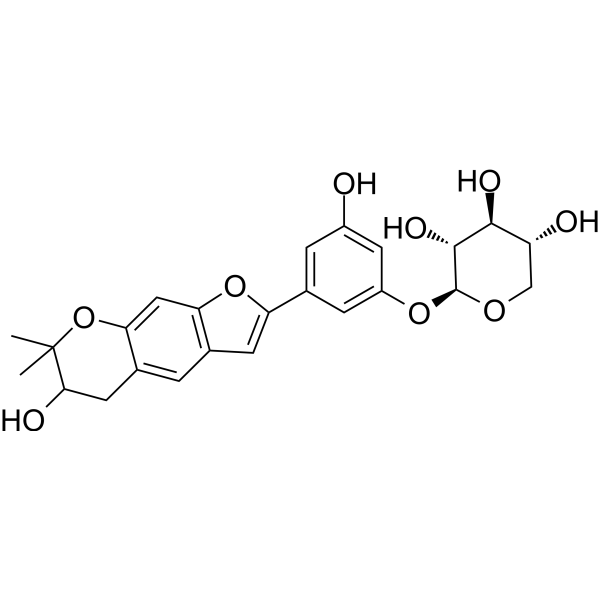
Mulberroside C is one of the main bioactive components in white mulberry (Morus alba L.). Mulberroside C exhibits antiplatelet, antiviral and neutrophil-regulating activities, and binds to EV-A71 VP1 with a Kd value of 1.289 nM. Mulberroside C reduces the phosphorylation level of ERK, promotes the phosphorylation of IP3RI at the Ser 1756 site, and decreases calcium influx and calcium mobilization. Mulberroside C inhibits the expression of P-selectin (P-selectin). Mulberroside C upregulates the cyclic nucleotide signaling pathway in human platelets. Mulberroside C binds to IL-23R, upregulates the expression of G-CSF, GM-CSF and RASGRP1, and activates the RAS/ERK signaling pathway. Mulberroside C promotes neutrophil maturation, accelerates the recovery of leukopenia, and enhances the antibacterial activity of neutrophils. Mulberroside C inhibits the replication of hepatitis C virus in replicon cells. Mulberroside C prevents the uncoating and genome release of EV-A71, and inhibits the synthesis of viral proteins and RNA. Mulberroside C can be used in studies related to thrombosis-mediated cardiovascular diseases, chemotherapy- and radiotherapy-induced leukopenia, hepatitis C virus infection, and hand, foot and mouth disease .
loading...
    loading...
Cat. No.: HY-B1537
CAS No.: 2169-64-4
Synonyms: 2',3',5'-Tri-O-acetyl-6-azauridine
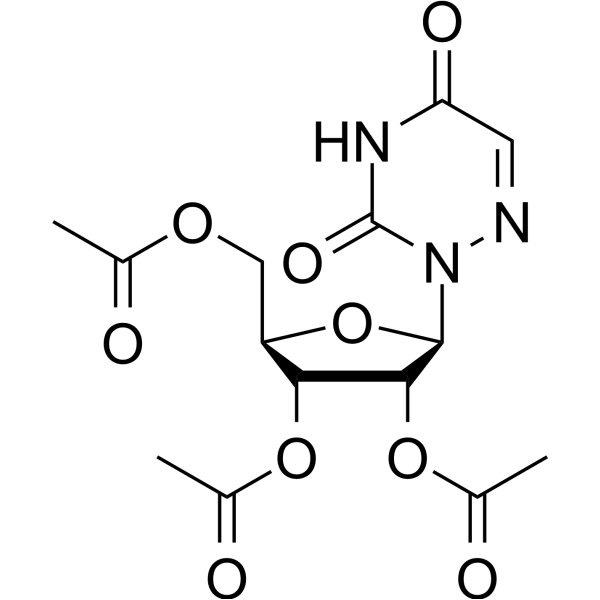
Azaribine (2',3',5'-Tri-O-acetyl-6-azauridine) is a potent orotidine monophosphate decarboxylase (OMPD) inhibitor. Azaribine is an antiviral inhibitor of several RNA viruses and inhibits viral genome replication and gene transcription. Azaribine shows broad-spectrum antiviral activity (EC50=3.80 nM-1.73 μM against influenza A and B viruses; EC50=1.62 μM against ZIKV Paraiba). Azaribine, a triacetate salt of Azauridine, has the potential for psoriasis research .
loading...
    loading...
Cat. No.: HY-137697D
Purity:  ≥98.0%
ddCTP trilithium solution (100 mM) is a chain-terminating dideoxynucleotide. ddCTP trilithium is a type of chain-terminating deoxynucleotide. ddCTP trilithium can be incorporated into the extension primer chain that lacks the 3'-hydroxyl group, thereby terminating primer extension, viral genome replication, and DNA synthesis. ddCTP trilithium can distinguish almost identical RNA through distinguishable extension products in primer extension inhibition experiments. ddCTP trilithium is the active metabolite of Zalcitabine (HY-17392), which can competitively inhibit HIV reverse transcriptase, terminate the synthesis of viral DNA chains, and thereby inhibit HIV replication .
loading...
    loading...
Cat. No.: HY-149648
CAS No.: 3118087-68-3
Purity:  99.84%
Target:  

RSV DNA/RNA Synthesis

Research Areas:  

Infection

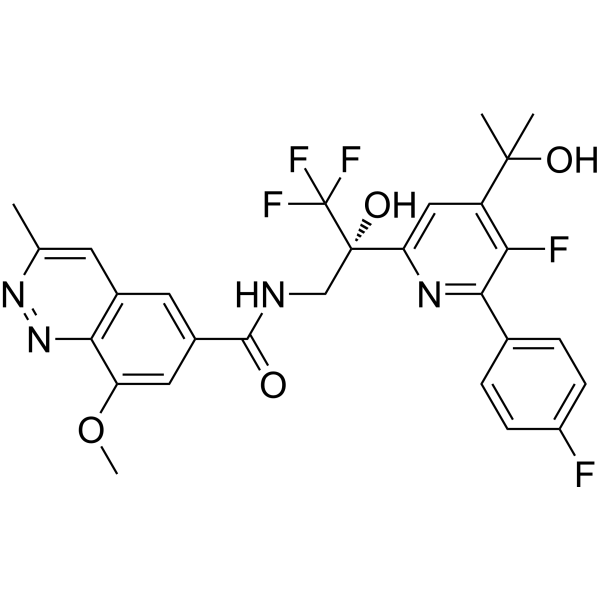
JNJ-8003 is a potent and orally active non-nucleoside RSV polymerase inhibitor with an IC50 of 0.29 nM. JNJ-8003 targets the L protein polymerase complex of RSV (IC50 = 0.67 nM), and blocks the transcription and replication of the viral genome by inhibiting the activity of RNA-dependent RNA polymerase (RdRp). JNJ-8003 displays subnanomolar activity in vitro as well as prominent efficacy in mice and a neonatal lamb models. JNJ-8003 can be used for the study of respiratory syncytial virus (RSV) .
loading...
    loading...
Cat. No.: HY-137697
CAS No.: 66004-77-1
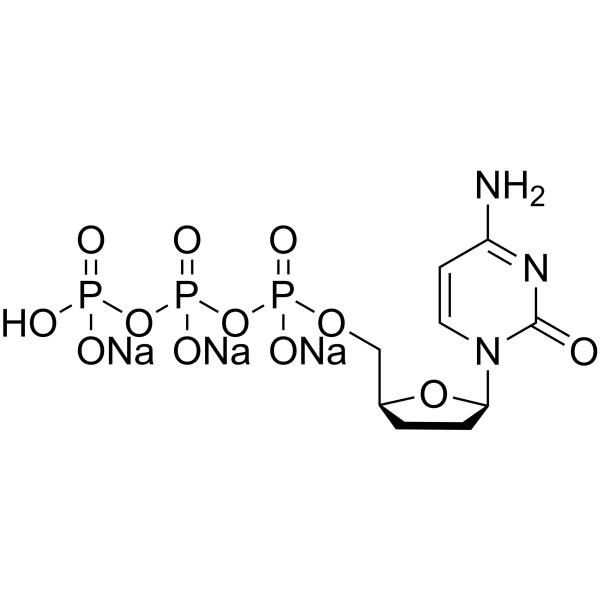
ddCTP is a type of chain-terminating deoxynucleotide. ddCTP can be incorporated into the extension primer chain that lacks the 3'-hydroxyl group, thereby terminating primer extension, viral genome replication, and DNA synthesis. ddCTP can distinguish almost identical RNA through distinguishable extension products in primer extension inhibition experiments. ddCTP is the active metabolite of Zalcitabine (HY-17392), which can competitively inhibit HIV reverse transcriptase, terminate the synthesis of viral DNA chains, and thereby inhibit HIV replication .
loading...
    loading...
Cat. No.: HY-137697B
CAS No.: 93939-77-6
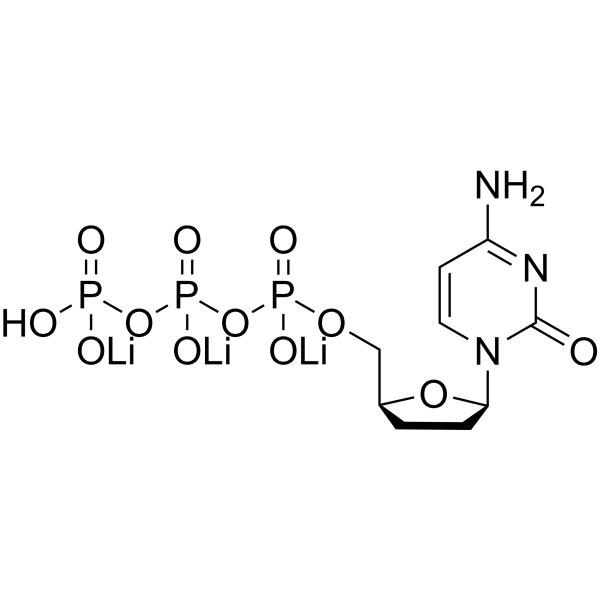
ddCTP trilithium is a type of chain-terminating deoxynucleotide. ddCTP trilithium can be incorporated into the extension primer chain that lacks the 3'-hydroxyl group, thereby terminating primer extension, viral genome replication, and DNA synthesis. ddCTP trilithium can distinguish almost identical RNA through distinguishable extension products in primer extension inhibition experiments. ddCTP trilithium is the active metabolite of Zalcitabine (HY-17392), which can competitively inhibit HIV reverse transcriptase, terminate the synthesis of viral DNA chains, and thereby inhibit HIV replication .
loading...
    loading...
Cat. No.: HY-174252
CAS No.: 3016396-78-1
Target:  

DNA/RNA Synthesis HSV

Research Areas:  

Infection

HSV-1/HSV-2-IN-3 inhibits the herpes-simplex-virus (HSV) helicase-primase complex, blocking the coordinated DNA-unwinding and primer-synthesis steps required for viral genome replication. HSV-1/HSV-2-IN-3 exhibits an EC50 of 7.0 nM against HSV-2 in a gD-immunofluorescence cell assay containing 2 % FBS and 57.5 nM when 10 % human serum is present. HSV-1/HSV-2-IN-3 achieves an EC50 of 1.1 nM in a qPCR replication assay. HSV-1/HSV-2-IN-3 shows strong selectivity over human carbonic-anhydrase off-targets (IC50 ≈ 2.9 µM for hCA II and > 35 µM for hCA I). HSV-1/HSV-2-IN-3 can be studied in anti-HSV research .
loading...
    loading...
Cat. No.: HY-161945
Target:  

HIV HIV Integrase

Research Areas:  

Infection

IN-RNA-IN-2 (compound 1a) is an inhibitor (IC50=70 nM) of the interaction between HIV-1 integrase and the viral RNA genome. IN-RNA-IN-2 exerts its anti-HIV activity by inhibiting the viral replication process .
loading...
    loading...
Cat. No.: HY-173121
Target:  

HBV

Research Areas:  

Infection

KR019 is a potent HBV capsid assembly modulator, exhibits potent antiviral activity in HBV-replicating cells. KR019 binds to the hydrophobic pocket at the core protein dimer-dimer interface, misdirecting capsid assembly into genome-free capsids and thereby inhibiting viral replication .
loading...
    loading...
Cat. No.: HY-P11137
CAS No.: 878495-58-0
Target:  

HSV

Research Areas:  

Cancer

LANA is a KSHV latency-associated nuclear antigen. The core function of LANA is to act as an "anchor" for the viral genome, attaching it to the chromatin of the host cell. LANA ensures that the episomal DNA of KSHV replicates together with the host chromosome and is evenly distributed among the daughter cells, thereby maintaining the latent infection of the virus in the cell population. LANA can regulate the transcription of viral and host cell genes, and regulate certain host cell genes to promote cell survival. LANA can be used to study the viral DNA tethering structure .
loading...
    loading...
Cat. No.: HY-137697A
ddCTP tetrasodium is a type of chain-terminating deoxynucleotide. ddCTP tetrasodium can be incorporated into the extension primer chain that lacks the 3'-hydroxyl group, thereby terminating primer extension, viral genome replication, and DNA synthesis. ddCTP tetrasodium can distinguish almost identical RNA through distinguishable extension products in primer extension inhibition experiments. ddCTP tetrasodium is the active metabolite of Zalcitabine (HY-17392), which can competitively inhibit HIV reverse transcriptase, terminate the synthesis of viral DNA chains, and thereby inhibit HIV replication .
loading...
    loading...
Cat. No.: HY-L027
1,218 compounds

Viruses are much simpler organisms than bacteria, and they are made from protein substances and nucleic acid. Despite the fact that the exact mechanism of infection is extremely specific to each type of virus, the general scheme of infection can be represented in the following manner: A virus is absorbed at the surface of a host cell and then permeates through the membrane, where it releases nucleic acid from its protein protection. Then the viral nucleic acid begins to replicate, and transcription of the viral genome takes place either in the cytoplasm, or in the nucleus of the host cell. As a result of these events, a large amount of viral nucleic acid and protein are made to make new generations of virions. Therefore, one mechanism of action of antiviral drugs is to interfere with the ability of a virus to get into a target cell. A second mechanism of action is to target the processes that synthesize virus components after a virus invades a cell, such as nucleotide or nucleoside analogs.

MCE designs a unique collection of 1,218 anti-virus compounds that target several viruses, including SARS-CoV, HBV, HCV, HIV, HSV and Influenza Virus. It’s an effective tool for anti-virus drug discovery.

Cat. No.: HY-180269
Research Areas:  

Infection

Anti-Influenza agent 10 (Compound 41) is an influenza A virus RNA-dependent RNA polymerase (RdRp) inhibitor. Anti-Influenza agent 10 exhibits potent antiviral activity against A/PR/8/34(H1N1) with an IC50 of 0.29μM and a KD of 4.11 μM. Anti-Influenza agent 10 can inhibit the assembly of the viral RdRp complex by disrupting the protein interaction between PA and PB1 subunits, thereby blocking the transcription and replication of the viral genome. Anti-Influenza agent 10 shows significant broad-spectrum effects on multiple influenza virus strains, such as H3N2, H3N8 and H9N2 with IC50 values of 3.96, 1.91 and 1.45 μM. Anti-Influenza agent 10 can be used for the research of influenza A Virus Infection .
loading...
    loading...
  • 1

