Delivery of temperature sensitive items including proteins and kits will be paused on 6/19 for the Juneteenth holiday. For urgent orders please contact customer service.
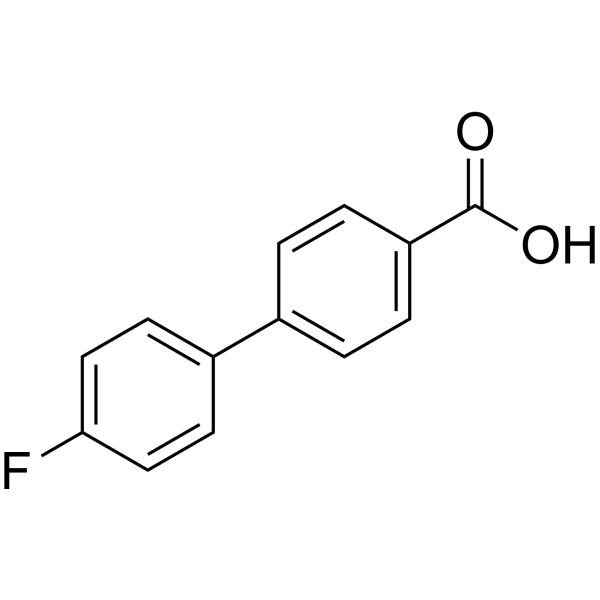
4-(4-Fluorophenyl)benzoic acid (Compoud 6) can bind to Bcl-2 with a KD value of 400 μM. 4-(4-Fluorophenyl)benzoic acid can be used to develope Bcl-2 selective anti-cancer agent .
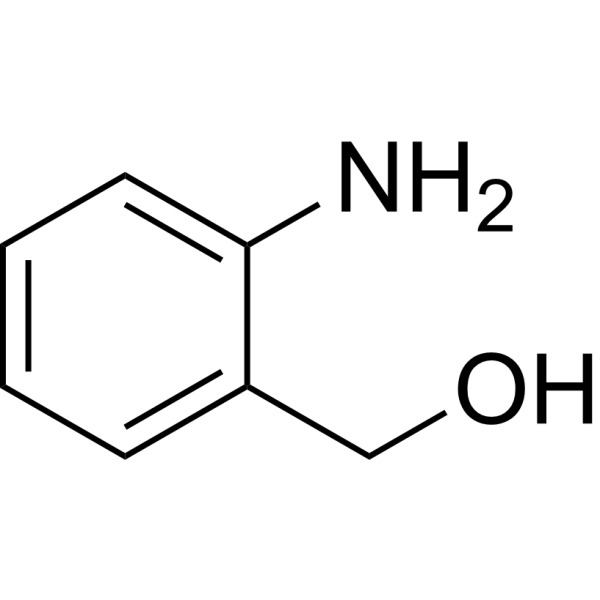
(2-Aminophenyl)methanol (2-Hydroxymethylaniline) is a molecular chaperone to rescue P123S mutant pendrin. (2-Aminophenyl)methanol has the advantages of low dose, long-term effect and low toxicity. (2-Aminophenyl)methanol can be used for the study of Pendred syndrome (a syndromic deafness) .
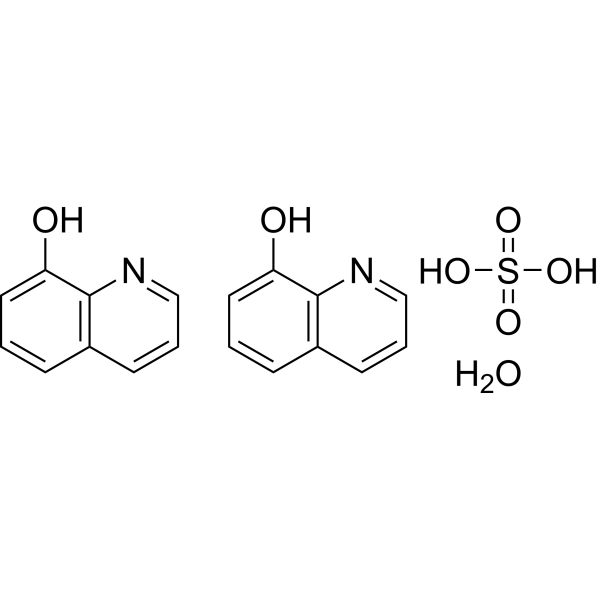
Quinolin-8-ol sulfate hydrate is an organic compound commonly used in dyes and as a raw material for chemical analysis. It can cooperate with metal ions to form dyes, and is widely used in the fields of dyes, printing and textile manufacturing. In addition, the compound also has good toxicity and biocompatibility, and is also used in some medical fields.
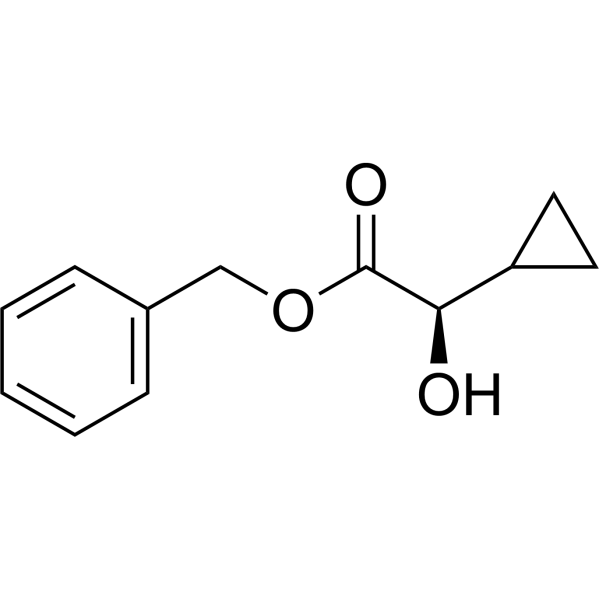
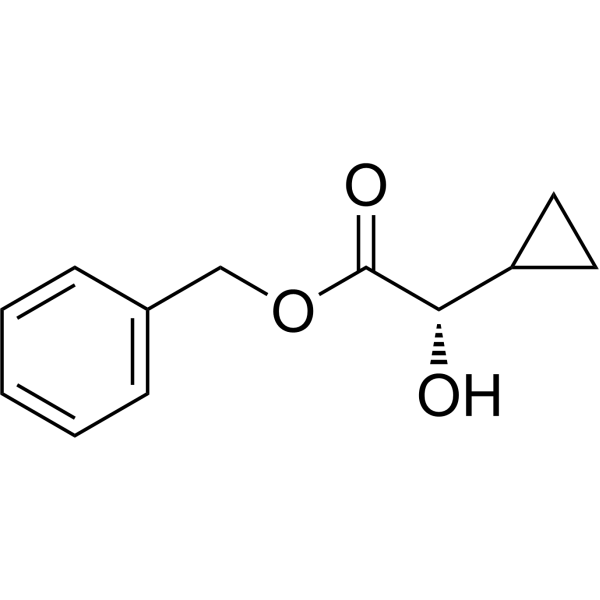
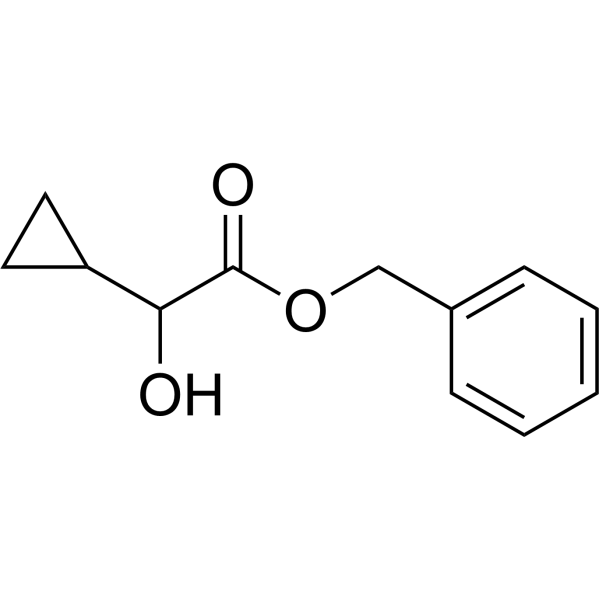
(S)-Benzyl 2-cyclopropyl-2-hydroxyacetate is an intermediate reactant in the synthesis of Camptothecin (HY-16560). Camptothecin is an inhibitor of the DNA topoisomerase Topo I, withIC50=679 nM .
Sulfadimethoxine (Sulphadimethoxine) 1000 µg/mL in methanol is an orally active sulfonamide antibiotic. Sulfadimethoxine 1000 µg/mL in methanol reduces Eimeria-related mortality, weight loss, and lesions. Sulfadimethoxine 1000 µg/mL in methanol can be used for the research of avian coccidiosis .
Sarafloxacin hydrochloride 100 μg/mL in methanol is an antibiotic with activity to inhibit bacterial growth. Sarafloxacin hydrochloride 100 μg/mL in methanol is widely used in veterinary medicine to inhibit bacterial infections. The mechanism of action of Sarafloxacin hydrochloride 100 μg/mL in methanol is mainly achieved by inhibiting the activity of bacterial DNA gyrase. Sarafloxacin hydrochloride 100 μg/mL in methanol is also used in animal feed to improve feed conversion and promote growth.
Benzo[b]thiophen-2-yl(5-bromo-2-fluorophenyl)methanol (α-(5-Bromo-2-fluorophenyl)benzo[b]thiophene-2-methanol) is a drug intermediate for synthesis of various active compounds.
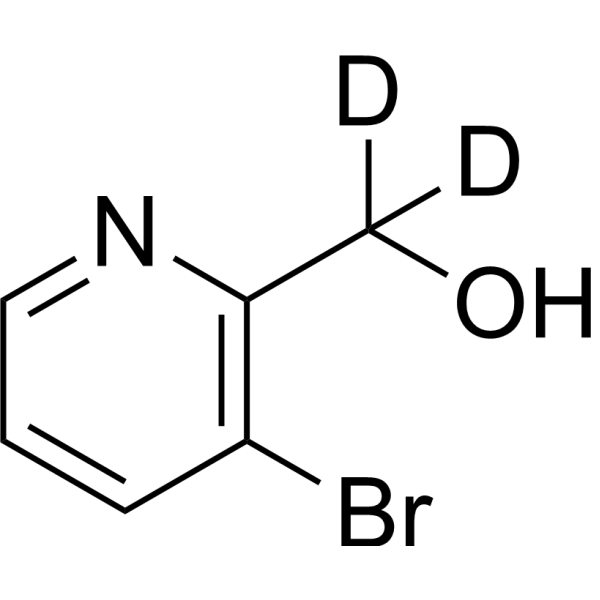
(3-Bromopyridin-2-yl)methanol (3-Bromopyridine-2-methanol) is a kind of biological materials or organic compounds that are widely used in life science research.
3-(bromomethyl)-2-cyclopropyl-4-(4-fluorophenyl)quinoline (Pitavastatin Impurity) (Standard) is the analytical standard of 3-(bromomethyl)-2-cyclopropyl-4-(4-fluorophenyl)quinoline (Pitavastatin Impurity). This product is intended for research and analytical applications.
((2-Cyclopropyl-4-(4-fluorophenyl)quinolin-3-yl)methyl)triphenylphosphonium bromide (Standard) is the analytical standard of ((2-Cyclopropyl-4-(4-fluorophenyl)quinolin-3-yl)methyl)triphenylphosphonium bromide. This product is intended for research and analytical applications.
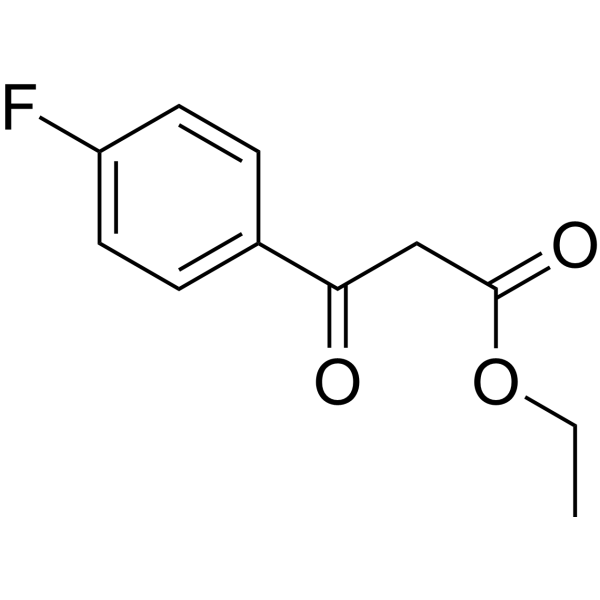
Ethyl 3-(4-fluorophenyl)-3-oxopropanoate is a biochemical reagent that can be used as a biological material or organic compound for life science related research.
3-(2-Chloro-6-fluorophenyl)-5-methylisoxazole-4-carboxylic acid (Standard) is the analytical standard of 3-(2-Chloro-6-fluorophenyl)-5-methylisoxazole-4-carboxylic acid. This product is intended for research and analytical applications.
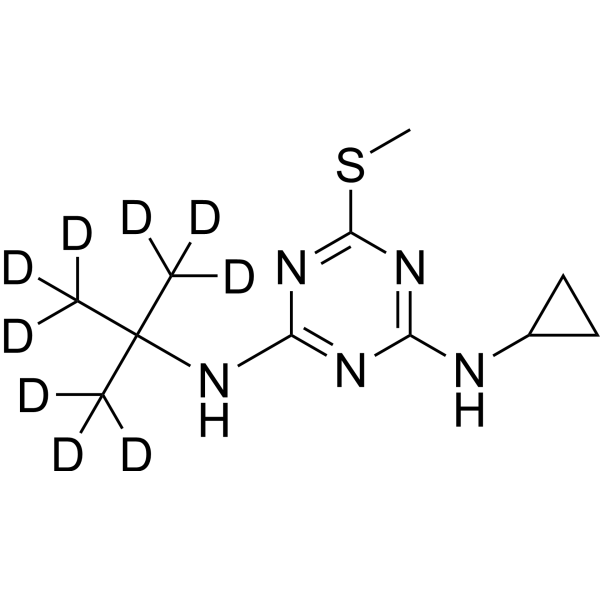
N2-(tert-Butyl)-N4-cyclopropyl-6-(methylthio)-1,3,5-triazine-2,4-diamine-d9 is the deuterium labeled N2-(tert-Butyl)-N4-cyclopropyl-6-(methylthio)-1,3,5-triazine-2,4-diamine .
Sulfadiazine 100 µg/mL in methanol is an orally active sulfonamide antibiotic. Sulfadiazine 100 µg/mL in methanol competitively inhibits p-aminobenzoic acid in the folic-acid-metabolism cycle, inhibiting multiplication of most Gram-positive and many Gram-negative bacteria. Sulfadiazine 100 µg/mL in methanol persists in soil long-term, and exerts selective pressure for sulfonamide-resistant microbial populations. Sulfadiazine 100 µg/mL in methanol targets Toxoplasma gondiiDHPS enzyme. Sulfadiazine 100 µg/mL in methanol can be used for the research of congenital toxoplasmosis and bacterial infection .
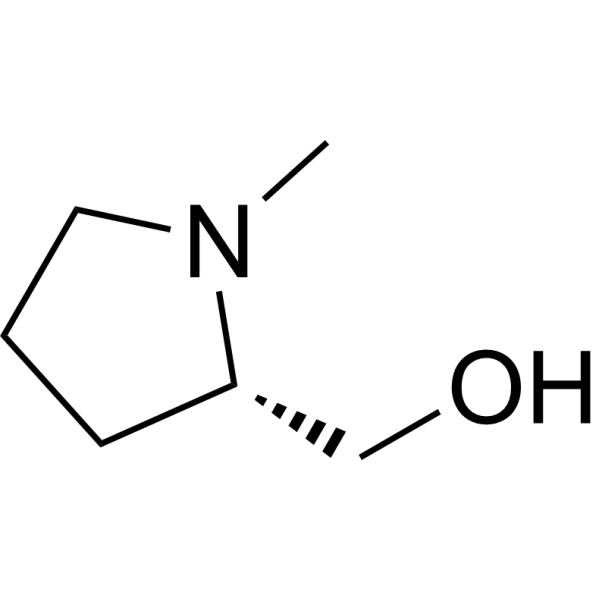
(S)-N-Methylpyrrolidine-2-methanol is a biochemical reagent that can be used as a biological material or organic compound for life science related research.
t-Butyl (3R,5S)-7-[2-cyclopropyl-4-(4-fluorophenyl)quinolin-3-yl]-3,5-isopropylidenedioxy-6-heptenoate (Standard) is the analytical standard of t-Butyl (3R,5S)-7-[2-cyclopropyl-4-(4-fluorophenyl)quinolin-3-yl]-3,5-isopropylidenedioxy-6-heptenoate. This product is intended for research and analytical applications.
Benzyl 2-cyclopropyl-2-hydroxyacetate is an intermediate in the synthesis of ADC linker.The linker composed of Benzyl 2-cyclopropyl-2-hydroxyacetate can be coupled to Exatecan (HY-13631) and combined with antibodies (such as antibody hu2F7) .
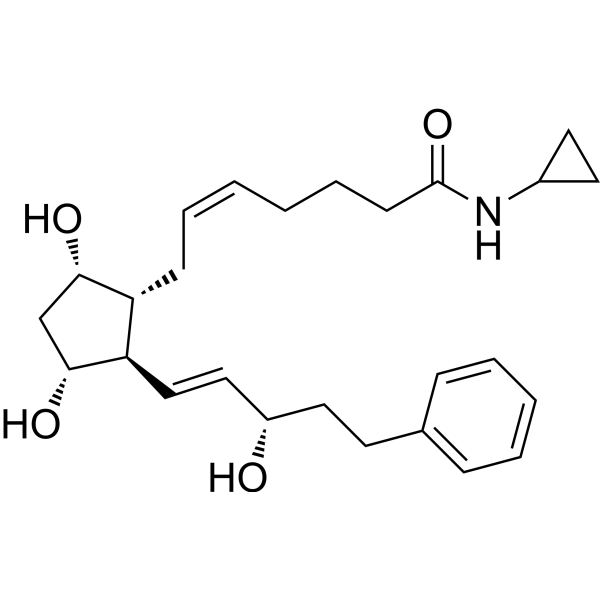
N-Cyclopropyl methyl bimatoprost (17-Phenyl trinor prostaglandin F2α cyclopropyl methyl amide) is an analog of Bimatoprost (HY-12956). N-Cyclopropyl methyl bimatoprost is an agonist for Prostaglandin F2α Receptor (FP receptor). N-Cyclopropyl methyl bimatoprost is potent to reduce the intraocular pressure and attenuate the glaucoma .
4-Dehydroxy-3-dehydro-pitavastatin lactone-d5 is the deuterium labeled (S,E)-6-(2-(2-cyclopropyl-4-(4-fluorophenyl)quinolin-3-yl)vinyl)-5,6-dihydro-2H-pyran-2-one (Pitavastatin Impurity) (HY-Z3610).
Lipid A (14:0(5)-cyclopropyl17:0(1)) diammonium, a lipid, is an adjuvant. Lipid A (14:0(5)-cyclopropyl17:0(1)) diammonium has immunostimulatory properties.
(1-(((tert-Butyldiphenylsilyl)oxy)methyl)cyclopropyl)methanol-d4 is the deuterium labeled (1-(((tert-Butyldiphenylsilyl)oxy)methyl)cyclopropyl)methanol.
5-(2-Fluorophenyl)-1H-pyrrole-3-carbaldehyde (Standard) is the analytical standard of 5-(2-Fluorophenyl)-1H-pyrrole-3-carbaldehyde. This product is intended for research and analytical applications.
4-[[(4-Fluorophenyl)imino]methyl]phenol-d4(4-{(E)-[(4-Fluorophenyl)imino]methyl}phenol-d4) is the deuterium labeled 4-[[(4-Fluorophenyl)imino]methyl]phenol (HY-W014178).
4-[[(4-Fluorophenyl)imino]methyl]phenol- 13C6 (4-{(E)-[(4-Fluorophenyl)imino]methyl}phenol- 13C6) is the 13C-labeled 4-[[(4-Fluorophenyl)imino]methyl]phenol (HY-W014178).
Cyclopropyl(piperazin-1-yl)methanone (Standard) is the analytical standard of Cyclopropyl(piperazin-1-yl)methanone. This product is intended for research and analytical applications.
N6-Cyclopropyl-9H-purine-2,6-diamine (Standard) is the analytical standard of N6-Cyclopropyl-9H-purine-2,6-diamine. This product is intended for research and analytical applications.
Thalidomide-5-methanol is an E3 ubiquitin ligase cereblon (CRBN) ligand used to recruit the cereblon protein. Thalidomide-5-methanol can be linked to a target protein ligand via a linker to form a PROTAC.
(2,3-Dimethoxyphenyl)methanol (Standard) is the analytical standard of (2,3-Dimethoxyphenyl)methanol. This product is intended for research and analytical applications.
2-(3-Chloropropyl)-2-(4-fluorophenyl)-1,3-dioxolane (2-(3-Chloropropyl)-2-(p-fluorophenyl)-1,3-dioxolane) is a kind of biological materials or organic compounds that are widely used in life science research.
Ethyl 1-cyclopropyl-6,7-difluoro-8-methoxy-4-oxo-1,4-dihydroquinoline-3-carboxylate (Standard) is the analytical standard of Ethyl 1-cyclopropyl-6,7-difluoro-8-methoxy-4-oxo-1,4-dihydroquinoline-3-carboxylate. This product is intended for research and analytical applications.
2-((4-Chlorophenyl)thio)-1,1-bis(4-fluorophenyl)ethanol (2-[(4-Chlorophenyl)sulfanyl]-1,1-bis(4-fluorophenyl)-1-ethanol) is a metal-organic framework (MOF).
2-((4-Chlorophenyl)sulfonyl)-1,1-bis(4-fluorophenyl)ethanol (2-[(4-Chlorophenyl)sulfonyl]-1,1-bis(4-fluorophenyl)-1-ethanol) is a metal-organic framework (MOF).
(2,3,4-Trimethoxyphenyl)methanol (Standard) is the analytical standard of (2,3,4-Trimethoxyphenyl)methanol. This product is intended for research and analytical applications.
(R)-3-(4-Bromo-3-fluorophenyl)-5-(hydroxymethyl)oxazolidin-2-one (Standard) is the analytical standard of (R)-3-(4-Bromo-3-fluorophenyl)-5-(hydroxymethyl)oxazolidin-2-one (HY-41142). This product is intended for research and analytical applications.
(3S,4R)-4-(4-Fluorophenyl)-3-hydroxymethyl-1-methylpiperidine (Standard) is the analytical standard of (3S,4R)-4-(4-Fluorophenyl)-3-hydroxymethyl-1-methylpiperidine (HY-W003303). This product is intended for research and analytical applications.
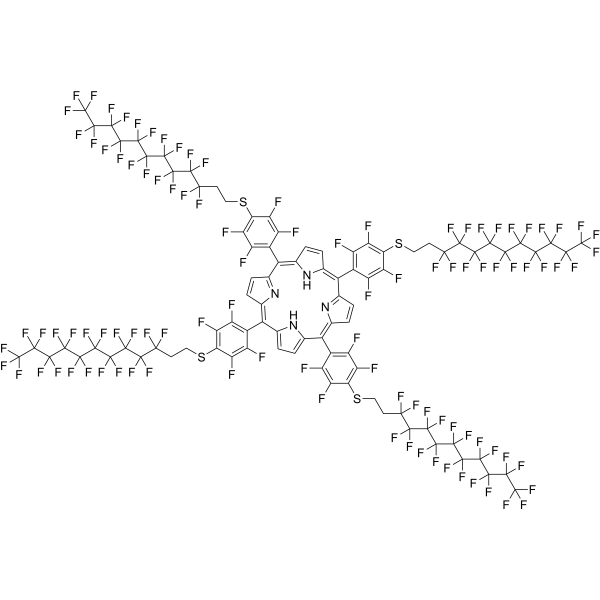
Perfluorododecylthio Tetra Fluorophenyl Porphyrin is a biochemical reagent that can be used as a biological material or organic compound for life science related research.
(2-Aminophenyl)methanol (2-Hydroxymethylaniline) is a molecular chaperone to rescue P123S mutant pendrin. (2-Aminophenyl)methanol has the advantages of low dose, long-term effect and low toxicity. (2-Aminophenyl)methanol can be used for the study of Pendred syndrome (a syndromic deafness) .
Quinolin-8-ol sulfate hydrate is an organic compound commonly used in dyes and as a raw material for chemical analysis. It can cooperate with metal ions to form dyes, and is widely used in the fields of dyes, printing and textile manufacturing. In addition, the compound also has good toxicity and biocompatibility, and is also used in some medical fields.
(3-Bromopyridin-2-yl)methanol (3-Bromopyridine-2-methanol) is a kind of biological materials or organic compounds that are widely used in life science research.
Ethyl 3-(4-fluorophenyl)-3-oxopropanoate is a biochemical reagent that can be used as a biological material or organic compound for life science related research.
(S)-N-Methylpyrrolidine-2-methanol is a biochemical reagent that can be used as a biological material or organic compound for life science related research.
2-(3-Chloropropyl)-2-(4-fluorophenyl)-1,3-dioxolane (2-(3-Chloropropyl)-2-(p-fluorophenyl)-1,3-dioxolane) is a kind of biological materials or organic compounds that are widely used in life science research.
Lipid A (14:0(5)-cyclopropyl17:0(1)) diammonium, a lipid, is an adjuvant. Lipid A (14:0(5)-cyclopropyl17:0(1)) diammonium has immunostimulatory properties.
MDO (methanol dehydrogenase) is responsible for oxidizing methanol to produce formaldehyde. Although the in vivo electron acceptor remains unidentified, in vitro experiments indicate that N,N-dimethyl-4-nitrosaniline (NDMA) can serve as a suitable electron acceptor and is subsequently reduced to 4-(hydroxyamino) -N,N-Dimethylaniline. MDO Protein, Mycobacterium sp. (His) is the recombinant MDO protein, expressed by E. coli , with N-6*His labeled tag.
N2-(tert-Butyl)-N4-cyclopropyl-6-(methylthio)-1,3,5-triazine-2,4-diamine-d9 is the deuterium labeled N2-(tert-Butyl)-N4-cyclopropyl-6-(methylthio)-1,3,5-triazine-2,4-diamine .
4-Dehydroxy-3-dehydro-pitavastatin lactone-d5 is the deuterium labeled (S,E)-6-(2-(2-cyclopropyl-4-(4-fluorophenyl)quinolin-3-yl)vinyl)-5,6-dihydro-2H-pyran-2-one (Pitavastatin Impurity) (HY-Z3610).
(1-(((tert-Butyldiphenylsilyl)oxy)methyl)cyclopropyl)methanol-d4 is the deuterium labeled (1-(((tert-Butyldiphenylsilyl)oxy)methyl)cyclopropyl)methanol.
4-[[(4-Fluorophenyl)imino]methyl]phenol-d4(4-{(E)-[(4-Fluorophenyl)imino]methyl}phenol-d4) is the deuterium labeled 4-[[(4-Fluorophenyl)imino]methyl]phenol (HY-W014178).
4-[[(4-Fluorophenyl)imino]methyl]phenol- 13C6 (4-{(E)-[(4-Fluorophenyl)imino]methyl}phenol- 13C6) is the 13C-labeled 4-[[(4-Fluorophenyl)imino]methyl]phenol (HY-W014178).
Western blot analysis of extracts from THP-1(lane 2(20μg), Jurkat (lane 3(20μg) and NIH3T3(lane 4(20μg) using FOXO1A (HY-P80132) Rabbit mAb. Proteins were transferred
to a PVDF membrane and blocked with 5% non-fat milk in TBST for 2 hour at room temperature. The primary antibody (1/1000) and Loading control antibody (Beta Actin, HY-P80438, 1/10000) was
used in 5% non-fat milk in TBST at 4°C overnight. Goat Anti-Mouse/Rabbit IgG-HRP Secondary Antibody (1/10000) was used for 1 hour at room temperature.
Western blot analysis of extracts from THP-1(lane 2(20μg), Jurkat (lane 3(20μg) and NIH3T3(lane 4(20μg) using FOXO1A (HY-P80132) Rabbit mAb. Proteins were transferred
to a PVDF membrane and blocked with 5% non-fat milk in TBST for 2 hour at room temperature. The primary antibody (1/1000) and Loading control antibody (Beta Actin, HY-P80438, 1/10000) was
used in 5% non-fat milk in TBST at 4°C overnight. Goat Anti-Mouse/Rabbit IgG-HRP Secondary Antibody (1/10000) was used for 1 hour at room temperature.
Western blot analysis of extracts from THP-1(lane 2(20μg), Jurkat (lane 3(20μg) and NIH3T3(lane 4(20μg) using FOXO1A (HY-P80132) Rabbit mAb. Proteins were transferred
to a PVDF membrane and blocked with 5% non-fat milk in TBST for 2 hour at room temperature. The primary antibody (1/1000) and Loading control antibody (Beta Actin, HY-P80438, 1/10000) was
used in 5% non-fat milk in TBST at 4°C overnight. Goat Anti-Mouse/Rabbit IgG-HRP Secondary Antibody (1/10000) was used for 1 hour at room temperature.
Western blot analysis of extracts from THP-1(lane 2(20μg), Jurkat (lane 3(20μg) and NIH3T3(lane 4(20μg) using FOXO1A (HY-P80132) Rabbit mAb. Proteins were transferred
to a PVDF membrane and blocked with 5% non-fat milk in TBST for 2 hour at room temperature. The primary antibody (1/1000) and Loading control antibody (Beta Actin, HY-P80438, 1/10000) was
MedchemExpress Validation 03
Western blot analysis of extracts from THP-1(lane 2(20μg), Jurkat (lane 3(20μg) and NIH3T3(lane 4(20μg) using FOXO1A (HY-P80132) Rabbit mAb. Proteins were transferred
MedchemExpress Validation 04
Western blot analysis of extracts from THP-1(lane 2(20μg), Jurkat (lane 3(20μg) and NIH3T3(lane 4(20μg) using FOXO1A (HY-P80132) Rabbit mAb. Proteins were transferred
to a PVDF membrane and blocked with 5% non-fat milk in TBST for 2 hour at room temperature. The primary antibody (1/1000) and Loading control antibody (Beta Actin, HY-P80438, 1/10000) was
used in 5% non-fat milk in TBST at 4°C overnight. Goat Anti-Mouse/Rabbit IgG-HRP Secondary Antibody (1/10000) was used for 1 hour at room temperature.
MedchemExpress Validation
Western blot analysis of extracts from THP-1(lane 2(20μg), Jurkat (lane 3(20μg) and NIH3T3(lane 4(20μg) using FOXO1A (HY-P80132) Rabbit mAb. Proteins were transferred
to a PVDF membrane and blocked with 5% non-fat milk in TBST for 2 hour at room temperature. The primary antibody (1/1000) and Loading control antibody (Beta Actin, HY-P80438, 1/10000) was
used in 5% non-fat milk in TBST at 4°C overnight. Goat Anti-Mouse/Rabbit IgG-HRP Secondary Antibody (1/10000) was used for 1 hour at room temperature.
Western blot analysis of extracts from THP-1(lane 2(20μg), Jurkat (lane 3(20μg) and NIH3T3(lane 4(20μg) using FOXO1A (HY-P80132) Rabbit mAb. Proteins were transferred
to a PVDF membrane and blocked with 5% non-fat milk in TBST for 2 hour at room temperature. The primary antibody (1/1000) and Loading control antibody (Beta Actin, HY-P80438, 1/10000) was
used in 5% non-fat milk in TBST at 4°C overnight. Goat Anti-Mouse/Rabbit IgG-HRP Secondary Antibody (1/10000) was used for 1 hour at room temperature.
MedchemExpress Validation
Western blot analysis of extracts from THP-1(lane 2(20μg), Jurkat (lane 3(20μg) and NIH3T3(lane 4(20μg) using FOXO1A (HY-P80132) Rabbit mAb. Proteins were transferred
to a PVDF membrane and blocked with 5% non-fat milk in TBST for 2 hour at room temperature. The primary antibody (1/1000) and Loading control antibody (Beta Actin, HY-P80438, 1/10000) was
used in 5% non-fat milk in TBST at 4°C overnight. Goat Anti-Mouse/Rabbit IgG-HRP Secondary Antibody (1/10000) was used for 1 hour at room temperature.
MedchemExpress Validation
Western blot analysis of extracts from THP-1(lane 2(20μg), Jurkat (lane 3(20μg) and NIH3T3(lane 4(20μg) using FOXO1A (HY-P80132) Rabbit mAb. Proteins were transferred
to a PVDF membrane and blocked with 5% non-fat milk in TBST for 2 hour at room temperature. The primary antibody (1/1000) and Loading control antibody (Beta Actin, HY-P80438, 1/10000) was
used in 5% non-fat milk in TBST at 4°C overnight. Goat Anti-Mouse/Rabbit IgG-HRP Secondary Antibody (1/10000) was used for 1 hour at room temperature.
MedchemExpress Validation
Western blot analysis of extracts from THP-1(lane 2(20μg), Jurkat (lane 3(20μg) and NIH3T3(lane 4(20μg) using FOXO1A (HY-P80132) Rabbit mAb. Proteins were transferred
to a PVDF membrane and blocked with 5% non-fat milk in TBST for 2 hour at room temperature. The primary antibody (1/1000) and Loading control antibody (Beta Actin, HY-P80438, 1/10000) was
used in 5% non-fat milk in TBST at 4°C overnight. Goat Anti-Mouse/Rabbit IgG-HRP Secondary Antibody (1/10000) was used for 1 hour at room temperature.
MedchemExpress Validation
Western blot analysis of extracts from THP-1(lane 2(20μg), Jurkat (lane 3(20μg) and NIH3T3(lane 4(20μg) using FOXO1A (HY-P80132) Rabbit mAb. Proteins were transferred
to a PVDF membrane and blocked with 5% non-fat milk in TBST for 2 hour at room temperature. The primary antibody (1/1000) and Loading control antibody (Beta Actin, HY-P80438, 1/10000) was
used in 5% non-fat milk in TBST at 4°C overnight. Goat Anti-Mouse/Rabbit IgG-HRP Secondary Antibody (1/10000) was used for 1 hour at room temperature.
MedchemExpress Validation
Western blot analysis of extracts from THP-1(lane 2(20μg), Jurkat (lane 3(20μg) and NIH3T3(lane 4(20μg) using FOXO1A (HY-P80132) Rabbit mAb. Proteins were transferred
to a PVDF membrane and blocked with 5% non-fat milk in TBST for 2 hour at room temperature. The primary antibody (1/1000) and Loading control antibody (Beta Actin, HY-P80438, 1/10000) was
used in 5% non-fat milk in TBST at 4°C overnight. Goat Anti-Mouse/Rabbit IgG-HRP Secondary Antibody (1/10000) was used for 1 hour at room temperature.
MedchemExpress Validation
Western blot analysis of extracts from THP-1(lane 2(20μg), Jurkat (lane 3(20μg) and NIH3T3(lane 4(20μg) using FOXO1A (HY-P80132) Rabbit mAb. Proteins were transferred
to a PVDF membrane and blocked with 5% non-fat milk in TBST for 2 hour at room temperature. The primary antibody (1/1000) and Loading control antibody (Beta Actin, HY-P80438, 1/10000) was
used in 5% non-fat milk in TBST at 4°C overnight. Goat Anti-Mouse/Rabbit IgG-HRP Secondary Antibody (1/10000) was used for 1 hour at room temperature.
MedChemExpress values your privacy and your trust is important to us. We use cookies to enhance your website experience. Some cookies are necessary to run the website.
Privacy and Cookie Policy







![2-(4-Fluorophenyl)-5-[(5-iodo-2-methylphenyl) methyl]thiophene](http://file.medchemexpress.com/product_pic/hy-i0182.gif)



![Benzo[b]thiophen-2-yl(5-bromo-2-fluorophenyl)methanol](http://file.medchemexpress.com/product_pic/hy-i0563.gif)


![1,2,3,4-Tetrahydrobenzo[h]quinolin-3-ol](http://file.medchemexpress.com/product_pic/hy-d0900.gif)

![3-Azaspiro[5.5]undecane-9-methanol](http://file.medchemexpress.com/product_pic/hy-159598.gif)



![Benz[a]anthracene-7-methanol-13C](http://file.medchemexpress.com/product_pic/hy-w778774.gif)

![t-Butyl (3R,5S)-7-[2-cyclopropyl-4-(4-fluorophenyl)quinolin-3-yl]-3,5-isopropylidenedioxy-6-heptenoate (Standard)](http://file.medchemexpress.com/product_pic/hy-w108710r.gif)






![4-[[(4-Fluorophenyl)imino]methyl]phenol-d4](http://file.medchemexpress.com/product_pic/hy-w699637.gif)


![4-[[(4-Fluorophenyl)imino]methyl]phenol-13C6](http://file.medchemexpress.com/product_pic/hy-w751537.gif)




![Pyrido[1,2-a]quinolin-11-iumchloride](http://file.medchemexpress.com/product_pic/hy-w543734.gif)


![4-[5-(4-Fluorophenyl)-1H-pyrazol-1-yl]benzoic acid](http://file.medchemexpress.com/product_pic/hy-w588963.gif)