



Senecionine

Based on 1 Customer Validation
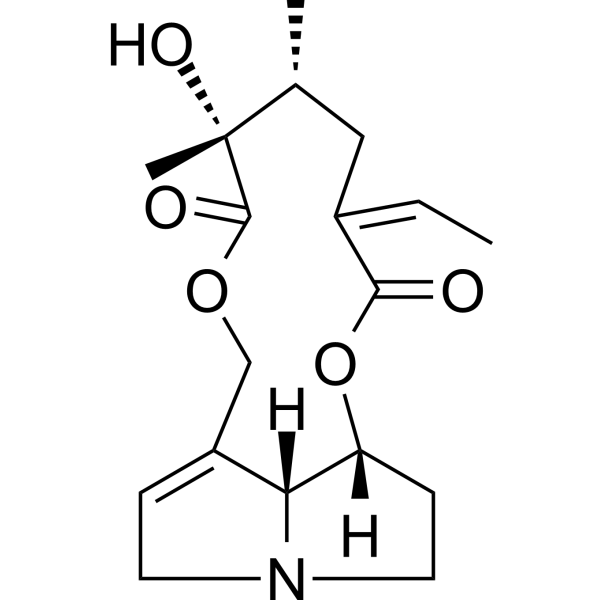
Senecionine (Senecionan-11,16-dione, 12-hydroxy-) is a pyrrolizidine alkaloid could be isolated from Senecio vulgaris. Senecionine decreases the activities of glutathione S-transferase, aminopyrine demethylase and arylhydrocarbon hydroxylase (AHH).
For research use only. We do not sell to patients.
- Purity : 99.48%
- CAS No.: 130-01-8
- Formula: C18H25NO5
- Molecular Weight:335.39
-
Storage:
4°C, protect from light
* In solvent : -80°C, 6 months; -20°C, 1 month (protect from light)

To place orders, for customer services and technical support, please contact: MedChemExpress USA
Tel: 609-228-6898 E-mail: [email protected] [email protected]


-
 Biological Activity
-
Chemical Information
-
Solvent & Solubility
- Purity & Documentation
- References
-
 Help & FAQs


-

HY-N2560R
Senecionine (Standard)Apoptosis Inducer -
HY-137301
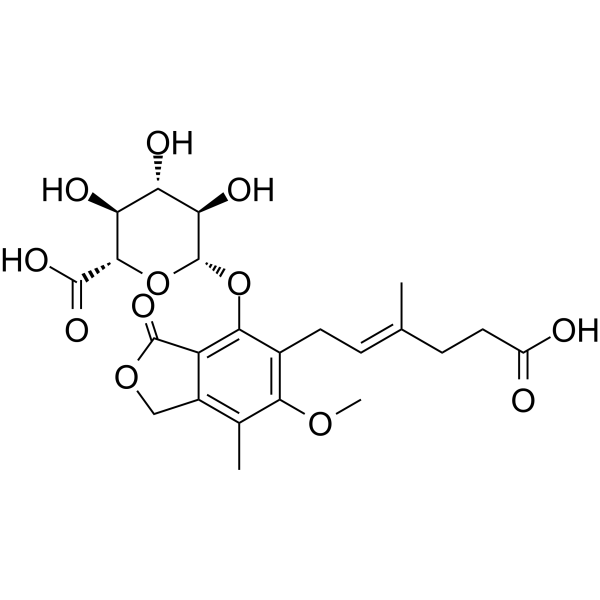
Mycophenolic acid glucuronideMPA Metabolite -
HY-A0070B
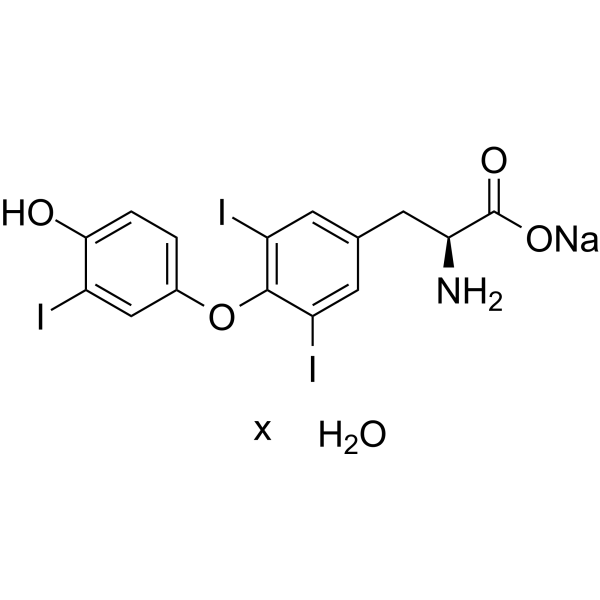
Liothyronine sodium hydrateTRα/TRβ Agonist -

HY-122489A
(S)-LaudanosineAlkaloid -
HY-W001978
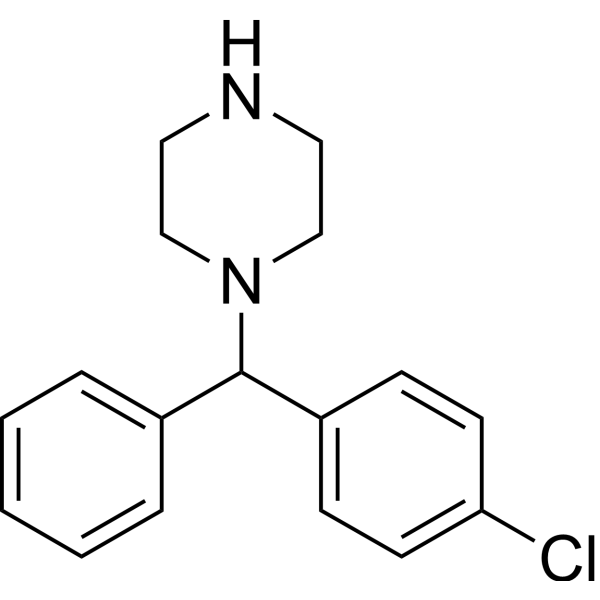
1-(4-Chlorobenzhydryl)piperazineBiochemical Reagent -

HY-137301R
Mycophenolic acid glucuronide (Standard)MPA Metabolite -
HY-B0539S2
Desloratadine-3,3,5,5-d4Stable Isotope -

HY-137387
Carvedilol GlucuronideDrug Metabolite


Biological Activity
Description
Cellular Effect
|
Cell Line

|
Type | Value | Description | References |
|---|---|---|---|---|
| A204 | IC50 |
150 μg/mL
Compound: 1
|
Cytotoxicity against human A204 cells after 24 hrs by soft agar colony forming assay
Cytotoxicity against human A204 cells after 24 hrs by soft agar colony forming assay
|
[PMID: 3210016] |
| CHO | EC50 |
>100 μg/mL
Compound: 3
|
Toxicity against Cricetulus griseus CHO (Chinese hamster ovary) cell by MTT assay
Toxicity against Cricetulus griseus CHO (Chinese hamster ovary) cell by MTT assay
|
10.1016/jbse.2007.08.015 |
| Sf9 | EC50 |
>100 μg/mL
Compound: 3
|
Toxicity against Spodoptera frugiperda (fall armyworm) Sf9 cells by MTT assay
Toxicity against Spodoptera frugiperda (fall armyworm) Sf9 cells by MTT assay
|
10.1016/jbse.2007.08.015 |
In Vitro
Pyrrolizidine alkaloids (PAs) are considered to be one of the most hepatotoxic groups of compounds of plant origin and are present in about 3% of the world's flowering plants. Most PAs represent a considerable health hazard to both livestock and humans through the consumption of plants and PA-contaminated products such as milk, honey, herbal teas, and medicines[1].
MedChemExpress (MCE) has not independently confirmed the accuracy of these methods. They are for reference only.
In Vivo
MedChemExpress (MCE) has not independently confirmed the accuracy of these methods. They are for reference only.


Chemical Information
-
CAS No. 130-01-8
-
Appearance Solid
-
Molecular Weight 335.39
-
Formula C18H25NO5
-
Color White to off-white
-
SMILES
O=C1O[C@@]2([H])[C@]3([H])N(CC=C3COC([C@](C)(O)[C@H](C)C/C1=C/C)=O)CC2
-
Synonyms
Senecionan-11,16-dione, 12-hydroxy-; Aureine; Senecionin
-
Structure Classification
-
Shipping
Room temperature in continental US; may vary elsewhere.
-
Storage
4°C, protect from light
* In solvent : -80°C, 6 months; -20°C, 1 month (protect from light)


Solvent & Solubility
In Vitro:
DMSO : 1.43 mg/mL (4.26 mM; ultrasonic and warming and heat to 60°C; Hygroscopic DMSO has a significant impact on the solubility of product, please use newly opened DMSO)
Please refer to the solubility information to select the appropriate solvent. Once prepared, please aliquot and store the solution to prevent product inactivation from repeated freeze-thaw cycles.
Storage method and period of stock solution: -80°C, 6 months; -20°C, 1 month (protect from light). When stored at -80°C, please use it within 6 months. When stored at -20°C, please use it within 1 month.
Please refer to the solubility information to select the appropriate solvent. Once prepared, please aliquot and store the solution to prevent product inactivation from repeated freeze-thaw cycles.
Storage method and period of stock solution: -80°C, 6 months; -20°C, 1 month (protect from light). When stored at -80°C, please use it within 6 months. When stored at -20°C, please use it within 1 month.
Concentration (start) × Volume (start) = Concentration (final) × Volume (final)


Purity & Documentation
-
Data Sheet (280 KB)
-
SDS (480 KB)
- English - EN (480 KB)
- Français - FR (480 KB)
- Deutsch - DE (480 KB)
- Norwegian - NO (480 KB)
- Español - ES (480 KB)
- Swedish - SV (480 KB)
- Italian - IT (480 KB)
- Korean - KR (480 KB)
- Portuguese - PT (480 KB)
-
Handling Instructions (2659 KB)
References
[1]. Wang C, et al. The comparative pharmacokinetics of two pyrrolizidine alkaloids, senecionine and adonifoline, and their main metabolites in rats after intravenous and oral administration by UPLC/ESIMS. Anal Bioanal Chem. 2011 Jul;401(1):275-87. [Content Brief]
[2]. Kakrani HK, et al. Effect of seneciphylline and senecionine on hepatic drug metabolizing enzymes in rats. J Ethnopharmacol. 1984 Dec;12(3):271-8. [Content Brief]
[3]. Tu ZB, et al. Identification of senecionine and senecionine N-oxide as antifertility constituents in Senecio vulgaris. J Pharm Sci. 1988 May;77(5):461-3. [Content Brief]


Complete Stock Solution Preparation Table
Please refer to the solubility information to select the appropriate solvent. Once prepared, please aliquot and store the solution to prevent product inactivation from repeated freeze-thaw cycles.
Storage method and period of stock solution: -80°C, 6 months; -20°C, 1 month (protect from light). When stored at -80°C, please use it within 6 months. When stored at -20°C, please use it within 1 month.
| Optional Solvent | Concentration Solvent Mass | 1 mg | 5 mg | 10 mg | 25 mg |
|---|---|---|---|---|---|
| DMSO | 1 mM | 2.9816 mL | 14.9080 mL | 29.8160 mL | 74.5401 mL |


Senecionine Related Classifications
HY-N2560 Related Classifications
 Powered by Bioz