



Endogenous Metabolite
Endogenous metabolites refer to the collective set of small-molecule chemical substances present within organelles, cells, organs, biological fluids, or entire organisms; their molecular weights are typically less than 1500 Da. These endogenous metabolites—including lipids, amino acids, short peptides, nucleic acids, carbohydrates, alcohols, and organic acids—not only participate in signal transduction governing genomic function but also receive upstream signals from the environment, thereby bridging the interrelationships among genotype, environment, and phenotype.
Based on their biological functions, microbial endogenous metabolites can be broadly classified into two categories: primary metabolites and secondary metabolites. Primary metabolites are the core molecules essential for supporting microbial growth and proliferation; they serve to provide energy to the microbes or act as precursors and cofactors for the synthesis of biological macromolecules. In contrast, microbial secondary metabolites are a class of low-molecular-weight products that are not strictly essential for microbial growth. Nevertheless, microbial secondary metabolites include numerous substances—such as antibiotics, anti-tumor agents, and cholesterol-lowering agents—that are of critical importance to human health[1][2][3]. Furthermore, the metabolome of a biological organism is influenced by a variety of endogenous factors, including age, sex, body composition, genetic background, and underlying pathological states. The small-molecule metabolites within an organism are diverse and highly distinct; their levels are typically subject to the synergistic regulation of a vast array of enzymes and transport proteins, undergoing processes of synthesis, transformation, degradation, and compartmentalized distribution. Metabolomics research based on endogenous metabolites has been widely applied in the fields of metabolic disorders, neurodegenerative diseases, cancer, cardiovascular diseases, and infectious diseases, where these metabolites hold potential utility as biomarkers or therapeutic targets[1][2][3].
References:
- [1]. Seyedsayamdost MR. Toward a global picture of bacterial secondary metabolism. J Ind Microbiol Biotechnol. 2019 Mar;46(3-4):301-311. [Content Brief]
- [2]. Ruiz B, et al. Production of microbial secondary metabolites: regulation by the carbon source. Crit Rev Microbiol. 2010 May;36(2):146-67. [Content Brief]
- [3]. Wishart DS. Metabolomics for Investigating Physiological and Pathophysiological Processes. Physiol Rev. 2019 Oct 1;99(4):1819-1875. [Content Brief]
Endogenous Metabolite Isoform Specific Products
All Product Categories
-
Endogenous Metabolite Related Products (8409)
Related Products (8409)

-
Antibodies (477)
-
Endogenous Metabolite Isoform Comparison
-
Hydrocortisone caproate
 0 ImagesHydrocortisone caproate is an orally active anti-inflammatory corticosteroid ester and an ester derivative of hydrocortisone. Hydrocortisone caproate inhibits granuloma formation, induces hepatic glycogen deposition, and exerts anti-inflammatory activity. Hydrocortisone caproate can be used in research related to hemorrhoids.
-
OH-α-PVP TFA
 0 ImagesCat. No.: HY-130529CAS No.: 1797986-63-0Synonyms: OH-α-Pyrrolidinovalerophenone TFAOH-α-PVP (OH-α-Pyrrolidinovalerophenone ) TFA is a metabolite of α-pyrrolidinovalerophenone.

-
3,3-Dimethyl-1-butanol (Standard)
 0 ImagesCat. No.: HY-W012977RCAS No.: 624-95-3Synonyms: DMB (Standard); Neohexanol (Standard)3,3-Dimethyl-1-butanol (Standard) is the analytical standard of 3,3-Dimethyl-1-butanol (HY-W012977). This product is intended for research and analytical applications. 3,3-Dimethyl-1-butanol (DMB) is an orally active inhibitor of trimethylamine (TMA) and trimethylamine N-oxide (TMAO). 3,3-Dimethyl-1-butanol inhibits the signaling pathway of p65 NF-κB and TGF-β1/Smad3. 3,3-Dimethyl-1-butanol has potential applications in cardiovascular disease (CVD).
-
S-(5'-Adenosyl)-L-methionine-13C5 sulfate
 0 ImagesCat. No.: HY-W338810SS-(5'-Adenosyl)-L-methionine-13C5 sulfate is the 13C-labeled S-(5'-Adenosyl)-L-methionine chloride (HY-W338810). S-(5'-Adenosyl)-L-methionine chloride is the endogenous methyl donor in the methionine cycle and numerous methylation reactions, including protein methylation. S-(5'-Adenosyl)-L-methionine chloride can activate cardiac ryanodine receptor RyR2 in a concentration-dependent manner, enhancing the affinity of RyR2 for ryanodine. The Kd of S-(5'-Adenosyl)-L-methionine chloride with MetJ in Escherichia coli is 0.18 mM. S-(5'-Adenosyl)-L-methionine chloride can cause changes in the methylation index of Cisplatin (HY-17394)-sensitive and Cisplatin-resistant ovarian cancer cells. S-(5'-Adenosyl)-L-methionine chloride can be used for methylation-related research.
-
Lactosyl-C18-sphingosine
 0 ImagesCat. No.: HY-131701CAS No.: 109785-20-8Synonyms: C18 Lactosyl(β) Ceramide; Lactosyl Sphingosine; Lyso-Lactosylceramide (synthetic)Lactosyl-C18-sphingosine (C18 Lactosyl(β) Ceramide; Lactosyl Sphingosine) is a bioactive sphingolipid that is a form of lactosylceramide but lacks the fatty acyl group. Lysolactosylceramide (1-50 μM) reduces the viability of human neutrophils in a concentration-dependent manner. Unlike lactosylceramide, Lactosyl-C18-sphingosine has no effect on protein synthesis and cell proliferation in cardiomyocytes. Lactosyl-C18-sphingosine is a lysoganglioside GM3.
-
3-Bromopropan-1-ol-d6
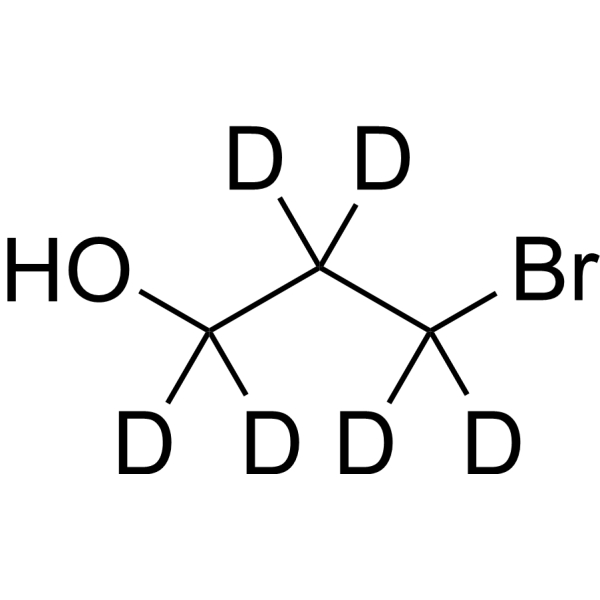 0 Images3-Bromopropan-1-ol-d6 is the deuterium labeled 3-Bromopropan-1-ol (HY-W007337). 3-Bromopropan-1-ol is an endogenous metabolite. 3-Bromopropan-1-ol is significantly upregulated during the estrus period in buffaloes. 3-Bromopropan-1-ol can be used in buffalo estrus research.
-
Dehydroevodiamine hydrochloride (Standard)
 0 ImagesCat. No.: HY-N6029RCAS No.: 111664-82-5Dehydroevodiamine hydrochloride Standard is the analytical standard of Dehydroevodiamine hydrochloride (HY-N6029). This product is intended for research and analytical applications. Dehydroevodiamine hydrochloride is a blood-brain barrier-permeable, orally effective AChE and BACE1 inhibitor (IC50 = 40.96 μM). Dehydroevodiamine hydrochloride is isolated and extracted from Evodia rutaecarpa. Dehydroevodiamine hydrochloride attenuates neurotoxicity through multiple targets by inhibiting BACE1 to block Aβ production, inhibiting AChE activity, scavenging ROS, and suppressing calcium influx. Dehydroevodiamine hydrochloride can be used for research on Alzheimer's disease, cerebral ischemia, vascular dementia, and other cognitive disorder-related diseases.
-
Emtricitabine-d2
 0 ImagesCat. No.: HY-17427S4Synonyms: BW1592-d2Emtricitabine-d2 (BW1592-d2) is deuterium labeled Emtricitabine. Emtricitabine is a nucleoside reverse transcriptase inhibitor (NRTI) with an EC50 of 0.01 μM in PBMC cell. It is an antiviral agent for the treatment of HIV infection.
-
Pteridine-2,4(1H,3H)-dione (Standard)
 0 ImagesPteridine-2,4(1H,3H)-dione is an endogenous metabolite.
-
2-Nonyl alcohol
 0 Images2-Nonyl alcohol is a metabolite that can be isolated from the fermentation product of strain PJ16.
-
Cinacalcet-d4 hydrochloride
 0 ImagesCat. No.: HY-W653978CAS No.: 2514927-75-2Synonyms: AMG-073-d4 hydrochlorideCinacalcet-d4 (AMG-073-d4) hydrochlorideis deuterium labeled Cinacalcet (hydrochloride). Cinacalcet hydrochloride (AMG-073 hydrochloride) is an orally active, allosteric agonist of Ca receptor (CaR), used for cardiovascular disease treatment.
-
Biotin-13C5
 0 ImagesCat. No.: HY-B0511S3Synonyms: Vitamin B7-13C5; Vitamin H-13C5; D-Biotin-13C5Biotin-13C5 (Vitamin B7-13C5) is 13C labeled Biotin. Biotin, vitamin B7 and serves as a coenzyme for five carboxylases in humans, involved in the synthesis of fatty acids, isoleucine, and valine, and in gluconeogenesis. Biotin is necessary for cell growth, the production of fatty acids, and the metabolism of fats and amino acids.
-
Propionyl-DL-carnitine chloride (Standard)
 0 ImagesPropionyl-DL-carnitine (chloride) (Standard) is the analytical standard of Propionyl-DL-carnitine (chloride). This product is intended for research and analytical applications. Propionyl-DL-carnitine chloride is a carnitine derivative. Propionyl-DL-carnitine chloride can be used for the research of inflammation.
-
Leukotriene B4-d5
 0 ImagesCat. No.: HY-107608S1Synonyms: LTB4-d5Leukotriene B4-d5 (LTB4-d5) is deuterium labeled Leukotriene B4. Leukotriene B4 (LTB4) is known as one of the most potent chemoattractants and activators of leukocytes and is involved in inflammatory diseases. Leukotriene B4 is also an alkyl chain-based PROTAC linker that can be used in the synthesis of PROTACs.
-
Matairesinol (Standard)
 0 ImagesMatairesinol (Standard) is the analytical standard of Matairesinol. This product is intended for research and analytical applications. Matairesinol confers anti-allergic effects in an allergic dermatitis mouse model. DfE-induced changes in IL-4 and IFN-γ mRNA expression in the ears of NC/Nga mice were reversed by matairesinol application.
-
Docosanoic acid-d2
 0 ImagesCat. No.: HY-W013049S2CAS No.: 71607-34-6Synonyms: Behenic acid-d2Docosanoic acid-d2 (Behenic acid-d2) is deuterium labeled Docosanoic acid (HY-W013049). Docosanoic acid (Behenic acid) is a long-chain saturated fatty acid. Docosanoic acid inhibits the double-stranded DNA (dsDNA) binding activity of p53 DNA binding domain, with a Kd of 12 nM. Docosanoic acid has low bioavailability and can increase cholesterol in humans.
-
Prostaglandin B3
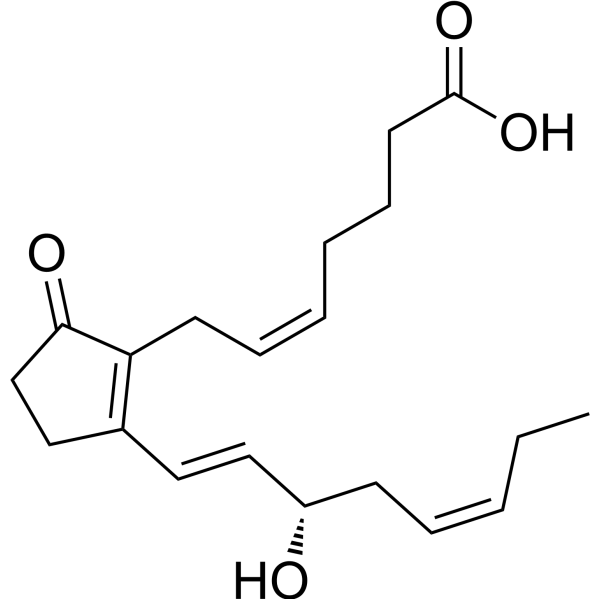 0 ImagesCat. No.: HY-117431CAS No.: 36614-32-1Synonyms: PGB3Prostaglandin B3 (PGB3) is a member of the class of prostaglandins B and a secondary alcohol. PGB3 exhibits a rather low affinity to human PPARγ with a Ki value greater than 1 mM compared with Ki values of 26.28 ± 8.7 μM for PGB1 and 77 ± 37.7 μM for PGB2.
-
N-Lauroyl-L-glutamic acid
 0 ImagesN-Lauroyl-L-glutamic acid is an amino acid derivative with anti-asthmatic activity. N-Lauroyl-L-glutamic acid has been found to improve asthma symptoms in studies. The potential application of N-Lauroyl-L-glutamic acid is mainly focused on the suppression of respiratory diseases. N-Lauroyl-L-glutamic acid may help improve the quality of life of patients.
-
C16-Ceramide-13C16
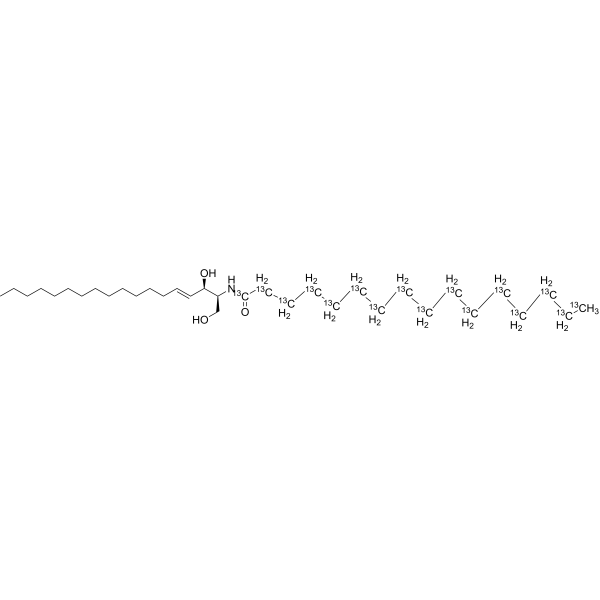 0 ImagesCat. No.: HY-100354SC16-Ceramide-13C16 is a 13C-labeled C16-Ceramide (HY-100354).




