



Apolipoprotein
Plasma lipoprotein metabolism is regulated and controlled by the specific apolipoprotein (apo-) constituents of the various lipoprotein classes. The major apolipoproteins include apoE, apoB, apoA-I, apoA-II, apoA-IV, apoC-I, apoC-II, and apoC-III. Specific apolipoproteins function in the regulation of lipoprotein metabolism through their involvement in the transport and redistribution of lipids among various cells and tissues, through their role as cofactors for enzymes of lipid metabolism, or through their maintenance of the structure of the lipoprotein particles.
Apolipoprotein Isoform Specific Products
All Product Categories
-
Apolipoprotein Related Products (86)
Related Products (86)

-
Apolipoprotein Isoform Comparison
-
Mipomersen sodium scrambled negative control
 0 ImagesCat. No.: HY-108764BMipomersen sodium scrambled negative control is the sequence scrambled negative control of Mipomersen sodium.
-
9(S)-HOTrE
 0 Images9(S)-HOTrE is a PPARα activator and an inducer of apolipoprotein A-I (apoA-I) mRNA expression. 9(S)-HOTrE upregulates the expression of PPARα target gene CPT1α. 9(S)-HOTrE can be used in the research of cardiovascular diseases.

-
APOC1 Human Pre-designed siRNA Set A
 0 ImagesCat. No.: HY-RS00844
APOC1 Human Pre-designed siRNA Set A contains three designed siRNAs for APOC1 gene (Human), as well as a negative control, a positive control, and a FAM-labeled negative control.
Components
APOC1 siRNA-1: 5 nmol (HPLC)
APOC1 siRNA-2: 5 nmol (HPLC)
APOC1 siRNA-3: 5 nmol (HPLC)
siRNA Negative Control: 5 nmol (HPLC)
FAM-labeled siRNA Negative Control: 5 nmol (HPLC)
GAPDH siRNA Positive Control: 5 nmol (HPLC)
-
Pelacarsen sodium scrambled negative control
 0 ImagesCat. No.: HY-151123CPelacarsen sodium scrambled negative control is the sequence scrambled negative control of Pelacarsen sodium.
-
Zerlasiran sodium scrambled negative control
 0 ImagesCat. No.: HY-147425CSynonyms: SLN360 sodium scrambled negative controlZerlasiran (SLN360) sodium scrambled negative control is the sequence scrambled negative control of Zerlasiran sodium (HY-147425A). Zerlasiran sodium is a siRNA targeting apolipoprotein A (ApoA). Zerlasiran sodium targets hepatic ApoA synthesis via RNA interference to degrade encoding mRNA. Zerlasiran sodium can be used for the research of atherosclerotic cardiovascular disease and elevated ApoA levels.
-
Lp(a)-IN-8
 0 ImagesCat. No.: HY-173322CAS No.: 3070206-18-4Lp(a)-IN-8 is a Lp(a) assembly inhibitor with an IC50 of 0.749 nM. Lp(a)-IN-8 can be used in studies related to cardiovascular diseases and elevated plasma Lp(a) levels.
-
Alcedaplin
 0 ImagesCat. No.: HY-187856CAS No.: 2956780-66-6Synonyms: MZE829Alcedaplin (MZE829) is an Apolipoprotein L1 (ApoL1) function inhibitor.
-
APOL1-IN-3
 0 ImagesCat. No.: HY-176196CAS No.: 2762826-72-0APOL1-IN-3 (Compound 1) is an APOL1 inhibitor. APOL1-IN-3 can be used in the research of kidney diseases.
-
APL180
 0 ImagesCat. No.: HY-P6365ACAS No.: 388566-97-0Synonyms: L-4FAPL180 (L-4F) is an apolipoprotein A-I mimic peptide, that improves the anti-inflammatory activity of high-density lipoprotein (HDL). APL180 can be used in researches of cardiovascular diseases.
-
Lp(a)-IN-6
 0 ImagesCat. No.: HY-171465CAS No.: 2566425-77-0Lp(a)-IN-6 (Compound 6) is a lipoprotein(a) (Lp(a)) inhibitor, with an IC50 of <0.314 nM. Lp(a)-IN-6 can be used for the research of cardiovascular disease (CVD).
-
1-Linoleoyl Glycerol-d5
 0 ImagesCat. No.: HY-W778692CAS No.: 1795137-84-6Synonyms: 1-Linoleoyl-rac-glycerol-d5; 1-Monolinolein-d51-Linoleoyl Glycerol-d5 (1-Linoleoyl-rac-glycerol-d5; 1-Monolinolein-d5) is the deuterium labeled 1-Linoleoyl Glycerol (HY-111346). 1-Linoleoyl glycerol is a LpPLA2 inhibitor. 1-Linoleoyl glycerol acts as a precursor for synthesizing various functional lipids, such as phospholipids. 1-Linoleoyl glycerol mitigates inflammation induced by Apolipoprotein CIII (reduction of IL-6).
-
FAM labled Zerlasiran sodium
 0 ImagesCat. No.: HY-147425DSynonyms: FAM labled SLN360 sodiumFAM labled Zerlasiran sodium is a FAM labled Zerlasiran sodium (HY-147425A). Zerlasiran sodium is a siRNA targeting apolipoprotein A (ApoA). Zerlasiran sodium targets hepatic ApoA synthesis via RNA interference to degrade encoding mRNA. Zerlasiran sodium can be used for the research of atherosclerotic cardiovascular disease and elevated ApoA levels.
-
Obicetrapib potassium
 0 ImagesCat. No.: HY-18778BCAS No.: 866399-90-8Synonyms: TA-8995 potassium; DEZ-001 potassium; AMG-899 potassiumObicetrapib (TA-8995; DEZ-001) potassium is an orally active cholesteryl ester transfer protein (CETP) inhibitor. Obicetrapib potassium potently reduces atherogenic lipoproteins (such as LDL-C, ApoB, Lp (a)) and increases HDL-C. Obicetrapib potassium can be used for the research of dyslipidemia and atherosclerotic cardiovascular disease (ASCVD).
-
LVGRQLEEFL (mouse)
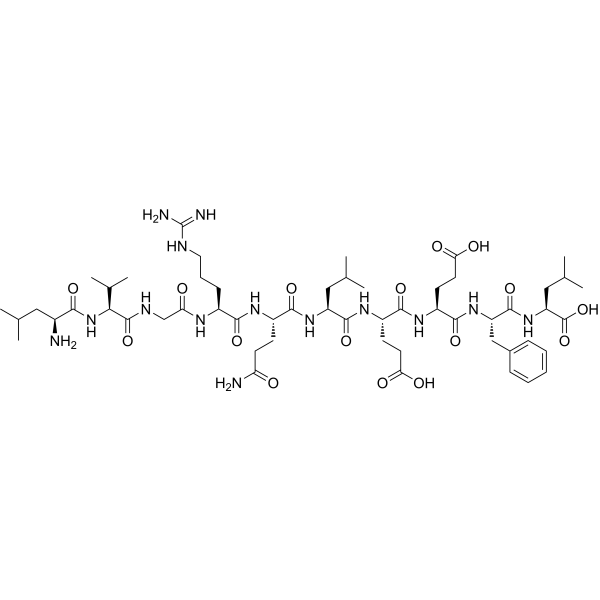 0 ImagesCat. No.: HY-P5169CAS No.: 608513-82-2LVGRQLEEFL (mouse) can be named as G * peptide, corresponding to amino acids 113 to 122 in apolipoprotein J ([113,122] apoJ)}. LVGRQLEEFL (mouse) exhibits anti-inflammatory and anti-atherogenic properties. LVGRQLEEFL (mouse) can be added to an apoJ mimetic, to form HM-10/10 peptide, which is a mimetic peptide and a novel chimeric high density lipoprotein. HM-10/10 peptide protects retinal pigment epithelium (RPE) and photoreceptors from oxidant induced cell death.
-
APOL1-IN-2
 0 ImagesCat. No.: HY-169932CAS No.: 2956781-84-1APOL1-IN-2 (Compound 467) is the inhibitor for Apolipoprotein 1 (APOL1). APOL1-IN-2 reduces the APOL1 G2/G1 induced cell death in HEK293 with EC50 of 4.74 nM and 14.3 nM. APOL1-IN-2 reduces the APOL1 G2/G1/G0 induced death of trypanosomes with EC50 of 2.24, 6.03 and 3.72 nM, respectively.

-
Anti-ApoCIII Antibody
 0 ImagesCat. No.: HY-P991865
-
ABCA1 inducer 1
 0 ImagesCat. No.: HY-169080CAS No.: 2839627-76-6ABCA1 inducer 1 is a nonlipogenic ABCA1 inducer. ABCA1 inducer 1 increases ABCA1 expression, enhances apolipoprotein (APOE) lipidation and reverses multiple Alzheimer’s disease (AD) phenotypes, without increasing triglycerides in E3/4FAD mice that express human APOE 3/4.
-
Tiadenol
 0 ImagesTiadenol is an orally effective lipid-lowering compound and peroxisome proliferator. Tiadenol promotes peroxisome-associated fatty acid metabolism, and its induction of the activities of enzymes such as palmitoyl-CoA hydrolase, carnitine acetyl-transferase and catalase is mainly associated with de novo protein synthesis. The triglyceride-lowering effect of Tiadenol is not accompanied by increased activities of lipoprotein lipase (LPL) and hepatic lipase (HL), and it reduces VLDL Apo E. Tiadenol can be used in studies related to lipid metabolism, peroxisome proliferation and hyperlipoproteinemia.



