



Drug Intermediate
Drug Iintermediate
Drug intermediates are used as raw materials for the production of bulk drugs, or they can refer to a material produced during synthesis of an API that must undergo further molecular change or processing before it becomes an API. Drug intermediates are hygienically formulated using high grade raw materials and they are used in the pharmaceutical and cosmetic industry[1][2].
References:
- [1]. Ma HC, et al. Homochiral Covalent Organic Framework for Catalytic Asymmetric Synthesis of a Drug Intermediate. J Am Chem Soc. 2020 Jul 22;142(29):12574-12578. [Content Brief]
- [2]. Ramachary D B, et al. Development of pharmaceutical drugs, drug intermediates and ingredients by using direct organo‐click reactions[J]. 2008.
All Product Categories
-
Drug Intermediate Related Products (4631)
Related Products (4631)

-
Biphenyl-4-amidoxime
 0 ImagesSynonyms: N'-hydroxy-4-phenylbenzene-1-carboximidamideBiphenyl-4-amidoxime (N'-hydroxy-4-phenylbenzene-1-carboximidamide) is a synthetic intermediate useful for pharmaceutical synthesis.
-
4-Iodoaniline-13C6
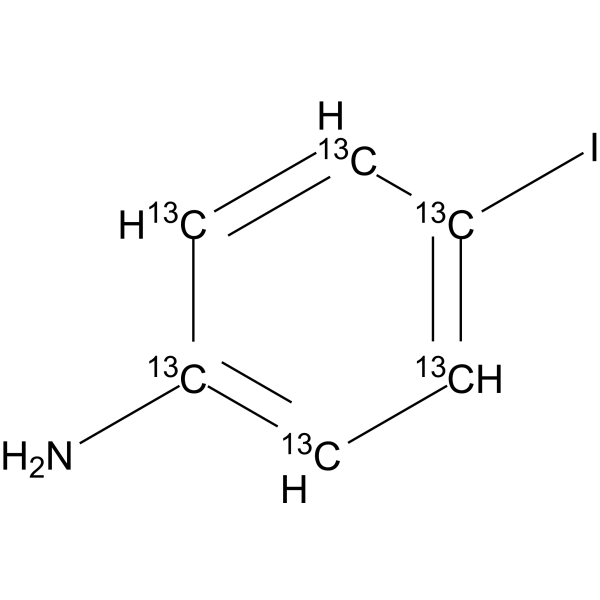 0 Images4-Iodoaniline-13C6 is the 13C labeled 4-Iodoaniline (HY-I0210). 4-Iodoaniline is a potent methemoglobin former. 4-Iodoaniline is also an intermediate. 4-Iodoaniline can be used to synthesize glycogen phosphorylase inhibitors. 4-Iodoaniline is used in the research of liver cancer and blood diseases.
-
Methyl 3-carbamoylbicyclo[1.1.1]pentane-1-carboxylate
![Methyl 3-carbamoylbicyclo[1.1.1]pentane-1-carboxylate](https://file.medchemexpress.com/product_pic/hy-w032995.gif "Click to View Methyl 3-carbamoylbicyclo[1.1.1]pentane-1-carboxylate Product Detail") 0 ImagesCat. No.: HY-W032995CAS No.: 156329-77-0Methyl 3-carbamoylbicyclo[1.1.1]pentane-1-carboxylate is a drug intermediate for synthesis of various active compounds.
0 ImagesCat. No.: HY-W032995CAS No.: 156329-77-0Methyl 3-carbamoylbicyclo[1.1.1]pentane-1-carboxylate is a drug intermediate for synthesis of various active compounds.
-
Methyl 3-(1H-indol-3-yl)propanoate
 0 ImagesCat. No.: HY-W092495CAS No.: 5548-09-4Methyl 3-(1H-indol-3-yl)propanoate is an indole derivative and can be used as a drug intermediate.
-
DMT-2'fluoro-da(bz) amidite
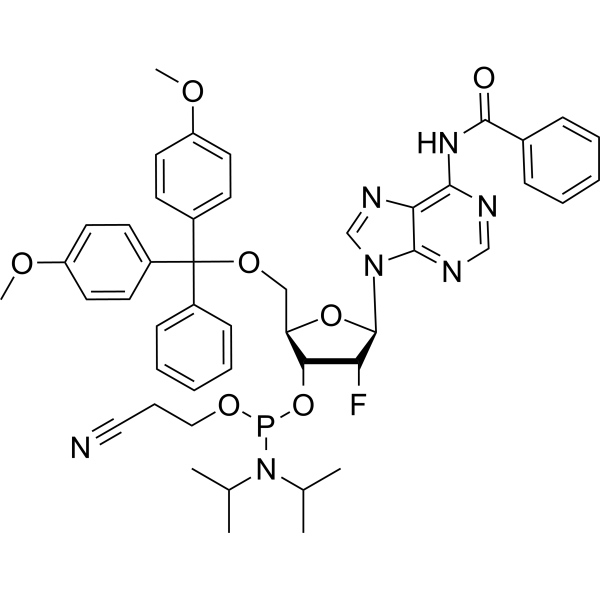 0 ImagesDMT-2'fluoro-da(bz) amidite is a key intermediate for synthesizing antisense oligonucleotides with high nuclease resistance, high RNA binding affinity, and maintained base-pair specificity.

-
tert-Butyl (R)-3-(4-chlorophenyl)piperazine-1-carboxylate
 0 ImagesCat. No.: HY-W037792CAS No.: 1228556-99-7tert-Butyl (R)-3-(4-chlorophenyl)piperazine-1-carboxylate is a drug intermediate for synthesis of various active compounds.
-
(S)-4-Benzyl-3-(5-bromopentanoyl)oxazolidin-2-one
 0 Images(S)-4-Benzyl-3-(5-bromopentanoyl)oxazolidin-2-one is a drug intermediate for synthesis of various active compounds.
-
Theophylline impurity 9
 0 ImagesCat. No.: HY-W087424CAS No.: 42772-85-0

-
2-Methylthiophene
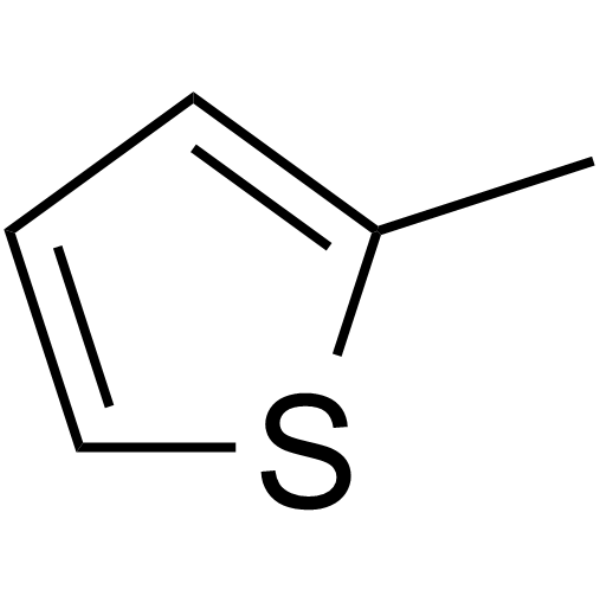 0 Images4-Methylthiophene is an intermediate used in the synthesis of the aromatic sulfur compounds.
-
D-Ribose 1,5-diphosphate
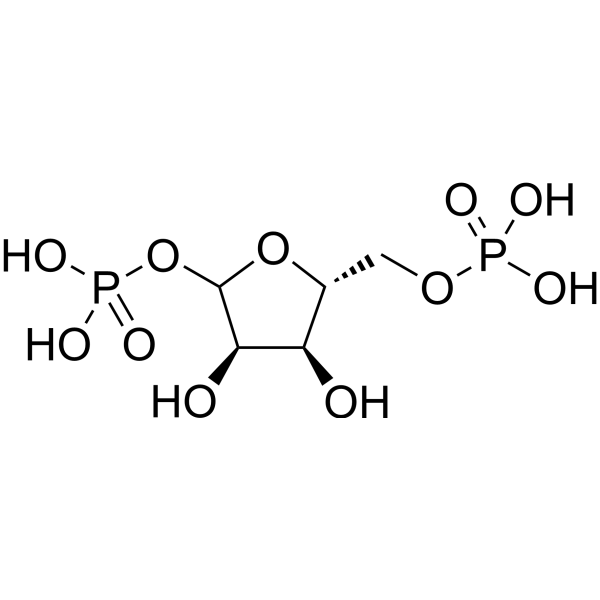 0 ImagesCat. No.: HY-114327CAS No.: 14689-84-0Synonyms: R15PD-Ribose 1,5-diphosphate (R15P) is a metabolic intermediate and enzyme substrate. Purified Tk-E2b2 converts D-Ribose 1,5-diphosphate into Ribulose-1,5-bisphosphate, with a specific activity of 32.3 μmol min-1 mg-1[1].
-
Benzyl (3aS,4R,6S,6aR)-6-hydroxy-2,2-dimethyltetrahydro-3aH-cyclopenta[d][1,3]dioxol-4-ylcarbamate
![Benzyl (3aS,4R,6S,6aR)-6-hydroxy-2,2-dimethyltetrahydro-3aH-cyclopenta[d][1,3]dioxol-4-ylcarbamate](https://file.medchemexpress.com/product_pic/hy-76819.gif "Click to View Benzyl (3aS,4R,6S,6aR)-6-hydroxy-2,2-dimethyltetrahydro-3aH-cyclopenta[d][1,3]dioxol-4-ylcarbamate Product Detail") 0 ImagesBenzyl (3aS,4R,6S,6aR)-6-hydroxy-2,2-dimethyltetrahydro-3aH-cyclopenta[d][1,3]dioxol-4-ylcarbamate is a drug intermediate for synthesis of various active compounds.
0 ImagesBenzyl (3aS,4R,6S,6aR)-6-hydroxy-2,2-dimethyltetrahydro-3aH-cyclopenta[d][1,3]dioxol-4-ylcarbamate is a drug intermediate for synthesis of various active compounds.
-
4-Acetoxycinnamic acid
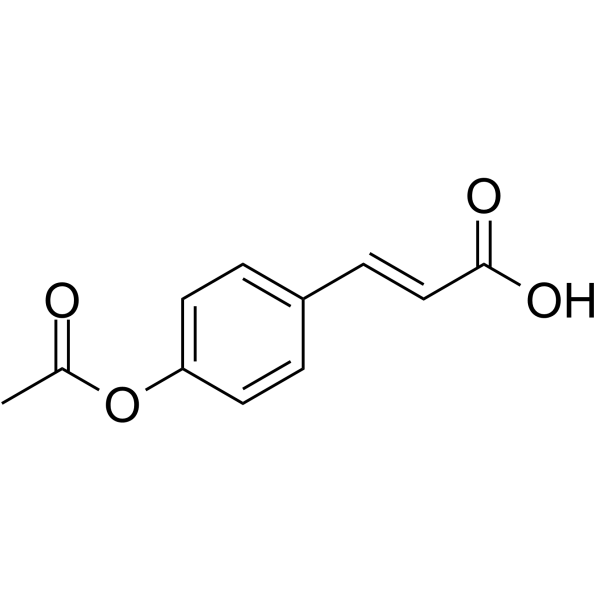 0 Images4-Acetoxycinnamic acid is an acetate ester obtained by the formal condensation of the hydroxy group of trans-4-coumaric acid with acetic acid. 4-Acetoxycinnamic acid is a member of cinnamic acids and a member of phenyl acetates. 4-Acetoxycinnamic acid derives from a trans-4-coumaric acid.

-
4-Chloro-3-nitrobenzoic acid
 0 Images4-Chloro-3-nitrobenzoic acid is a benzoic acid derivative and an important intermediate for the synthesis of anticancer agents. 4-Chloro-3-nitrobenzoic acid shows low cytotoxicity against HepG2, A549 and HeLa cancer cells in vitro (>10,000 μM). 4-Chloro-3-nitrobenzoic acid can block thymidine uptake and inhibit lymphocyte growth. 4-Chloro-3-nitrobenzoic acid serves as a ligand for Cu (II) complexes and is used in the preparation of 10H-pyrazino[2,3-b][1,4]benzothiazine derivatives.
-
Antibacterial agent 265
 0 ImagesAntibacterial agent 265 (Compound 2) is an antibacterial agent. Antibacterial agent 265 shows antibacterial activity against Staphylococcus Aureus, Micrococcus Luteus, Bacillus subtilis, gram-negative Escherichia coli, Pseudomonas aeruginosa and Flavobacterium devorans.
-
tert-Butyl chlorosulfonylcarbamate compound with 1,4-diazabicyclo[2.2.2]octane (1:2)
![tert-Butyl chlorosulfonylcarbamate compound with 1,4-diazabicyclo[2.2.2]octane (1:2)](https://file.medchemexpress.com/product_pic/hy-78394.gif "Click to View tert-Butyl chlorosulfonylcarbamate compound with 1,4-diazabicyclo[2.2.2]octane (1:2) Product Detail") 0 ImagesCat. No.: HY-78394CAS No.: 2443502-73-4tert-Butyl chlorosulfonylcarbamate compound with 1,4-diazabicyclo[2.2.2]octane (1:2) is a drug intermediate for synthesis of various active compounds.
0 ImagesCat. No.: HY-78394CAS No.: 2443502-73-4tert-Butyl chlorosulfonylcarbamate compound with 1,4-diazabicyclo[2.2.2]octane (1:2) is a drug intermediate for synthesis of various active compounds.
-
Copper(I) thiocyanate
 0 ImagesCat. No.: HY-W075796CAS No.: 1111-67-7Copper (I) thiocyanate is a monovalent copper pseudohalide that exists in two crystalline forms, α and β, both containing bridging thiocyanate groups. Copper (I) thiocyanate can form coordination complexes with ligands such as triphenylphosphine and pyridine.
-
3-Oxo-2,3-dihydro-1H-indazole-5-carboxylic acid
 0 Images3-Oxo-2,3-dihydro-1H-indazole-5-carboxylic acid is a drug intermediate for synthesis of various active compounds.



