



1-Phenyl-1-propanol

Based on 1 Customer Validation
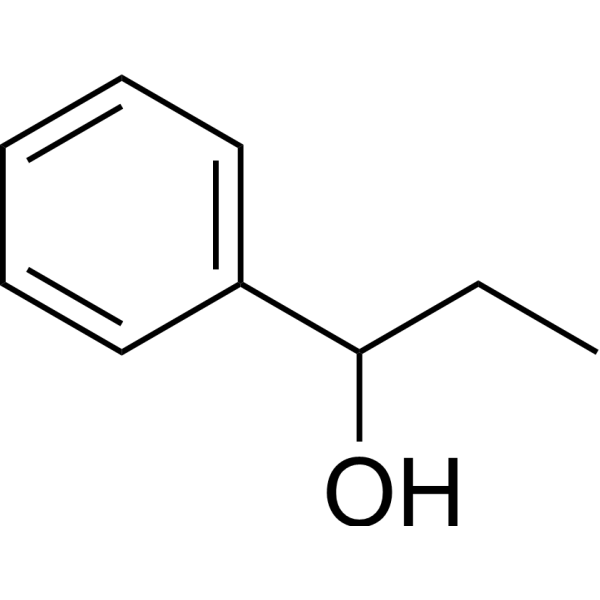
1-Phenyl-1-propanol is an isomer of phenylpropanol. 1-Phenyl-1-propanol can serve as a fragrance or flavor enhancer, and as a chiral intermediate in the synthesis of Fluoxetine (HY-B0102).
For research use only. We do not sell to patients.
- Purity : 99.95%
- CAS No.: 93-54-9
- Formula: C9H12O
- Molecular Weight:136.19
-
Storage:Pure form -20°C, 3 years , 4°C, 2 years ; In solvent -80°C, 6 months , -20°C, 1 month

To place orders, for customer services and technical support, please contact: MedChemExpress USA
Tel: 609-228-6898 E-mail: [email protected] [email protected]


-
 Biological Activity
-
Chemical Information
-
Solvent & Solubility
- Purity & Documentation
- References
-
 Help & FAQs




Biological Activity
Description
In Vitro
FT-IR spectroscopic analysis of 1-phenyl-1-propanol (4000-400 cm-1) confirms that O-H vibrations are unaffected by other functional groups, while C-H out-of-plane and C=C stretching vibrations are influenced by the substitutional group[2].
FT-Raman spectroscopic analysis of 1-phenyl-1-propanol (4000-100 cm-1) confirms the vibrational assignments, with O-H vibrations unaffected by other groups and C-H and C=C vibrations influenced by the substitutional group[2].
The HOMO-LUMO analysis of 1-phenyl-1-propanol indicates that the compound is chemically stable with a high chemical hardness of 3.16 eV and moderate electrophilicity index, and the molecule has strong intermolecular interactions due to its dipole moment[2].
The Fukui function analysis of 1-phenyl-1-propanol identifies C4 and C2 as the preferred sites for nucleophilic attack and C1, C3, C5, C6 for electrophilic attack, with C6 showing anomalous nucleophilic behavior due to the O-H group[2].
The MEP map of 1-phenyl-1-propanol shows that the oxygen atom is the most negative region (nucleophilic), while the phenyl ring and O-H hydrogen are electrophilic regions, indicating the molecule's reactive sites[2].
MedChemExpress (MCE) has not independently confirmed the accuracy of these methods. They are for reference only.


Chemical Information
-
CAS No. 93-54-9
-
Appearance Liquid (Density: 0.994 g/cm3)
-
Molecular Weight 136.19
-
Formula C9H12O
-
Color Colorless to light yellow
-
SMILES
CCC(C1=CC=CC=C1)O
-
Shipping
Room temperature in continental US; may vary elsewhere.
-
Storage
Pure form -20°C 3 years 4°C 2 years In solvent -80°C 6 months -20°C 1 month


Solvent & Solubility
In Vitro:
DMSO : 100 mg/mL (734.27 mM; Need ultrasonic; Hygroscopic DMSO has a significant impact on the solubility of product, please use newly opened DMSO)
Please refer to the solubility information to select the appropriate solvent. Once prepared, please aliquot and store the solution to prevent product inactivation from repeated freeze-thaw cycles.
Storage method and period of stock solution: -80°C, 6 months; -20°C, 1 month. When stored at -80°C, please use it within 6 months. When stored at -20°C, please use it within 1 month.
Please refer to the solubility information to select the appropriate solvent. Once prepared, please aliquot and store the solution to prevent product inactivation from repeated freeze-thaw cycles.
Storage method and period of stock solution: -80°C, 6 months; -20°C, 1 month. When stored at -80°C, please use it within 6 months. When stored at -20°C, please use it within 1 month.
Concentration (start) × Volume (start) = Concentration (final) × Volume (final)


Purity & Documentation
-
Data Sheet (283 KB)
-
SDS (393 KB)
- English - EN (393 KB)
- Français - FR (393 KB)
- Deutsch - DE (393 KB)
- Norwegian - NO (393 KB)
- Español - ES (393 KB)
- Swedish - SV (393 KB)
- Italian - IT (393 KB)
- Korean - KR (393 KB)
- Portuguese - PT (393 KB)
-
Handling Instructions (2659 KB)
References


Complete Stock Solution Preparation Table
Please refer to the solubility information to select the appropriate solvent. Once prepared, please aliquot and store the solution to prevent product inactivation from repeated freeze-thaw cycles.
Storage method and period of stock solution: -80°C, 6 months; -20°C, 1 month. When stored at -80°C, please use it within 6 months. When stored at -20°C, please use it within 1 month.
| Optional Solvent | Concentration Solvent Mass | 1 mg | 5 mg | 10 mg | 25 mg |
|---|---|---|---|---|---|
| DMSO | 1 mM | 7.3427 mL | 36.7134 mL | 73.4268 mL | 183.5671 mL |
| 5 mM | 1.4685 mL | 7.3427 mL | 14.6854 mL | 36.7134 mL | |
| 10 mM | 0.7343 mL | 3.6713 mL | 7.3427 mL | 18.3567 mL | |
| 15 mM | 0.4895 mL | 2.4476 mL | 4.8951 mL | 12.2378 mL | |
| 20 mM | 0.3671 mL | 1.8357 mL | 3.6713 mL | 9.1784 mL | |
| 25 mM | 0.2937 mL | 1.4685 mL | 2.9371 mL | 7.3427 mL | |
| 30 mM | 0.2448 mL | 1.2238 mL | 2.4476 mL | 6.1189 mL | |
| 40 mM | 0.1836 mL | 0.9178 mL | 1.8357 mL | 4.5892 mL | |
| 50 mM | 0.1469 mL | 0.7343 mL | 1.4685 mL | 3.6713 mL | |
| 60 mM | 0.1224 mL | 0.6119 mL | 1.2238 mL | 3.0595 mL | |
| 80 mM | 0.0918 mL | 0.4589 mL | 0.9178 mL | 2.2946 mL | |
| 100 mM | 0.0734 mL | 0.3671 mL | 0.7343 mL | 1.8357 mL |


1-Phenyl-1-propanol Related Classifications
HY-W012618 Related Classifications
 Powered by Bioz
Keywords
- 1-Phenyl-1-propanol
- 93-54-9
- Drug Intermediate
- Fukui function analysis
- modified cyclic decapeptides
- nonlinear optical material
- NBO analysis
- TD-DFT calculations
- Hsu method
- HOMO-LUMO analysis
- B3LYP method with 6-311++G(d
- p) basis set
- Free-jet absorption millimetre-wave spectroscopy
- DIPPR Project 801 correlation
- Inhibitor
- inhibitor
- inhibit