



GLP Receptor
GLP Receptor
The GLP receptors contain two family members, GLP-1 receptor (GLP1R, or GLP-1R) and GLP-2 receptor (GLP2R or GLP-1R), activated by the glucagon-like peptides (GLPs). GLPs are s secreted by intestinal cells; causes insulin release; inhibits glucagon secretion, appetite, and energy intake; and delays gastric emptying because GLP receptors are located on the gut, pancreas, brainstem, hypothalamus, and vagal-afferent nerves. GLP-1 has only one known receptor, GLP1R, and regulates gut motility, appetite, islet function, and glucose homeostasis, whereas GLP-2, the agonist of GLP2R, enhances intestinal nutrient absorption. GLP-1R agonists are used to treat diabetes and obesity, and a GLP-2R agonist is approved to treat short bowel syndrome. An investigation of the actions of GLP receptor activation on gallbladder motility has demonstrated that GLP-2 receptor activation increases gallbladder volume in vivo and decreases spontaneous activity in GBSM bundles ex vivo. Like the inhibitory transmitters, which elicit their actions via an adenylate cyclase-protein kinase A-KATP channel pathway, the GLP-2 receptor signals through this same pathway.
All Product Categories
-
GLP Receptor Inhibitors
(17)
View all products
-
GLP Receptor Agonists
(149)
View all products
-
GLP Receptor Antagonists
(9)
View all products
-
GLP Receptor Activators
(14)
View all products
-
GLP Receptor Modulators
(8)
View all products
-
GLP Receptor Inducer
(1)
View all products
-
GLP Receptor Degrader
(1)
View all products
-
GLP Receptor Controls
(2)
View all products
-
GLP Receptor Ligands
(2)
View all products
-
GLP Receptor Related Products (233)
Related Products (233)

-
Antibodies (1)
-
Vurolenatide
 0 ImagesCat. No.: HY-P3389CAS No.: 2434640-83-0Vurolenatide is a long-lasting GLP-1 analogue. Vurolenatide can be studied in research on short bowel syndrome.
-
MEDI-4166
 0 ImagesCat. No.: HY-P992407MEDI-4166 is an antibody-peptide gene fusion molecule of a PCSK9 antibody and a GLP-1 analog. MEDI-4166 is applicable to research related to type 2 diabetes.
-
GLP-1R agonist 15
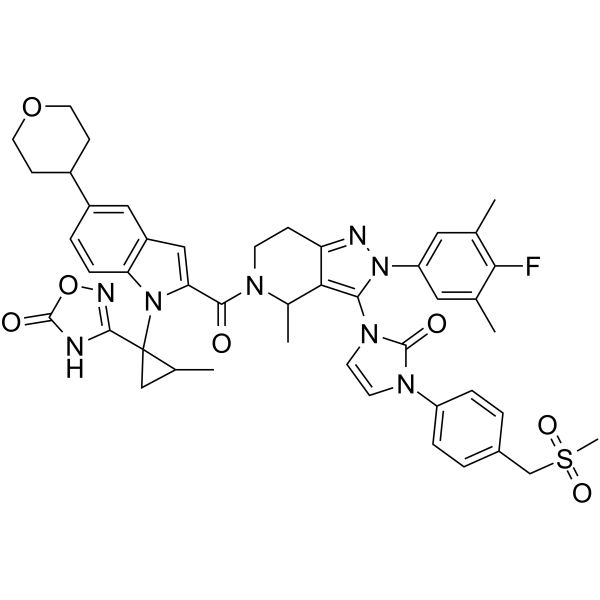 0 ImagesCat. No.: HY-147628CAS No.: 2763621-11-8GLP-1R agonist 15 (Compound 101) is a GLP-1 receptor agonist.
-
GLP-1R agonist 21
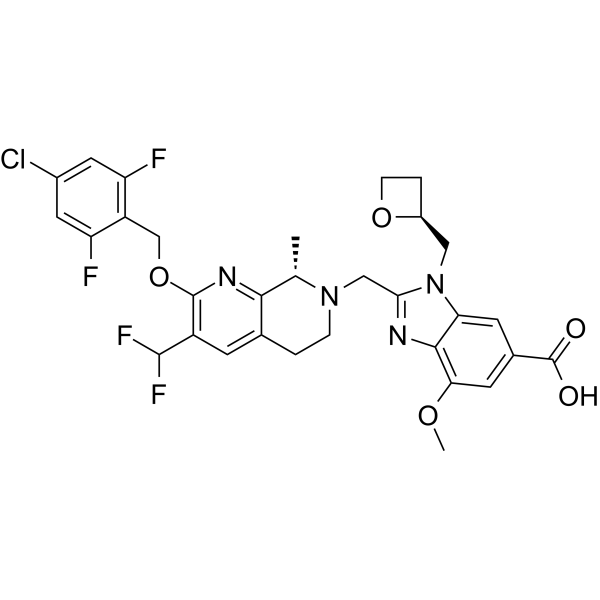 0 ImagesCat. No.: HY-162436CAS No.: 3033288-30-8GLP-1R agonist 21 (Compound I-134) is an agonist for glucagon-like peptide-1 receptor (GLP-1 receptor), with EC50 of 0.0104 nM.
-
FC382K10W15 TFA
 0 ImagesCat. No.: HY-P5161AFC382K10W15 TFA is a glucagon analogue and GLP-1R/GCGR agonist. FC382K10W15 TFA can be used in type 2 diabetes research.
-
Linvixdutide
 0 ImagesCat. No.: HY-P11670CAS No.: 3056608-44-4Linvixdutide is a glucagon and glucagon-like peptide 1 receptor (GLP-1R) agonist with anti-obesity effects.
-
GEP44
 0 ImagesCat. No.: HY-P11043GEP44 is a peptide biased triple agonist targeting Glucagon-like peptide 1 receptor (GLP-1R), neuropeptide Y1 Receptor (Y1-R), and neuropeptide Y2 Receptor (Y2-R). GEP44 induces Y1-R antagonist-controlled, GLP-1R-dependent stimulation of insulin secretion in both rat and human pancreatic islets by counteracting effects of Y1-R and GLP-1R agonism. GEP44 promotes insulin-independent Y1-R-mediated glucose uptake in muscle tissue and significantly reduces food intake and body weight in diet-induced obese rat models. GEP44 can be used for obesity and type 2 diabetes mellitus research.
-
GLP-1 receptor agonist 15
 0 ImagesGLP-1 receptor agonist 15 (Example 4) is a GLP receptor agonist with an EC50 of 0.74 nM. The IC50 for the hERG potassium ion channel is 10.1 μM. GLP-1 receptor agonist 15 can be used for research in the field of diabetes.
-
GLP-1R agonist 19
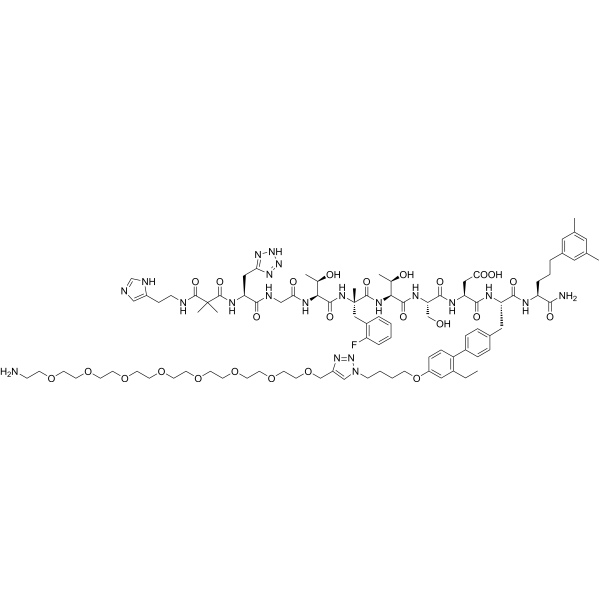 0 ImagesCat. No.: HY-160031CAS No.: 2765065-09-4GLP-1R agonist 19 (M3190) is a potent and selective GLP-1R agonist. GLP-1R agonist 19 has excellent plasma stability, liver microsomal stability, and low hERG toxicity.
-
Retatrutide, Phe22(13C9,15N) TFA
 0 ImagesCat. No.: HY-P3506S1Synonyms: LY3437943, Phe22(13C9,15N) TFARetatrutide, Phe22(13C9,15N) (LY3437943, Phe22(13C9,15N) TFA is the 13C, 15N-labeled Retatrutide (HY-P3506). Retatrutide (LY3437943) is a triple agonist peptide of the glucagon receptor (GCGR), glucosedependent insulinotropic polypeptide receptor (GIPR), and glucagon-like peptide-1 receptor (GLP-1R). Retatrutide binds human GCGR, GIPR, and GLP-1R with EC50 values of 5.79, 0.0643 and 0.775 nM, respectively. Retatrutide can be used for the research of obesity.
-
GLP-1R agonist 20
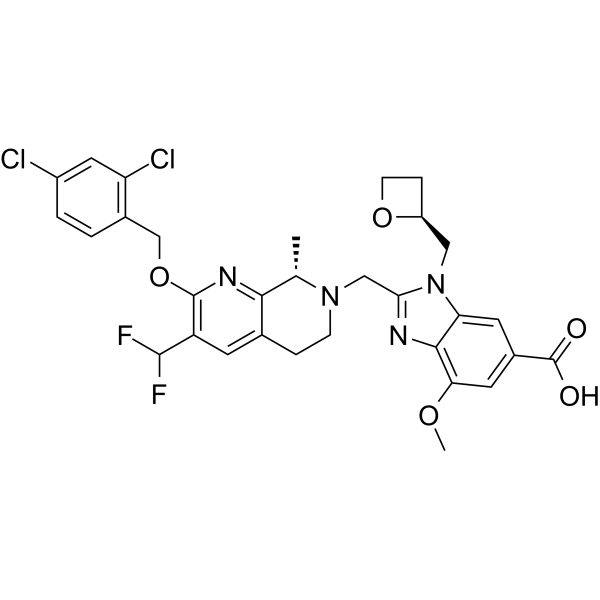 0 ImagesCat. No.: HY-162435CAS No.: 3033288-27-3GLP-1R agonist 20 (Compound I-132) is an agonist for glucagon-like peptide-1 receptor (GLP-1 receptor), with EC50 of 0.0162 nM.
-
G9a-IN-4
 0 ImagesCat. No.: HY-178378G9a-IN-4 is a G9a inhibitor with high selectivity (IC50 = 32 nM). G9a-IN-4 shows high selectivity against the other tested lysine/arginine methyltransferases. G9a-IN-4 exhibits high enzymatic activity against G9a and more potent antiproliferative effects against all tested cancer cells. G9a-IN-4 significantly suppresses the H3K9me2 level. G9a-IN-4 triggers autophagy by inducing the production of ROS, thus leading to cell apoptosis and cell cycle arrest at G0/G1 in CT26 colon cells. G9a-IN-4 can be used for the study of colon cancer.
-
PP18
 0 ImagesCat. No.: HY-P10327PP18 is a novel OXM-based dual GLP-1 and glucagon receptor agonist with EC50 values of 0.487 nM target hGLP-1R and 0.188 nM target hGcgR.
-
GLP-1R agonist 27
 0 ImagesCat. No.: HY-168481CAS No.: 3086417-33-3GLP-1R agonist 27 (compound 21) is a potent and orally active GLP-1R agonist. GLP-1R agonist 27 promots cyclic adenosine monophosphate (cAMP) accumulation. GLP-1R agonist 27 reduces blood glucose levels and food intake. GLP-1R agonist 27 has the potential for the research of obesity and type 2 diabetes mellitus (T2DM).
-
Retatrutide (crude)
 0 ImagesCat. No.: HY-P3506CPCAS No.: 2381089-83-2Synonyms: LY3437943 (crude)Retatrutide (LY3437943) (crude) is the crude form of Retatrutide (HY-P3506). Retatrutide is a triple agonist peptide of the glucagon receptor (GCGR), glucosedependent insulinotropic polypeptide receptor (GIPR), and glucagon-like peptide-1 receptor (GLP-1R). Retatrutide binds human GCGR, GIPR, and GLP-1R with EC50 values of 5.79, 0.0643 and 0.775 nM, respectively. Retatrutide can be used for the research of obesity.
-
DeDPP4
 0 ImagesCat. No.: HY-182336DeDPP4 is a DPP-4 PROTAC degrader. DeDPP4 induces sustained elevation of glucagon-like peptide-1 (GLP-1), enhances glucose tolerance, causes persistent reduction of blood glucose, and achieves long-term blood glucose regulation in animal models of type 2 diabetes. DeDPP4 mediates dose-dependent DPP-4 depletion in cancer cells, and also targets and degrades DPP-4 in the liver and adipose tissues of animal models with type 2 diabetes. DeDPP4 can be used for the research of type 2 diabetes and non-small cell lung cancer.
-
TE-8105
 0 ImagesCat. No.: HY-P11042TE-8105 is a GLP-1 receptor agonist that has demonstrated prolonged and potent efficacy in models of diabetes, obesity, and non-alcoholic steatohepatitis (NASH).
-
(R)-V-0219
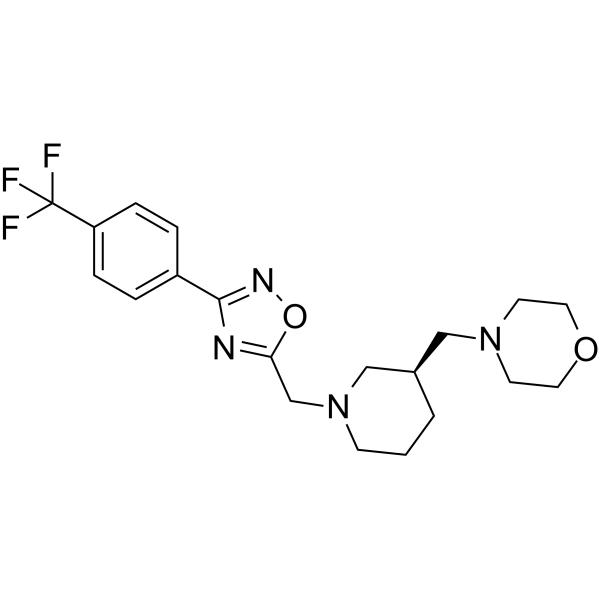 0 ImagesCat. No.: HY-143312BCAS No.: 3031984-80-9(R)-V-0219 is an enantiomer of V-0219 (HY-143312). V-0219 is an orally active and positive allosteric modulator (PAM) of the GLP Receptor-1 (GLP-1R). (R)-V-0219 activates calcium fluxes in HEK cells stably expressing hGLP-1R.
-
K-757
 0 ImagesCat. No.: HY-175420CAS No.: 2696409-13-7K-757 is an orally active, gut-targeted GPR40 agonist with EC50 values of 2.1 nM, 5.6 nM, 4.2 nM and 166 nM in humans, mice, rats and dogs, respectively. K-757 activates nutrient receptors co-expressed on pancreatic β cells and intestinal enteroendocrine cells. K-757 mediates and induces the secretion of satiety hormones GLP-1 and PYY in multiple in vitro and in vivo models. When used in combination with GPR119 agonist K-833, K-757 acts as a potentiator to elevate circulating levels of satiety hormones. K-757 can be used in the research of type 2 diabetes, weight loss and other related metabolic disorders.
-
Zabopegdutide
 0 ImagesCat. No.: HY-P11673CAS No.: 2468152-46-5




