



Deuruxolitinib

Based on 1 Customer Validation
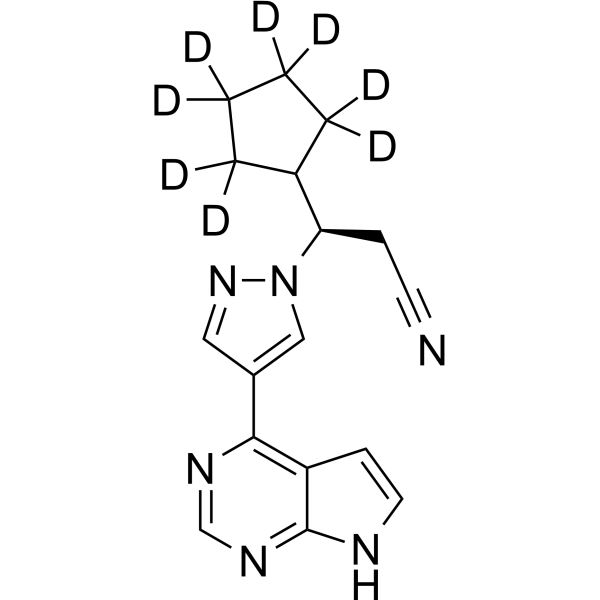
Deuruxolitinib (CTP-543; Ruxolitinib-d8) is a deuterated analog of Ruxolitinib (HY-50856) and an orally active, selective inhibitor of JAK1 and JAK2. Deuruxolitinib blocks Janus kinase-mediated cytokine receptor signaling and proinflammatory cytokine gene expression. Deuruxolitinib is primarily metabolized in the liver via CYP2C9. Deuruxolitinib promotes scalp hair regrowth in severe chronic alopecia areata. Deuruxolitinib is used in alopecia areata-related research.
For research use only. We do not sell to patients.
- Purity : 99.18%
- CAS No.: 1513883-39-0
- Formula: C17H10D8N6
- Molecular Weight:314.41
-
Storage:Powder -20°C, 3 years ; In solvent -80°C, 6 months , -20°C, 1 month

To place orders, for customer services and technical support, please contact: MedChemExpress USA
Tel: 609-228-6898 E-mail: [email protected] [email protected]


-
 Biological Activity
-
Chemical Information
-
Solvent & Solubility
- Protocols
- Purity & Documentation
- References
-
 Help & FAQs




Biological Activity
Description
|
JAK1 |
JAK2 |
Tyk2 |
In Vitro
Stable heavy isotopes of hydrogen, carbon, and other elements have been incorporated into candidate compounds, largely as tracers for quantitation during the development process. Deuteration has gained attention because of its potential to affect the pharmacokinetic and metabolic profiles of candidate compounds[2].
Potential advantages of deuterated compounds:
(1) Extend the half-life in vivo. Deuterated compounds may be able to prolong the pharmacokinetic characteristics of the compound, that is, prolong the half-life in vivo. This can improve compound safety, efficacy and tolerability, and increase ease of administration.
(2) Improve oral bioavailability. Deuterated compounds may reduce the degree of unwanted metabolism (first-pass metabolism) in the gut wall and liver, allowing a greater proportion of the unmetabolized candidate compound to reach its target site of action. High bioavailability determines its activity at low doses and better tolerance.
(3) Improve metabolic characteristics. Deuterated compounds may reduce the formation of toxic or reactive metabolites and improve compound metabolism.
(4) Improve compound safety. Deuterated compounds may reduce or eliminate adverse side effects of candidate compounds and are safe.
(5) Preserve the therapeutic properties. Deuterated compounds are expected to retain similar biochemical potency and selectivity to hydrogen analogs in previous studies.
MedChemExpress (MCE) has not independently confirmed the accuracy of these methods. They are for reference only. Further protocols information, click here.
Clinical Trial
| NCT Number | Sponsor | Condition | Start Date |
Phase

|
|---|---|---|---|---|
| NCT01329991 | Plexxikon| | 2011-05 | PHASE1 |
Application
1. This compound can be used as a tracer
2. This compound can be used as an internal standard for quantitative analysis by NMR, GC-MS, or LC-MS.


Chemical Information
-
CAS No. 1513883-39-0
-
Unlabeled CAS 941678-49-5
-
Appearance Solid
-
Molecular Weight 314.41
-
Formula C17H10D8N6
-
Color White to off-white
-
SMILES
N#CC[C@@H](N1N=CC(C2=C3C(NC=C3)=NC=N2)=C1)C4C([2H])(C([2H])(C([2H])(C4([2H])[2H])[2H])[2H])[2H]
-
Synonyms
CTP-543; Ruxolitinib-d8; INCB18424-d8
-
Shipping
Room temperature in continental US; may vary elsewhere.
-
Storage
Powder -20°C 3 years In solvent -80°C 6 months -20°C 1 month


Solvent & Solubility
In Vitro:
DMSO : 116.67 mg/mL (371.08 mM; Need ultrasonic; Hygroscopic DMSO has a significant impact on the solubility of product, please use newly opened DMSO)
Please refer to the solubility information to select the appropriate solvent. Once prepared, please aliquot and store the solution to prevent product inactivation from repeated freeze-thaw cycles.
Storage method and period of stock solution: -80°C, 6 months; -20°C, 1 month. When stored at -80°C, please use it within 6 months. When stored at -20°C, please use it within 1 month.
Please refer to the solubility information to select the appropriate solvent. Once prepared, please aliquot and store the solution to prevent product inactivation from repeated freeze-thaw cycles.
Storage method and period of stock solution: -80°C, 6 months; -20°C, 1 month. When stored at -80°C, please use it within 6 months. When stored at -20°C, please use it within 1 month.
Concentration (start) × Volume (start) = Concentration (final) × Volume (final)

Protocols
-
RT-PCR
Reverse transcription technology uses RNA as a template to synthesize DNA. RT-PCR is simple, specific and sensitive, and can be used to detect gene expression levels and expression differences in cells; detect RNA virus content; clone cDNA sequences of specific genes.
-
RNA extraction experimental
By lysing cells, releasing RNA, and removing impurities such as proteins and DNA, high-purity RNA products are finally obtained. The commonly used traditional method is the guanidine isothiocyanate/phenol/chloroform method (Trizol), which is suitable for a variety of animal materials including animal tissues, microorganisms, cultured cells, etc., and most plant materials.
-
Research Protocol for Inflammation-related Diseases
The NLRP3 inflammasome is a cytosolic innate immune signaling platform that integrates priming signals and danger-signal activation to promote caspase-1 activation, maturation of IL-1β and IL-18, and gasdermin D-mediated pyroptotic cell death. The core experimental logic is to determine whether inflammatory disease phenotypes are driven by increased NLRP3 expression, ASC-containing inflammasome assembly, caspase-1 cleavage, GSDMD cleavage, and extracellular release of IL-1β/IL-18 rather than by nonspecific cell injury alone. The pathway is strongly linked to inflammation-related disease phenotypes because monosodium urate crystals activate NALP3/NLRP3 inflammasome signaling in gout-like crystal inflammation, cholesterol crystals activate NLRP3 inflammasomes in atherogenesis models, and DSS-induced intestinal inflammation has been reported to involve NLRP3 inflammasome activity. However, experimental colitis studies also show context-dependent protective effects of NLRP3 inflammasome co
-
Real Time qPCR (Q-PCR)
Real-time quantitative PCR (qPCR) quantifies an amplifiable nucleic-acid target by monitoring fluorescence during PCR cycling rather than measuring product only after amplification. The increase in fluorescence tracks accumulation of PCR product, and the quantification cycle (Cq; historically also Ct/CP) is related to the initial amount of target: samples containing more starting target generally reach the defined fluorescence threshold in fewer cycles.


Purity & Documentation
-
Data Sheet (291 KB)
-
SDS (252 KB)
- English - EN (252 KB)
- Français - FR (252 KB)
- Deutsch - DE (252 KB)
- Norwegian - NO (252 KB)
- Español - ES (252 KB)
- Swedish - SV (252 KB)
- Italian - IT (252 KB)
- Korean - KR (252 KB)
- Portuguese - PT (252 KB)
-
Handling Instructions (2659 KB)
References


Complete Stock Solution Preparation Table
Please refer to the solubility information to select the appropriate solvent. Once prepared, please aliquot and store the solution to prevent product inactivation from repeated freeze-thaw cycles.
Storage method and period of stock solution: -80°C, 6 months; -20°C, 1 month. When stored at -80°C, please use it within 6 months. When stored at -20°C, please use it within 1 month.
| Optional Solvent | Concentration Solvent Mass | 1 mg | 5 mg | 10 mg | 25 mg |
|---|---|---|---|---|---|
| DMSO | 1 mM | 3.1806 mL | 15.9028 mL | 31.8056 mL | 79.5140 mL |
| 5 mM | 0.6361 mL | 3.1806 mL | 6.3611 mL | 15.9028 mL | |
| 10 mM | 0.3181 mL | 1.5903 mL | 3.1806 mL | 7.9514 mL | |
| 15 mM | 0.2120 mL | 1.0602 mL | 2.1204 mL | 5.3009 mL | |
| 20 mM | 0.1590 mL | 0.7951 mL | 1.5903 mL | 3.9757 mL | |
| 25 mM | 0.1272 mL | 0.6361 mL | 1.2722 mL | 3.1806 mL | |
| 30 mM | 0.1060 mL | 0.5301 mL | 1.0602 mL | 2.6505 mL | |
| 40 mM | 0.0795 mL | 0.3976 mL | 0.7951 mL | 1.9879 mL | |
| 50 mM | 0.0636 mL | 0.3181 mL | 0.6361 mL | 1.5903 mL | |
| 60 mM | 0.0530 mL | 0.2650 mL | 0.5301 mL | 1.3252 mL | |
| 80 mM | 0.0398 mL | 0.1988 mL | 0.3976 mL | 0.9939 mL | |
| 100 mM | 0.0318 mL | 0.1590 mL | 0.3181 mL | 0.7951 mL |


Deuruxolitinib Related Classifications
HY-50856S Related Classifications
 Powered by Bioz