12 Results for "

Camellia sinensis

" in MedChemExpress (MCE) Product Catalog:
Products (12)

12 Results for "Camellia sinensis" in MCE Product Catalog:

Cat. No.: HY-N2524
CAS No.: 135095-52-2
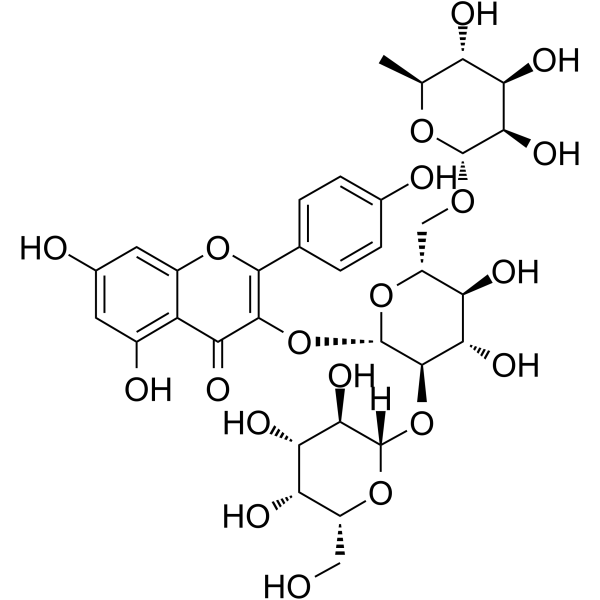
Camelliaside A is a phytochemical and also a HER2 ligand. Camelliaside A shows no inhibitory effect on mycelial growth of Rhizoctonia solani, indicating no antifungal activity against this pathogen. Camelliaside A is applicable to breast cancer-related research .
loading...
    loading...
Cat. No.: HY-N12153
CAS No.: 220114-30-7
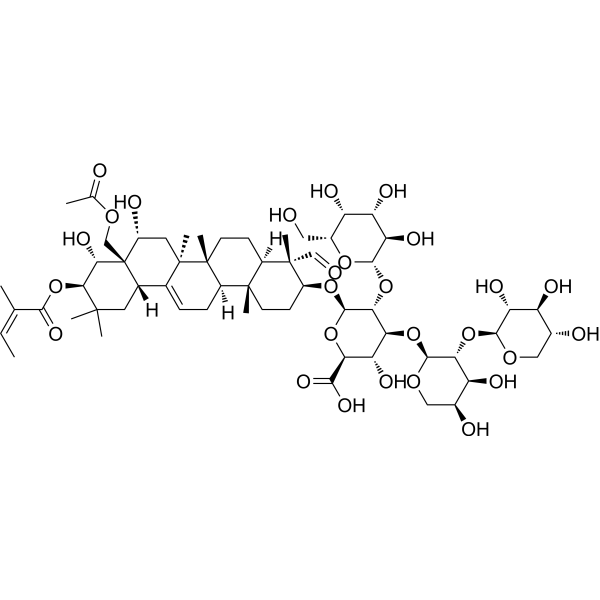
Theasaponin E2 shows cytotoxicity against K562 and HL60 cells (IC50: 14.7 μg/mL). Theasaponin E2 can be isolated from Camellia sinensis .
loading...
    loading...
Cat. No.: HY-17517
CAS No.: 223580-51-6
Research Areas:  

Infection

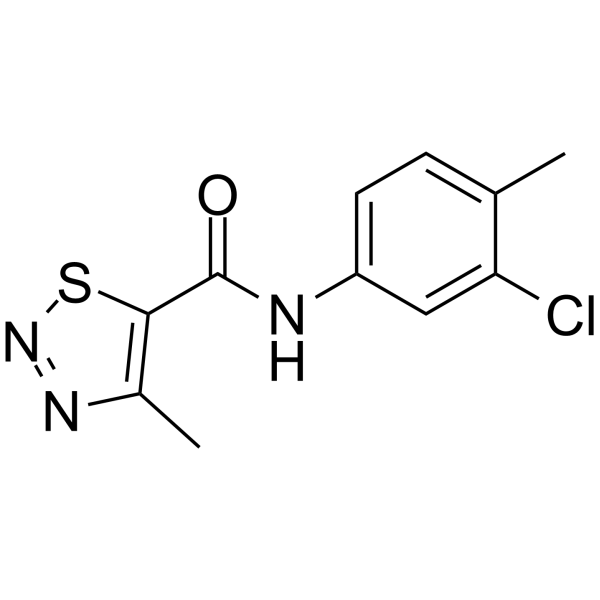
Tiadinil is a systemic acquired resistance (SAR) inducer, plant elicitor and antifungal agent. Tiadinil promotes the production of herbivore-induced plant volatiles in Camellia sinensis (tea plant). Tiadinil inhibits mycelial growth, spore germination and germ tube elongation of Stagonosporopsis citrulli in vitro. Tiadinil can be used in studies related to vine blight .
loading...
    loading...
Cat. No.: HY-W711045
CAS No.: 2609-23-6
Deoxygeraniol, a monoterpenoid, has been reported in Camellia sinensis, Magnolia sieboldii, and Zingiber officinale. It is commonly used as an intermediate in the synthesis of fragrances or flavorings.
loading...
    loading...
Cat. No.: HY-N21158
Camellia sinensis polysaccharide is a polysaccharide derived from Camellia sinensis.
loading...
    loading...
Cat. No.: HY-N21452
Camellia sinensis seed polysaccharide is a polysaccharide derived from Camellia sinensis seed.
loading...
    loading...
Cat. No.: HY-N19888
CAS No.: 403480-85-3
β-Maltoside is a 2-phenylethyl glycoside. β-Maltoside resists hydrolysis by purified β-primeverosidase derived from fresh Camellia sinensis var. sinensis cv. Yabukita leaves .
loading...
    loading...
Cat. No.: HY-N20574
Category:  

Extract

Target:  

Others

White tea extract is an extract of white tea (Camellia sinensis) that has anti-inflammatory and antioxidant properties.
loading...
    loading...
Cat. No.: HY-N20409
Category:  

Extract

Target:  

Others

Black tea root extract is an extract from the root of black tea (Camellia sinensis) that can be used to protect teeth.
loading...
    loading...
Cat. No.: HY-N17379
CAS No.: 194292-73-4
Camelliquercetiside D is a natural product. Camelliquercetiside D can be isolated from the leaves of Camellia sinensis. Camelliquercetiside D inhibits alcohol dehydrogenase, with an IC50 of 41.5 μM against yeast ADH. Camelliquercetiside D exhibits scavenging activity against DPPH .
loading...
    loading...
Cat. No.: HY-N17378
CAS No.: 1365758-45-7
Camelliquercetiside B is a natural product. Camelliquercetiside B can be isolated from the leaves of Camellia sinensis. Camelliquercetiside B inhibits alcohol dehydrogenase (Alcohol dehydrogenase), with an IC50 of 13.7 μM against yeast alcohol dehydrogenase. Camelliquercetiside B exhibits scavenging activity against DPPH free radicals .
loading...
    loading...
Cat. No.: HY-W747972A
CAS No.: 6789-80-6
(Z)-3-Hexenal is an isomer of Hydrosorbaldehyde (HY-W747972). (Z)-3-Hexenal is a green leaf volatile and also the main contributor to the fresh, grassy aroma of tea leaves. (Z)-3-Hexenal undergoes irreversible conversion to (E)-2-hexenal via (Z)-3:(E)-2-hexenal isomerase (CsHI). (Z)-3-Hexenal plays a key role in protecting plants against biotic stresses (such as pathogens and insects) and acting as a signaling chemical .
loading...
    loading...
  • 1

