14 Results for "

HCC1937 cell

" in MedChemExpress (MCE) Product Catalog:
Products (14)

14 Results for "HCC1937 cell" in MCE Product Catalog:

1
1 Cited Publications
Cat. No.: HY-133120
CAS No.: 2503017-97-6
Purity:  99.74%
Target:  

PROTACs Akt

Research Areas:  

Cancer

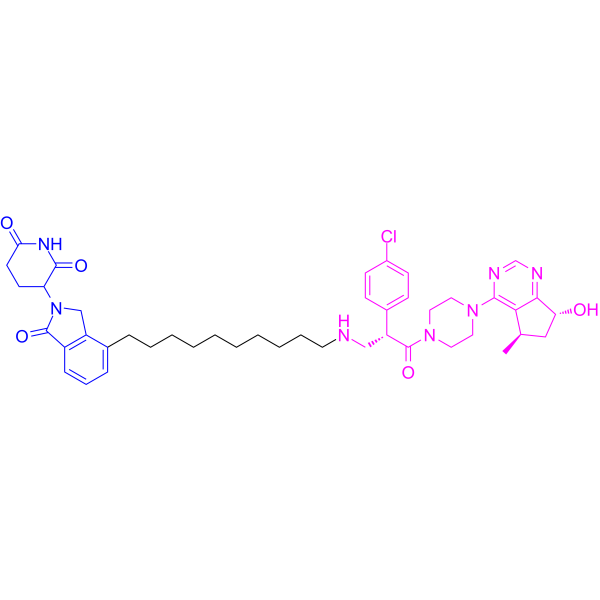
INY-03-041 is a potent, highly selective and PROTAC-based pan-AKT degrader consisting of the ATP-competitive AKT inhibitor Ipatasertib (HY-15186) conjugated to Lenalidomide (HY-A0003, Cereblon ligand). INY-03-041 inhibits AKT1, AKT2 and AKT3 with IC50s of 2.0, 6.8 and 3.5 nM, respectively .
loading...
    loading...
1
1 Cited Publications
Cat. No.: HY-133120A
Purity:  99.27%
Target:  

PROTACs Akt

Research Areas:  

Cancer

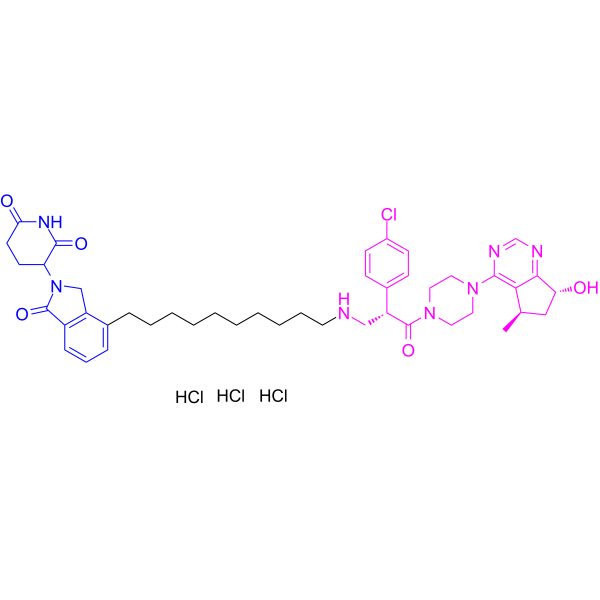
INY-03-041 trihydrochloride is a potent, highly selective and PROTAC-based pan-AKT degrader consisting of the ATP-competitive AKT inhibitor Ipatasertib (HY-15186) conjugated to Lenalidomide (HY-A0003). INY-03-041 trihydrochloride inhibits AKT1, AKT2 and AKT3 with IC50s of 2.0, 6.8 and 3.5 nM, respectively .
loading...
    loading...
1
1 Cited Publications
Cat. No.: HY-W009300
CAS No.: 3131-23-5
Synonyms: 4-OHE1
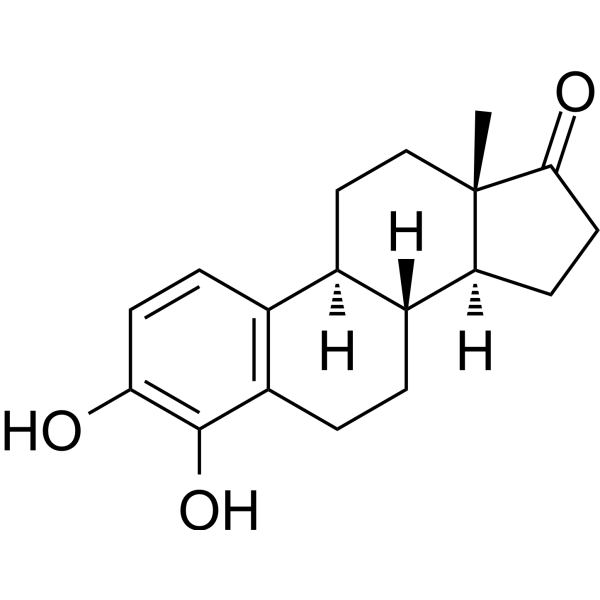
4-Hydroxyestrone (4-OHE1) is a brain-penetrant estrogen metabolite. 4-Hydroxyestrone shows neuroprotective effects involving increased cytoplasmic localization of p53 resulting from SIRT1-mediated p53 deacetylation. 4-Hydroxyestrone relies on PDI to mediate its protective effect against chemically induced ferroptosis in estrogen receptor-negative cancer cells. 4-Hydroxyestrone inhibits lipid peroxidation and lipid-ROS accumulation. 4-Hydroxyestrone blocks preovulatory luteinizing hormone surges in Rattus norvegicus. 4-Hydroxyestrone can be used for the researches of neurodegeneration, breast cancer and endocrine disease .
loading...
    loading...
Cat. No.: HY-U00447
CAS No.: 38275-34-2
Research Areas:  

Cancer

PK11000 is an alkylating agent, and stabilizes the DNA-binding domain of both WT and mutant p53 proteins by covalent cysteine modification without compromising DNA binding. PK11000 has anti-tumor activities .
loading...
    loading...
Cat. No.: HY-149086
Research Areas:  

Cancer

BPA-B9 is a RXRα ligand and antagonist targeting the pRXRα-PLK1 interaction. BPA-B9 has excellent RXRα-binding affinity (KD=39.29 ± 1.12 nM). BPA-B9 inhibits the proliferation of cancer cells by inducing mitotic arrest and cell apoptosis .
loading...
    loading...
Cat. No.: HY-155993
CAS No.: 3032451-66-1
Purity:  99.39%
Target:  

PARP

Research Areas:  

Cancer

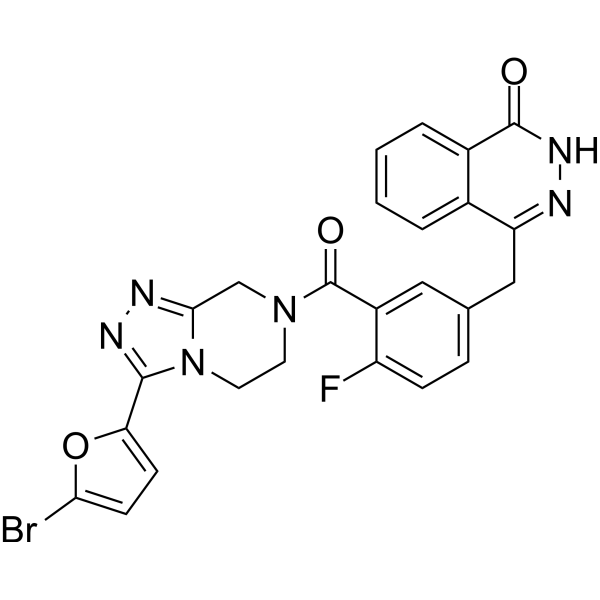
YCH1899 is an orally active PARP inhibitor, with an IC50< 0.001 nM for PARP1/2. YCH1899 exhibits distinct antiproliferation activity against Olaparib (HY-10162)-resistant and Talazoparib (HY-16106)-resistant Capan-1 cells (Capan-1/OP and Capan-1/TP cells) , with IC50 values of 0.89 and 1.13 nM, respectively. YCH1899 has acceptable pharmacokinetic properties in rats .
loading...
    loading...
Cat. No.: HY-161934
Research Areas:  

Cancer

PARP1-IN-27 (Compound 9B) is the inhibitor for PARP1 and PARP2, with IC50 of 2.53 nM and 6.45 nM in cell SUM149PT. PARP1-IN-27 inhibits the proliferation of BRCA-mutated cancer cells SUM149PT, HCC1937 and Capan-1, with IC50 of 0.62, 1.91 and 4.26 μM respectively. PARP1-IN-27 aggravates DNA double-strand breaks, increases ROS generation, arrests cell cycle at G2/M phase, and induces apoptosis in SUM149PT .
loading...
    loading...
Cat. No.: HY-170321
Target:  

Apoptosis

Research Areas:  

Cancer

Apoptosis inducer 31 (compound 19) induces caspase-dependent apoptosis. Apoptosis inducer 31 plays an important role in cancer research .
loading...
    loading...
Cat. No.: HY-187532
Research Areas:  

Cancer

PFKL-IN-1 is an orally active PFKL inhibitor, with a human-derived IC50 value of 52.63 nM and a Kd of 0.24 μM. PFKL-IN-1 directly binds to PFKL and inhibits its enzymatic activity. PFKL-IN-1 inhibits glycolysis, induces apoptosis and suppresses cell proliferation in breast cancer cells. PFKL-IN-1 exhibits antitumor efficacy in mouse models and enhances the therapeutic effect of anti-PD-L1 agents. PFKL-IN-1 can be used in breast cancer-related research .
loading...
    loading...
Cat. No.: HY-187473
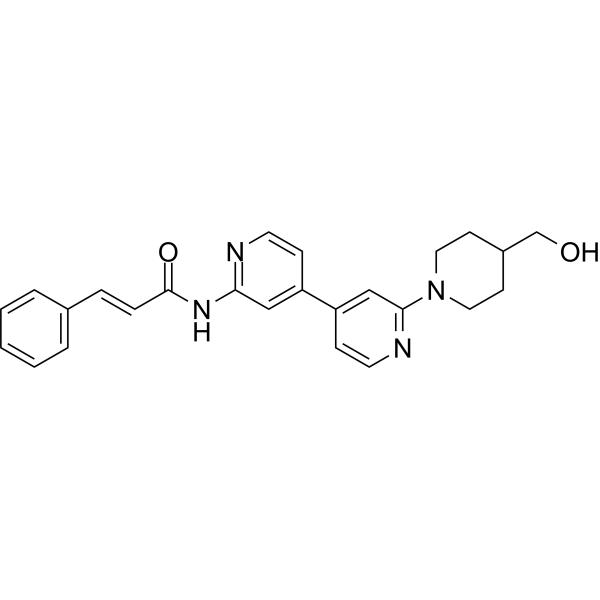
PARP1-IN-58 is a ROS-responsive prodrug constructed based on a natural stilbene scaffold, and its active parent nucleus 24c acts as a selective PARP-1 inhibitor. PARP1-IN-58 only hydrolyzes to release the active parent compound in the high-ROS microenvironment of tumors; the active parent compound competitively binds to PARP-1 and blocks DNA single-strand damage repair, upregulates intracellular ROS levels, reduces mitochondrial membrane potential, and thereby induces cell cycle arrest and mitochondria-dependent apoptosis. PARP1-IN-58 exerts potent proliferation-inhibiting effects on BRCA-deficient breast cancer cells under simulated tumor oxidative stress conditions, and exhibits tumor growth inhibitory activity in breast cancer xenograft models. PARP1-IN-58 can be used in cancer-related research .
loading...
    loading...
Cat. No.: HY-181928
CAS No.: 3123529-62-1
Target:  

c-Met/HGFR PARP Apoptosis

Research Areas:  

Cancer

PARP1/c-Met-IN-3 (Compound L19) is a selective c-Met and PARP1 inhibitor, with an IC50 of 5.4 nM against c-Met and an IC50 of 3.7 nM against PARP1. PARP1/c-Met-IN-3 inhibits PARP2 enzymatic activity with an IC50 of 4.52 nM, and shows no specificity for PARP1 and PARP2. PARP1/c-Met-IN-3 induces cell cycle arrest and apoptosis. PARP1/c-Met-IN-3 exhibits anti-tumor activity against triple-negative breast cancer .
loading...
    loading...
Cat. No.: HY-183765
Target:  

PARP Pyruvate Kinase

Research Areas:  

Cancer

PARP1/PKM2-IN-1 is a dual PARP1/PKM2 inhibitor, with an IC50 of 39.5 nM against PARP1, and IC50 values of 261 nM (recombinant PKM2) and 50 nM (dimeric PKM2) against PKM2. PARP1/PKM2-IN-1 reduces the dimerization of PKM2 and decreases its nuclear accumulation level. PARP1/PKM2-IN-1 also selectively downregulates PKM2 mRNA and impairs poly (ADP-ribose)-mediated nuclear retention of PKM2. PARP1/PKM2-IN-1 exhibits antiproliferative activity and inhibits the formation of 3D cancer spheroids. PARP1/PKM2-IN-1 can be used in research related to mammary adenocarcinoma, triple-negative breast cancer, BRCA1-mutant triple-negative breast cancer, and prostate adenocarcinoma .
loading...
    loading...
Cat. No.: HY-N18190
CAS No.: 146763-55-5
N-Desmethyldauricine is a NF-κB p65 inhibitor and apoptosis inducer. N-Desmethyldauricine reduces the protein expression level of p65, induces apoptosis, arrests the cell cycle at the G0/G1 phase, attenuates intercellular adhesion, and inhibits the growth of 3D spheroids of triple-negative breast cancer. N-Desmethyldauricine can be used in studies related to triple-negative breast cancer .
loading...
    loading...
Cat. No.: HY-183581
CAS No.: 3064481-29-1
Research Areas:  

Cancer

USP1-IN-18 is an orally active USP1 inhibitor with a human IC50 of 17.0 nM. USP1-IN-18 inhibits USP1-UAF1 deubiquitinase activity and drives ubiquitinated PCNA accumulation. USP1-IN-18 induces DNA damage, replication stress, and G2-M phase cell cycle arrest. USP1-IN-18 can be used for the research of triple-negative breast cancer .
loading...
    loading...
  • 1

