
14 Results for "

strychnine

" in MedChemExpress (MCE) Product Catalog:
Products (14)

14 Results for "strychnine" in MCE Product Catalog:

1
1 Cited Publications
Cat. No.: HY-101620
CAS No.: 202808-11-5
Purity:  95.03%
Target:  

iGluR

Research Areas:  

Neurological Disease

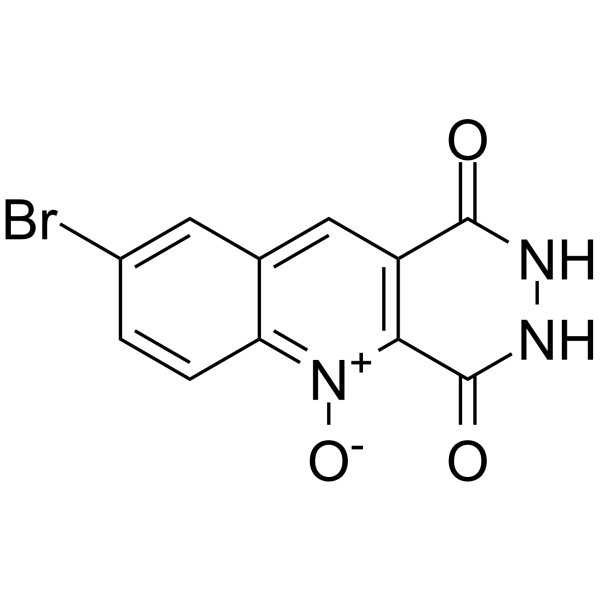
MRZ 2-514 is an antagonist of the strychnine-insensitive modulatory site of the NMDA receptor (glycineB), with Ki of 33 μM.
loading...
    loading...
Cat. No.: HY-W014504
CAS No.: 343-65-7
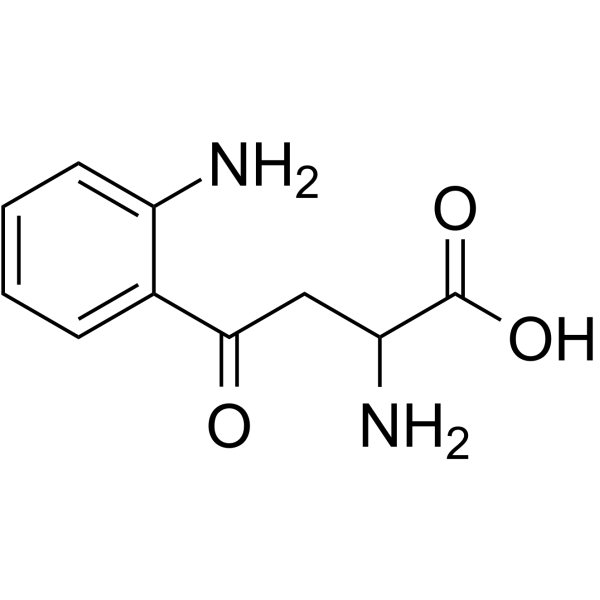
DL-Kynurenine is a key metabolite in the tryptophan metabolic pathway and can cross the blood-brain barrier. DL-Kynurenine has a bidirectional regulatory effect on neural excitability. DL-Kynurenine can enhance the convulsive and lethal effects caused by strychnine. DL-Kynurenine is the precursor of Kynurenic acid (HY-100806), which is an antagonist at the glycine site of NMDA receptors and can counteract excitatory toxins. DL-Kynurenine can be used for research on neurotoxicity .
loading...
    loading...
Cat. No.: HY-159051
CAS No.: 39775-75-2
Dragendorff reagent is a potassium bismuth iodide solution composed of basic bismuth nitrate (Bi (NO3)3), 2,3-Dihydroxysuccinic acid (HY-N2436) and Potassium iodide (HY-Y0283). Dragendorff reagent is used to detect alkaloids and other nitrogen-containing compounds. Dragendorff reagent is applied for rapid screening of herbal products .
loading...
    loading...
Cat. No.: HY-E70012
CAS No.: 9001-74-5
Target:  

Bacterial

Research Areas:  

Infection Neurological Disease

Penicillinase is an enzyme capable of hydrolyzing penicillin. Penicillinase converts penicillin into penicilloic acid, which has no antigenicity, and destroys the antibacterial, antigenic and epileptogenic properties of penicillin. Penicillinase shortens the duration of penicillin-induced seizures and neutralizes the ability of penicillin to form epileptogenic foci. Penicillinase can be used in research related to penicillin hypersensitivity and penicillin-induced encephalopathy .
loading...
    loading...
Cat. No.: HY-W681659
CAS No.: 25967-29-7
Synonyms: KB-509
Target:  

GABA Receptor

Research Areas:  

Neurological Disease

Flutoprazepam (KB-509), a benzodiazepine drug, possesses anticonflict effect. Flutoprazepam (KB-509) prevents maximal electroshock, pentetrazol, and strychnine-induced convulsions in mice .
loading...
    loading...
Cat. No.: HY-19545
CAS No.: 87075-17-0
Synonyms: R-(+)-SCH-23390
Target:  

Dopamine Receptor

Research Areas:  

Neurological Disease

SCH-23390 is a dopamine D1-like receptor antagonist (with Ki values of 0.2 nM and 0.3 nM for the D1 and D5 receptor subtypes, respectively). SCH-23390 can shorten the latency period for cocaine-induced lever pressing behavior in rats. SCH-23390 can also eliminate generalized seizures caused by chemical convulsants, such as arecoline (HY-B0726A) and strychnine, and is used in research on neurological disorders related to the dopamine system .
loading...
    loading...
Cat. No.: HY-121670
CAS No.: 2455-84-7
Target:  

Others

Research Areas:  

Neurological Disease

Ambenoxan is a central nervous system-acting skeletal muscle relaxant that is effective in mice, rats, rabbits, dogs, and monkeys without loss of the righting reflex. It has no peripheral neuromuscular blocking effects and significantly reduces or eliminates decerebrate rigidity in rabbits, but does not antagonize the effects of strychnine, leptazol, or tremorine. Like other central nervous system depressants, ambenoxan prolongs sleep duration with hexobarbitone, but it has no local anesthetic effects. In anesthetized cats, the agent lowers blood pressure and reduces the pressor response to epinephrine, but has no effect on norepinephrine.
loading...
    loading...
Cat. No.: HY-121670A
CAS No.: 1617-99-8
Target:  

Adrenergic Receptor

Research Areas:  

Neurological Disease

Ambenoxan hydrochloride is a central nervous system-acting skeletal muscle relaxant that is effective in mice, rats, rabbits, dogs, and monkeys without loss of the righting reflex. It has no peripheral neuromuscular blocking effects and significantly reduces or eliminates decerebrate rigidity in rabbits, but does not antagonize the effects of strychnine, leptazol, or tremorine. Like other central nervous system depressants, ambenoxan prolongs sleep duration with hexobarbitone, but it has no local anesthetic effects. In anesthetized cats, the agent lowers blood pressure and reduces the pressor response to epinephrine, but has no effect on norepinephrine.
loading...
    loading...
Cat. No.: HY-W014504S1
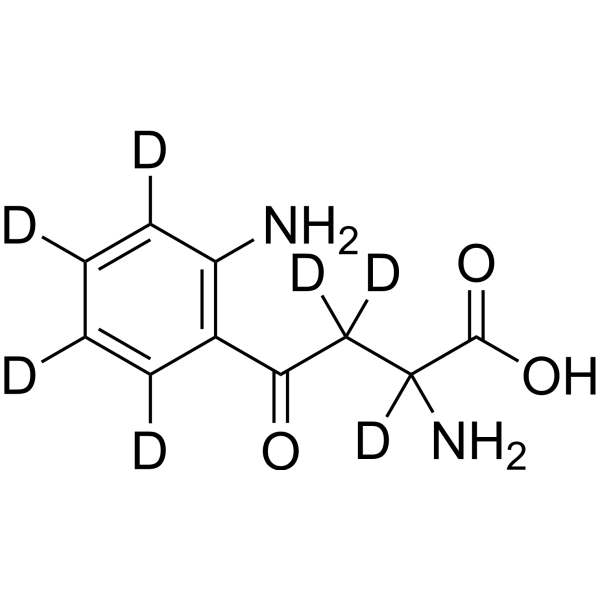
DL-Kynurenine-d7 is the deuterium labeled DL-Kynurenine. DL-Kynurenine is a key metabolite in the tryptophan metabolic pathway and can cross the blood-brain barrier. DL-Kynurenine has a bidirectional regulatory effect on neural excitability. DL-Kynurenine can enhance the convulsive and lethal effects caused by strychnine. DL-Kynurenine is the precursor of Kynurenic acid (HY-100806), which is an antagonist at the glycine site of NMDA receptors and can counteract excitatory toxins. DL-Kynurenine can be used for research on neurotoxicity.
loading...
    loading...
Cat. No.: HY-W014504R
CAS No.: 343-65-7
DL-Kynurenine (Standard) is the analytical standard of DL-Kynurenine. This product is intended for research and analytical applications. DL-Kynurenine is a key metabolite in the tryptophan metabolic pathway and can cross the blood-brain barrier. DL-Kynurenine has a bidirectional regulatory effect on neural excitability. DL-Kynurenine can enhance the convulsive and lethal effects caused by strychnine. DL-Kynurenine is the precursor of Kynurenic acid (HY-100806), which is an antagonist at the glycine site of NMDA receptors and can counteract excitatory toxins. DL-Kynurenine can be used for research on neurotoxicity.
loading...
    loading...
Cat. No.: HY-182479
CAS No.: 130613-18-2
Target:  

iGluR

Research Areas:  

Others Neurological Disease

MDL 100748 is an NMDA receptor glycine site antagonist. MDL 100748 modulates NMDA receptor function by acting at the strychnine-insensitive glycine site, which is required for NMDA receptor activation alongside glutamate. MDL 100748 decreases response rates in operant conditioning sessions in phencyclidin (PCP)-trained rats. MDL 100748 can be used for reserach on dementias and schizophrenia .
loading...
    loading...
Cat. No.: HY-W975902
CAS No.: 116850-44-3
Research Areas:  

Neurological Disease

MDL-27531 acts functionally like a glycine agonist. MDL-27531 selectively reduces hindlimb contractions. MDL-27531 selectively reverses strychnine-induced seizures in mice. MDL-27531 inhibits pentylenetetrazol-induced seizures with an ED50 of 55 mg/kg. MDL-27531 promotes the binding of benzodiazepine antagonist Ro 15-1788 to cerebral cortex of mice without changing GABA levels. MDL-27531 can be studied in research on reflex control dysfunction .
loading...
    loading...
Cat. No.: HY-W291147
CAS No.: 27199-40-2
Target:  

Others

Research Areas:  

Neurological Disease

Pifexole is a biologically active 3,5-disubstituted-1,2,4-oxadiazole compound. Pifexole exhibits antispasmodic and muscle relaxant activities, with no effect on monosynaptic knee-jerk reflex. Pifexole can be used in studies related to muscle relaxation and spasm .
loading...
    loading...
Cat. No.: HY-L071
602 compounds

Alkaloids are a large and complex group of cyclic compounds that contain N. About 2,000 different alkaloids have been isolated. Important alkaloids include morphine, strychnine, atropine, colchicine, ephedrine, quinine, and nicotine. Alkaloids are useful as diet ingredients, supplements, and pharmaceuticals, in medicine and in other applications in human life. They showed anti-inflammatory, anticancer, analgesics, local anesthetic and pain relief, neuropharmacologic, antimicrobial, antifungal, and many other activities. Alkaloids are also important compounds in organic synthesis for searching new semisynthetic and synthetic compounds with possibly better biological activity than parent compounds.

MCE designs a unique collection of 602 alkaloids that all come from natural products. MCE Alkaloids Library is a useful tool for drug discovery that can be used for high throughput screening (HTS) and high content screening (HCS).

  • 1

