



Microtubule/Tubulin
Microtubules are a component of the cytoskeleton, found throughout the cytoplasm. These tubular polymers of tubulin can grow as long as 50 micrometres, with an average length of 25 µm, and are highly dynamic. The outer diameter of a microtubule is about 24 nm while the inner diameter is about 12 nm. Microtubules are found in eukaryotic cells and are formed by the polymerization of a dimer of two globular proteins, alpha and beta tubulin. Tubulin is one of several members of a small family of globular proteins. The tubulin superfamily includes five distinct families, the alpha-, beta-, gamma-, delta-, and epsilon-tubulins and a sixth family which is present only in kinetoplastid protozoa. The most common members of the tubulin family are α-tubulin and β-tubulin, the proteins that make up microtubules. Microtubules are very important in a number of cellular processes. They are involved in maintaining the structure of the cell.
All Product Categories
-
Microtubule/Tubulin Inhibitors
(812)
View all products
-
Microtubule/Tubulin Agonists
(2)
View all products
-
Microtubule/Tubulin Antagonist
(1)
View all products
-
Microtubule/Tubulin Activators
(21)
View all products
-
Microtubule/Tubulin Modulators
(20)
View all products
-
Microtubule/Tubulin Inducers
(5)
View all products
-
Microtubule/Tubulin Degraders
(3)
View all products
-
Microtubule/Tubulin Controls
(19)
View all products
-
Microtubule/Tubulin Ligands
(5)
View all products
-
Microtubule/Tubulin Related Products (1003)
Related Products (1003)

-
Antibodies (69)
-
Monomethyl auristatin E intermediate-12
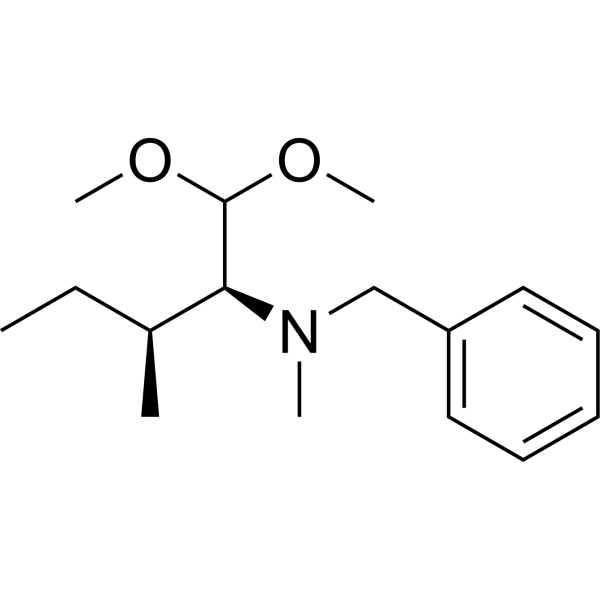 0 ImagesCat. No.: HY-78910CAS No.: 870640-61-2Monomethyl auristatin E intermediate-12 is an intermediate reagent in the synthesis of Monomethyl auristatin E (HY-15162). Monomethyl auristatin E (MMAE) is a microtubule/tubulin inhibitor with anticancer activity. MMAE is widely used as the cytotoxic component (ADC Cytotoxin) of antibody-drug conjugates (ADCs).
-
Tirbanibulin (Standard)
 0 ImagesSynonyms: KX2-391 (Standard); KX-01 (Standard)
-
Tubulin polymerization-IN-57
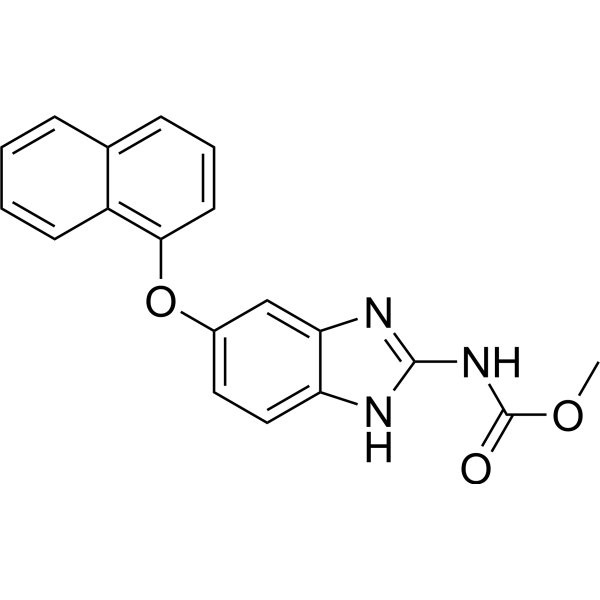 0 ImagesCat. No.: HY-155459CAS No.: 95385-38-9
-
BRD9876 (Standard)
 0 ImagesCat. No.: HY-110208RCAS No.: 32703-82-5BRD9876 (Standard) is the analytical standard of BRD9876 (HY-110208). This product is intended for research and analytical applications. BRD9876 is the "rigor" inhibitor that locks Kinesin-5 (Eg5) in a state with enhanced microtubules (MTs) binding, leading to bundling and stabilization of MTs. BRD9876 interacts with the tyrosine 104 residue that is part of the α4-α6 allosteric binding pocket. BRD9876 specifically targets microtubule-bound Eg5 and selectively inhibits myeloma over CD34 cells. BRD9876 has the potential for multiple myeloma (MM) research.
-
Kribb3
 0 ImagesCat. No.: HY-120027CAS No.: 129414-88-6
-
2-Methoxyestradiol (Standard)
 0 Images2-Methoxyestradiol (Standard) is the analytical standard of 2-Methoxyestradiol. This product is intended for research and analytical applications. 2-Methoxyestradiol (2-ME2), an orally active endogenous metabolite of 17β-estradiol (E2), is an apoptosis inducer and an angiogenesis inhibitor with potent antineoplastic activity. 2-Methoxyestradiol also destablize microtubules. 2-Methoxyestradio, also a potent superoxide dismutase (SOD) inhibitor and a ROS-generating agent, induces autophagy in the transformed cell line HEK293 and the cancer cell lines U87 and HeLa.
-
Monomethyl auristatin E intermediate-10
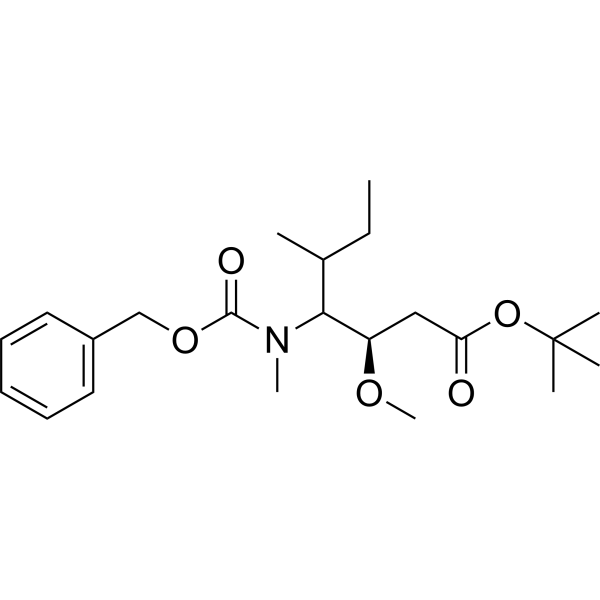 0 ImagesCat. No.: HY-78903AMonomethyl auristatin E intermediate-10 is an intermediate reagent in the synthesis of Monomethyl auristatin E (HY-15162). Monomethyl auristatin E (MMAE) is a microtubule/tubulin inhibitor with anticancer activity. MMAE is widely used as the cytotoxic component (ADC Cytotoxin) of antibody-drug conjugates (ADCs).
-
Antiproliferative agent-64
 0 ImagesCat. No.: HY-168326CAS No.: 1139263-21-0Antiproliferative agent-64 (Compound 76) is an inhibitor for eukaryotic translation initiation factor 4E (eIF4E), that block the secondary structure of mRNA, thereby inhibiting protein translation. Antiproliferative agent-64 inhibits the 5' untranslated region (5'UTR) of c-Myc (c-myc 5'UTR) with an EC50 of 1.2 nM, inhibits 5'UTR encoding tubulin (tub 5'UTR) with an EC50 of 40 nM. Antiproliferative agent-64 inhibits the proliferation of MDA-MB-231 with an EC50 of 7 nM.
-
Alfalone
 0 ImagesCat. No.: HY-W470415CAS No.: 970-48-9Alfalone (compound 9ia) is an antimitotic agent. Alfalone causes cleavage arrest and initiates the formation of tuberculate eggs.
-
Fmoc-L-Lys (Boc)-OH-13C6,15N2
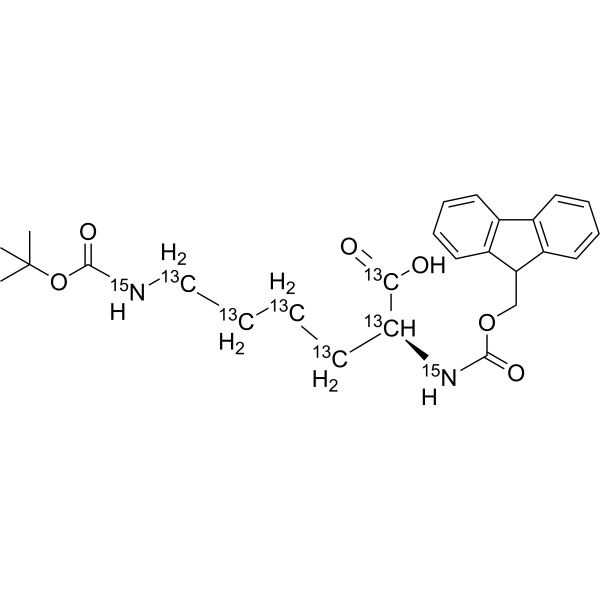 0 ImagesFmoc-L-Lys (Boc)-OH-13C6,15N2 is a 15N-labeled and 13C-labled Fmoc-L-Lys (Boc)-OH (HY-79128). Fmoc-L-Lys (Boc)-OH is a lysine derivative.
-
Vincristine (Standard)
 0 ImagesCat. No.: HY-N0488ARCAS No.: 57-22-7Synonyms: Leurocristine (Standard); NSC-67574 (Standard); 22-Oxovincaleukoblastine (Standard)Vincristine (Standard) is the analytical standard of Vincristine (HY-N0488A). This product is intended for research and analytical applications. Vincristine (Leurocristine; NSC-67574; 22-Oxovincaleukoblastine) is a microtubule inhibitor that disrupts microtubule polymerization by binding to β-tubulin (with a Ki of 85 nM in bovine), arrests the cell cycle and induces apoptosis. Vincristine inhibits cell replication, tumor blood flow and the proliferation of various cancer cells, while triggering effects such as oxidative stress, inflammation, calcium overload, epithelial-mesenchymal transition and peripheral neuropathic pain. Vincristine upregulates the expression of various transporters and nuclear receptors, and enriches gastric cancer stem-like cells. Vincristine is used in research related to various tumors including acute lymphoblastic leukemia, lymphoma, melanoma, gastric cancer, solid tumors and sarcomas.
-
Vinorelbine ditartrate (Standard)
 0 ImagesSynonyms: KW-2307 (Standard); Nor-5'-anhydrovinblastine ditartrate (Standard)Vinorelbine (ditartrate) (Standard) is the analytical standard of Vinorelbine (ditartrate). This product is intended for research and analytical applications. Vinorelbine (ditartrate) is an anti-mitotic agent which inhibits the proliferation of Hela cells with IC50 of 1.25 nM.
-
Monomethyl auristatin E intermediate-4
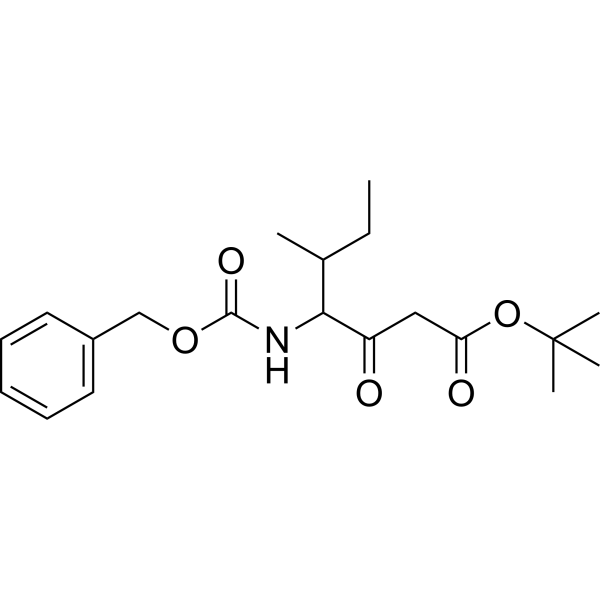 0 ImagesCat. No.: HY-43147CAS No.: 1823777-46-3Monomethyl auristatin E intermediate-4 is an intermediate reagent in the synthesis of Monomethyl auristatin E (HY-15162). Monomethyl auristatin E (MMAE) is a microtubule/tubulin inhibitor with anticancer activity. MMAE is widely used as the cytotoxic component (ADC Cytotoxin) of antibody-drug conjugates (ADCs).
-
Tubulin inhibitor 9
 0 ImagesCat. No.: HY-137866CAS No.: 1151995-69-5Tubulin inhibitor 9 (compound 7) is a tubulin (Microtubule/Tubulin)Inhibitors with anticancer activity (MDA-MB 231, IC50=0.9 nM).
-
DW532
 0 ImagesCat. No.: HY-116068CAS No.: 1267949-42-7DW532 is a dual inhibitor of tubulin and tyrosine kinase, with IC50 values of 4.9 μM and 5.5 μM against EGFR and VEGFR2, respectively, and a KD of 3.6 μM for tubulin. DW532 induces cell cycle arrest at the G2/M phase, triggers cell apoptosis via caspase-related pathways, and inhibits angiogenesis. DW532 can be used for research related to cancers (e.g., breast cancer).
-
Tirbanibulin dihydrochloride (Standard)
 0 ImagesSynonyms: KX2-391 dihydrochloride (Standard); KX-01 dihydrochloride (Standard)Tirbanibulin (dihydrochloride) (Standard) is the analytical standard of Tirbanibulin (dihydrochloride). This product is intended for research and analytical applications. Tirbanibulin (dihydrochloride) (KX2-391 (dihydrochloride)) is an inhibitor of Src that targets the peptide substrate site of Src, with GI50 of 9-60 nM in cancer cell lines.
-
UA62784
 0 ImagesCat. No.: HY-110090CAS No.: 313367-92-9UA62784 is a microtubule polymerization inhibitor that interacts with tubulin dimers. UA62784 is a novel specific inhibitor of centromere protein E (CENP-E) kinesin. UA62784 can be used for the study of pancreatic cancer.
-
DM1 Impurity
 0 ImagesCat. No.: HY-48703CAS No.: 936481-22-0DM1 Impurity is the impurity of Mertansine (DM1) (HY-19792).
-
(S,S,S)-Icafolin-methyl
 0 Images(S,S,S)-Icafolin-methyl is an isomer of Icafolin-methyl (HY-170505). Icafolin-methyl is a herbicide and plant β-tubulin (Microtubule/Tubulin) inhibitor. Icafolin-methyl binds to the β-tubulin region of the Colchicine (HY-16569) binding site, thereby blocking the polymerization of plant tubulin. As a non-selective herbicide, Icafolin-methyl exhibits post-emergence activity against weeds in both cool-season and warm-season cropping systems, including resistant ryegrass and darnel biotypes. Icafolin-methyl can be used for herbicide research.
-
3-Bromocarbazole-d7
 0 Images3-Bromocarbazole-d7 is the d7-labeled 3-Bromocarbazole (HY-33798). 3-Bromocarbazole is an inhibitor of the aryl hydrocarbon receptor (AHR). 3-Bromocarbazole induces the mRNA expression of CYP1A1 and CYP1B1, with EC50 values of 2500 nM and 1100 nM, respectively. 3-Bromocarbazole inhibits motor neuron axon length by downregulating the mRNA transcription levels of α1-tubulin, Gap43, Syn2a and shha in zebrafish larvae. 3-Bromocarbazole reduces central nervous system neurogenesis by downregulating the mRNA transcription levels of elavl3, nrd, mbp and gfap in zebrafish larvae. 3-Bromocarbazole induces developmental neurotoxicity and decreases body length in zebrafish larvae or embryos; at high concentrations, it also reduces hatching rate, and increases mortality and malformation rate. 3-Bromocarbazole can be used in studies related to developmental neurotoxicity and breast cancer.




