



PSMA
Prostate-specific membrane antigen
PSMA is a transmembrane protein that anchores to the cell membrane through its transmembrane region and is mainly expressed in prostate epithelial cells but also exists in other tissues. PSMA exhibits glutamate-preferring carboxypeptidase activity that hydrolyzes polyglutamylated folic acid to release folic acid monomers. PSMA mediates the endocytosis on the cell surface. PSMA acts as an angiogenesis marker in cancer cells. PSMA can be used as a diagnostic marker for prostate cancer, and for detection of invasiveness and metastatic ability of the tumor[1].
All Product Categories
-
PSMA Related Products (92)
Related Products (92)

-
Antibodies (1)
-
CBP-1018
 0 ImagesCBP-1018 is a PDC (peptide-drug conjugate) formed by conjugating Monomethyl auristatin E (HY-15162) to a dual-targeting ligand of FLOR1/PSMA (prostate-specific membrane antigen) via a linker (HY-78738). CBP-1018 binds to FLOR1 and prostate-specific membrane antigen (PSMA). CBP-1018 is applicable to the research of solid tumors and metastatic castration-resistant prostate cancer.
-
Flotufolastat
 0 ImagesCat. No.: HY-180308CAS No.: 2305060-41-5Synonyms: rhPSMA-7.3Flotufolastat is a prostate-specific membrane antigen (PSMA) modulator. Flotufolastat is also a radiodiagnostic agent used in prostate cancer imaging. Flotufolastat can be used in research on prostate cancer and other cancers.
-
AAZTA-NI-PSMA-093
 0 ImagesCat. No.: HY-P11261AAZTA-NI-PSMA-093 is a bispecific agent targeting prostate-specific membrane antigen (PSMA) with an IC50 value for PSMA of 87.48 nM. AAZTA-NI-PSMA-093 has a PSMA targeting module and an oxygen-sensitivity module (hypoxia-sensitive NI-moiety). AAZTA-NI-PSMA-093 can utilize the PSMA targeting property as a "navigation system" to efficiently concentrate the entire molecule within prostate cancer cells, and once the cells are in an oxygen-deficient state, the molecule will irreversibly capture and remain in the oxygen-deficient cells, achieving "secondary enrichment". AAZTA-NI-PSMA-093 can be labeled with ⁶⁸Ga and ¹⁷⁷Lu, and has high accumulation and rapid clearance characteristics in mouse models. AAZTA-NI-PSMA-093 can be used for the study of prostate cancer.
-
CQ-16
 0 ImagesCat. No.: HY-169336CAS No.: 3024354-59-1CQ-16 is an orally active small molecule drug conjugate (SMDC) targeting prostate-specific membrane antigen (PSMA). CQ-16 exhibits highly selective antiproliferative activity between PSMA-positive and PSMA-negative prostate cells. In addition, CQ-16 also has PARP inhibitory activity (IC50=1 nM). (Pink: PSMA Ligand (HY-139840); Black: Linker (HY-W037980); Blue: PARP Inhibitor (HY-10162))
-
MIP-1072
 0 ImagesCat. No.: HY-129615CAS No.: 949575-20-6MIP-1072 is a competitive prostate-specific membrane antigen (PSMA) inhibitor with a Ki value of 4.6 nM. MIP-1072 specifically binds to PSMA and is internalized into PSMA-expressing prostate cancer cells. MIP-1072 accumulates in PSMA-expressing prostate cancer xenografts. MIP-1072 specifically blocks the uptake of 68Ga-NOTA-GUL by PSMA-positive prostate cancer xenografts. When radiolabeled with 123I, MIP-1072 functions as a SPECT/CT molecular imaging agent. MIP-1072 can be used in prostate cancer-related research.

-
NH2-NODAGA hydrochloride
 0 ImagesCat. No.: HY-164575BNH2-NODAGA hydrochloride is an amino-modified NODAGA-type bifunctional chelator, specifically designed for amidation coupling with targeting ligands via squaric acid (SA), followed by coordination with radionuclides (e.g., 68Ga, 177Lu). NH2-NODAGA hydrochloride can be coupled with diethyl squarate to form a PSMA inhibitor conjugate, which is used in prostate cancer research.
-
PSMA ligand 1
 0 ImagesCat. No.: HY-175229CAS No.: 3066073-36-4PSMA ligand 1 (Compound 1c) is a PSMA ligand with an IC50 of 26.74 nM. The [18F]-labeled PSMA ligand 1 can serve as a PSMA PET tracer and is used in research on the diagnosis of prostate cancer.
-
PSMA-SulfoCy7
 0 ImagesCat. No.: HY-D3353CAS No.: 2766510-90-9PSMA-SulfoCy7 is a high-affinity imaging agent targeting PSMA/GCPII (with a Ki of 18.1 nM for human PSMA). PSMA-SulfoCy7 regulates PSMA-dependent NAAG hydrolysis. PSMA-SulfoCy7 exhibits excellent in vivo imaging capability, enabling clear visualization of PSMA-expressing tumors in xenograft models, with no obvious toxicity even at a dose of 87.9 mg/kg. PSMA-SulfoCy7 is widely used in prostate cancer-related studies.
-
PSMA-1-SMCC
 0 ImagesCat. No.: HY-P11310Purity: 98.16%PSMA-1-SMCC is a selective binding agent targeting Prostate-Specific Membrane Antigen (PSMA). PSMA-1-SMCC is promising for research of targeted imaging for prostate cancer.
-
MIP-1095
 0 ImagesCat. No.: HY-123733CAS No.: 949575-22-8Synonyms: RPS-001MIP-1095 (RPS-001) is a PSMA inhibitor with a Ki value of 0.24 nM. MIP-1095 binds to PSMA with high affinity and can be internalized into PSMA-expressing cancer cells. When radiolabeled with 123I, 124I or 131I, MIP-1095 enables SPECT/CT imaging, PET/CT imaging or targeted radiation delivery, respectively. 131I-MIP-1095 can alter serum PSA levels and relieve bone pain. MIP-1095 can be used in research related to metastatic castration-resistant prostate cancer.
-
MLN 591
 0 ImagesCat. No.: HY-P991360Synonyms: MLN2704 antibodyMLN 591 is a human monoclonal antibody (mAb) targeting PSMA. MLN 591 can be used in Prostate cancer research.
-
PSMA-IN-4
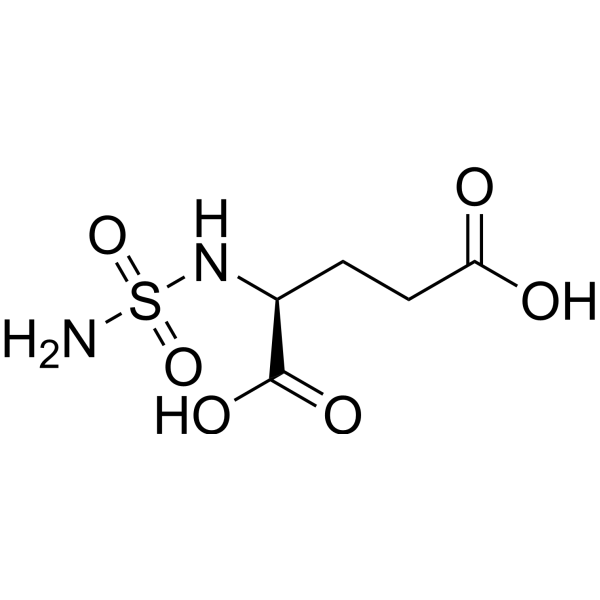 0 ImagesCat. No.: HY-163196CAS No.: 1561171-59-2PSMA-IN-4 (compound 9) is a potent inhibitor of PSMA, with the IC50 value of 1.2 μM.
-
NH2-NODAGA
 0 ImagesCat. No.: HY-164575CAS No.: 1630114-57-6NH2-NODAGA is an amino-modified NODAGA-type bifunctional chelator, specifically designed for amidation coupling with targeting ligands via squaric acid (SA), followed by coordination with radionuclides (e.g., 68Ga, 177Lu). NH2-NODAGA can be coupled with diethyl squarate to form a PSMA inhibitor conjugate, which is used in prostate cancer research.
-
(S)-Zadavotide guraxetan
 0 ImagesCat. No.: HY-153130CAS No.: 2713429-51-5Synonyms: (S)-PSMA I&T; (S)-PNT-2002(S)-Zadavotide guraxetan ((S)-PSMA I&T) is the S-isomer of EuK-Sub-kf-iodo-y-DOTAGA. (S)-Zadavotide guraxetan is a PSMA targeting compound.
-
BQ7876
 0 ImagesCat. No.: HY-P10743BQ7876 is a probe targeting prostate-specific membrane antigen (PSMA) that contains a DOTA chelator. BQ7876, after being radiolabeled with radionuclide (177Lu), functions in both radionuclide imaging and tumor cell destruction by specifically binding to PSMA. BQ7876 shows potential for research in the field of metastatic castration-resistant prostate cancer (mCRPC). BQ7876 can be used for the synthesis/research of Radionuclide-Drug Conjugates (RDCs).

-
PSMA-IN-1
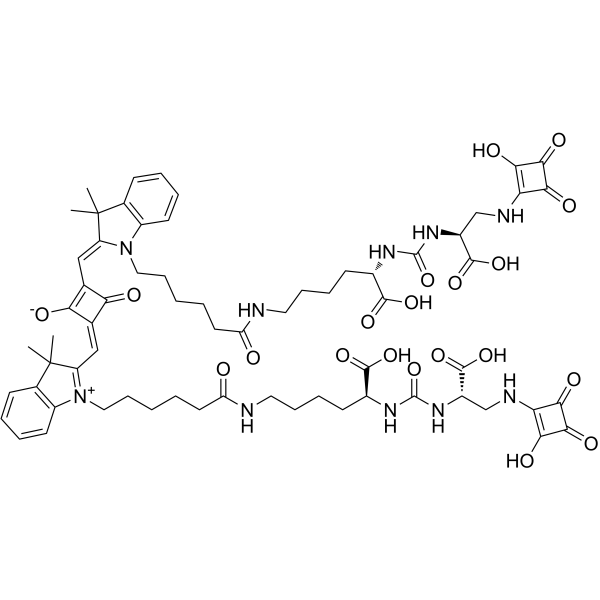 0 ImagesCat. No.: HY-149297PSMA-IN-1 (compound 23) is an inhibitor of PSMA with a Ki value of 2.49 nM. PSMA-IN-1 inhibits tumor growth with high selectivity and specificity in PSMA+ xenograft models. PSMA-IN-1 is a NIR probe (λEX: 620 nm; λEM: 670 nm) used for tumor disappearance. PSMA-IN-1 can be used for research on prostate cancer.
-
PSMA-R2
 0 ImagesCat. No.: HY-178248CAS No.: 2576410-20-1PSMA ligand 2 is a prostate specific membrane antigen (PSMA) ligand with a glutamate-urea-lysine (GUL) moiety. PSMA ligand 2 can be efficiently labeled with radioactive nuclides such as 68Ga and 177Lu and specifically binds to PSMA-positive tumor cells. PSMA ligand 2 can be used for imaging of PSMA-expressing tumors or cells via PET or SPECT imaging. PSMA ligand 2 can be used for the research of prostate cancer.
-
JR11-PEG3-HBED-CC-PSMA-03
 0 ImagesCat. No.: HY-P11485JR11-PEG3-HBED-CC-PSMA-03 (Compound 1) is an RDC-related compound containing the chelating agent HBED-CC, the JR11 peptide (SSTR2 antagonist), and the PSMA ligand. JR11-PEG3-HBED-CC-PSMA-03 shows SSTR2-binding affinities and PSMA-binding affinities, with IC50 s of 59.2 nM, 57.0 nM, respectively. JR11-PEG3-HBED-CC-PSMA-03 can be radiolabeled with [68Ga]. [68Ga] radiolabeled JR11-PEG3-HBED-CC-PSMA-03 can be used in diagnostic studies of neuroendocrine differentiated prostate cancer.




