



PSMA Ligand
- 1
- 2
-
PSMA-azide
 0 Images
PSMA-azide is a prostate-specific membrane antigen (PSMA) ligand. PSMA-azide inhibits PSMA-dependent NAAG (N-acetylaspartylglutamic acid) hydrolysis, with an IC50 of 9 nM and a Ki of 1 nM. PSMA-azide contains an Azide group and can undergo copper-catalyzed azide-alkyne cycloaddition reaction (CuAAc) with molecules containing Alkyne groups.
-
Ancelvotide Guraxetan
 0 ImagesSynonyms: PNT2001; LY4181530; PSMA-62
-
EC1169
 0 Images
EC1169 is a cytotoxic maytansinoid conjugate that specifically binds to prostate-specific membrane antigen (PSMA). EC1169 precisely delivers the maytansinoid B hydrazide payload to PSMA-positive cells to exert antitumor activity. EC1169 only inhibits the growth of PSMA-positive cells but has no effect on PSMA-negative cells, and enables complete recovery in mice bearing PSMA-positive tumors. EC1169 exhibits safety with no body weight loss or major organ damage induced. EC1169 is used in studies of prostate cancer and other PSMA-expressing malignancies.
-
PSMA targeting peptide TFA
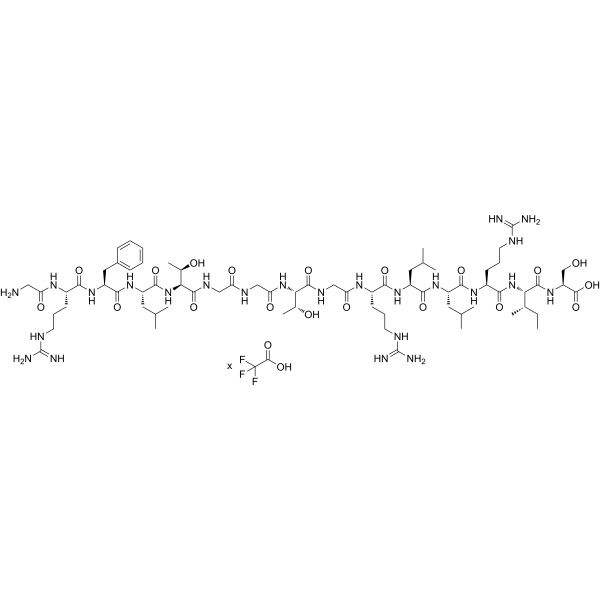 0 ImagesCat. No.: HY-P10055APurity: 98.54%Synonyms: PSMA-1 TFA
PSMA targeting peptide (PSMA-1) TFA is a PSMA-binding peptide that selectively binds to the PSMA receptor on prostate cancer cells and acts as a peptide-based siRNA delivery system by complexing and releasing siRNA. PSMA targeting peptide TFA can be used in research on prostate cancer.
-
PDI2
 0 ImagesSynonyms: PSMA-DOTA-PEI2
PDI2 (PSMA-DOTA-PEI2) is a prostate-specific membrane antigen (PSMA) ligand that acts as a tumor retention agent, renal uptake reducer, imaging agent and antitumor agent, applicable in SPECT diagnostic imaging and radiotheranostics. PDI2 specifically binds to PSMA on prostate cancer cells, enters cells via clathrin-dependent endocytosis, and exhibits higher tumor retention rate and lower renal uptake level. PDI2 is applicable in research related to prostate cancer and castration-resistant metastatic prostate cancer.
-
PSMA targeting peptide
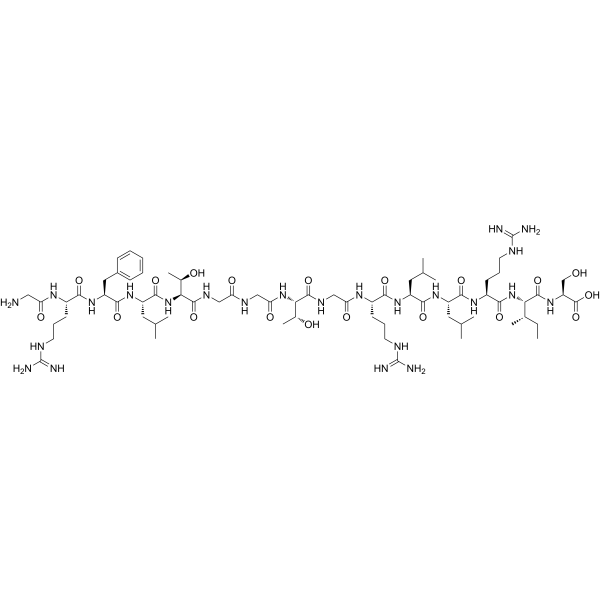 0 ImagesCat. No.: HY-P10055CAS No.: 2042750-71-8Synonyms: PSMA-1
PSMA targeting peptide (PSMA-1) is a PSMA-binding peptide that selectively binds to the PSMA receptor on prostate cancer cells and acts as a peptide-based siRNA delivery system by complexing and releasing siRNA. PSMA targeting peptide can be used in research on prostate cancer.
-
CBP-1018
 0 Images
CBP-1018 is a PDC (peptide-drug conjugate) formed by conjugating Monomethyl auristatin E (HY-15162) to a dual-targeting ligand of FLOR1/PSMA (prostate-specific membrane antigen) via a linker (HY-78738). CBP-1018 binds to FLOR1 and prostate-specific membrane antigen (PSMA). CBP-1018 is applicable to the research of solid tumors and metastatic castration-resistant prostate cancer.
-
Cy5-ZW2-617
 0 ImagesCat. No.: HY-182240
Cy5-ZW2-617 is a PSMA ligand with a IC50 of 4.39 nM. Cy5-ZW2-617 specifically binds to PSMA and is thereby internalized by PSMA-positive cells. Cy5-ZW2-617 shows uptake in PSMA-positive tumor cells and tumor xenografts in mice. Cy5-ZW2-617 can be used for the research of prostate cancer.
-
PSMA ligand 1
 0 ImagesCat. No.: HY-175229CAS No.: 3066073-36-4
PSMA ligand 1 (Compound 1c) is a PSMA ligand with an IC50 of 26.74 nM. The [18F]-labeled PSMA ligand 1 can serve as a PSMA PET tracer and is used in research on the diagnosis of prostate cancer.
-
PSMA-SulfoCy7
 0 ImagesCat. No.: HY-D3353CAS No.: 2766510-90-9
PSMA-SulfoCy7 is a high-affinity imaging agent targeting PSMA/GCPII (with a Ki of 18.1 nM for human PSMA). PSMA-SulfoCy7 regulates PSMA-dependent NAAG hydrolysis. PSMA-SulfoCy7 exhibits excellent in vivo imaging capability, enabling clear visualization of PSMA-expressing tumors in xenograft models, with no obvious toxicity even at a dose of 87.9 mg/kg. PSMA-SulfoCy7 is widely used in prostate cancer-related studies.
-
PSMA-1-SMCC
 0 ImagesCat. No.: HY-P11310Purity: 98.16%
PSMA-1-SMCC is a selective binding agent targeting Prostate-Specific Membrane Antigen (PSMA). PSMA-1-SMCC is promising for research of targeted imaging for prostate cancer.

-
PSMA-R2
 0 ImagesCat. No.: HY-178248CAS No.: 2576410-20-1
PSMA ligand 2 is a prostate specific membrane antigen (PSMA) ligand with a glutamate-urea-lysine (GUL) moiety. PSMA ligand 2 can be efficiently labeled with radioactive nuclides such as 68Ga and 177Lu and specifically binds to PSMA-positive tumor cells. PSMA ligand 2 can be used for imaging of PSMA-expressing tumors or cells via PET or SPECT imaging. PSMA ligand 2 can be used for the research of prostate cancer.
-
JR11-PEG3-HBED-CC-PSMA-03
 0 ImagesCat. No.: HY-P11485
JR11-PEG3-HBED-CC-PSMA-03 (Compound 1) is an RDC-related compound containing the chelating agent HBED-CC, the JR11 peptide (SSTR2 antagonist), and the PSMA ligand. JR11-PEG3-HBED-CC-PSMA-03 shows SSTR2-binding affinities and PSMA-binding affinities, with IC50 s of 59.2 nM, 57.0 nM, respectively. JR11-PEG3-HBED-CC-PSMA-03 can be radiolabeled with [68Ga]. [68Ga] radiolabeled JR11-PEG3-HBED-CC-PSMA-03 can be used in diagnostic studies of neuroendocrine differentiated prostate cancer.
-
JANX-007
 0 ImagesCat. No.: HY-P992535
JANX-007 is a tumor protease-activated anti-PSMA x CD3 bispecific T cell engager (BiTE). After JANX-007 is cleaved by tumor-specific proteases in the tumor microenvironment to remove the mask, CD3 is exposed, recruiting T cells to kill PSMA-positive tumor cells, and the activated and released TCE fragment can be rapidly cleared. JANX-007 can be used in cancer-related research, such as metastatic castration-resistant prostate cancer.
-
PSMA-trillium
 0 ImagesCat. No.: HY-158119ACAS No.: 3036415-37-6Synonyms: Felivotide mopaxetan
PSMA-trillium (Felivotide mopaxetan) is a PSMA-targeted molecule that contains a highly specific PSMA-binding motif, an albumin-binding domain optimized for tumor uptake and retention, and a Macropa chelator conjugated to the α-emitter 225Ac. PSMA-trillium binds to albumin to prolong plasma retention time and binds to PSMA via its specific motif. 225Ac-PSMA-Trillium exhibits dose-dependent inhibition of LNCaP tumor growth in mice. PSMA-trillium can be used in research related to prostate cancer and metastatic castration-resistant prostate cancer.
-
Ctx-L3
 0 ImagesCat. No.: HY-181829
Ctx-L3 is a selective EGFR PTAC (PSMA-targeted chimera) degrader (DC50: 4.3 pM in LNCaP cells) and LYTAC. Ctx-L3 recruits prostate-specific membrane antigen (PSMA) and mediates lysosomal degradation of EGFR in PSMA-positive prostate cancer cells. Ctx-L3 exhibits degrading activity against EGFR in prostate cancer cells. Ctx-L3 is applicable to related research on prostate cancer.
-
PSMA-N5
 0 ImagesCat. No.: HY-P11598CAS No.: 3092260-02-8
PSMA-N5 (Compound 15) is a PSMA ligand with a Ki value of 0.71 nM. PSMA-N5 acts as a PET radiotracer for prostate cancer imaging. PSMA-N5 is applicable to the research of prostate cancer and other related cancers.
-
PSMA-DIM
 0 ImagesCat. No.: HY-175248
PSMA-DIM is a dimeric PSMA ligand with a Kd of 37.09 nM for LNCaP cells. PSMA-DIM can be radiolabeled with [68Ga]Ga to form [68Ga]Ga-PSMA-DIM. [68Ga]Ga-PSMA-DIM can effectively distinguish between cells and animal models with different expression levels of PSMA. [68Ga]Ga-PSMA-DIM exhibits high LNCaP cells uptake and tumor uptake peak values. PSMA-DIM can be used for the study of prostate cancer (PCa).
-
NOTA-SP2A-PSMAL
 0 ImagesCat. No.: HY-181853
NOTA-SP₂A-PSMAL is a ligand targeting prostate-specific membrane antigen (PSMA), which competitively binds to PSMA with high binding affinity and an IC50 value of 0.26 nM. 18F-labeled NOTA-SP2A-PSMAL can be used as a PET tracer for positron emission tomography imaging of prostate cancer. NOTA-SP2A-PSMAL can be used for the synthesis and research of radionuclide conjugates (RDCs).
- 1
- 2



