



Radionuclide-Drug Conjugates (RDCs)
Radionuclide-drug conjugates (RDCs) are one of the most promising development directions for nuclear drug targeted therapy. RDC is composed of targeting element, linker, chelate and radioactive isotope. RDC has advantages in early tumor diagnosis, treatment and postoperative tumor evaluation. The same ligand can be connected to nuclides used for disease diagnosis and treatment respectively, promoting the integration of diagnosis and treatment of RDC drugs. This entry provides molecular intermediates that can be used in the synthesis and research of RDC.
Radionuclide-Drug Conjugates (RDCs) Isoform Specific Products
All Product Categories
-
Radionuclide-Drug Conjugates (RDCs) Related Products (230)
Related Products (230)

-
Radionuclide-Drug Conjugates (RDCs) Isoform Comparison
-
NODAGA-LM3 TFA
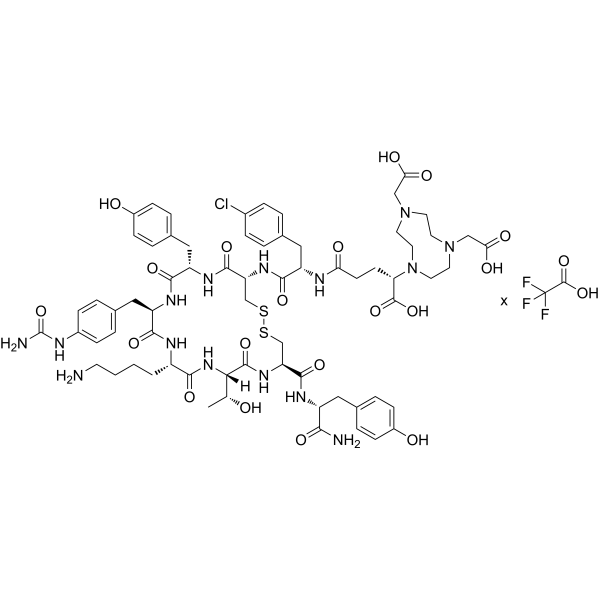 0 ImagesCat. No.: HY-P5362ANODAGA-LM3 TFA is a ligand that can cross the blood-brain barrier and targets somatostatin receptor SSTR2 with high affinity (IC50 = 1.3 nM). NODAGA-LM3 TFA does not trigger the internalization of SSTR2 and can inhibit agonist-induced internalization processes. NODAGA-LM3 TFA shows low uptake in normal tissues such as the liver and spleen, but high uptake in the lungs and blood pool. 68Ga-labeled NODAGA-LM3 TFA can serve as a PET imaging agent for well-differentiated neuroendocrine tumors, and is applied in studies related to small cell lung cancer and well-differentiated neuroendocrine tumors.
-
Tyr3-Octreotate acetate
 0 ImagesCat. No.: HY-P10239APurity: 99.76%Tyr3-Octreotate acetate is a somatostatin analog. Tyr3-Octreotate acetate exhibits high uptake into tumor, that is capable to be labeled with radioactive metal and thus exhibits antitumor efficacy. Tyr3-Octreotate acetate can be used for the synthesis/research of Radionuclide-Drug Conjugates (RDCs).
-
VCAM1 binding peptide acetate
 0 ImagesCat. No.: HY-P11088APurity: 99.76%VCAM1 binding peptide acetate is a VCAM1 binder with internalization activity. VCAM1 binding peptide acetate can be labeled with 5-FAM. VCAM1 binding peptide acetate serves as a component of biosensing systems for visualizing in vitro VCAM1 endocytic pathways. VCAM1 binding peptide acetate forms the research and development basis for MacroP and NAMP, PET radiotracers targeting VCAM1. VCAM1 binding peptide acetate is applicable to studies related to atherosclerosis.
-
EB-PSMA-617
 0 ImagesCat. No.: HY-163683CAS No.: 2375590-67-1EB-PSMA-617 is a modified form of PSMA-617 that has enhanced pharmacokinetic properties by conjugating it to Evans Blue (EB) to extend its circulation half-life to improve prostate tumor uptake and radiotherapy efficacy. In preclinical studies using PC3-PIP-loaded mice, EB-PSMA-617 demonstrated prolonged blood half-life, increased accumulation in PSMA-positive tumors, and successful tumor elimination with lower radioactivity.
-
p-SCN-Bn-HOPO
 0 ImagesCat. No.: HY-136952CAS No.: 1822331-55-4p-SCN-Bn-HOPO is a bifunctional chelator that forms stable octadentate complexes with Zr (IV) and 89Zr4+ via four 1,2-hydroxypyridone groups. p-SCN-Bn-HOPO conjugates with antibodies through the formation of thiourea bonds with lysine residues, and enables efficient 89Zr radiolabeling under mild conditions. p-SCN-Bn-HOPO inhibits bone uptake of free radiometals, stabilizes radiometal-antibody conjugates, and achieves PET imaging with low background and enhanced tumor-to-organ contrast. p-SCN-Bn-HOPO can be used in breast cancer-related research.
-
DTPA-tetra(tBu)ester
 0 ImagesCat. No.: HY-164592CAS No.: 180152-83-4DTPA-tetra(tBu)ester is a radionuclide conjugate (RDC), which is capable of binding to a radionuclide. RDC has the ability to specifically target biomolecules and can be used in medical imaging or therapy.
-
(S)-EB-FAPI-B2
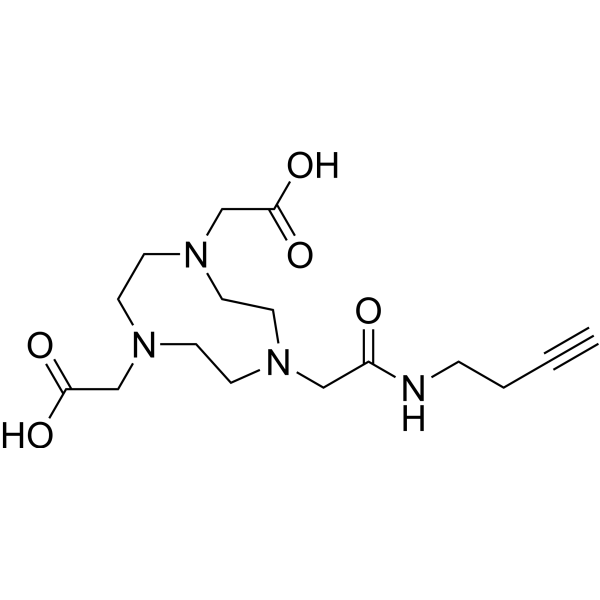
 0 ImagesCat. No.: HY-159770ACAS No.: 2740747-99-1(S)-EB-FAPI-B2 (Compound II-11) is a precursor for radiopharmaceutical labeling, which can be combined with radionuclides to create radionuclide drug conjugates (RDCs). RDCs have the capability to specifically target biomolecules and can be used in medical imaging.
-
NO2A-Azide trihydrochloride
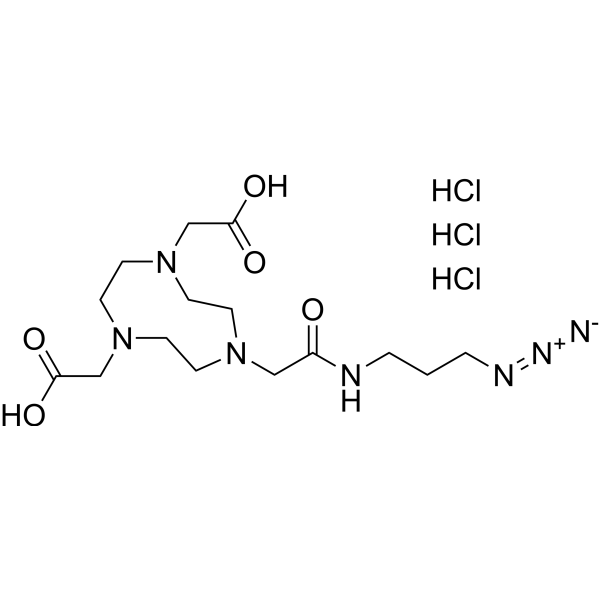 0 ImagesCat. No.: HY-W717800ACAS No.: 2435782-92-4NO2A-Azide (trihydrochloride)is a bifunctional chelator (Bifunctional Chelator; BFC) and a macrocyclic NOTA derivative used for tumor pre-targeting. NO2A-Azide (trihydrochloride) can be used for conjugation of peptides and radionuclides.
-
DOTA-Bombesin (1-14)
 0 ImagesCat. No.: HY-P10729CAS No.: 593287-40-2DOTA-Bombesin (1-14) is composed of chelator DOTA and Bombesin (HY-P0195). DOTA-Bombesin (1-14) is used for research of cancer through combination with radioactive elements. DOTA-Bombesin (1-14) can be used for the synthesis/research of Radionuclide-Drug Conjugates (RDCs).
-
DTPA anhydride
 0 ImagesCat. No.: HY-W011118CAS No.: 23911-26-4DTPA anhydride is a bifunctional chelator whose anhydride can react with amino groups in proteins (such as lysine residues) to form stable amide bonds. DTPA anhydride can also bind to radionuclides to synthesize radionuclide-labeled drug conjugates (RDCs). RDCs have the ability to specifically target biomolecules and can be used in medical imaging or therapy.
-
DOTA-ECL1i
 0 ImagesDOTA-ECL1i is a conjugate of the CCR2 inhibitor ECL1i (HY-P11553) and DOTA. When radiolabeled with 68Ga, DOTA-ECL1i serves as a PET tracer that targets CCR2 expression. DOTA-ECL1i can be used in research related to pulmonary fibrosis, cardiac injury, abdominal aortic aneurysm inflammation, atherosclerosis, head and neck cancer, and pancreatic cancer.
-
Tyr3-Octreotate
 0 ImagesTyr3-Octreotate is a ligand for somatostatin receptor subtype 2 (sst2), with an IC50 value of 1.3 nM against sst2 when labeled with [111In-DTPA], and an IC50 value of 1.6 nM against sst2 when labeled with [90Y-DOTA]. Radiolabeled Tyr3-Octreotate generates cell-associated radioactivity, and acts as both a tumor growth inhibitor and a tumor cytotoxic agent. When radiolabeled with 177Lu or 90Y, Tyr3-Octreotate serves as a peptide receptor radionuclide therapy (PRRT) analog. Tyr3-Octreotate can be used in studies related to pancreatic tumors.
-
Cyprodenate
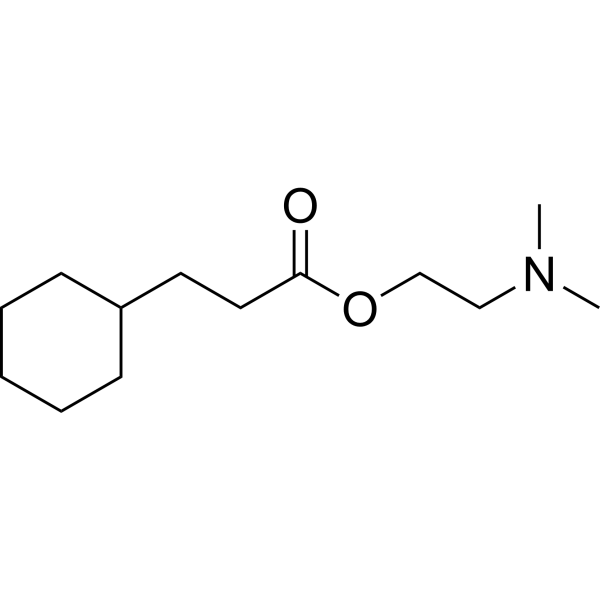 0 ImagesSynonyms: ActebralCyprodenate is an orally active and blood-brain barrier-penetrant stimulant. Cyprodenate can be labeled with 14C. Cyprodenate can be used in the research of psychiatric disorders.
-
AKIR001
 0 ImagesCat. No.: HY-P991922Purity: 99.41%AKIR001 is a high-affinity human IgG1 antibody targeting CD44v6. AKIR001 carries LALA-silencing mutations in its FcγR-binding domain to reduce FcγR and C1q interactions, minimizing tissue interactions and limiting CDC and ADCC risks. [177Lu] radiolabeled AKIR001, namely [177Lu]Lu-AKIR001, has anticancer activity against epidermoid carcinoma.
-
MMA-NODAGA
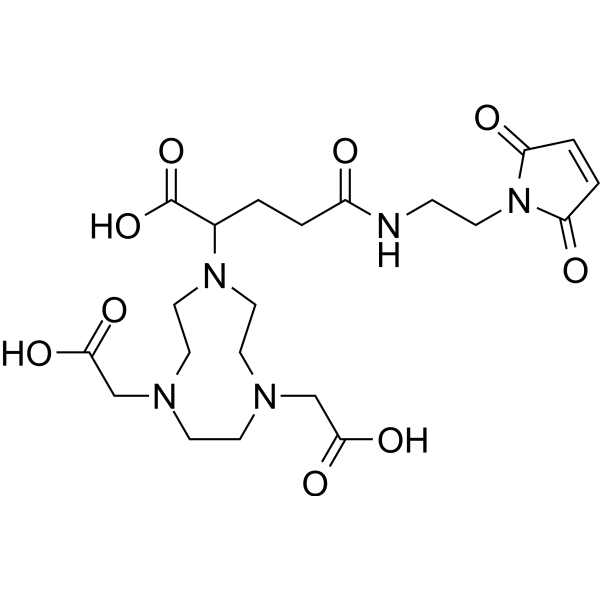 0 ImagesCat. No.: HY-160607CAS No.: 1440903-11-6MMA-NODAGA is a chelator for site-specific labeling of targeting proteins containing unpaired cysteine. MMA-NODAGA can be used to conjugate with exosome and 64Cu in image with positron emission tomography (PET).
-
NOTA (Standard)
 0 ImagesNOTA (Standard) is the analytical standard of NOTA. This product is intended for research and analytical applications. NOTA is a bifunctional chelate which acts as the framework to construct PET imaging tools. NOTA also can be used for probe design and signal amplification via the multivalent effect. NOTA can be used in multiple myeloma, breast cancer, lymphoma and myocardial infarction research.
-
AZD-2184
 0 ImagesCat. No.: HY-165470CAS No.: 945400-24-8AZD-2184 is a β-amyloid (Aβ(1-40)) fibril binder with blood-brain barrier permeability, exhibiting a Kd of 8.4 nM for hAβ(1-40). AZD-2184 binds to the same site as CPIB, shows low levels of non-specific binding to brain tissue, rapidly enters and clears from the brain tissue of normal rats, and binds reversibly to plaques in vivo. The radiolabeled form of AZD-2184 can serve as a PET ligand for the visualization of Aβ deposits. AZD-2184 is applicable to research related to Alzheimer's disease.
-
PD151242
 0 ImagesCat. No.: HY-136785CAS No.: 155561-67-4PD151242 is a selective competitive antagonist of the endothelin ETA receptor, with KD values of 0.65 nM, 0.64 nM and 1.92 nM for human, rat and porcine receptors, respectively, and a KD value of 104 μM for the human ETβ receptor. When radiolabeled as [125I]-PD151242, PD151242 can be used to visualize and localize renal vascular ETA receptors.
-
Icopezil maleate
 0 ImagesCat. No.: HY-105157ACAS No.: 145815-98-1Synonyms: CP-118954 maleateIcopezil maleate (CP-118954 maleate) is an orally active, selective AchE inhibitor with an IC50 of 0.33 nM. Icopezil maleate increases acetylcholine levels in the brain and striatum of mammals, induces centrally mediated tremors and peripherally mediated salivation, and improves working memory performance in aged dogs. Icopezil maleate serves as a parent compound for radioiodine-labeled acetylcholinesterase imaging agents. Icopezil maleate is applicable to research related to Alzheimer's disease.



