



Ser/Thr Kinase
Protein Serine-Threonine Kinase
Ser/Thr Kinase belongs to the eukaryotic protein kinase (ePK) superfamily and can use ATP to phosphorylate the hydroxyl group of serine or threonine residues in the kinase recognition amino acid sequence. The widely known anticancer targets in the Ser/Thr Kinase family are protein kinase C (PKC) and cyclin-dependent kinases (CDKs). There are two types of Ser/Thr Kinase: one is a kinase that phosphorylates receptor molecules, i.e., receptor protein serine/threonine kinases, such as activated receptor kinases and transforming growth factor β receptor kinases; the other is a kinase that acts as an intracellular signal transduction protein. The latter can phosphorylate several key targets of multiple signaling pathways and affect a variety of biological functions including growth, differentiation, cell cycle progression, and metabolism. This family contains several different groups of kinases, including (1) the CK group of kinases: casein kinases; (2) the AGC group: the kinases protein kinase A (PKA), protein kinase B (PKB or v-akt murine thymoma viral oncogene homolog 1: AKT1), and protein kinase C (PKC); (3) the CAMK group of kinases: Ca2+/calmodulin-dependent kinases; (4) the CMGC group of kinases: mos/raf kinases, mitogen-activated kinases (MAPKs), cyclin-dependent kinases (CDKs), and glycogen synthase kinases (GSKs); and (5) the STE group of kinases: homologs of yeast sterile kinases 7, 11, and 20 kinases.Ser/Thr Kinase family regulates the glucocorticoid receptor (GR), a nuclear hormone receptor superfamily protein. For example, MAPK, CDK, PKB/AKT1 and GSK3β can phosphorylate GR at specific residues; PKA, AKT1, PKC, MAPK, AMPK and mTOR can additionally phosphorylate other kinases and/or transcriptional cofactors associated with DNA-associated GR to indirectly regulate GR. It is worth mentioning that p38 MAPK in the MAPK family regulates serine phosphorylation of GR through upstream MAP2K2/4, while another JNK inhibits GR transcriptional activity by enhancing the nuclear export of the receptor[1][2].
All Product Categories
-
Ser/Thr Kinase Related Products (52)
Related Products (52)

-
Arg-Gly-Tyr-Ser-Leu-Gly
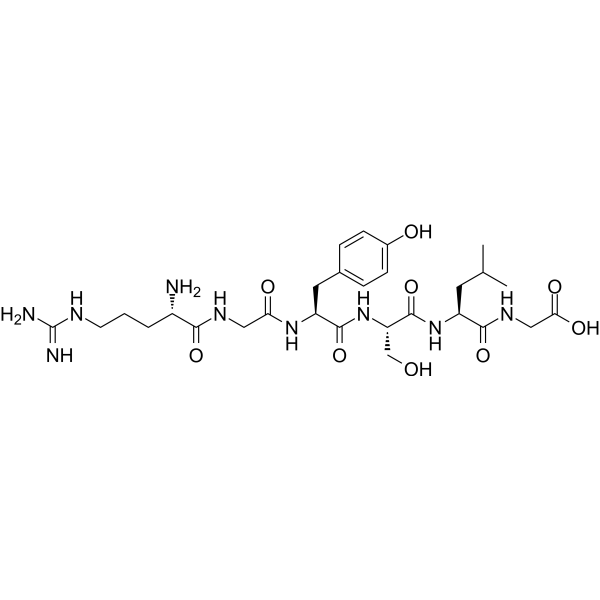 0 ImagesArg-Gly-Tyr-Ser-Leu-Gly is corresponding to the sequence of residues from 21 through 26 in lysozyme. Arg-Gly-Tyr-Ser-Leu-Gly can be used as a substrate for the protein kinase, and phosphorylated at serine residue by protein kinase.
-
PROTAC TRIB2 degrader-1
 0 ImagesCat. No.: HY-168274CAS No.: 3100306-42-8PROTAC TRIB2 degrader-1 is a selective TRIB2 PROTAC degrader with a DC50 of 16.84 nM in PC3 cells. PROTAC TRIB2 degrader-1 directly interacts with TRIB2 and induces its degradation via the CRBN-dependent ubiquitin-proteasome pathway. PROTAC TRIB2 degrader-1 inhibits cancer cell proliferation and promotes apoptosis by inducing PARP cleavage. PROTAC TRIB2 degrader-1 is applicable to relevant research on prostate cancer.
-
VU6080195
 0 ImagesCat. No.: HY-181281VU6080195 is a blood-brain barrier-permeable pan-TAOK activator. VU6080195 shows the highest potency against TAOK1 (EC50 = 270 nM), followed by TAOK3 (EC50 = 503 nM) and TAOK2 (EC50 = 1,376 nM). VU6080195 can be used for the research of diseases such as neurodevelopmental disorders, tauopathies and breast cancer.

-
KHS1 Recombinant Human Active Protein Kinase
 0 ImagesCat. No.: HY-E70839MAP4K5 (KHS1) belongs to the mammalian Ste20-like serine/threonine kinase family. MAP4K5 plays an important role in regulating a range of cellular responses and is involved in Wnt signaling in hematopoietic cells. KHS1 Recombinant Human Active Protein Kinase is a recombinant KHS1 protein that can be used to study KHS1-related functions.
-
STK10-IN-1
 0 ImagesCat. No.: HY-178974SLK/STK10-IN-2 (Compound 23) is a highly selective STK10 inhibitor, with a Kd of 365 nM and an IC50 of 0.85 μM. SLK/STK10-IN-2 exhibits EC50 of 0.89 μM in NanoBRET cell experiments. SLK/STK10-IN-2 shows no significant binding to SLK, STK3/4. SLK/STK10-IN-2 can be used to study STK10-related diseases (such as abnormal lymphocyte migration).
-
SY-5102
 0 ImagesCat. No.: HY-180355CAS No.: 2365230-48-2SY-5102 is a potent, selective, and orally active cyclin-dependent kinase (CDK7) inhibitor with a Kd value of 0.03 nM. SY-5102 occupies the ATP-binding pocket of CDK7 via non-covalent binding to inhibit CDK7 activity, and downregulates its phosphorylation of cyclin CDK and RNA polymerase II. SY-5102 inhibits cancer cell proliferation, and induces tumor growth inhibition and regression. SY-5102 can be used in research related to triple-negative breast cancer.
-
ICK Recombinant Human Active Protein Kinase
 0 ImagesCat. No.: HY-E70729The intestinal cell kinase (ICK) protein belongs to the ros-cross hybridizing kinase (RCK) family. ICK is a ciliary protein, involved in ciliogenesis and regulation of intraflagellar transport (IFT). ICK Recombinant Human Active Protein Kinase is a recombinant ICK protein that can be used to study ICK-related functions.
-
Milciclib maleate
 0 ImagesCat. No.: HY-10424ACAS No.: 1253645-38-3Synonyms: PHA-848125 maleateMilciclib (PHA-848125) maleate is a cyclin-dependent kinase inhibitor that impairs melanoma cell growth and modulates gene expression involved in cell cycle regulation. Milciclib maleate has been shown to significantly affect the expression of various genes, including down-regulating PTTG1, contributing to its antiproliferative activity. Milciclib maleate enhances sensitivity to treatment in p53 mutated melanoma cells when combined with PTTG1 silencing.
-
Odemsertib etifosfate
 0 ImagesCat. No.: HY-187883CAS No.: 2602614-45-7Odemsertib etifosfate is a serine/threonine kinase inhibitor.
-
PROTAC TSSK1 Degrader-1
 0 ImagesCat. No.: HY-184428PROTAC TSSK1 Degrader-1 is a TSSK1 PROTAC degrader with a DC50 of 10.8 nM and an IC50 of 56.8 nM. PROTAC TSSK1 Degrader-1 reduces sperm motility and impairs in vitro fertilization capacity. PROTAC TSSK1 Degrader-1 undergoes metabolic N-dealkylation and exhibits high efflux properties. PROTAC TSSK1 Degrader-1 is applicable to studies related to male fertility.
-
CSBP ligand 1
 0 ImagesCat. No.: HY-178214CAS No.: 165806-32-6CSBP ligand 1 (Compound 36) is a ligand of CSBP, with an IC50 of 0.08 μM for CSBP binding. CSBP ligand 1 can inhibit the production of TNF in mice treated with LPS (HY-D1056). CSBP ligand 1 has no significant inhibitory activity against PGHS-1 (IC50: 16 μM) and 5-LO (IC50: 60 μM). CSBP ligand 1 can be used in the research of inflammation-related diseases.
-
Mosipasertib
 0 ImagesCat. No.: HY-187878CAS No.: 1903809-77-7Mosipasertib is a Serine/threonine kinase inhibitor and antineoplastic.
-
ILK-IN-4
 0 ImagesCat. No.: HY-177912CAS No.: 1333146-87-4ILK-IN-4 (compound 49) is an integrin-linked kinase (ILK) inhibitor. ILK-IN-4 can be used for cancer research.
-
BARK1 Recombinant Human Active Protein Kinase
 0 ImagesCat. No.: HY-E70788BARK1 Recombinant Human Active Protein Kinase is a membrane LRR-RLK (leucine-rich repeat receptor-like kinase) protein that specifically binds to BAK1 and its homologs.
-
PROTAC TSSK1 Degrader-2
 0 ImagesCat. No.: HY-184464PROTAC TSSK1 Degrader-2 is a cereblon-recruiting PROTAC degrader targeting TSSK1, with a DC50 of 10.8 nM and an IC50 of 56.8 nM against TSSK1. PROTAC TSSK1 Degrader-2 recruits the cereblon E3 ubiquitin ligase to induce proteasomal degradation of TSSK1. PROTAC TSSK1 Degrader-2 reduces the motility and in vitro fertilization capacity of mouse sperm. PROTAC TSSK1 Degrader-2 undergoes metabolic N-dealkylation and exhibits high efflux. PROTAC TSSK1 Degrader-2 can be used in studies related to male fertility.
-
UNC10112785
 0 ImagesCat. No.: HY-128491CAS No.: 748142-06-5UNC10112785 is a serine/threonine kinase inhibitor with a human GSK-3β IC50 of 0.031 μM, human CDK-2 IC50 of 0.016 μM, and human CDK-4 IC50 of 1.99 μM. UNC10112785 can be used for the research of type 2 diabetes.
-
Protein kinase inhibitor 16
 0 ImagesCat. No.: HY-171294CAS No.: 928316-79-4Protein kinase inhibitor 16 exhibits inhibitory activity against a variety of Ser/Thr kinase or receptor or non-receptor tyrosine kinase.
-
IMB-YH-8
 0 ImagesCat. No.: HY-116611CAS No.: 17615-10-0IMB-YH-8 is a serine/threonine protein kinase (PknB) inhibitor. IMB-YH-8 has strong antibacterial activity against Mycobacterium tuberculosis (MIC = 0.25 µg/mL). IMB-YH-8 can be used in the research of tuberculosis.
-
Anti-neuroinflammation agent 3
 0 ImagesCat. No.: HY-171276CAS No.: 928316-71-6Anti-neuroinflammation agent 3 (Compound A.10.3) exhibits inhibitory activity against a variety of Ser/Thr kinase or receptor or non-receptor tyrosine kinase.



