



UGT
UDP-glucuronosyltransferase; Uridine diphosphate glucuronosyltransferase
UGT is a type of catabolic enzyme that belongs to the family of detoxification enzymes. UGT consists of two subfamilies, UGT1 and UGT2. UGT1 consists of 5 exons and has a unique gene structure. There are thirteen exon 1s from UGT1A1 to UGT1A13P, and exon 2 to exon 5 are used in common for all mRNAs expressed from the gene. Each isoform of UGT1 results from differential splicing of exon1s to common exon 2-5, and has an unique spectrum of substrate specificity. In contrast, the genes of the UGT2 family consist of 6 exons, and all the enzymes have an individual set of exon 1 to exon 6. UGT involves in the detoxification and excretion of many xenobiotic and endogeneous substances in intrahepatic and extrahepatic tissues. The mutations of UGT1A1 cause hereditary unconjugated hyperbilirubinemias: Crigler-Najjar syndrome type I, type II and Gilbert syndrome.
All Product Categories
-
UGT Related Products (45)
Related Products (45)

-
Flunitrazolam
 0 ImagesCat. No.: HY-137979CAS No.: 2243815-18-9Flunitrazolam is an orally active designer Benzodiazepine. Flunitrazolam is biologically toxic, class in psychoactive substances.
-
Yangambin
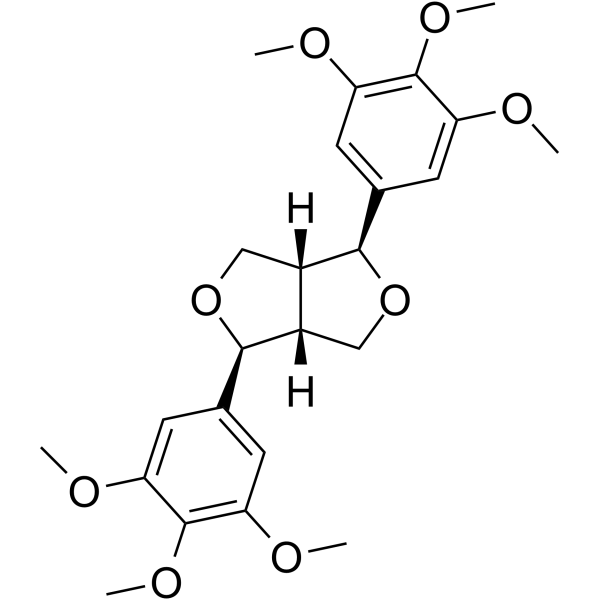 0 ImagesYangambin is a PAF receptor antagonist and UGT1A1/UGT1A3 inhibitor, with an IC50 of 29.7 μM and a Ki of 17.1 μM against human UGT1A1, and an IC50 of 56.5 μM and a Ki of 66.8 μM against human UGT1A3. Yangambin blocks PAF-mediated responses, inhibits LTB4-mediated neutrophil infiltration, and suppresses inflammatory events and anaphylactic contraction. Yangambin acts as a central nervous system inhibitor to reduce spontaneous activity, and also exhibits analgesic, anticonvulsant, antileishmanial, vasodilatory and hypotensive effects. Yangambin blocks voltage-gated Ca2+ channels, reduces the production of NO, TNF-α, IL-6 and PGE2 in cells, increases the production of IL-10, and exerts a protective effect against cardiovascular injury. Yangambin can be used in research related to allergies, cutaneous leishmaniasis, central nervous system diseases and cardiovascular diseases.
-
Human UGT1A6
 0 ImagesCat. No.: HY-E72108Human UGT1A6 is a UDP-glucuronosyltransferase. UGT1A6 catalyzes the glucuronidation of 5-hydroxytryptamine (HY-B1473A), 1-Naphthol (HY-Y1309), and Acetaminophen (HY-66005). Human UGT1A6 can be used in studies related to the pathogenesis of bladder cancer.
-
UK-157147
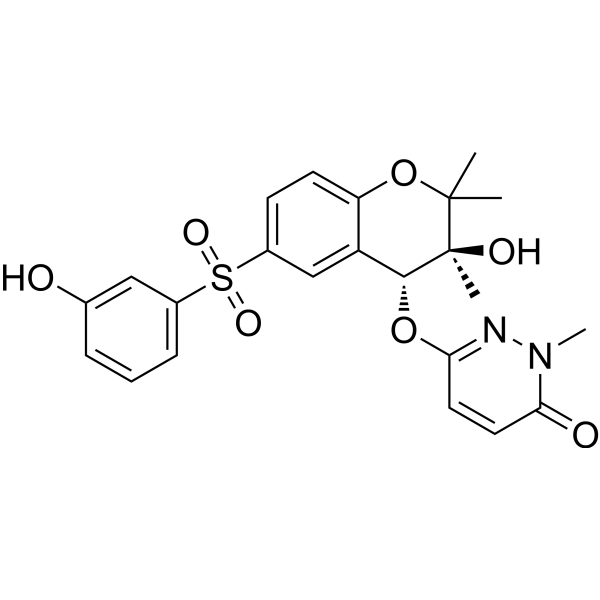 0 ImagesCat. No.: HY-100319CAS No.: 162704-20-3UK-157147 is a substrate for UDP-glucuronosyltransferases (UGT1A1) with a Km value of 105 μM.


-
Schisanhenol (Standard)
 0 ImagesCat. No.: HY-N0859RCAS No.: 69363-14-0Synonyms: Schizanhenol (Standard); Gomisin-K3 (Standard)Schisanhenol (Standard) (Schizanhenol (Standard)) is the analytical standard of Schisanhenol (HY-N0859). This product is intended for research and analytical applications. Schisanhenol, a lignan, is an orally active antioxidant. Schisanhenol reduces AChE activity, increases SIRT1 and PGC-1α expression, and decreases phosphorylated Tau (Ser 396) levels. Schisanhenol increases SOD and glutathione peroxidase activity, decreases malondialdehyde (MDA) content, and inhibits UGT2B7 activitY. Schisanhenol attenuates ox-LDL-induced apoptosis, intracellular reactive oxygen species generation, and cytotoxicity in endothelial cells. Schisanhenol inhibits LDL oxidation, brain mitochondrial and membrane peroxidative damage, and brain mitochondrial swelling and disintegration. Schisanhenol can be used for the research of Alzheimer’s disease, atherosclerosis, brain ischemia, and age-related brain deterioration.
-
Human UGT1A9
 0 ImagesCat. No.: HY-E72111Human UGT1A9 is a UDP-glucuronosyltransferase. UGT1A9 catalyzes the transfer of glucuronic acid from UDP-glucuronic acid (HY-N7033) to Umbelliferone (HY-N0573), 4-methylumbelliferone (HY-N0187), Scopoletin (HY-N0342), and α-Naphthol. Functional folding of UGT1A9 requires N-glycosylation; the deglycosylated mature protein still retains full activity.
-
Berupipam hemifumarate
 0 ImagesCat. No.: HY-107081CAS No.: 172940-14-6Berupipam hemifumarate is a selective antagonist of the dopamine D1 receptor (dopamine D1 receptor). Berupipam hemifumarate is a substrate of UDP-glucuronosyltransferase (UGT) and has a high affinity for UGT enzymes but a relatively low conversion rate. The glucuronidation rate of Berupipam hemifumarate varies among different species and genders. Berupipam hemifumarate can be used for the study of psychotic disorders.
-
Human UGT2B7
 0 ImagesCat. No.: HY-E72113Human UGT2B7 is a UDP-glucuronosyltransferase isoform. Human UGT2B7 catalyzes the glucuronidation of Clopidogrel carboxylic acid (HY-141749A), Chloramphenicol (HY-B0239), and Morphine. Human UGT2B7 can be used in studies related to acute coronary syndrome and thrombus-induced events.
-
Human UGT1A4
 0 ImagesCat. No.: HY-E72107Human UGT1A4 is a UDP-glucuronosyltransferase. Human UGT1A4 is the major enzyme catalyzing the glucuronidation of 25-hydroxyvitamin D3 (HY-32351) in the liver, and maintains vitamin D homeostasis by clearing 25-hydroxyvitamin D3. Human UGT1A4 regulates the substrate-dependent enzymatic activities of UGT1A1 and UGT1A6, while its own activity is also subject to substrate-dependent regulation by co-expressed UGT1A1 and UGT1A6.
-
Ciramadol
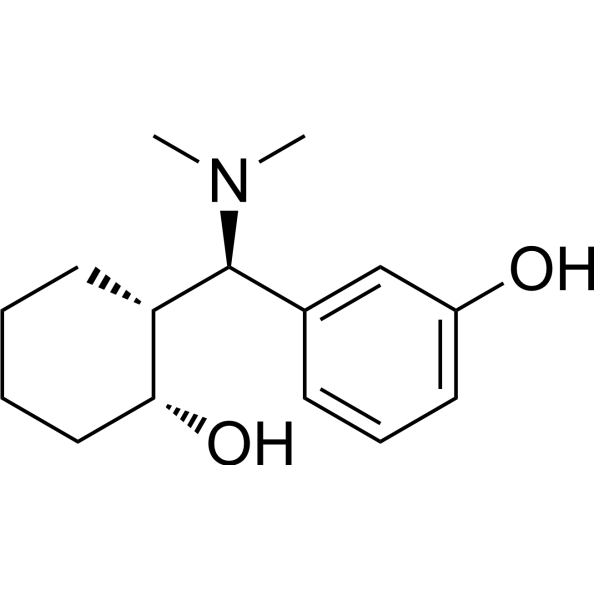 0 ImagesCat. No.: HY-136653CAS No.: 63269-31-8Synonyms: WY 15705Ciramadol (WY 15705) is a potent and orally active analgesic agent with both narcotic agonist and UDP-glucuronyltransferase modulator properties. Ciramadol (WY 15705) can be used for postoperative pain research research.
-
Human UGT1A8
 0 ImagesCat. No.: HY-E72110Human UGT1A8 is a UDP-glucuronosyltransferase. Human UGT1A8 catalyzes the transfer of glucuronosyl group from UDPGA to Dihydrotestosterone, forming DHT monoglucuronide. Human UGT1A8 catalyzes the transfer of glucuronosyl group from UDPGA to DHT monoglucuronide, introducing a second glucuronosyl group at the C2' position of the latter to form DHT diglucuronide. Human UGT1A8 catalyzes the glucuronidation reactions of coumarins, anthraquinones, flavonoids, phenolic compounds, catechol estrogens, primary amines including 4-Aminobiphenyl, and some opioids.
-
Bakuchiol (Standard)
 0 ImagesCat. No.: HY-N0235RCAS No.: 10309-37-2Synonyms: (S)-(+)-Bakuchiol (Standard)Bakuchiol (Standard) is the analytical standard of Bakuchiol. This product is intended for research and analytical applications. Bakuchiol is a phytoestrogen that can be obtained from psoralen seeds. Bakuchiol has been proven to be a non-competitive inhibitor of multiple enzymes, including UDP-glucuronosyltransferase 2B7 (UGT2B7) and human carboxylesterase 2 (hCE2) , with IC50s values of 40.9 μM and 7.28 μM, respectively. Bakuchiol exhibits significant research and application potential in areas such as anti-inflammatory, antibacterial, antitumor therapies, as well as drug metabolism regulation.
-
Human UGT1A3
 0 ImagesCat. No.: HY-E72106Human UGT1A3 is an UDP-glucuronosyltransferase. Human UGT1A3 catalyzes the glucuronidation of Estrone (HY-B0234), amine substrates, opioids, coumarins, flavonoids and anthraquinones. Human UGT1A3 binds to Chenodeoxycholic Acid (HY-76847) in the liver. Human UGT1A3 can be used in research related to cholestatic liver diseases.
-
MK-3901
 0 ImagesCat. No.: HY-122163CAS No.: 1149750-69-5
-
Human UGT2B4
 0 ImagesCat. No.: HY-E72116Human UGT2B4 is a UDP-glucuronosyltransferase. UGT2B4 catalyzes the glucuronidation of bile acids, Carvedilol (HY-B0006) and 6-hydroxylated bile acids to form glucuronide derivatives. UGT2B4 participates in the inactivation of endogenous and exogenous substances, including catechol estrogens, C19 steroids, phenols and monoterpenoids. Human UGT2B4 can be used in the research of hypertension, angina pectoris, chronic heart failure and intrahepatic cholestasis.
-
Human UGT1A10
 0 ImagesCat. No.: HY-E72112Human UGT1A10 is a UDP-glucuronosyltransferase. UGT1A10 catalyzes the glucuronidation of Mycophenolic acid (HY-B0421). Human UGT1A10 mediates glucuronidation modification of 34 out of 42 tested bioflavonoids. Human UGT1A10 is applicable to relevant research on colorectal cancer.

-
Haplopine
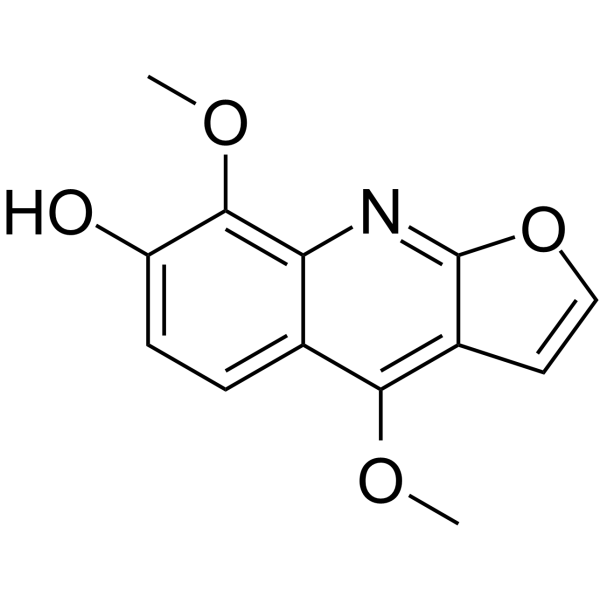 0 ImagesHaplopine is a substance with anti-inflammatory, antioxidant and photoactivated antibacterial activities. It also acts as an inhibitor of UGT1A7 and a photoactivated restriction endonuclease inhibitor. Haplopine inhibits the mRNA/protein expression of IL-6, TSLP, GM-CSF, G-CSF, IL-4, IL-13 and COX-2, while upregulating the mRNA/protein expression of SOD, CAT and HO-1. Haplopine inhibits the glucuronidation reaction catalyzed by UGT1A7 through competitive hydrophobic binding. Haplopine exerts photoactivated restriction endonuclease inhibitory effects by binding to DNA. Haplopine exhibits photoactivated activity against methicillin-resistant Staphylococcus aureus. Haplopine alleviates symptoms of atopic dermatitis. Haplopine can be used in research related to atopic dermatitis and methicillin-resistant Staphylococcus aureus infections.



