



UGT Substrate
-
4-Hydroxyretinoic acid
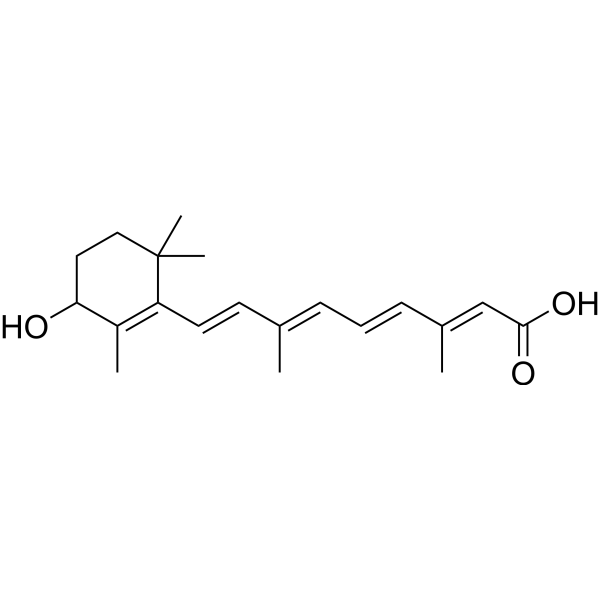 0 ImagesArt. -Nr.: HY-125904CAS. Nr.: 66592-72-1
4-Hydroxyretinoic acid (4-HRA) is a derivative of Retinoic acid (HY-14649). 4-Hydroxyretinoic acid is formed via the catalysis of retinol by cytochrome P-450 isoenzymes. 4-Hydroxyretinoic acid also serves as a substrate for UDP-glucuronosyltransferase (s) and recombinant UGT2B7. 4-Hydroxyretinoic acid binds to the nuclear receptor RAR (Retinoic Acid Receptor), activates RAR and RXR-alpha, subsequently regulates gene expression and cell differentiation, and induces cancer cell apoptosis (Apoptosis). 4-Hydroxyretinoic acid also participates in multiple physiological processes such as immunoregulation, neuroprotection and antioxidation.
-
3-Methyl-2-nitrophenol
 0 ImagesArt. -Nr.: HY-W006081CAS. Nr.: 4920-77-8
3-Methyl-2-nitrophenol is a UDP-glucuronyltransferase (EC 2.4.1.17) acceptor substrate that can be confirmed to undergo glucuronidation catalyzed by the enzyme to form a glucuronide conjugate. 3-Methyl-2-nitrophenol functions as a substrate for conjugation, with glucuronidation forming a glucuronide conjugate that eliminates the parent compound’s characteristic yellow color. 3-Methyl-2-nitrophenol has higher lipid solubility that contributes to high glucuronidation conversion rate, and exhibits lower absorbance at 340 nm to act as a less interfering substrate for the NADH-NAD+-linked UDP-glucuronyltransferase assay.
-
Posaconazole D-glucuronide
 0 ImagesArt. -Nr.: HY-172565Synonyms: SCH 56592 D-glucuronide
Posaconazole D-glucuronide (SCH 56592 D-glucuronide) is a glucuronide metabolite of the antifungal agent Posaconazole (HY-17373). Posaconazole D-glucuronide can be formed in human liver microsomes catalyzed by UGT1A4.



