



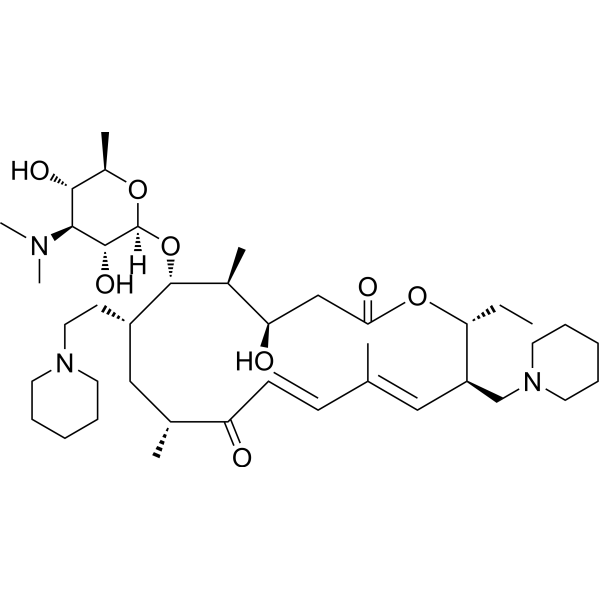
Tildipirosin

Based on 1 Customer Validation
Tildipirosin, a long-acting macrolide, has antibiotic activity.
Nos produits utilisent uniquement pour la recherche. Nous ne vendons pas aux patients.
- Pureté : 99.95%
- CAS No.: 328898-40-4
- Formule: C41H71N3O8
- Masse moléculaire:734.02
-
Stockage:Powder -20°C, 3 years , 4°C, 2 years ; In solvent -80°C, 2 years , -20°C, 1 year

To place orders, for customer services and technical support, please contact: MedChemExpress USA
Tel: 609-228-6898 E-mail: [email protected] [email protected]


-
 Activité biologique
-
Chemical Information
-
Solvant et solubilité
- Pureté et documentation
- Références
-
 Help & FAQs



Voir tous les produits spécifiques à Isoform Antibiotic
More

Activité biologique
Description
IC50 & Target
|
Macrolide |
In Vitro
Tildipirosin exhibits the inhibitory effect on C. coli species, and 23 of 31 (74%) isolates have MICs of 8 or 16 μg/mL while 8 of 31 (26%) have MIC >256 μg/mL. MICs against C. jejuni are 8-64 μg/mL. Tildipirosin against S. enterica and E. coli are 2-8 μg/mL[1]. Tildipirosin inhibits the treponeme isolates form from CODD lesions from 19 sheep, with MIC90 of 0.0469 mg/L[3]. The P. multocida B130 clones show the MIC of 0.25 mg/L for tildipirosin. The 10 P. multocida isolates that carry only erm(42) exhibit MIC of 16-32 mg/L for tildipirosin. The single M. haemolytica that harbours only erm(42) shows MIC of 32 mg/L for tildipirosin[4].
MedChemExpress (MCE) has not independently confirmed the accuracy of these methods. They are for reference only.
In Vivo
MedChemExpress (MCE) has not independently confirmed the accuracy of these methods. They are for reference only.


Chemical Information
-
CAS No. 328898-40-4
-
Appearance Solid
-
Masse moléculaire 734.02
-
Formule C41H71N3O8
-
Color Off-white to light yellow
-
SMILES
O[C@H]([C@H]([C@H](O)[C@@H](C)O1)N(C)C)[C@]1([H])O[C@H]2[C@H](C[C@H](C(/C=C/C(C)=C/[C@H](CN3CCCCC3)[C@@H](CC)OC(C[C@@H](O)[C@@H]2C)=O)=O)C)CCN4CCCCC4
-
Livraison
Room temperature in continental US; may vary elsewhere.
-
Stockage
Powder -20°C 3 years 4°C 2 years In solvent -80°C 2 years -20°C 1 year


Solvant et solubilité
In Vitro:
DMSO : ≥ 100 mg/mL (136.24 mM; Hygroscopic DMSO has a significant impact on the solubility of product, please use newly opened DMSO)
* "≥" means soluble, but saturation unknown.
Please refer to the solubility information to select the appropriate solvent. Once prepared, please aliquot and store the solution to prevent product inactivation from repeated freeze-thaw cycles.
Storage method and period of stock solution: -80°C, 2 years; -20°C, 1 year. When stored at -80°C, please use it within 2 years. When stored at -20°C, please use it within 1 year.
Please refer to the solubility information to select the appropriate solvent. Once prepared, please aliquot and store the solution to prevent product inactivation from repeated freeze-thaw cycles.
Storage method and period of stock solution: -80°C, 2 years; -20°C, 1 year. When stored at -80°C, please use it within 2 years. When stored at -20°C, please use it within 1 year.
Concentration (start) × Volume (start) = Concentration (final) × Volume (final)
In Vivo:
Select the appropriate dissolution method based on your experimental animal and administration route.
- For the following dissolution methods, please ensure to first prepare a clear stock solution using an In Vitro approach and then sequentially add co-solvents:
- To ensure reliable experimental results, the clarified stock solution can be appropriately stored based on storage conditions. As for the working solution for In Vivo experiments, it is recommended to prepare freshly and use it on the same day.
- The percentages shown for the solvents indicate their volumetric ratio in the final prepared solution. If precipitation or phase separation occurs during preparation, heat and/or sonication can be used to aid dissolution.
Add each solvent one by one: 10% DMSO 40% PEG300 5% Tween-80 45% Saline
Solubility: ≥ 3 mg/mL (4.09 mM); Clear solution
This protocol yields a clear solution of ≥ 3 mg/mL (saturation unknown).
Taking 1 mL working solution as an example, add 100 μL DMSO stock solution (30.0 mg/mL) to 400 μL PEG300, and mix evenly; then add 50 μL Tween-80 and mix evenly; then add 450 μL Saline to adjust the volume to 1 mL.
Preparation of Saline: Dissolve 0.9 g sodium chloride in ddH₂O and dilute to 100 mL to obtain a clear Saline solution.
Add each solvent one by one: 10% DMSO 90% (20% SBE-β-CD in Saline)
Solubility: ≥ 3 mg/mL (4.09 mM); Clear solution
This protocol yields a clear solution of ≥ 3 mg/mL (saturation unknown).
Taking 1 mL working solution as an example, add 100 μL DMSO stock solution (30.0 mg/mL) to 900 μL 20% SBE-β-CD in Saline, and mix evenly.
Preparation of 20% SBE-β-CD in Saline (4°C, storage for one week): 2 g SBE-β-CD powder is dissolved in 10 mL Saline, completely dissolve until clear.
In Vivo Dissolution Calculator
Please enter the basic information of animal experiments:
-
-
-
-
Recommended: Prepare an additional quantity of animals to account for potential losses during experiments.
Please enter your animal formula composition:
-
%DMSO +
Recommended: Keep the proportion of DMSO in working solution below 2% if your animal is weak.
-
%+
-
+%Tween-80 + +
-
%Saline +
The co-solvents required include: DMSO, . All of co-solvents are available by MedChemExpress (MCE). , Tween 80. All of co-solvents are available by MedChemExpress (MCE).
Working solution concentration: 0.22 mg/mL
Method for preparing stock solution: mg drug dissolved in μL DMSO. Stock solution concentration: mg/mL.
1. Take μL DMSO stock solution;
2. Add μL .
μL , mix evenly;
3. Then add μL Tween 80, mix evenly;
4. Then add μL
Please ensure that the stock solution in the first step is dissolved to a clear state, and add co-solvents in sequence. You can use ultrasonic heating (ultrasonic cleaner, recommended frequency 20-40 kHz), vortexing, etc. to assist dissolution.


Pureté et documentation
-
Fiche technique (288 KB)
-
SDS (393 KB)
- English - EN (393 KB)
- Français - FR (393 KB)
- Deutsch - DE (393 KB)
- Norwegian - NO (393 KB)
- Español - ES (393 KB)
- Swedish - SV (393 KB)
- Italian - IT (393 KB)
- Korean - KR (393 KB)
- Portuguese - PT (393 KB)
-
Instruction de manipulation (2659 KB)
Références
[1]. Rose M, et al. A microbiological assay to estimate the antimicrobial activity of parenteral tildipirosin against foodborne pathogens and commensals in the colon of beef cattle and pigs. J Vet Pharmacol Ther. 2016 Jun;39(3):277-86. [Content Brief]
[2]. Angell JW, et al. In vitro susceptibility of contagious ovine digital dermatitis associated Treponema spp. isolates to antimicrobial agents in the UK. Vet Dermatol. 2015 Dec;26(6):484-7, e114-5. [Content Brief]
[3]. Confer AW, et al. Clinical disease and lung lesions in calves experimentally inoculated with Histophilus somni five days after metaphylactic administration of tildipirosin or tulathromycin. Am J Vet Res. 2016 Apr;77(4):358-66. [Content Brief]
[4]. Michael GB, et al. Increased MICs of gamithromycin and tildipirosin in the presence of the genes erm(42) and msr(E)-mph(E) for bovine Pasteurella multocida and Mannheimia haemolytica. J Antimicrob Chemother. 2012 Jun;67(6):1555-7. [Content Brief]


Complete Stock Solution Preparation Table
Please refer to the solubility information to select the appropriate solvent. Once prepared, please aliquot and store the solution to prevent product inactivation from repeated freeze-thaw cycles.
Storage method and period of stock solution: -80°C, 2 years; -20°C, 1 year. When stored at -80°C, please use it within 2 years. When stored at -20°C, please use it within 1 year.
| Optional Solvent | Concentration Solvent Mass | 1 mg | 5 mg | 10 mg | 25 mg |
|---|---|---|---|---|---|
| DMSO | 1 mM | 1.3624 mL | 6.8118 mL | 13.6236 mL | 34.0590 mL |
| 5 mM | 0.2725 mL | 1.3624 mL | 2.7247 mL | 6.8118 mL | |
| 10 mM | 0.1362 mL | 0.6812 mL | 1.3624 mL | 3.4059 mL | |
| 15 mM | 0.0908 mL | 0.4541 mL | 0.9082 mL | 2.2706 mL | |
| 20 mM | 0.0681 mL | 0.3406 mL | 0.6812 mL | 1.7030 mL | |
| 25 mM | 0.0545 mL | 0.2725 mL | 0.5449 mL | 1.3624 mL | |
| 30 mM | 0.0454 mL | 0.2271 mL | 0.4541 mL | 1.1353 mL | |
| 40 mM | 0.0341 mL | 0.1703 mL | 0.3406 mL | 0.8515 mL | |
| 50 mM | 0.0272 mL | 0.1362 mL | 0.2725 mL | 0.6812 mL | |
| 60 mM | 0.0227 mL | 0.1135 mL | 0.2271 mL | 0.5677 mL | |
| 80 mM | 0.0170 mL | 0.0851 mL | 0.1703 mL | 0.4257 mL | |
| 100 mM | 0.0136 mL | 0.0681 mL | 0.1362 mL | 0.3406 mL |


Tildipirosin Related Classifications
HY-A0071 Related Classifications
 Powered by Bioz