



Endometriosis
-
Endometriosis (12)

- 1

- Formula: C23H16Cl2N2
- Molecular Weight: 391.29
DIM-3,5-Cl2 is an inverse NR4A1/NR4A2 agonist with KD values of 7.7 μM and 12.0 μM for NR4A1 and NR4A2, respectively. DIM-3,5-Cl2 acts as an inverse agonist to downregulate pro-oncogenic and proendometriotic gene products, and as an agonist to enhance NR4A1/2/Sp1/Sp4-mediated CD71 transactivation. DIM-3,5-Cl2 induces ferroptosis via ROS formation, lipoperoxidation, MDA production, and reduced GPX4, SLC7A11 expression. DIM-3,5-Cl2 induces apoptosis via PARP and caspase-3 cleavage, reduced BCL-2 expression, and inhibits cancer cell viability. DIM-3,5-Cl2 can be used for the research of triple negative breast cancer, endometriosis, and colorectal cancer.

- Formula: C28H31FN2O3
- Molecular Weight: 462.56
BAY-1128688 is a potent, orally active and selective AKR1C3 inhibitor with IC50 < 2 nM. BAY-1128688 shows high selectivity over related AKR1C enzymes (1C1, 1C2, 1C4) and AKR1D1. BAY-1128688 exhibits no relevant activity at major nuclear hormone receptors. BAY-1128688 reduces endometriotic lesions in the marmoset monkey endometriosis model. BAY-1128688 can be used for endometriosis research.
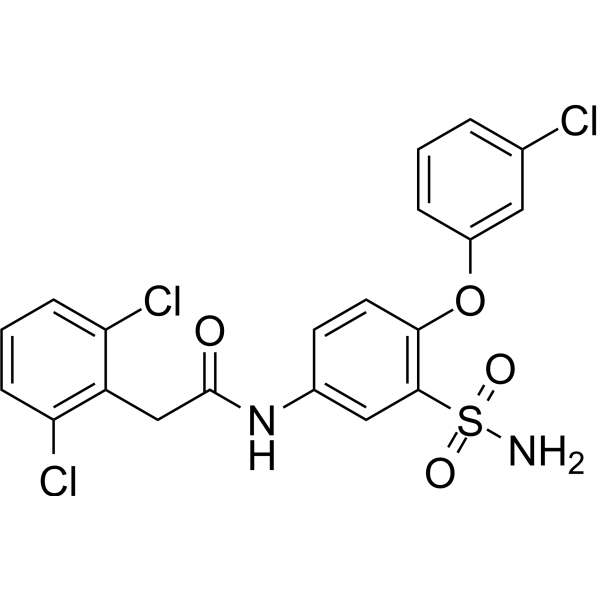
- Formula: C20H15Cl3N2O4S
- Molecular Weight: 485.77
P2X4 antagonist-1 is a P2X4 receptor antagonist with an IC50 of 15 nM. P2X4 antagonist-1 inhibits ATP (HY-B2176)-induced calcium influx. P2X4 antagonist-1 can be used for the research of pain syndromes, endometriosis, cancer.

- Formula: C23H28N4O2
- Molecular Weight: 392.49
BAY-163 is a tertiary urea derivative and inactive negative control probe for BAY-439 (HY-178123). BAY-163 does not inhibit phospholipase A2 group V (PLA2-G5) activity in immune cells. BAY-163 can be used for research on endometriosis.

- Formula: C27H23ClFN5O3
- Molecular Weight: 519.95
GPR54 antagonist‑1 is a GPR54 antagonist with IC50 values of 3.6 nM and 15 nM against human and rat GPR54, respectively. GPR54 antagonist‑1 shows blood‑brain barrier penetration. GPR54 antagonist‑1 blocks the function of human and rat GPR54 receptors. GPR54 antagonist‑1 suppresses plasma luteinizing hormone levels in castrated male rats. GPR54 antagonist‑1 can be used for the study of prostate cancer and endometriosis.

AMY109 is an anti-human interleukin-8 (IL-8) monoclonal antibody, with a Ka of 36.8 pM for human IL-8, and a Ka of 380 pM for cynomolgus monkey IL-8. AMY109 binds to human and cynomolgus monkey IL-8 in a pH-dependent manner, inhibits IL-8-mediated activation of CXCR1 and CXCR2, and blocks the downstream biological activities of IL-8. AMY109 inhibits neutrophil recruitment to endometriotic lesions and suppresses monocyte chemoattractant protein-1 production by neutrophils. AMY109 is applicable to research related to endometriosis.

- Formula: C12H9ClO
- Molecular Weight: 204.65
4-Chlorodiphenyl ether (4-CDE) is an estrogen-mimicking active compound. 4-Chlorodiphenyl ether maintains the survival of endometriotic cysts and exhibits estrogenic activity associated with the growth of endometriotic implants. 4-Chlorodiphenyl ether can be used in research related to endometriosis.

- Formula: C20H25NO5
- Molecular Weight: 359.42
CP8754 is an orally active, selective human progesterone receptor (hPR) antagonist that blocks progesterone-mediated signaling pathways. CP8754 competitively inhibits the binding of [3H]-progesterone to hPR. And in vitro, CP8754 inhibits progesterone-dependent exogenous luciferase and endogenous alkaline phosphatase expression; while in vivo, CP8754 inhibits rabbit endometrial transformation. CP8754 does not significantly bind to human glucocorticoid receptors (hGR), estrogen receptors (hER), or rat androgen receptors (rAR). CP8754 can be used in the study of progesterone-related diseases such as breast cancer, endometriosis, uterine fibroids, and meningioma, as well as hormone-dependent tumors.

- Formula: C24H23N3O3
- Molecular Weight: 401.46
ADX68692 is an orally active FSHR negative allosteric regulator, with an IC50 value of 140 nM against hFSHR. ADX68692 antagonizes hCG (HY-107953)-mediated cAMP production, β-arrestin 2 recruitment, and the LH/CGR signaling pathway. ADX68692 partially inhibits testosterone synthesis. ADX68692 blocks follicle growth, disrupts the estrous cycle in rats, and reduces the pregnancy rate in rats. ADX68692 can be used in research related to contraception and endometriosis.

- Formula: C28H38N4O3S
- Molecular Weight: 510.69
L-367773 is an orally active, selective oxytocin receptor antagonist, with Ki values of 26 nM and 61 nM for rat uterine oxytocin receptor and human uterine oxytocin receptor, respectively. L-367773 inhibits Oxytocin-stimulated uterine contractions.
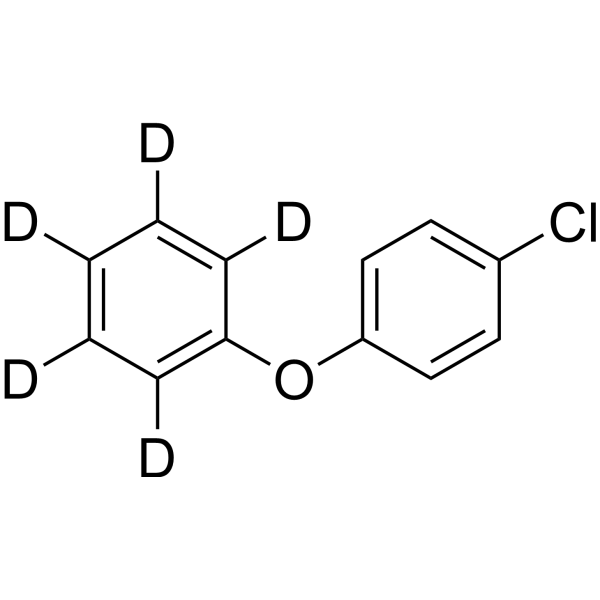
- Formula: C12H4D5ClO
- Molecular Weight: 209.68
4-Chlorodiphenyl ether-d5 (4-CDE-d5) is the deuterium labeled 4-Chlorodiphenyl ether. 4-Chlorodiphenyl ether is an estrogen-mimicking active compound. 4-Chlorodiphenyl ether maintains the survival of endometriotic cysts and exhibits estrogenic activity associated with the growth of endometriotic implants. 4-Chlorodiphenyl ether can be used in research related to endometriosis.

- Formula: C17H17NO2
- Molecular Weight: 267.32
4-DMA-3'-OH-Chalcone (compound 24) is a synthetic chalcone derivative and selective cytotoxic agent.4-DMA-3'-OH-Chalcone reduces viability of endometriotic cells, while preserving or enhancing viability of eutopic endometrial cells.4-DMA-3'-OH-Chalcone can be used for the research of endometriosis.
- 1



