



CHMA1004
Based on 3 publication(s) in Google Scholar
CHMA1004 (Methyl piperazine-2-carboxylate; METTL3 activator-1 free base) is a METTL3/METTL14/WTAP methyltransferase complex activator. CHMA1004 exhibits neuroprotective and anxiolytic potential by enhancing m6A methylation modification of RNA. CHMA1004 promotes HIV replication in an infection context. CHMA1004 can be used in studies related to anxiety disorders and HIV-1 infection.
For research use only. We do not sell to patients.
- CAS No.: 2758-98-7
- Formula: C6H12N2O2
- Molecular Weight:144.17
-
Storage:
Please store the product under the recommended conditions in the Certificate of Analysis.


To place orders, for customer services and technical support, please contact: MedChemExpress USA
Tel: 609-228-6898 E-mail: [email protected] [email protected]


-
 Biological Activity
-
Chemical Information
- Purity & Documentation
- References
-
 Help & FAQs


-

HY-109659
1-(3-Aminopropyl)-4-methylpiperazine -

HY-W105411
N,N'-Diacryloylpiperazine -
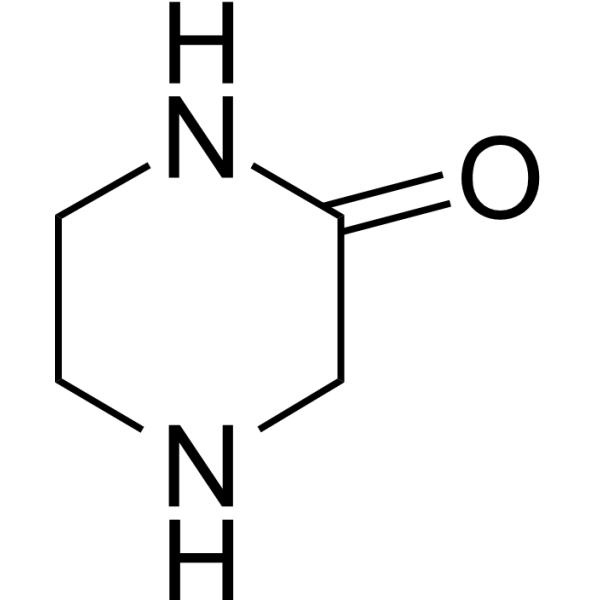
HY-20128
Piperazin-2-one -
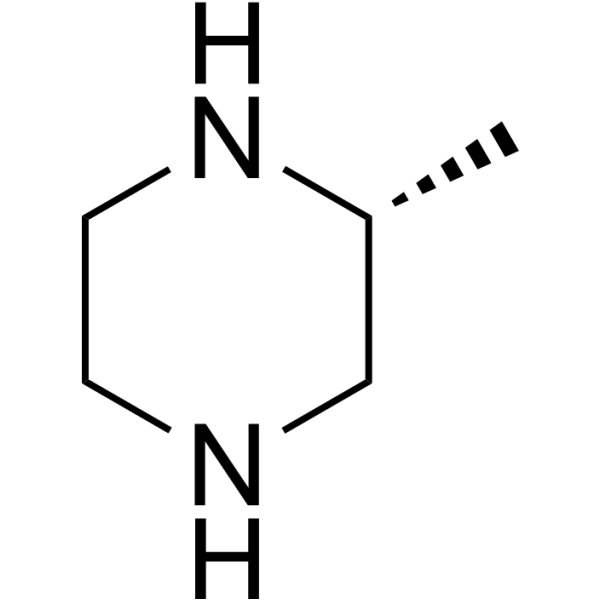
HY-34767
(R)-2-Methylpiperazine -

HY-W027208
1,4-Bis(3-aminopropyl)piperazine -
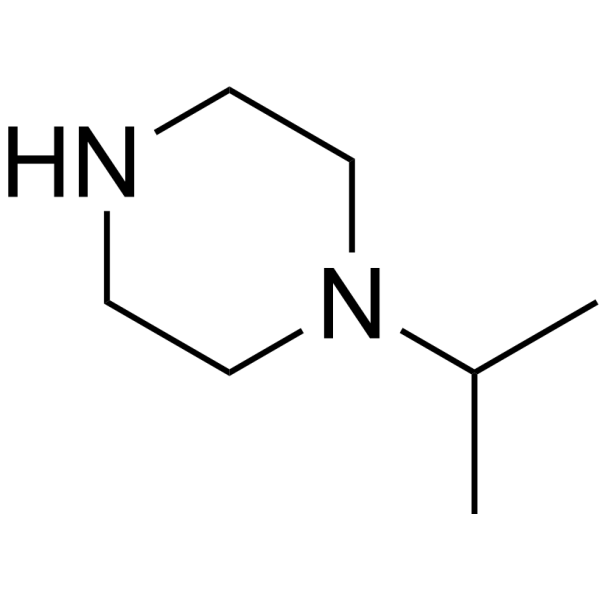
HY-W012744
Isopropylpiperazine -
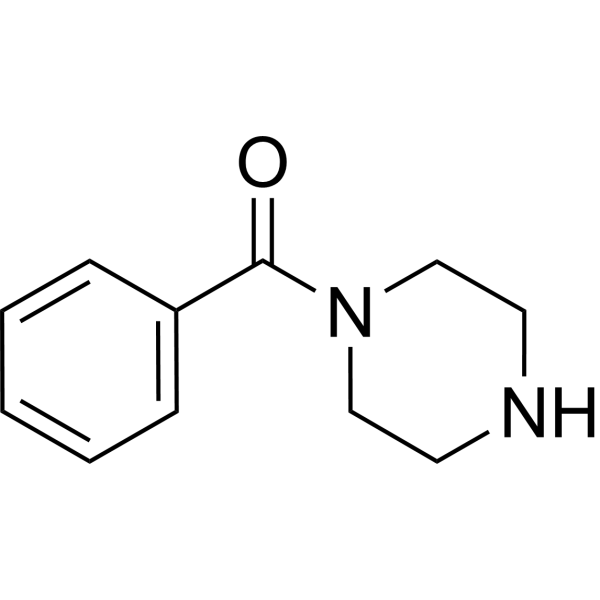
HY-W002698
1-Benzoylpiperazine -

HY-W015661
3-(Piperazin-1-yl)propan-1-ol -

HY-W077402
tert-Butyl 4-(3-bromopropyl)piperazine-1-carboxylate -
HY-W451242
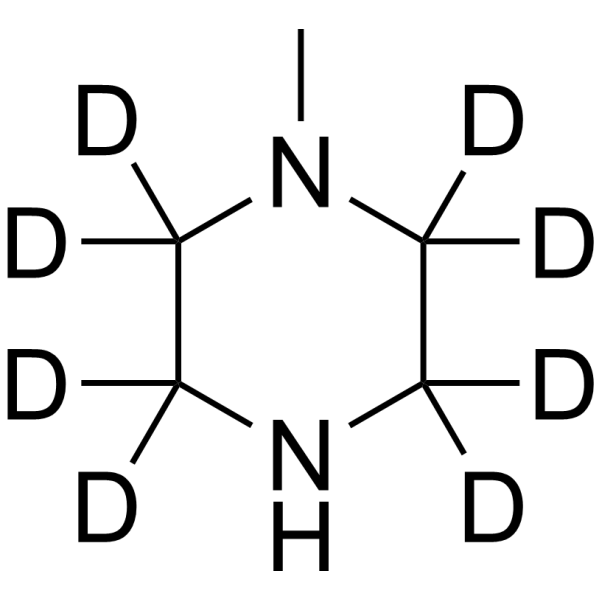
1-Methylpiperazine-2,2,3,3,5,5,6,6-d8
Publications Citing Use of MedChemExpress (MCE) CHMA1004
More

Biological Activity
Description
In Vitro
CHMA1004 protects human stem cell-derived dopamine neurons against 6-OHDA-induced cell death[1].
CHMA1004 (Compound 4) (0.001-10 μM; 48 h) induces a concentration-dependent increase in HIV-1 p24 release from ACH-2 cells[2].
CHMA1004 (10 μM; 48 h) promotes the production of infectious HIV-1 viral particles in ACH-2 cells, which is verified by enhanced luciferase activity in infected TZM-bl cells[2].
CHMA1004 (10 μM; 48 h) increases the m6A methylation level in mRNA of ACH-2 cells to more than twice the original level, and elevates the m6A methylation level in HIV-1 viral RNA by approximately 18%[2].
CHMA1004 (1 nM-10 μM) slightly increases the m6A methylation level in mRNA of HEK-293 cells[2].
MedChemExpress (MCE) has not independently confirmed the accuracy of these methods. They are for reference only.
-
Cell Line:ACH-2 cells (harboring HIV-1 provirus)
-
Concentration:0.001 μM, 0.01 μM, 0.1 μM, 1 μM, 10 μM
-
Incubation Time:48 h
-
Result:Caused a concentration-dependent increase in HIV-1 p24 release (measured as optical density at 450 nm).
Showed statistically significant increases at 0.1 μM, 1 μM, and 10 μM compared to control.
In Vivo
MedChemExpress (MCE) has not independently confirmed the accuracy of these methods. They are for reference only.
-
Animal Model:Wistar rats (male and female; 3 months old at study start; male body weight 499 g, female body weight 290 g)[1]
-
Dosage:1 mg/kg (subchronic; acute microdialysis); 5 mg/kg (subchronic; acute microdialysis)
-
Administration:i.p.; daily; 17-18 days (subchronic); i.p.; single dose (acute microdialysis)
-
Result:Increased time spent moving, line crossings, and rearings in female rats in acute open field test.
Showed a similar non-significant tendency in males at 5 mg/kg in acute open field test.
Reduced faecal boli counts in male rats at 5 mg/kg in acute open field test.
Increased head-dips in female rats during the first repeated elevated zero-maze test at 1 mg/kg and 5 mg/kg.
Increased open quadrant entries in male rats during the second repeated elevated zero-maze test at 5 mg/kg.
Reduced stretched-attend postures in male rats during the first repeated elevated zero-maze test at 5 mg/kg.
Increased swimming time and reduced struggling time in female rats on both test days of repeated forced swimming test at 1 mg/kg and 5 mg/kg.
Tended to increase locomotion in male rats during amphetamine challenge at subchronic 5 mg/kg.
Reduced the baseline sex difference in 50-kHz USVs by increasing vocalisations in males and reducing them in females during amphetamine challenge at subchronic 5 mg/kg.
Had no significant effect on extracellular striatal dopamine levels in acute microdialysis at 1 mg/kg and 5 mg/kg.
Increased normetanephrine (NMN) levels in males and females in striatum at subchronic 5 mg/kg.
Increased the DOPAC/DA ratio in males in striatum at subchronic 5 mg/kg.
Decreased the DOPAC/DA ratio in females in striatum at subchronic 1 mg/kg.
Increased NMN levels in males in frontal cortex at subchronic 1 mg/kg and 5 mg/kg.
Increased noradrenaline (NA) levels in males in frontal cortex at subchronic 5 mg/kg.
Increased homovanillic acid (HVA) levels in males in locus coeruleus at subchronic 1 mg/kg.
Decreased HVA levels in females in locus coeruleus at subchronic 1 mg/kg and 5 mg/kg.
Increased NA levels in males and females in ventral tegmental area at subchronic 1 mg/kg.
Altered expression of 172 genes (e.g., downregulated Acsm5, Gpr83; upregulated Fgr, Hes1) in striatum of females at subchronic 1 mg/kg.
Altered expression of 120 genes (e.g., downregulated Vwa5b2, Peli1; upregulated Nbl1, Mdga1) in striatum of females at subchronic 5 mg/kg.
Showed consistent expression changes across doses in seven overlapping genes (Galns, Hps3, Misp3, Nbl1, Samd4a, Slc28a2, Spon2) in striatum of females.


Chemical Information
-
CAS No. 2758-98-7
-
Molecular Weight 144.17
-
Formula C6H12N2O2
-
SMILES
COC(=O)C1CNCCN1
-
Synonyms
Methyl piperazine-2-carboxylate; METTL3 activator-1 free base
-
Shipping
Room temperature in continental US; may vary elsewhere.
-
Storage
Please store the product under the recommended conditions in the Certificate of Analysis.


Publications (3)
-
Journal Impact Factor
-
Most Recent
-
Autophagy
Chaperone-mediated autophagy reprograms heterogeneous subsets of activated macrophages in immune thrombocytopenia. [Abstract]2026 Jun 26:1-17. PMID: 42329073 -
Front Immunol
Repetitive transcranial magnetic stimulation alleviates neuropathic pain via microglial polarization by modulating the METTL3/NMDAR2B/NLRP3 pathway. [Abstract]2026 Jan 26:16:1666920. PMID: 41668762 -


Purity & Documentation
References
[1].
Kanarik M, et al. RNA m6A methyltransferase activator affects anxiety-related behaviours, monoamines and striatal gene expression in the rat. Acta Neuropsychiatr. 2024 Oct 9;37:e52.
[Content Brief]
[2]. Selberg S, et al. HIV Replication Is Increased by RNA Methylation METTL3/METTL14/WTAP Complex Activators. ACS Omega. 2021;6(24):15957-15963. Published 2021 Jun 11. [Content Brief]

Calculators
Concentration (start) × Volume (start) = Concentration (final) × Volume (final)


CHMA1004 Related Classifications
HY-W125425 Related Classifications
 Powered by Bioz