11 Results for "

XBP1 mRNA

" in MedChemExpress (MCE) Product Catalog:
Products (11)

11 Results for "XBP1 mRNA" in MCE Product Catalog:

  • Targets Recommended:
15
15 Cited Publications
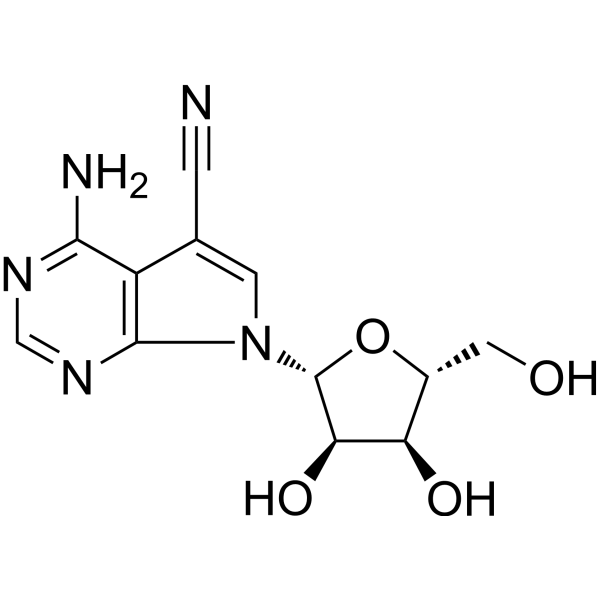
Cat. No.: HY-103248
CAS No.: 606-58-6
Purity:  99.78%
Synonyms: Vengicide
Toyocamycin (Vengicide) is an adenosine analog produced by Streptomyces diastatochromogenes, acts as an XBP1 inhibitor. Toyocamycin blocks RNA synthesis and ribosome function, and induces apoptosis. Toyocamycin affects IRE1α-XBP1 pathway, and inhibits XBP1 mRNA cleavage with an IC50 value of 80 nM with affecting IRE1α auto-phosphorylation. Toyocamycin specifically inhibits CDK9 with an IC50 value of 79 nM .
loading...
    loading...
1
1 Cited Publications
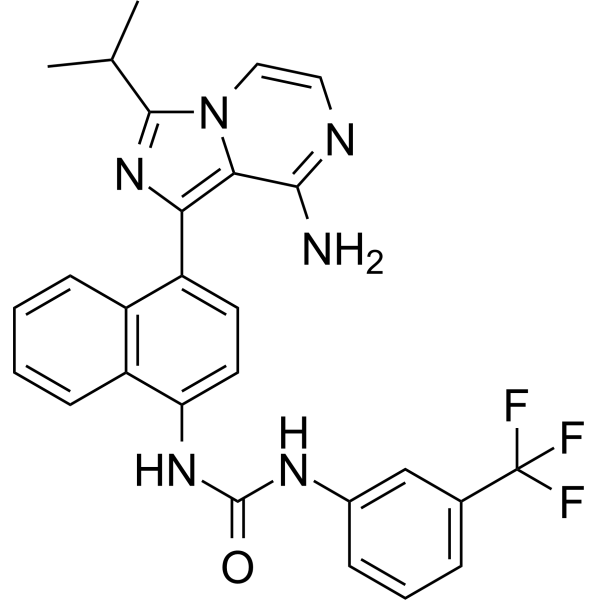
Cat. No.: HY-18509
CAS No.: 1414938-21-8
Target:  

IRE1

Research Areas:  

Cancer

IRE1α kinase-IN-2 is a potent IRE1α kinase inhibitor, with an EC50 of 0.82 μM. IRE1α kinase-IN-2 inhibits IRE1α kinase autophosphorylation (IC50=3.12 μM). IRE1α kinase-IN-2 inhibits XBP1 mRNA splicing in the WT cell lines .
loading...
    loading...
Cat. No.: HY-160229
Synonyms: R-1075 sodium
ssRNA40 sodium (R-1075 sodium) is a single-stranded RNA40 derived from HIV-1. ssRNA40 sodium activates the TLR7, TLR8, TLR2, RIG-I, MDA5, MyD88, Caspase-3, IRE1α, NLRP3 inflammasome and IRF7 signaling pathways. ssRNA40 sodium alters mRNA expression in neutrophils, induces pro-inflammatory cytokines, ROS, autophagy (autophagy), pyroptosis (pyroptosis), neuronal death, neurodegeneration, aggregate formation and NK cell activation. ssRNA40 sodium activates the expression of CD62L, CD11b, CD69, MX1, OAS1, ATG7, LC3B and XBP1 in immune cell and neuronal populations. ssRNA40 sodium causes cortical neuron loss and axonal damage in mice in a TLR7-dependent manner. ssRNA40 sodium can be used in research on HIV-1 infection, neurodegeneration, COVID-19 and HIV-associated neurological disorders .
loading...
    loading...
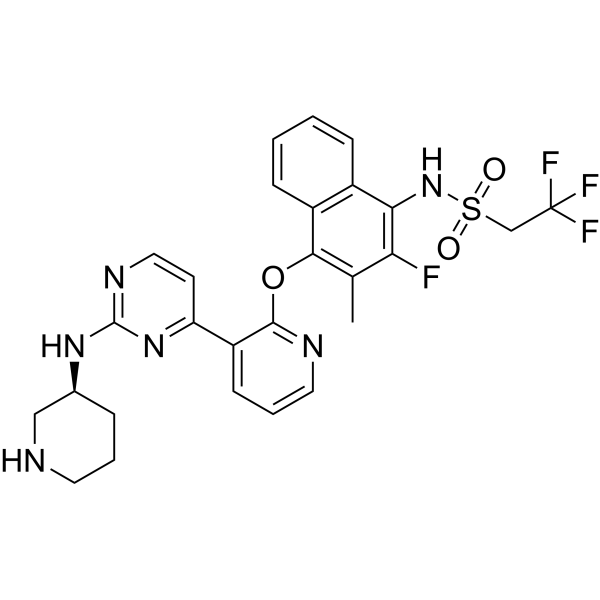
Cat. No.: HY-145425
CAS No.: 2771006-54-1
Target:  

IRE1 Apoptosis FGFR

Research Areas:  

Inflammation/Immunology

PAIR2 is a highly selective inhibitor targeting the kinase domain of human IRE1α, with a Ki value of 8.8 nM against human IRE1α. PAIR2 fully occupies the ATP-binding site of the IRE1α kinase domain, partially antagonizes the ribonuclease activity of IRE1α, specifically inhibits regulated IRE1α-dependent decay (RIDD) and its mediated substrate cleavage, while preserving the splicing function of Xbp1 mRNA. PAIR2 also promotes the differentiation of B cells into plasma cells, blocks IRE1α-induced cell apoptosis, and restores the expression of Fgfr2 mRNA in AT2 cells. PAIR2 effectively reaches a steady-state concentration in the lung tissues of Mus musculus, and serves as an important tool for investigating the function of the IRE1α signaling pathway in diseases such as pulmonary fibrosis .
loading...
    loading...
Cat. No.: HY-178946
Target:  

IRE1

Research Areas:  

Cancer

IA107 is a potent, selective, and allosteric IRE1α RNase (IC50 = 16 nM (non phosphorylated), IC50 = 9 nM (phosphorylated)) inhibitor. IA107 can inhibit endoplasmic reticulum stress-induced XBP1 mRNA splicing and protein expression, and has no cytotoxicity .
loading...
    loading...
Cat. No.: HY-158386
CAS No.: 3033375-01-5
Target:  

IRE1

Research Areas:  

Cancer

IRE1a-IN-1 (Compound 10) is an IRE1α inhibitor, with an IC50 of less than 100 nM for XBP1 mRNA. IRE1a-IN-1 can be used for the research of cancer .
loading...
    loading...
Cat. No.: HY-158393
CAS No.: 3033375-24-2
Target:  

IRE1

Research Areas:  

Cancer

IRE1a-IN-2 (Compound 30) is an IRE1α inhibitor, with an IC50 of over than 200 nM for XBP1 mRNA. IRE1a-IN-2 can be used for the research of cancer .
loading...
    loading...
Cat. No.: HY-168843
CAS No.: 837408-39-6
Target:  

Apoptosis Autophagy

Research Areas:  

Cancer

PSP205 is a potent anticancer agent. PSP205 shows cytotoxicity. PSP205 induces apoptosis. PSP205 induces ER-stress-mediated autophagy. PSP205 increases the protein expression of LC3BII and increases the CHOP and spliced XBP1 at the mRNA and protein levels .
loading...
    loading...
Cat. No.: HY-138844
CAS No.: 1184391-57-8
3-AP-Me is a dimethyl derivative of the nucleotide reductase inhibitor 3-AP (SML0568). 3-AP-Me can activate the endoplasmic reticulum (ER) stress pathway by promoting the phosphorylation of eIF2α and increasing the gene expression of transcription factors ATF4 and ATF6, leading to cell apoptosis. Additionally, 3-AP-Me can activate the stress kinases c-Jun N-terminal kinase (JNK) and p38 mitogen-activated protein kinases. 3-AP-Me also leads to the upregulation of the spliced mRNA variant XBP1, can be used in cancer research .
loading...
    loading...
Cat. No.: HY-181886
Target:  

IRE1 PDGFR c-Kit

Research Areas:  

Others

AK177 is an allosteric activator of IRE1α ribonuclease, with values of 480 nM and 180 nM against non-phosphorylated and phosphorylated IRE1α, respectively. AK177 promotes IRE1α-mediated cleavage of XBP1 mRNA probe in a concentration-dependent manner and binds stably to its kinase domain. However, AK177 shows poor kinase selectivity, and due to poor membrane permeability at the cellular level, it induces no significant downstream pathway activation or antiproliferative activity .
loading...
    loading...
Cat. No.: HY-123996
CAS No.: 20041-64-9
Research Areas:  

Infection Cancer

3-ethoxy-5,6-dibromosalicylaldehyde is a potent, non-competitive, selective IRE1 (including IRE1α) inhibitor (IC50s: ∼0.12 μM for hIRE1α-cyto; 6 μM for yeast Ire1). 3-ethoxy-5,6-dibromosalicylaldehyde inhibits XBP-1 splicing. 3-ethoxy-5,6-dibromosalicylaldehyde induces Apoptosis. 3-ethoxy-5,6-dibromosalicylaldehyde upregulates the mRNA expression level of TXNIP, while downregulating the expression level of TXN. 3-ethoxy-5,6-dibromosalicylaldehyde exhibits anticancer activity against pancreatic cancer. 3-ethoxy-5,6-dibromosalicylaldehyde significantly inhibits chikungunya virus replication .
loading...
    loading...
  • 1

