13 Results for "

mitochondrial topoisomerase II

" in MedChemExpress (MCE) Product Catalog:
Products (13)

13 Results for "mitochondrial topoisomerase II" in MCE Product Catalog:

3
3 Cited Publications
Cat. No.: HY-13721
CAS No.: 81267-65-4
Purity:  99.89%
Synonyms: Idronoxil; Dehydroequol; Haginin E
Research Areas:  

Cancer

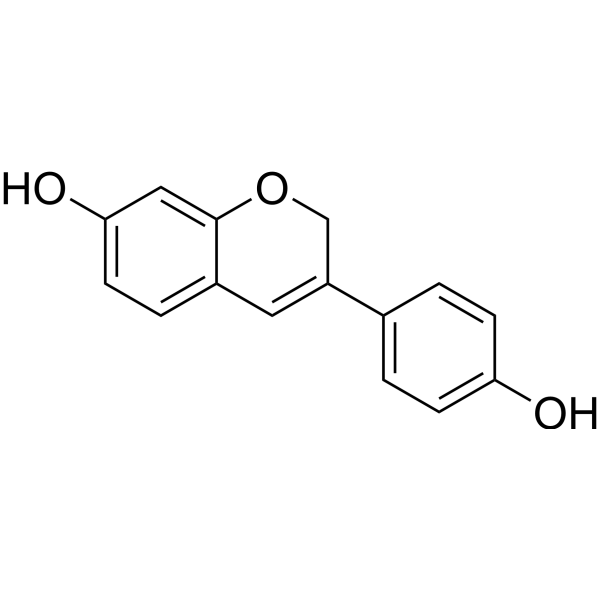
Phenoxodiol (Idronoxil), a synthetic analog of Genestein, activates the mitochondrial caspase system, inhibits XIAP (an apoptosis inhibitor), and sensitizes the cancer cells to Fas-mediated apoptosis. Phenoxodiol also inhibits DNA topoisomerase II by stabilizing the cleavable complex. Phenoxodiol induces cell cycle arrest in the G1/S phase of the cell cycle and upregulates p21 WAF1 via a p53 independent manner .
loading...
    loading...
Cat. No.: HY-W046353
CAS No.: 1504-74-1
Synonyms: o-Methoxycinnamaldehyde
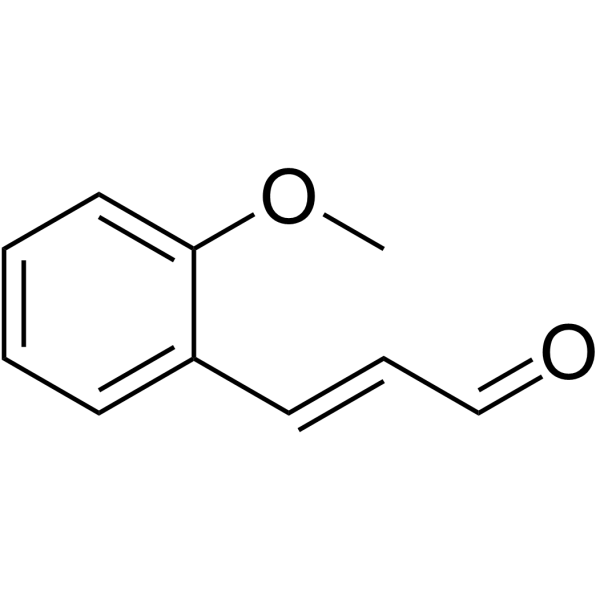
2-Methoxycinnamaldehyde (o-Methoxycinnamaldehyde) is a natural compound that can be isolated from Cinnamomum cassia. 2-Methoxycinnamaldehyde inhibits topoisomerase-I/II and NF-κB signaling pathway, causes mitochondrial dysfunction, induces lysosomal vesiculation, thereby leading to DNA damage and cell apoptosis. 2-Methoxycinnamaldehyde exhibits antitumor effects .
loading...
    loading...
Cat. No.: HY-12888
CAS No.: 907543-25-3
Target:  

Topoisomerase Bacterial

Research Areas:  

Infection

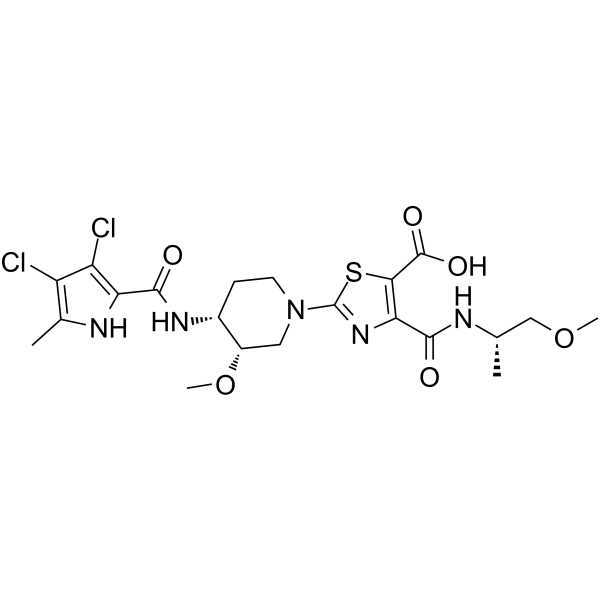
AZD5099 is an orally effective pyrrole amide inhibitor and antibacterial agent. AZD5099 shows over 10000-fold higher selectivity for bacterial type II topoisomerases than for human topoisomerase IIα, with a IC50 value of 0.032 μmol/L against Staphylococcus aureus GyrB, a IC50 of 0.760 μmol/L against Escherichia coli GyrB, a IC50 of 73 nM against Escherichia coli ParE, a Kd of 83.8 nmol/L for Staphylococcus aureus GyrB, and a IC50 of >50 μM against human topoisomerase IIα. AZD5099 inhibits rat Mrp2 ATPase activity, competitively binds to the ATP-binding site of bacterial type II topoisomerases, blocks enzyme activity, reduces bacterial DNA and RNA synthesis, disrupts DNA replication and transcription processes, and induces mitochondrial toxicity. AZD5099 exhibits activity against Gram-positive bacteria, fastidious Gram-negative bacteria and drug-resistant strains, reduces bacterial loads in mouse infection models, and has a low spontaneous resistance frequency. AZD5099 can be used in studies related to infections caused by Gram-positive bacteria and fastidious Gram-negative bacteria, methicillin-resistant Staphylococcus aureus infections, Streptococcus pneumoniae pulmonary infections, as well as Staphylococcus aureus and Escherichia coli infections .
loading...
    loading...
Cat. No.: HY-143279
CAS No.: 99140-25-7
Target:  

Topoisomerase Apoptosis

Research Areas:  

Cancer

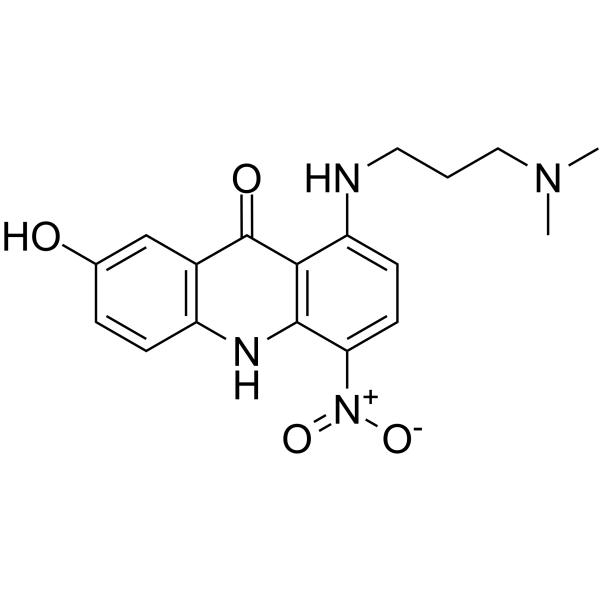
Topoisomerase II inhibitor 3 (Compound 6 h ) is a acridone derivatives, as well as a Type II DNA topoisomerase (topo II) inhibitor , as a topo IIα/β inhibitor with the value of IC50 is 0.17 μM for topo IIα and the value of IC50 is 0.23 μM for topo IIβ subtypes, caused obvious DNA damage, and induced apoptosis by triggering the loss of mitochondrial membrane potential .
loading...
    loading...
Cat. No.: HY-179018
Topoisomerase II-IN-25 (Compound 6a) is a selective inhibitor of topoisomerase II and has no inhibitory activity on topoisomerase I. Topoisomerase II-IN-25 exhibits significant anti-PC-3 cell activity. Topoisomerase II-IN-25 significantly increases intracellular ROS levels, inducing oxidative stress. Topoisomerase II-IN-25 causes depolarization of mitochondrial membrane potential and promotes cell apoptosis. Topoisomerase II-IN-25 blocks PC-3 cells in the G2/M phase. Topoisomerase II-IN-25 can be used for the study of prostate cancer .
loading...
    loading...
Cat. No.: HY-170557
Research Areas:  

Cancer

Topoisomerase IIα-IN-10 (Compound 13r) is an inhibitor of Topoisomerase IIα. It binds to the active site of DNA when complexed with Topoisomerase IIα, and this binding is stabilized through interactions with DNA base pairs and amino acid residues. Topoisomerase IIα-IN-10 can induce Apoptosis by intercalating DNA and inhibiting Topoisomerase IIα, thereby disrupting the mitochondrial membrane potential and inhibiting the growth of HCT116 cell lines, with an IC50 of 4.37 μM against HCT116 cells. Topoisomerase IIα-IN-10 can be used for research in the field of cancer treatment .
loading...
    loading...
Cat. No.: HY-122481
CAS No.: 74578-01-1
Research Areas:  

Cancer

Thaspine acetate, an alkaloid, is a topoisomerase I and II inhibitor. Thaspine acetate induces cancer cell apoptosis. Thaspine acetate induces Bak and Bax activation, mitochondrial cytochrome c release and mitochondrial membrane permeabilization. Thaspine acetate can be isoalted from the cortex of the South American tree Croton lechleri .
loading...
    loading...
Cat. No.: HY-W046353R
CAS No.: 1504-74-1
Synonyms: o-Methoxycinnamaldehyde (Standard)
2-Methoxycinnamaldehyde (Standard) is the analytical standard of 2-Methoxycinnamaldehyde. This product is intended for research and analytical applications. 2-Methoxycinnamaldehyde (o-Methoxycinnamaldehyde) is a natural compound that can be isolated from Cinnamomum cassia. 2-Methoxycinnamaldehyde inhibits topoisomerase-I/II and NF-κB signaling pathway, causes mitochondrial dysfunction, induces lysosomal vesiculation, thereby leading to DNA damage and cell apoptosis. 2-Methoxycinnamaldehyde exhibits antitumor effects .
loading...
    loading...
Cat. No.: HY-13721R
CAS No.: 81267-65-4
Synonyms: Idronoxil (Standard); Dehydroequol (Standard); Haginin E (Standard)
Research Areas:  

Cancer

Phenoxodiol (Standard) is the analytical standard of Phenoxodiol. This product is intended for research and analytical applications. Phenoxodiol (Idronoxil), a synthetic analog of Genestein, activates the mitochondrial caspase system, inhibits XIAP (an apoptosis inhibitor), and sensitizes the cancer cells to Fas-mediated apoptosis. Phenoxodiol also inhibits DNA topoisomerase II by stabilizing the cleavable complex. Phenoxodiol induces cell cycle arrest in the G1/S phase of the cell cycle and upregulates p21WAF1 via a p53 independent manner .
loading...
    loading...
Cat. No.: HY-183330
Topo I/II-IN-3 is a dual inhibitor of topoisomerase I/II (topoisomerase I/II), with an IC50 of 8.99 μM against Topo I and an IC50 of 26.92 μM against Topo II. Topo I/II-IN-3 induces DNA damage, elevates intracellular ROS levels, activates the mitochondrial apoptosis pathway, and exerts cytotoxicity against cancer cells. Topo I/II-IN-3 upregulates the expression of γ-H2AX, p53, activated caspase-9, Bax and activated caspase-3, while downregulating the expression of Bcl-2. Topo I/II-IN-3 can be used in research related to breast cancer, liver cancer and gastric cancer .
loading...
    loading...
Cat. No.: HY-B0356G
CAS No.: 85721-33-1
Synonyms: Bay-09867 (GMP)
Ciprofloxacin GMP is Ciprofloxacin (HY-B0356) produced by using GMP guidelines. GMP small molecules works appropriately as an auxiliary reagent for cell therapy manufacture. Ciprofloxacin (Bay-09867) is an orally active, blood-brain barrier permeable fluoroquinolone antibacterial agent. Ciprofloxacin exerts bactericidal effects primarily by inhibiting topoisomerase II and IV. Ciprofloxacin inhibits the proliferation of human dental pulp stem cells and chondrocytes from young rats, and also activates the Akt signaling pathway and upregulates markers such as β-catenin and Nanog to maintain the morphological characteristics of stem cells. Ciprofloxacin induces significant neurotoxicity and tissue damage, including reducing serotonin and glutathione levels in the brain, inducing oxidative stress and depression-like behaviors, and causing articular cartilage damage. Ciprofloxacin can be applied to research related to infections of necrotic young permanent teeth and neurotoxicity .
loading...
    loading...
Cat. No.: HY-105904
CAS No.: 54824-20-3
Research Areas:  

Cancer

Pinafide is an orally active anticancer agent. Pinafide binds to double-stranded DNA via intercalation, stabilizes the DNA-topoisomerase II complex, induces photo-induced DNA damage and ROS production, causes lysosomal and mitochondrial dysfunction, impairs DNA and RNA synthesis, and blocks cell growth. Pinafide binds to human serum albumin in vitro, undergoes biotransformation via reduction and acetylation in rats, and can cross the placental barrier of pregnant rats. Pinafide can be used in cancer-related research such as hepatocellular carcinoma .
loading...
    loading...
Cat. No.: HY-W800535
CAS No.: 480-26-2
Cryptolepine is an orally active multi-potent alkaloid with anti-cancer, anti-bacterial, anti-viral, anti-malarial, anti-inflammatory, anti-hyperglycemic, relieve pain and other properties. Cryptolepine acts as an inhibitor of c-Myc, mTOR, NF-κB, HIF-1, MAPK and an activator of AMPKα1/2. It intercalates into DNA, inhibits topoisomerase II (Top II), disrupts mitochondrial dynamics and induces apoptosis. Cryptolepine also exhibits anti-plasmodial and cholinesterase inhibitory activities. Cryptolepine can be used in research related to tumors (melanoma, hepatocellular carcinoma, mammary adenocarcinoma, etc.), malaria, inflammatory diseases and diabetes, particularly in studies focused on inhibiting tumor growth and anti-plasmodial infection .
loading...
    loading...
  • 1

