Infection
-
Infection Produits associés (18904)
Produits associés (18904)

-
Anticorps (22)
-
Cationomycin
 0 ImagesCat. No.: HY-N14010CAS No.: 80394-65-6
Cationomycin inhibits the activity of Gram-positive bacteria and mycobacterium, but has no effect on Gram-negative bacteria, yeast and fungi. The feed containing 50-100 ppm Cationomycin could effectively prevent coccidiosis of chicken.
-
K11002 hydrobromide
 0 ImagesCat. No.: HY-183387CAS No.: 1348565-08-1
K11002 hydrobromide is a cysteine protease inhibitor. K11002 hydrobromide forms a covalent bond with the active site cysteine residue via Michael addition. K11002 hydrobromide inhibits the growth of Trypanosoma brucei. K11002 hydrobromide can be used in the research of African human trypanosomiasis (sleeping sickness).
-
Pillaromycin A
 0 ImagesCat. No.: HY-N14677CAS No.: 30361-37-6
Pillaromycin A has anti-mycobacteria, Gram-positive bacteria and Gram-negative bacteria effects, but the effect of anti-Gram-negative bacteria is weak. Pillaromycin A also has antitumor activity.
-
Zinniol
 0 ImagesCat. No.: HY-N9573CAS No.: 17811-28-8
Zinniol is a penta-substituted benzene phytotoxin that can be produced by a variety of phytopathogenic fungi. Zinniol can be detected in sunflower tissues in the early stage of infection and may be involved in the occurrence of sunflower diseases.
-
Tioxolone (Standard)
 0 Images
Tioxolone (Standard) is the analytical standard of Tioxolone. This product is intended for research and analytical applications. Tioxolone is an inhibitor for the carbonic anhydrase. Tioxolone exhibits anti-leishmanial, antitumor, and anti-inflammatory activities. Tioxolone can be used in research of acne and psoriasis.
-
PA36-2
 0 ImagesCat. No.: HY-181404
PA36-2 is an Mdr1 inhibitor and azole resistance reversal agent, with a IC50 of 1.0 μg/mL and a Kd of 4.209 μM against Candida albicans Mdr1. By effectively inhibiting the activity of the Mdr1 efflux pump, PA36-2 prevents the pumping of substrates out of cells, enhances the intracellular accumulation of azole antibiotics, and exerts a synergistic effect with antifungal agents such as Fluconazole (FLC) (HY-B0101). PA36-2 can be used in the research of azole-resistant candidiasis.
-
Opaviraline
 0 ImagesCat. No.: HY-107003CAS No.: 178040-94-3Synonyms: GW420867X
Opaviraline (GW420867X) is an anti-HIV-1 reverse transcriptase inhibitor.
-
Lamivudine-13C,15N2
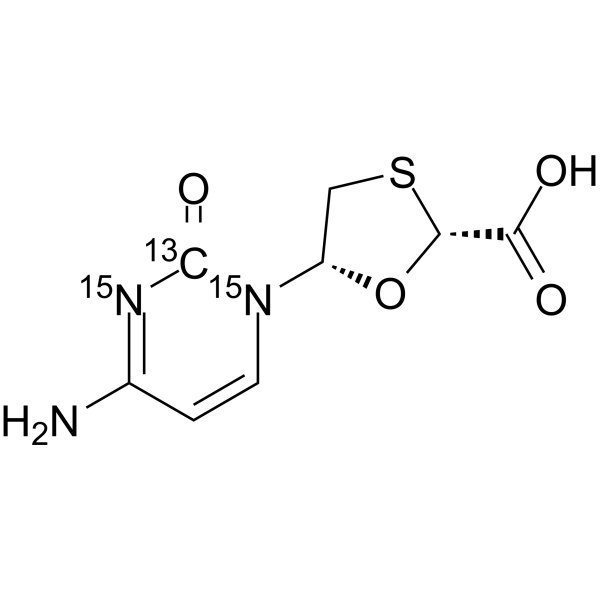 0 ImagesCat. No.: HY-135330CAS No.: 1391052-30-4
Lamivudine-13C,15N2 is a labelled impurity of Lamivudine (BCH-189). Lamivudine is a nucleoside reverse transcriptase inhibitors (NRTIs), and can inhibit HIV reverse transcriptase 1/2 and the reverse transcriptase of hepatitis B virus.
-
Toremifene citrate (Standard)
 0 ImagesSynonyms: Z-Toremifene citrate (Standard); NK 622 (Standard); FC-1157a (Standard)
Toremifene (citrate) (Standard) is the analytical standard of Toremifene (citrate). This product is intended for research and analytical applications. Toremifene citrate (Z-Toremifene citrate) is a second-generation selective estrogen-receptor modulator (SERM) in development for the prevention of osteoporosis. Toremifene citrate also potent inhibits infectious EBOV Zaire and Marburg (MARV) with IC50 of 0.07 µM and 2.6 µM, respectively.
-
IMBI
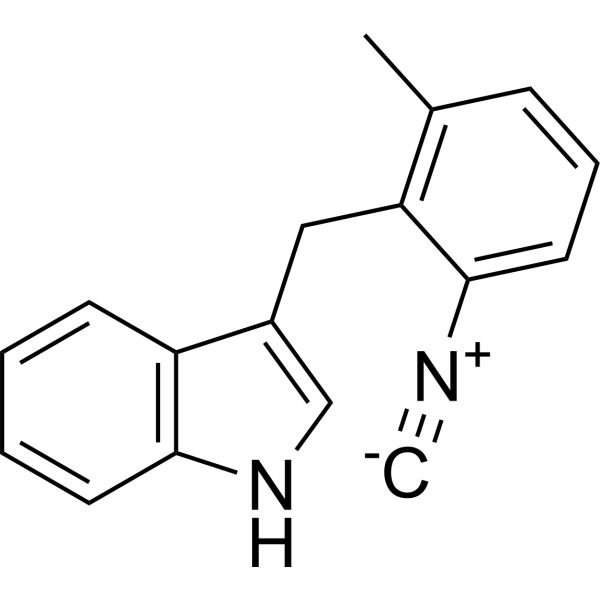 0 ImagesCat. No.: HY-149762CAS No.: 2785359-14-8
IMBI (compound 32) is an antibacterial agent that inhibits quorum sensing (QS) against drug-resistant pathogens. IMBI inhibits biofilm formation of Salmonella marcescens and restores or increases its susceptibility to antimicrobial drugs.
-
SARS-CoV-2 Mpro-IN-34
 0 ImagesCat. No.: HY-159961CAS No.: 3061154-57-9
SARS-CoV-2 Mpro-IN-34 (Compound 26) is an inhibitor for SARS-CoV-2 Mpro with an IC50 of 6 nM. SARS-CoV-2 Mpro-IN-34 exhibits inhibitory efficacy against OC43 Mpro with an IC50 of 33 nM. SARS-CoV-2 Mpro-IN-34 exhibits antiviral activity in SARS-CoV-2 infected Vero E6 cell with an EC50 of 0.103 μM.
-
Valinomycin (Standard)
 0 Images
Valinomycin (Standard) is the analytical standard of Valinomycin (HY-N6693). This product is intended for research and analytical applications. Valinomycin is a potassium-specific ionophore, the valinomycin-K+ complex can be incorporated into biological bilayer membranes with the hydrophobic surface of valinomycin, destroys the normal K+ gradient across the membrane, and as a result Kills the cells, incorporating into liposomes can significantly reduces the cytotoxicity and enhances the targeting effect. Valinomycin exhibits antibiotic, antifungal, antiviral, antitumor and insecticidal efficacy, thus can be used for relevant research.
-
Glysperin A
 0 ImagesCat. No.: HY-N14653CAS No.: 78213-56-6
Glysperin A has anti-Gram positive bacteria and negative bacteria (including aminoglycoside antibiotic resistant bacteria) activity.

-
ω-azido-C6 Ceramide
 0 Images
ω-azido-C6 Ceramide reduces the membrane potential, and exhibits antibacterial activity against Neisseria, with MIC of 2 µg/ml for N. meningitidis MC58 and N. gonorrhoeae FA1090.
-
Plazomicin
 0 ImagesCat. No.: HY-16955CAS No.: 1154757-24-0Synonyms: ACHN 490
Plazomicin (ACHN 490) is a semi-synthetic aminoglycoside Antibiotic. Plazomicin acts as a substrate for Aminoglycoside acetyltransferase and Aminoglycoside phosphotransferase. Plazomicin is not modified by various common aminoglycoside-modifying enzymes. Plazomicin selectively inhibits MATE2-K. Plazomicin exhibits activity against multidrug-resistant bacteria, including carbapenem-resistant Enterobacterales.
-
3,3'-Methylenebis[5-methyloxazolidine]
![3,3'-Methylenebis[5-methyloxazolidine]](https://file.medchemexpress.com/product_pic/hy-w108862.gif "Click to View 3,3'-Methylenebis[5-methyloxazolidine] Product Detail") 0 ImagesCat. No.: HY-W108862CAS No.: 66204-44-2
0 ImagesCat. No.: HY-W108862CAS No.: 66204-44-23,3'-Methylenebis[5-methyloxazolidine] is a bisoxazolidine-based hydrogen sulfide scavenger and fungicide derived from monoisopropanolamine (MIPA). 3,3'-Methylenebis[5-methyloxazolidine] exists as a mixture of structural isomers. 3,3'-Methylenebis[5-methyloxazolidine] is oil-soluble and serves as an oil-soluble alternative to hydrated hexahydrotriazine-based scavengers. 3,3'-Methylenebis[5-methyloxazolidine] can scavenge hydrogen sulfide and methanethiol via chemical reactions, and its scavenging efficiency increases after hydrolysis to MIPA-triazine in water.
-
Pleuromutilin conjugate T7
 0 ImagesCat. No.: HY-184387CAS No.: 2552327-34-9
Pleuromutilin conjugate T7 is a broad-spectrum antibacterial agent. Pleuromutilin conjugate T7 inhibits bacterial energy uptake, reverses drug efflux, interferes with carbohydrate metabolism, inhibits protein synthesis, disrupts biofilms, impairs cell membrane integrity, and attenuates the functions of virulence and adhesion factors. Pleuromutilin conjugate T7 can be used in studies related to Methicillin (HY-121544)-resistant Staphylococcus aureus (MRSA) infections, multidrug-resistant Enterococcus faecalis infections, and Gram-negative bacterial infections.
-
Polyoxin H
 0 ImagesCat. No.: HY-N14213CAS No.: 24695-54-3
Polyoxin H is a nucleoside antifungal antibiotic and has significant effects on rice sheath blight.
-
5-Amino-4-carbethoxy-1-phenylpyrazole
 0 ImagesCat. No.: HY-W041958CAS No.: 16078-71-0
5-Amino-4-carbethoxy-1-phenylpyrazole is a pyrazole derivative that inhibits biofilm formation by Staphylococcus aureus strains without exerting significant inhibitory effects on the growth of planktonic bacteria. 5-Amino-4-carbethoxy-1-phenylpyrazole can be used in studies related to Staphylococcus aureus infections.