



Endogenous Metabolite
Endogenous metabolites refer to the collective set of small-molecule chemical substances present within organelles, cells, organs, biological fluids, or entire organisms; their molecular weights are typically less than 1500 Da. These endogenous metabolites—including lipids, amino acids, short peptides, nucleic acids, carbohydrates, alcohols, and organic acids—not only participate in signal transduction governing genomic function but also receive upstream signals from the environment, thereby bridging the interrelationships among genotype, environment, and phenotype.
Based on their biological functions, microbial endogenous metabolites can be broadly classified into two categories: primary metabolites and secondary metabolites. Primary metabolites are the core molecules essential for supporting microbial growth and proliferation; they serve to provide energy to the microbes or act as precursors and cofactors for the synthesis of biological macromolecules. In contrast, microbial secondary metabolites are a class of low-molecular-weight products that are not strictly essential for microbial growth. Nevertheless, microbial secondary metabolites include numerous substances—such as antibiotics, anti-tumor agents, and cholesterol-lowering agents—that are of critical importance to human health[1][2][3]. Furthermore, the metabolome of a biological organism is influenced by a variety of endogenous factors, including age, sex, body composition, genetic background, and underlying pathological states. The small-molecule metabolites within an organism are diverse and highly distinct; their levels are typically subject to the synergistic regulation of a vast array of enzymes and transport proteins, undergoing processes of synthesis, transformation, degradation, and compartmentalized distribution. Metabolomics research based on endogenous metabolites has been widely applied in the fields of metabolic disorders, neurodegenerative diseases, cancer, cardiovascular diseases, and infectious diseases, where these metabolites hold potential utility as biomarkers or therapeutic targets[1][2][3].
References:
- [1]. Seyedsayamdost MR. Toward a global picture of bacterial secondary metabolism. J Ind Microbiol Biotechnol. 2019 Mar;46(3-4):301-311. [Content Brief]
- [2]. Ruiz B, et al. Production of microbial secondary metabolites: regulation by the carbon source. Crit Rev Microbiol. 2010 May;36(2):146-67. [Content Brief]
- [3]. Wishart DS. Metabolomics for Investigating Physiological and Pathophysiological Processes. Physiol Rev. 2019 Oct 1;99(4):1819-1875. [Content Brief]
Endogenous Metabolite Isoform Specific Products
All Product Categories
-
Endogenous Metabolite Related Products (8420)
Related Products (8420)

-
Antibodies (477)
-
Endogenous Metabolite Isoform Comparison
-
Acetaminophen glucuronide (Standard)
 0 ImagesCat. No.: HY-113083RCAS No.: 16110-10-4Synonyms: APAP-glu (Standard)Acetaminophen glucuronide (Standard) is the analytical standard of Acetaminophen glucuronide. This product is intended for research and analytical applications. Acetaminophen glucuronide (APAP-glu) is an inactive glucuronide metabolite of Acetaminophen (HY-66005). Acetaminophen is a selective cyclooxygenase-2 (COX-2) inhibitor and a potent hepatic N-acetyltransferase 2 (NAT2) inhibitor.
-
2'-Deoxycytidine-2'-13C
 0 ImagesCat. No.: HY-W654136Synonyms: Deoxycytidine-13C; Cytosine deoxyriboside-13C; Deoxyribose cytidine-13C2'-Deoxycytidine-2'-13C is 13C labeled 2'-Deoxycytidine. 2'-Deoxycytidine, a deoxyribonucleoside, can inhibit biological effects of Bromodeoxyuridine (Brdu). 2'-Deoxycytidine is essential for the synthesis of nucleic acids, that can be used for the research of cancer.
-
D-Alanine-d
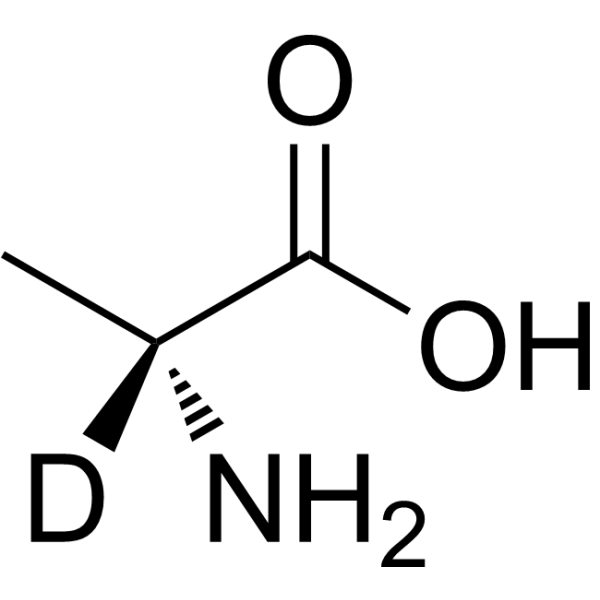 0 ImagesCat. No.: HY-41700S2CAS No.: 56595-54-1Synonyms: (R)-Alanine-d1; Ba 2776-d1; D-α-Alanine-d1D-Alanine-d is the deuterium labeled D-Alanine. D-Alanine is a weak GlyR (inhibitory glycine receptor) and PMBA agonist, with an EC50 of 9 mM for GlyR.
-
Hexylresorcinol (Standard)
 0 ImagesHexylresorcinol (Standard) is the analytical standard of Hexylresorcinol. This product is intended for research and analytical applications. Hexylresorcinol (4-Hexylresorcinol) is a natural compound found in plants with antimicrobial, anthelmintic, antiseptic and antitumor activities. Hexylresorcinol can induce apoptosis in squamous carcinoma cells. Hexylresorcinol is a reversible and noncompetitive inhibitor of α-glucosidase. Hexylresorcinol has protective effects against oxidative DNA damage.
-
Glucosamine-13C6
 0 ImagesCat. No.: HY-B1125SSynonyms: D-Glucosamine-13C6; Chitosamine-13C6Glucosamine-13C6 (D-Glucosamine-13C6) is 13C labeled Glucosamine. Glucosamine (D-Glucosamine) is an amino sugar and a prominent precursor in the biochemical synthesis of glycosylated proteins and lipids, is used as a dietary supplement. Glucosamine also is a natural constituent of glycosaminoglycans in the cartilage matrix and synovial fluid, which when administered exogenously, exerts pharmacological effects on osteoarthritic cartilage and chondrocytes.
-
C18 ((±)-2'-Hydroxy) ceramide (d18:1/18:0)
 0 ImagesCat. No.: HY-165034CAS No.: 34249-41-7Synonyms: ((±)-2'-Hydroxy) cer(d18:1/18:0); 18:0 (2R/S-OH)-Ceramide; ((±)-2'-Hydroxy) ceramide (d18:1/18:0)C18 ((±)-2'-Hydroxy) ceramide ((±)-2'-Hydroxy) cer) (d18:1/18:0) is a bioactive sphingolipid found in the stratum corneum layer of mammalian epidermis. Ceramides maintains the normal hydration levels required for the normal physiological.


-
(9E,11E)-9-Nitro-9,11-octadecadienoic acid
 0 ImagesCat. No.: HY-138896CAS No.: 1417651-32-1Synonyms: 9E,11E-9-Nitro CLA(9E,11E)-9-Nitro-9,11-octadecadienoic acid (9E,11E-9-Nitro CLA) is a nitro-fatty acid, It is formed by exposure of 9Z, 11E-CLA to acidified nitrite, peroxynitrite, gaseous nitrogen dioxide, or a combination of myeloperoxidase, hydrogen peroxide, and nitrite.
-
Adenine monohydrochloride hemihydrate (Standard)
 0 ImagesAdenine monohydrochloride hemihydrate (Standard) is the analytical standard of Adenine monohydrochloride hemihydrate (HY-W015213). This product is intended for research and analytical applications. Adenine monohydrochloride hemihydrate is a hydrochloride derivative of Adenine. Adenine (6-Aminopurine), a purine, is one of the four nucleobases in the nucleic acid of DNA. Adenine acts as a chemical component of DNA and RNA. Adenine also plays an important role in biochemistry involved in cellular respiration, the form of both ATP and the cofactors (NAD and FAD), and protein synthesis.
-
Nepitrin (Standard)
 0 ImagesNepitrin (Standard) (Nepetin-7-glucoside (Standard)) is the analytical standard of Nepitrin (HY-N5010). This product is intended for research and analytical applications. Nepitrin (Nepetin-7-glucoside) is an orally active bradykinin and angiotensin antagonist isolated from Scrophularia striata. Nepitrin antagonizes the spasmogenic effects of Bradykinin and Angiotensin, thereby inhibiting inflammatory mediator pathways. Nepitrin is applicable to arthritis-related research.
-
Tetrahydrothiophen-3-one (Standard)
 0 ImagesTetrahydrothiophen-3-one (Standard) is the analytical standard of Tetrahydrothiophen-3-one (HY-W010594). This product is intended for research and analytical applications. Tetrahydrothiophen-3-one is an endogenous metabolite. Tetrahydrothiophen-3-one scavenges DPPH free radicals. Tetrahydrothiophen-3-one can be used in studies related to Candida infections.
-
PtdIns-(4,5)-P2 (1,2-dipalmitoyl) ammonium
 0 ImagesCat. No.: HY-181446PtdIns-(4,5)-P2 (1,2-dipalmitoyl) ammonium (PI(4,5)P2) is a signaling molecule. PtdIns-(4,5)-P2 (1,2-dipalmitoyl) ammonium is critical at multiple stages of endocytosis, where it sequentially recruits adaptor proteins and accessory proteins to endocytic sites. PtdIns-(4,5)-P2 (1,2-dipalmitoyl) ammonium is considered essential for maintaining the structure of the Golgi apparatus and the transport of proteins within the Golgi apparatus.
-
Linalool-13C3
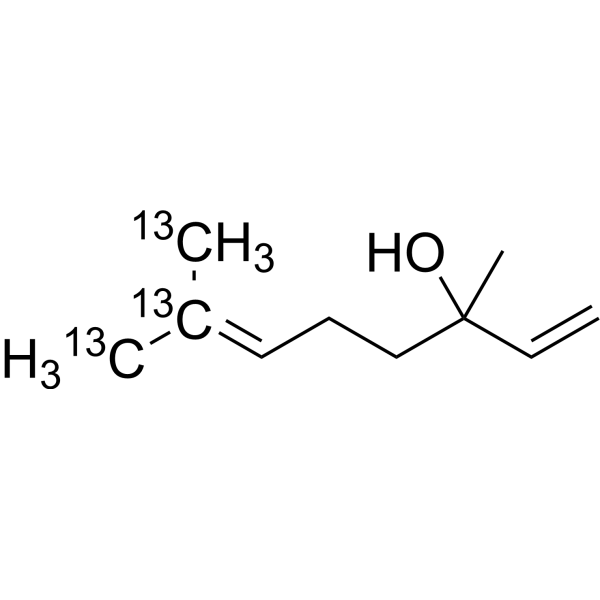 0 ImagesCat. No.: HY-N0368S1Linalool-13C3 is 13C labeled Linalool (HY-N0368). Linalool is a natural monoterpene which is a competitive NMDA receptor antagonist. Linalool is orally active and crosses the blood-brain barrier. Linalool has anticancer, antibacterial, anti-inflammatory, neuroprotective, anxiolytic, antidepressant, anti-stress, cardioprotective, hepatoprotective, nephroprotective and pulmonary protective activities.
-
PMX 53 monoacetate
 0 ImagesCat. No.: HY-106178DCAS No.: 852629-88-0Synonyms: 3D53 monoacetatePMX 53 monoacetate (3D53 monoacetate) is a potent orally active CD88 (C5aR) antagonist that inhibits C5a-induced neutrophil myeloperoxide release and chemotactic activity. PMX 53 monoacetate has an IC50 value of 20 nM against C5a-induced neutrophil myeloperoxide release. >The value is 22 nM, and the IC50 value of the chemotactic activity is 75 nM. PMX 53 monoacetate is also an agonist of MrgX2.
-
Dimethindene maleate (Standard)
 0 ImagesDimethindene (maleate) (Standard) is the analytical standard of Dimethindene (maleate). This product is intended for research and analytical applications. Dimethindene maleate is a selective histamine H1 antagonist with antihistamine effects. Dimethindene maleate can be used for the research of hypersensitivity reactions.
-
γ-CEHC (Standard)
 0 ImagesCat. No.: HY-113095RCAS No.: 178167-75-4Ftivazide (Standard) is the analytical standard of Ftivazide. This product is intended for research and analytical applications. Ftivazide has anti-tuberculosis activity.
-
5-Hydroxytryptophol (Standard)
 0 ImagesCat. No.: HY-W041019RCAS No.: 154-02-95-Hydroxytryptophol is a mammalian serotonin metabolite that can be used as a sensitive biomarker for recent alcohol intake. 5-Hydroxytryptophol is formed by alcohol-induced changes in the serotonin metabolic pathway and is excreted in the urine as a glucuronic acid conjugate. 5-Hydroxytryptophol is elevated in urine excretion and can be used clinically to monitor alcohol intake in scenarios such as alcohol relapse.

-
Radiclonic acid
 0 ImagesCat. No.: HY-N19220CAS No.: 49620-14-6Radiclonic acid acts as an Antibacterial agent, anticancer agent, and root growth promoter. Radiclonic acid is isolable from fungi of the genus Penicillium. Radiclonic acid exhibits antibacterial activity against MRSA with a MIC of 3.13 μg/mL. Radiclonic acid shows anticancer activity against esophageal cancer, bladder cancer, and liver cancer. Radiclonic acid promotes root growth in Chinese cabbage seedlings. Radiclonic acid is inactive against pancreatic cancer and cervical cancer. Radiclonic acid can be used in research related to Staphylococcus aureus infection, bladder cancer, esophageal cancer, and liver cancer.




