



Agomelatine hydrochloride (Standard)
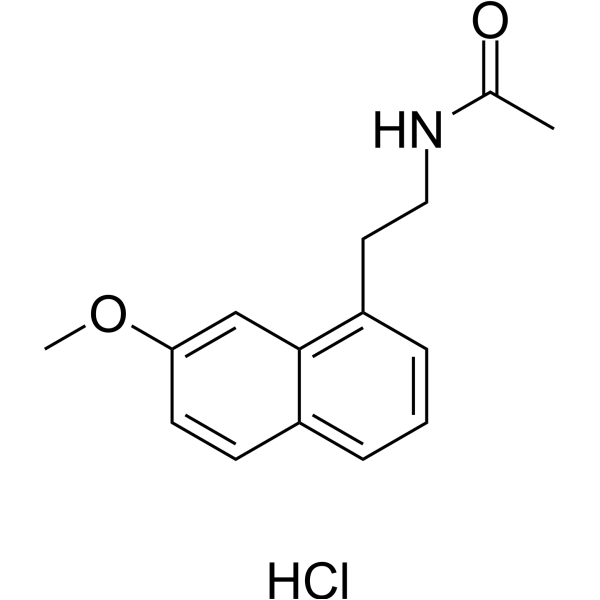
Agomelatine (hydrochloride) (Standard) is the analytical standard of Agomelatine (hydrochloride). This product is intended for research and analytical applications. Agomelatine hydrochloride (S-20098 hydrochloride) is a specific agonist of MT1 and MT2 receptors with Kis of 0.1, 0.06, 0.12, and 0.27 nM for CHO-hMT1, HEK-hMT1, CHO-hMT2, and HEK-hMT2, respectively. Agomelatine hydrochloride is a selective 5-HT2C receptor antagonist with pKis of 6.4 and 6.2 at native (porcine) and cloned, human 5-HT2C receptors, respectively.
For research use only. We do not sell to patients.
- Purity : 98%
- CAS No.: 1176316-99-6
- Formula: C15H18ClNO2
- Molecular Weight:279.76
-
Storage:
Please store the product under the recommended conditions in the Certificate of Analysis.


To place orders, for customer services and technical support, please contact: MedChemExpress USA
Tel: 609-228-6898 E-mail: [email protected] [email protected]


-
 Product Information
-
Chemical Information
- Purity & Documentation
-
 Help & FAQs





Product Information
Information
Application
The compound is the grade of analytical standard, which is the reference standard supplied assay. It is commonly used in qualitative, quantitative and methodological research experiments in HPLC, GC and MS.


Chemical Information
-
CAS No. 1176316-99-6
-
Molecular Weight 279.76
-
Formula C15H18ClNO2
-
SMILES
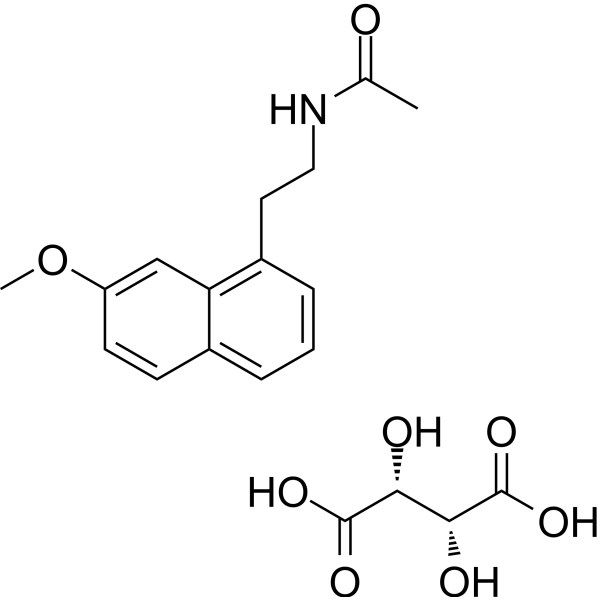
CC(NCCC1=C2C=C(OC)C=CC2=CC=C1)=O.Cl
-
Synonyms
S-20098 hydrochloride (Standard)
-
Structure Classification
-
Initial Source
-
Shipping
Room temperature in continental US; may vary elsewhere.
-
Storage
Please store the product under the recommended conditions in the Certificate of Analysis.


Purity & Documentation
References
[1]. Audinot V, et al. New selective ligands of human cloned melatonin MT1 and MT2 receptors. Naunyn Schmiedebergs Arch Pharmacol. 2003 Jun;367(6):553-61. [Content Brief]
[2]. Millan MJ, et al. The novel melatonin agonist agomelatine (S20098) is an antagonist at 5-hydroxytryptamine2C receptors, blockade of which enhances the activity of frontocortical dopaminergic and adrenergic pathways. J Pharmacol Exp Ther. 2003 Sep;306(3):954-64. [Content Brief]
[3]. Aguiar CC, et al. Effects of agomelatine on oxidative stress in the brain of mice after chemically induced seizures. Cell Mol Neurobiol. 2013 Aug;33(6):825-35. [Content Brief]

Calculators
Concentration (start) × Volume (start) = Concentration (final) × Volume (final)


Agomelatine hydrochloride (Standard) Related Classifications
HY-17038AR Related Classifications
 Powered by Bioz