



PIM2
PIM2 is a serine/threonine kinase that supports cell survival and proliferation, and early work defined Pim-2 as a transcriptionally regulated apoptotic inhibitor[1]. Mechanistically, PIM2 phosphorylates BAD at Ser112 and reverses BAD-induced cell death, linking PIM2 kinase activity to anti-apoptotic signaling[2]. In multiple myeloma, Pim2 expression is highly elevated and is required for myeloma cell proliferation through TSC2 phosphorylation and mTORC1 modulation[3]. PIM2 kinase also supports plasmablast generation and plasma cell survival, connecting B-cell differentiation models with myeloma research applications[4]. Compared with related isoforms, PIM2 shares 55% sequence identity with PIM1, but structural differences between PIM1 and PIM2 may guide isoform-selective inhibitor design[5]. In BAD phosphorylation assays, Pim-2 predominantly phosphorylated Ser112, whereas Pim-3 was least specific for Ser112 and more effective at Ser136 and Ser155[6]. For experimental applications, the pan-PIM inhibitor PIM447 showed preclinical antimyeloma and bone-protective effects, while first-in-human studies evaluated oral PIM447 in relapsed or refractory multiple myeloma[7][8].
References:
- [1]. Fox CJ, et al. The serine/threonine kinase Pim-2 is a transcriptionally regulated apoptotic inhibitor. Genes Dev. 2003 Aug 1;17(15):1841-54. [Content Brief]
- [2]. Yan B, et al. The PIM-2 kinase phosphorylates BAD on serine 112 and reverses BAD-induced cell death. J Biol Chem. 2003 Nov 14;278(46):45358-67. [Content Brief]
- [3]. Lu J, et al. Pim2 is required for maintaining multiple myeloma cell growth through modulating TSC2 phosphorylation. Blood. 2013 Aug 29;122(9):1610-20. [Content Brief]
- [4]. Haas M, et al. PIM2 kinase has a pivotal role in plasmablast generation and plasma cell survival, opening up novel treatment options in myeloma. Blood. 2022 Apr 14;139(15):2316-2337. [Content Brief]
- [5]. Bullock AN, et al. Crystal structure of the PIM2 kinase in complex with an organoruthenium inhibitor. PLoS One. 2009 Oct 20;4(10):e7112. [Content Brief]
- [6]. Macdonald A, et al. Pim kinases phosphorylate multiple sites on Bad and promote 14-3-3 binding and dissociation from Bcl-XL. BMC Cell Biol. 2006 Jan 10;7:1. [Content Brief]
- [7]. Paíno T, et al. The Novel Pan-PIM Kinase Inhibitor, PIM447, Displays Dual Antimyeloma and Bone-Protective Effects, and Potently Synergizes with Current Standards of Care. Clin Cancer Res. 2017 Jan 1;23(1):225-238. [Content Brief]
- [8]. Raab MS, et al. The first-in-human study of the pan-PIM kinase inhibitor PIM447 in patients with relapsed and/or refractory multiple myeloma. Leukemia. 2019 Dec;33(12):2924-2933. [Content Brief]
All Product Categories
-
PIM2 Related Products (33)
Related Products (33)

- 1
- 2
-
CDK6/PIM1-IN-1
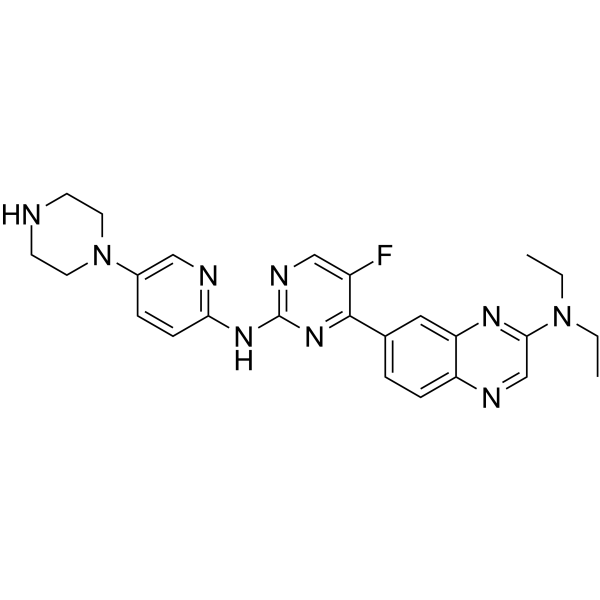 0 ImagesCat. No.: HY-142696CAS No.: 2677026-14-9CDK6/PIM1-IN-1 is a potent and balanced dual CDK6/PIM1 inhibitor with IC50 values of 39 and 88 nM, respectively. CDK6/PIM1-IN-1 inhibits CDK4 (IC50=3.6 nM). CDK6/PIM1-IN-1 significantly inhibits acute myeloid leukemia (AML) cell proliferation, arrest cell cycle at the G1 phase, and promote cell apoptosis. CDK6/PIM1-IN-1 exhibits potent anti-AML activity.
-
CRT0066101 trihydrochloride
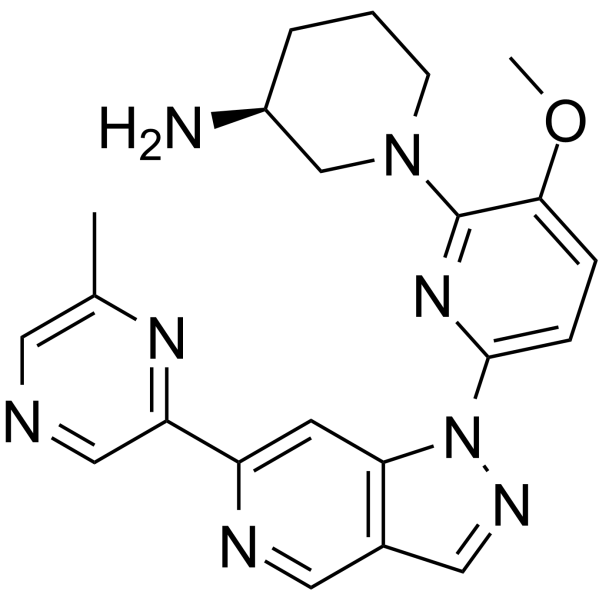
 0 ImagesCRT0066101 trihydrochloride is the trihydrochloride salt form of CRT0066101 (HY-15698). CRT0066101 trihydrochloride is an orally active PKD inhibitor with IC50 values of 1 nM, 2.5 nM and 2 nM for PKD1, PKD2, and PKD3, respectively. CRT0066101 trihydrochloride is also an inhibitor for PIM2 with an IC50 of ~135.7 nM. CRT0066101 trihydrochloride exhibits anti-inflammatory activity in mice LPS (HY-D1056)-induced lung injury models, and has anticancer effects.
-
VS-II-173
 0 ImagesCat. No.: HY-122670CAS No.: 1627962-21-3VS-II-173 is a pan-Pim kinase inhibitor with IC50 values of 0.07 μM and 0.02 μM for Pim1 and Pim3, respectively, and a residual activity of 46% for Pim2 at 1 μM. VS-II-173 also inhibits kinases such as HIPK2, PRK2, RSK1, DYRK1a and AMPKα1, selectively inhibiting acute myeloid leukemia (AML) cells with significantly lower toxicity to non-malignant cells (EC50 > 30 μM). VS-II-173 weakens the phosphorylation of substrates such as Stat5 (Y694), MDM2 (S166), Bad (S112), and 4E-BP1 (T37/46) by inhibiting Pim kinase-mediated signaling pathways, blocking pro-survival signals in AML cells and inducing apoptosis. VS-II-173 synergistically enhances anti-AML activity when combined with Daunorubicin (HY-13062A). VS-II-173 can be used in AML research, especially for AML with FLT3-ITD mutations and NPM1 mutations .
-
FD2024
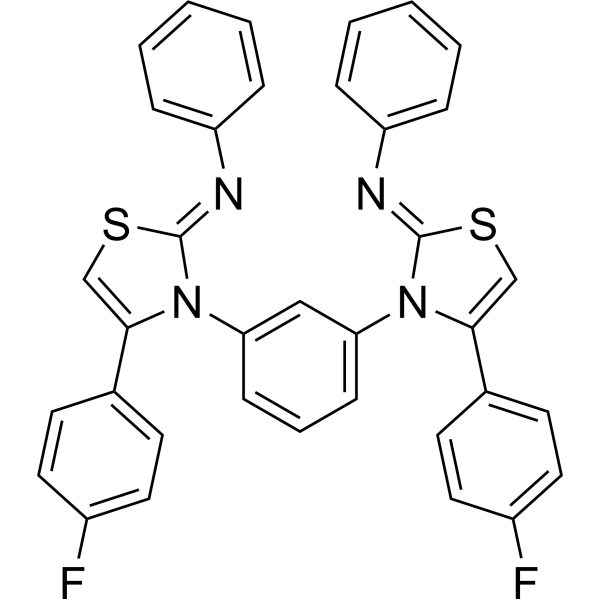
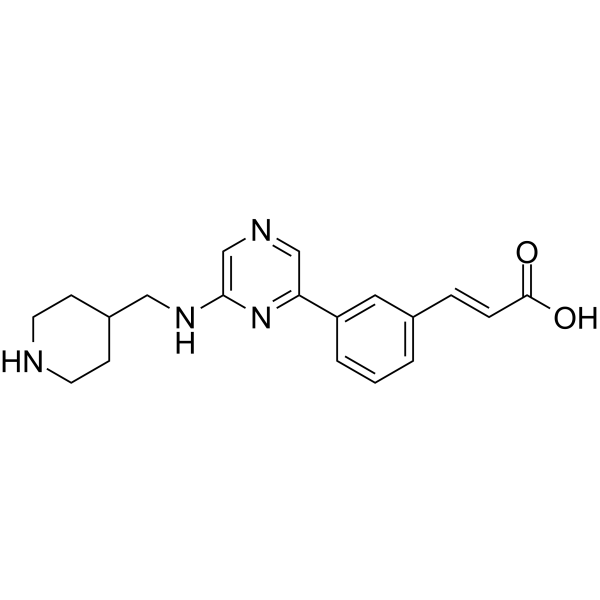
 0 ImagesCat. No.: HY-181925FD2024 is a pan-PIM kinase inhibitor with IC50 values of 0.17 nM, 1.86 nM, and 0.38 nM against PIM-1, PIM-2, and PIM-3, respectively. FD2024 induces cell apoptosis. FD2024 inhibits the phosphorylation of mTOR, p70S6K, S6, 4EBP1, and BAD proteins. FD2024 exhibits anti-acute myeloid leukemia activity. FD2024 can be used in studies related to acute myeloid leukemia.

-
PIM3-IN-1 hydrochloride
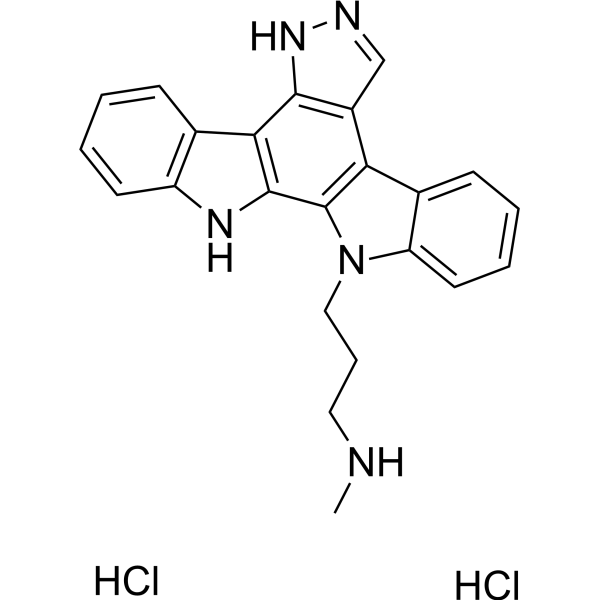 0 ImagesCat. No.: HY-163442A
-
PIM-IN-6
 0 ImagesCat. No.: HY-184811CAS No.: 2698319-19-4PIM-IN-6 is an inhibitor of PIM1 and PIM2, with an IC50 of 254 nM against PIM1 and an IC50 of 1.78 μM against PIM2. PIM-IN-6 can be used for the research of acute myeloid leukemia.
-
Nuvisertib (Standard)
 0 ImagesSynonyms: TP-3654 (Standard)Nuvisertib (Standard) (TP-3654 (Standard)) is the analytical standard of Nuvisertib (HY-101126). This product is intended for research and analytical applications. Nuvisertib (TP-3654) is an orally active second-generation pan-PIM kinase inhibitor with Ki values of 5 nM, 239 nM, and 42 nM against PIM-1, PIM-2, and PIM-3, respectively. Nuvisertib inhibits JAK-independent inflammatory and survival signaling pathways, reduces the production of proinflammatory cytokines, restores apoptotic sensitivity, inhibits mTORC1, MYC, and TGF-β signaling pathways, and decreases the expression of fibrosis markers. Nuvisertib selectively impairs the transport function of ABCG2, resensitizes multidrug-resistant cancer cells to cytotoxic drugs, and overcomes JAK2 inhibitor resistance. Nuvisertib can be used in research related to myelofibrosis, renal cell carcinoma, multidrug-resistant cancer, advanced solid tumors, urothelial carcinoma, and prostate adenocarcinoma.
-
Pim-1/2 kinase inhibitor 2
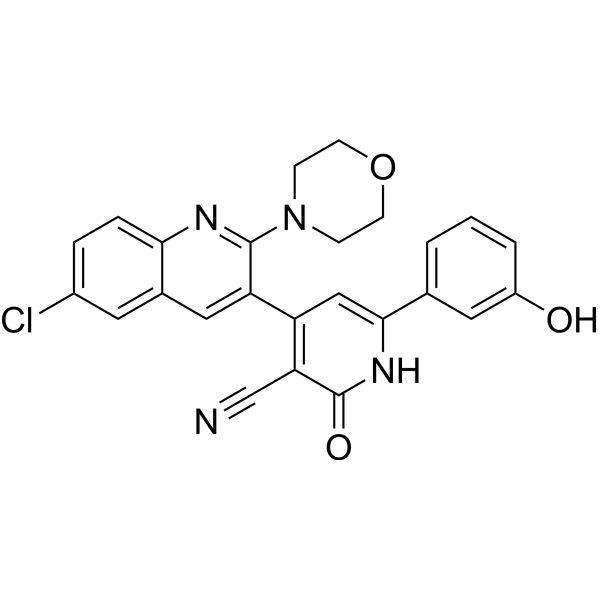 0 ImagesCat. No.: HY-157404CAS No.: 2918764-16-4Pim-1/2 kinase inhibitor 2 (compound 5b) is a competitive PIM-1 and PIM-2 kinase inhibitor with IC50s of 1.31 μM and 0.67 μM, respectively. Pim-1/2 kinase inhibitor 2 shows in-vitro low cytotoxicity against normal human lung fibroblast Wi-38 cell line and potent in-vitro anticancer activity against myeloid leukaemia (NFS-60), liver (HepG-2), prostate (PC-3), and colon (Caco-2) cancer cell lines.
-
Nuvisertib hydrochloride
 0 ImagesCat. No.: HY-101126ACAS No.: 1418143-09-5Synonyms: TP-3654 hydrochlorideNuvisertib hydrochloride (TP-3654 hydrochloride) is an orally active second-generation pan-PIM kinase inhibitor with Ki values of 5 nM, 239 nM, and 42 nM against PIM-1, PIM-2, and PIM-3, respectively. Nuvisertib hydrochloride inhibits JAK-independent inflammatory and survival signaling pathways, reduces the production of proinflammatory cytokines, restores apoptotic sensitivity, inhibits mTORC1, MYC, and TGF-β signaling pathways, and decreases the expression of fibrosis markers. Nuvisertib hydrochloride selectively impairs the transport function of ABCG2, resensitizes multidrug-resistant cancer cells to cytotoxic drugs, and overcomes JAK2 inhibitor resistance. Nuvisertib hydrochloride can be used in research related to myelofibrosis, renal cell carcinoma, multidrug-resistant cancer, advanced solid tumors, urothelial carcinoma, and prostate adenocarcinoma.
- 1
- 2



