



Wee1
Wee1 is a nuclear kinase belonging to the Ser/Thr family of protein kinases in the fission yeast Schizosaccharomyces pombe (S. pombe). Wee1 has amolecular mass of 96 kDa and it is a key regulator of cell cycle progression. Wee1 influences cell size by inhibiting the entry into mitosis, through inhibiting Cdk1. Wee1 has homologues in many other organisms, including mammals. Wee1 inhibits Cdk1 by phosphorylating it on two different sites, Tyr15 and Thr14. Cdk1 is crucial for the cyclin-dependent passage of the various cell cycle checkpoints. At least three checkpoints exist for which the inhibition of Cdk1 by Wee1 is important: G2/M checkpoint, Cell size checkpoint, DNA damage checkpoint. Wee1 is shown to phosphorylate histone H2B at tyrosine 37 residue which regulates global expression of histones.
WEE1 subfamily includes PMYT1.
WEE1 subfamily includes PMYT1.
Wee1 Isoform Specific Products
All Product Categories
-
Wee1 Related Products (82)
Related Products (82)

-
Wee1 Isoform Comparison
-
WEE1/PKMYT1-IN-3
 0 ImagesCat. No.: HY-169946BCAS No.: 3047759-60-1WEE1/PKMYT1-IN-3 is the axial chiral M configuration of WEE1/PKMYT1-IN-1 (HY-169946). WEE1/PKMYT1-IN-1 is a potent and orally active WEE1 and PKMYT1 inhibitor. WEE1/PKMYT1-IN-1 shows antiproliferation activity.
-
PKMYT1-IN-12
 0 ImagesCat. No.: HY-180484CAS No.: 2974454-59-4
-
PD-166285
 0 ImagesCat. No.: HY-175819CAS No.: 717094-37-6PD-166285 is a PKMYT1 inhibitor, with an IC50 value of 17 nM. PD166285 shows strong antiproliferative effects against CCNE1-amplified OVCAR3 cells (IC50 = 0.14 μM) and HCC1569 cells (IC50 = 0.21 μM). PD166285 induces apoptosis and arrests CCNE1-amplified HCC1569 cells at the G1/S phase of the cell cycle. PD166285 can be used for the research of PKMYT1-targeted therapies for CCNE1-amplified cancers.
-
PD0166285 dihydrochloride
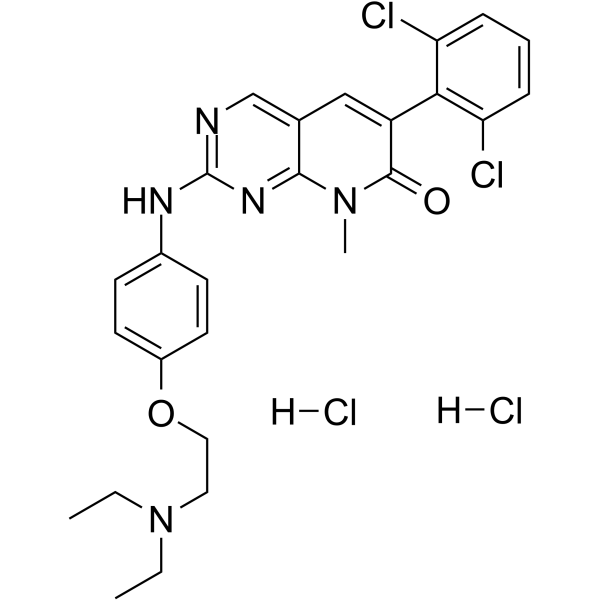 0 ImagesCat. No.: HY-13925ACAS No.: 212391-63-4
-
PKMYT1-IN-15
 0 ImagesCat. No.: HY-187562PKMYT1-IN-15 is an orally active PKMYT1 inhibitor with an IC50 of 6.02 nM. PKMYT1-IN-15 inhibits the phosphorylation of CDK1 at Thr14. As an antiproliferative agent, DNA damage inducer and antitumor agent, PKMYT1-IN-15 triggers replication-associated DNA damage and cell death in CCNE1-amplified cancer cells, and suppresses tumor growth in the OVCAR3 xenograft model. PKMYT1-IN-15 can be used for the research of CCNE1-amplified cancers (e.g., ovarian cancer, breast cancer).
-
BAA-065
 0 ImagesCat. No.: HY-182790BAA-065 is a selective and orally active PKMYT1 inhibitor with an IC50 of <50 nM. BAA-065 inhibits cancer cells proliferation, induces γH2AX expression and DNA damage. BAA-065 inhibits tumor growth in OVCAR3 xenograft mice. BAA-065 can be used for the research of cancer, such as ovarian cancer.
-
WEE1/PKMYT1-IN-4
 0 ImagesCat. No.: HY-183547CAS No.: 3055032-68-0WEE1/PKMYT1-IN-4 is a selective WEE1/PKMYT1 inhibitor, with IC50 values of 0.185 μM and 2.2 nM for human WEE1 and PKMYT1, respectively. WEE1/PKMYT1-IN-4 inhibits phosphorylation of CDK1 at T14 and Y15, disrupting the G2/M cell cycle checkpoint. WEE1/PKMYT1-IN-4 can be used for the research of colorectal cancer and amplified breast cancer.
-
APO-50815
 0 ImagesCat. No.: HY-183278APO-50815 is a WEE1 kinase inhibitor with a human IC50 of 9 nM. APO-50815 induces DNA damage, replication stress, S-phase cell accumulation, and apoptosis. APO-50815 can be used for the research of metastatic colorectal cancer.
-
WEE1-IN-8
 0 ImagesCat. No.: HY-161871CAS No.: 2493422-74-3WEE1-IN-8 (Compound 55) is a selective WEE1 inhibitor, with an IC50 of 0.98 nM. WEE1-IN-8 (Compound 55) can be used for the research of Pancreatic cancer, Ovarian cancer, Colorectal cancer, Uterine serous carcinoma, etc.
-
AZD1775-C3-NH2
 0 ImagesCat. No.: HY-133703CAS No.: 2101954-45-2AZD1775-C3-NH2 is a Target Protein Ligand-Linker Conjugate that contains a target protein ligand and a PROTAC linker, and can recruit E3 ligases. AZD1775-C3-NH2 can be used for the synthesis of Pomalidomide-C3-adavosertib (HY-133618).
-
Adavosertib-C3-NH-Boc
 0 ImagesCat. No.: HY-176363CAS No.: 2113725-19-0Adavosertib-C3-NH-Boc is a Target Protein Ligand-Linker Conjugate that incorporates a ligand for Wee1 (HY-10993) and a PROTAC linker (HY-W011561), which recruits E3 ligases. Adavosertib-C3-NH-Boc can be used for synthesis of PROTAC Pomalidomide-C3-adavosertib (HY-133618).
-
PKMYT1-IN-11
 0 ImagesCat. No.: HY-176957CAS No.: 3097325-25-9PKMYT1-IN-11 (Example 1) is a PKMYT1 inhibitor with an IC50 of 4.49 nM. PKMYT1-IN-11 inhibits the proliferation of HCC1569 cells. When combined with Gemcitabine (HY-17026), PKMYT1-IN-11 shows a significant anti-tumor effect in the OVCAR3 xenograft mouse model. PKMYT1-IN-11 can be used for the study of various cancers such as breast cancer and ovarian cancer.

-
CJM061
 0 ImagesCat. No.: HY-182433CAS No.: 1847445-87-7CJM061 is a WEE1 kinase inhibitor with a target IC50 of 2.8 nM. CJM061 acts as a sensitizer and exhibits synergistic effects with Cisplatin (HY-17394) in medulloblastoma cells. CJM061 can be used for the research of medulloblastoma.
-
Tubulin/LSD1-IN-1
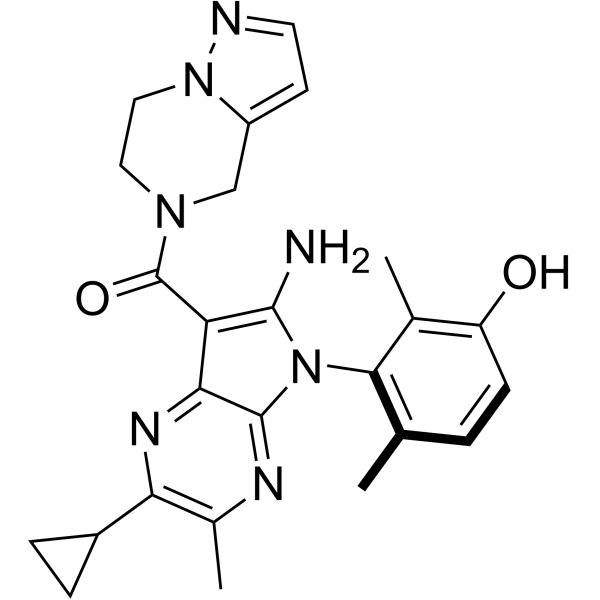
 0 ImagesCat. No.: HY-176283Tubulin/LSD1-IN-1 is an effective dual inhibitor of Tubulin polymerization and LSD1 (IC50 = 1.72 μM). Tubulin/LSD1-IN-1 has broad-spectrum antiproliferative activity against cancer cell lines. Tubulin/LSD1-IN-1 inhibits tubulin polymerization by targeting colchicine binding sites, thereby disrupting the microtubule network in gastric cancer cells. Tubulin/LSD1-IN-1 increases the methylation levels of H3K4me1/2 and H3K9me2/3, thereby achieving epigenetic regulation. Tubulin/LSD1-IN-1 induces G2/M arrest, promotes apoptosis, and effectively inhibits colony formation of gastric cancer cells.
-
WEE1-IN-11
 0 ImagesCat. No.: HY-168180CAS No.: 2975172-98-4WEE1-IN-11 (Compound 13) is a potent CDK2 inhibitor with an IC50 of 2.0 nM. WEE1-IN-11 inhibits NCI–H446, A427, OVCAR3, C33A,and WiDr cells with IC50s of 93.9, 34.5, 86.7, 23.1, and 85 nM, respectively.

-
DB07006
 0 ImagesCat. No.: HY-160948CAS No.: 622855-60-1DB07006 (compound 18) is a potent, ATP-cpmpetitive dual inhibitor of Wee1 (IC50 = 0.030 μM) and Chk1 checkpoint kinases (IC50 = 0.018 μM). DB07006 demonstrates effective abrogation of the G2/M checkpoint in combination with DNA-damaging agents in cellular models. DB07006 can be used for cancer research.
-
XH-30
 0 ImagesCat. No.: HY-180893CAS No.: 3077136-87-6XH-30 is a potent, selective, and orally active PKMYT1 inhibitor, with an IC50 of 4.1 nM. XH-30 suppresses the proliferation of P53-mutated triple-negative breast cancer (TNBC) cells by inducing G2/M phase release, DNA damage, and apoptosis. XH-30 demonstrates antitumor effects in an MDA-MB-231 mouse model. XH-30 can be used for P53-mutated TNBC research.



