



YAP
Yes-associated protein
YAP (Yes-associated protein) is a transcription co-activator in the Hippo tumor suppressor pathway and controls cell growth, tissue homeostasis and organ size. YAP is inhibited by the kinase Lats, which phosphorylates YAP to induce its cytoplasmic localization and proteasomal degradation. YAP induces gene expression by binding to the TEAD family transcription factors.
The function of YAP in human cancer is complex and could be cell-type-dependent. For instance, YAP could function as a tumor suppressor in some cell types, such as hematological cancers, by inducing apoptosis in response to DNA damage.
YAP Isoform Specific Products
All Product Categories
-
YAP Related Products (160)
Related Products (160)

-
Antibodies (8)
-
YAP Isoform Comparison

-
TEAD ligand 4
 0 ImagesCat. No.: HY-181592TEAD ligand 4 is a TEAD PROTAC ligand. TEAD ligand 4 can be conjugated with E3 ligase Ligand (HY-181591) and linker to synthesize PROTAC TEAD1/IAP degrader (HY-181590) .
-
M3686
 0 ImagesCat. No.: HY-170764CAS No.: 2738550-24-6M3686 (Compound 29) is a potent, selective TEAD1 inhibitor with an IC50 value of 51 nM. M3686 also shows weaker binding activity on TEAD3. M3686 potently inhibits cell viability against YAP-dependent NCI-H226 cell line with an IC50 value of 0.06 uM. M3686 shows strong anti-tumor effects in the NCI-H226 xenograft model.
-
AICAR-13C2,15N
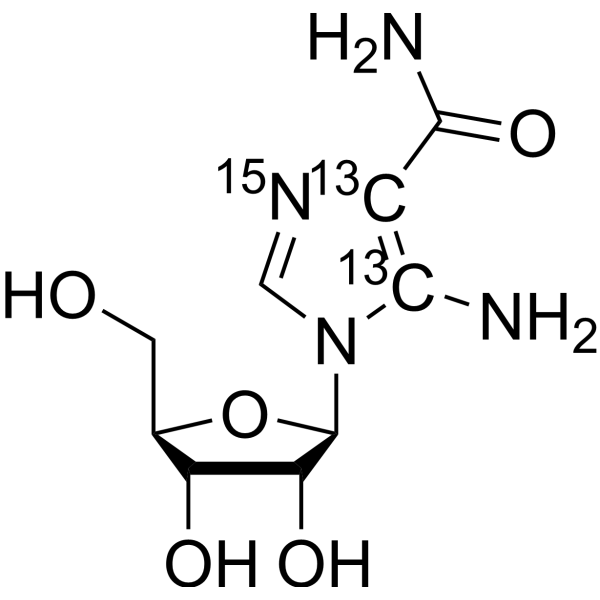 0 ImagesCat. No.: HY-13417SCAS No.: 1609374-70-0Synonyms: Acadesine-13C2,15N; AICA Riboside-13C2,15NAICAR-13C2,15N (Acadesine-13C2,15N; AICA Riboside-13C2,15N) is the 13C and 15N labeled AICAR (HY-13417). AICAR (Acadesine) is an adenosine analog and a AMPK activator. AICAR regulates the glucose and lipid metabolism, and inhibits proinflammatory cytokines and iNOS production. AICAR is also an autophagy, YAP and mitophagy inhibitor.
-
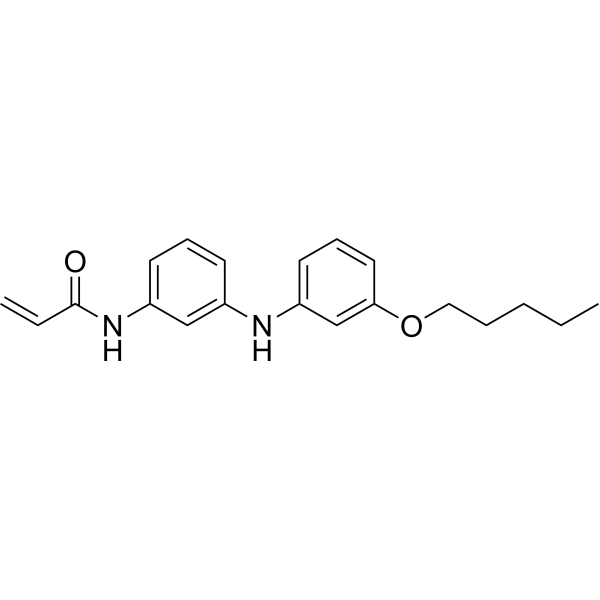
TEAD-IN-20
 0 ImagesCat. No.: HY-172932CAS No.: 3007592-85-7
-
HC278
 0 ImagesCat. No.: HY-185230CAS No.: 3096503-40-8
-
PROTAC TEAD1/IAP degrader-1
 0 ImagesCat. No.: HY-181534PROTAC TEAD1/IAP degrader-1 (Compound A232) is a selective TEAD1 and cIAP1 PROTAC degrader, with DC50 values of 14 nM and 270 nM, respectively. PROTAC TEAD1/IAP degrader-1 promotes the ubiquitination and degradation of TEAD1 and cIAP1. PROTAC TEAD1/IAP degrader-1 downregulates the expression of the TEAD-dependent gene CTGF. PROTAC TEAD1/IAP degrader-1 exhibits anticancer activity against mesothelioma.
-
TEAD-IN-21
 0 ImagesCat. No.: HY-178098TEAD-IN-21 is a potent and orally active pan-TEAD inhibitor with an IC50 of 3 nM. TEAD-IN-21 effectively inhibited the proliferation of Huh-7 cells. TEAD-IN-21 selectively downregulates TEAD-dependent downstream genes. TEAD-IN-21 achieves tumor regression in a liver cancer-derived tumor xenograft mice model. TEAD-IN-21 can be used in the research of hepatocellular carcinoma (HCC).
-
TEAD ligand 5
 0 ImagesCat. No.: HY-181595CAS No.: 2417720-74-0TEAD ligand 5 (Compound S19) is a TEAD PROTAC ligand. TEAD ligand 5 can be conjugated with E3 ligase Ligand (HY-181531) and linker (HY-181608) to synthesize PROTAC TEAD/IAP degrader-1 (HY-181594) .
-
Gαq/11 protein-IN-2
 0 ImagesCat. No.: HY-179165Gαq/11 protein-IN-2 (Compound 9g) is a Gαq/11 protein inhibitor, with an IC50 of 11.3 μM. Gαq/11 protein-IN-2 induces Apoptosis, increases p-YAP. Gαq/11 protein-IN-2 has anticancer activity against uveal melanoma.
-
AZ'4331
 0 ImagesCat. No.: HY-189200CAS No.: 3006101-94-3AZ'4331 is an orally active pan-TEAD family inhibitor, with an IC50 of 0.381 μM against TEAD1, 0.020 μM against TEAD2, 0.014 μM against TEAD3, and 0.031 μM against TEAD4. AZ'4331 slows cell cycle progression. AZ'4331 exerts effects in cancer xenograft models with dysregulated Hippo pathway. AZ'4331 can be used to study cancers with altered Hippo pathways, including mesothelioma, head and neck squamous cell carcinoma, and EGFR-mutant non-small cell lung cancer.
-
LC-TEAD01
 0 ImagesCat. No.: HY-183728LC-TEAD01 is a potent covalent transcription enhancer-associated domain (TEAD) inhibitor with an IC50 of 116 nM and a Ki of 0.132 μM. LC-TEAD01 disrupts the TEAD-YAP interaction and inhibits TEAD-dependent transcriptional activity. LC-TEAD01 suppresses the proliferation of NF2-deficient cancer cells. LC-TEAD01 inhibits tumor growth in NF2-deficient xenograft models. LC-TEAD01 can be used in studies related to NF2-deficient malignant pleural mesothelioma.
-
OPN-9643
 0 ImagesCat. No.: HY-179559CAS No.: 2866423-06-3
-
VS3
 0 ImagesCat. No.: HY-179706CAS No.: 2576427-49-9VS3 is a YAP-TEAD interaction inhibitor. VS3 directly disrupts the interaction between YAP-TEAD by binding to TEAD4 Interface 3 (Kd = 6 μM) on the surface. VS3 exhibits anti-proliferative activity against HT29, HCT116, and A2780. VS3 can be used for research on colorectal adenocarcinoma and ovarian cancer.
-
EA-C15
 0 ImagesCat. No.: HY-179440EA-C15 is a potent and selective TEAD inhibitor with an IC50 of 0.34 μM. EA-C15 covalently binds to the TEAD palmitoylation site, blocks palmitoylation and transcriptional activity, and inhibits YAP-dependent cancer cell proliferation and YAP-TEAD target gene (CTGF and CYR61) transcription. EA-C15 can be used for cancer research.

-
YAP/TAZ-TEAD-IN-2
 0 ImagesCat. No.: HY-168704YAP/TAZ-TEAD-IN-2 (Compound 51) is a YAP/TAZ-TEAD inhibitor that inhibits the interaction between YAP/TAZ and TEAD. YAP/TAZ-TEAD-IN-2 suppresses the transcriptional activity of TEAD, with an IC50 of 1.2 nM. YAP/TAZ-TEAD-IN-2 inhibits YAP/TAZ-TEAD target genes expression (Cyr61, CTGF, AXL and Survivin) and breast cancer cell proliferation.
-
PY-PAP
 0 ImagesCat. No.: HY-176548CAS No.: 2765218-57-1PY-PAP is a photoactivatable affinity probe and a derivative of PY-60 (HY-141644). PY-PAP retains the cellular function of activating YAP transcriptional activity. In 293A cells, PY-PAP can label cathepsin D (CTSD) and annexin A2 (ANXA2) through ultraviolet crosslinking and click reactions. PY-PAP plays a key role in identifying ANXA2 as the specific target of PY-60.
-
USP10-IN-4
 0 ImagesCat. No.: HY-175538USP10-IN-4 is a potent ubiquitin-specific protease 10 (USP10) inhibitor with an IC50 of 10.87 μM and a Kd of 365 nM. USP10-IN-4 effectively inhibits USP10-mediated proteasomal degradation of downstream proteins YAP and p53, leading to the subsequent downregulation of CDK4 in the p53 signaling pathway. USP10-IN-4 promotes apoptosis in HCC cells and inhibits the onset and progression of liver cancer. USP10-IN-4 can used for the study of hepatocellular carcinoma (HCC).




