



TEAD
TEAD (TEA domain) transcription factors comprise a highly conserved family of DNA-binding proteins that function as the major transcriptional effectors of the Hippo signaling pathway and regulate cell growth, proliferation, tissue homeostasis, regeneration, and embryonic development[1][2]. Mechanistically, TEAD proteins bind genomic target sequences and cooperate with the transcriptional coactivators YAP and TAZ to control transcriptional programs that govern cellular proliferation, differentiation, and survival[1][3]. Through this YAP/TAZ-TEAD transcriptional module, Hippo pathway activity is translated into gene-expression outputs that influence developmental processes and organ homeostasis[1][4]. In disease contexts, increased TEAD transcriptional activity has been associated with tumorigenesis and therapeutic resistance, and dysregulated Hippo signaling can promote TEAD-dependent oncogenic transcription in multiple cancer types[3][5][6]. Experimental studies further demonstrate that disruption of YAP-TEAD interactions suppresses YAP-dependent gene expression and oncogenic transformation, supporting TEAD as a critical functional node in cancer biology[3]. Compared with related family members, TEAD1, TEAD3, and TEAD4 are broadly expressed in multiple adult tissues, whereas TEAD2 displays a more restricted embryonic expression pattern and is largely absent from adult tissues, indicating distinct biological roles despite strong structural conservation[7]. Research on TEAD-targeted therapeutics has therefore focused on inhibitors that disrupt TEAD-mediated transcriptional complexes or directly antagonize TEAD activity, providing valuable experimental tools for investigating Hippo pathway function and evaluating anticancer strategies[5][8][2].
References:
- [1]. Lin KC, et al. Regulation of the Hippo Pathway Transcription Factor TEAD. Trends Biochem Sci. 2017 Nov;42(11):862-872. [Content Brief]
- [2]. Chapeau EA, et al. Direct and selective pharmacological disruption of the YAP-TEAD interface by IAG933 inhibits Hippo-dependent and RAS-MAPK-altered cancers. Nat Cancer. 2024 Jul;5(7):1102-1120. [Content Brief]
- [3]. Zhou Y, et al. The TEAD Family and Its Oncogenic Role in Promoting Tumorigenesis. Int J Mol Sci. 2016 Jan 21;17(1):138. [Content Brief]
- [4]. Currey L. TEAD family transcription factors in development and disease. Development. 2021 Jun 15;148(12):dev196675. [Content Brief]
- [5]. Holden JK, et al. Targeting the Hippo Pathway and Cancer through the TEAD Family of Transcription Factors. Cancers (Basel). 2018 Mar 20;10(3):81. [Content Brief]
- [6]. Cunningham R. The Hippo pathway in cancer: YAP/TAZ and TEAD as therapeutic targets in cancer. Clin Sci (Lond). 2022 Feb 11;136(3):197-222. [Content Brief]
- [7]. Landin-Malt A, et al. An evolutionary, structural and functional overview of the mammalian TEAD1 and TEAD2 transcription factors. Gene. 2016 Oct 10;591(1):292-303. [Content Brief]
- [8]. Gibault F, et al. Targeting Transcriptional Enhanced Associate Domains (TEADs). J Med Chem. 2018 Jun 28;61(12):5057-5072. [Content Brief]
-
TEAD Related Products (39)
Related Products (39)

- 1
- 2
-
MYF-03-69
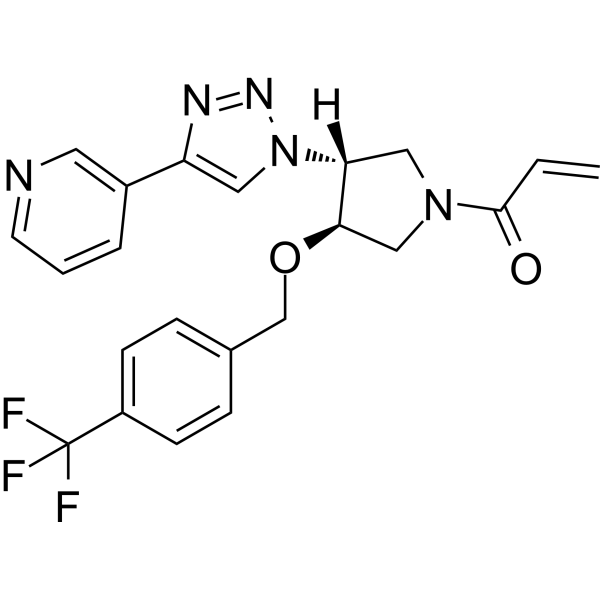 0 ImagesSynonyms: TEAD-IN-3MYF-03-69 (TEAD-IN-3) is a covalent and irreversible TEAD inhibitor with IC50s of 385, 143, 558 and 173 nM for TEAD1, TEAD2, TEAD3 and TEAD4. MYF-03-69 disrupts YAP-TEAD association, suppresses TEAD transcriptional activity (IC50 = 56 nM) and up-regulates apoptosis gene BMF. MYF-03-69 selectively inhibits mesothelioma cancer cells with defective Hippo signaling. MYF-03-69 can be used for the study of malignant pleural mesothelioma (MPM).
-
PROTAC TEAD degrader-1
 0 ImagesPROTAC TEAD degrader-1 is a TEAD2 degrader and antiproliferative agent with selective activity toward TEAD2 relative to other TEAD family members. PROTAC TEAD degrader-1 relies on CRBN and the proteasome system for TEAD2 degradation; disruption of CRBN binding attenuates this activity. PROTAC TEAD degrader-1 decreases expression of YAP target genes CYR61 and CTGF. PROTAC TEAD degrader-1 can be used for the research of NF2-deficient cancer.

-
OPN-9652
 0 ImagesOPN-9652 is a potent, orally active, and covalent TEAD inhibitor (MSTO-211H TEAD IC50 = 0.005 µM) targeting the central palmitate binding pocket of TEADs. OPN-9652 reduces TEAD-dependent reporter activity and expression of TEAD targets (CTGF and CYR61). OPN-9652 resensitizes drug-tolerant SOX10 KO cells to BRAFi + MAPKi. OPN-9652 delays the onset of tumor resistance to BRAFi + MEKi from minimal residual disease (MRD) in a BRAF mutant A375 xenograft mouse model. OPN-9652 can be used for melanoma research.
-
KG-FP-003
 0 ImagesCat. No.: HY-186117CAS No.: 3066008-42-9KG-FP-003 is a highly potent, selective, and durable TEAD PROTAC degrader (TEAD1 DC50 = 6 ± 4 nM, TEAD2 DC50 = 68 ± 15 nM, TEAD3 DC50 = 12 ± 5 nM, TEAD4 DC50 = 7 ± 5 nM). KG-FP-003 promotes ubiquitination and degradation of TEAD. KG-FP-003 exhibits anticancer activity against mesothelioma and ovarian cancer.
-
TEAD-IN-21
 0 ImagesCat. No.: HY-178098CAS No.: 3128953-16-9TEAD-IN-21 is a potent and orally active pan-TEAD inhibitor with an IC50 of 3 nM. TEAD-IN-21 effectively inhibited the proliferation of Huh-7 cells. TEAD-IN-21 selectively downregulates TEAD-dependent downstream genes. TEAD-IN-21 achieves tumor regression in a liver cancer-derived tumor xenograft mice model. TEAD-IN-21 can be used in the research of hepatocellular carcinoma (HCC).
-
TEAD-IN-27
 0 ImagesCat. No.: HY-189653TEAD-IN-27 is a TEAD1-4 inhibitor that inhibits TEAD-dependent transcriptional activity. TEAD-IN-27 directly binds to and stabilizes TEAD1 and TEAD4, and binds purified TEAD protein in thermal shift assays. TEAD-IN-27 inhibits hepatic stellate cell activation and fibrotic gene expression, and alleviates chemically induced liver fibrosis and extracellular matrix deposition. TEAD-IN-27 can be used for research on liver fibrosis.
-
AZ'4331
 0 ImagesCat. No.: HY-189200CAS No.: 3006101-94-3AZ'4331 is an orally active pan-TEAD family inhibitor, with an IC50 of 0.381 μM against TEAD1, 0.020 μM against TEAD2, 0.014 μM against TEAD3, and 0.031 μM against TEAD4. AZ'4331 slows cell cycle progression. AZ'4331 exerts effects in cancer xenograft models with dysregulated Hippo pathway. AZ'4331 can be used to study cancers with altered Hippo pathways, including mesothelioma, head and neck squamous cell carcinoma, and EGFR-mutant non-small cell lung cancer.

-
TEAD ligand 1
 0 ImagesCat. No.: HY-158400CAS No.: 2971850-47-0TEAD ligand 1 is the ligand for target protein TEAD. TEAD ligand 1 is utilized for synthesis of PROTAC TEAD degrader-1 (HY-158342).
-
TEAD ligand 4
 0 ImagesCat. No.: HY-181592TEAD ligand 4 is a TEAD PROTAC ligand. TEAD ligand 4 can be conjugated with E3 ligase Ligand (HY-181591) and linker to synthesize PROTAC TEAD1/IAP degrader (HY-181590) .
-
M3686
 0 ImagesCat. No.: HY-170764CAS No.: 2738550-24-6M3686 (Compound 29) is a potent, selective TEAD1 inhibitor with an IC50 value of 51 nM. M3686 also shows weaker binding activity on TEAD3. M3686 potently inhibits cell viability against YAP-dependent NCI-H226 cell line with an IC50 value of 0.06 uM. M3686 shows strong anti-tumor effects in the NCI-H226 xenograft model.
-
PROTAC TEAD1/IAP degrader-1
 0 ImagesCat. No.: HY-181534PROTAC TEAD1/IAP degrader-1 (Compound A232) is a selective TEAD1 and cIAP1 PROTAC degrader, with DC50 values of 14 nM and 270 nM, respectively. PROTAC TEAD1/IAP degrader-1 promotes the ubiquitination and degradation of TEAD1 and cIAP1. PROTAC TEAD1/IAP degrader-1 downregulates the expression of the TEAD-dependent gene CTGF. PROTAC TEAD1/IAP degrader-1 exhibits anticancer activity against mesothelioma.
-
TEAD ligand 5
 0 ImagesCat. No.: HY-181595CAS No.: 2417720-74-0TEAD ligand 5 (Compound S19) is a TEAD PROTAC ligand. TEAD ligand 5 can be conjugated with E3 ligase Ligand (HY-181531) and linker (HY-181608) to synthesize PROTAC TEAD/IAP degrader-1 (HY-181594) .
-
LC-TEAD01
 0 ImagesCat. No.: HY-183728LC-TEAD01 is a potent covalent transcription enhancer-associated domain (TEAD) inhibitor with an IC50 of 116 nM and a Ki of 0.132 μM. LC-TEAD01 disrupts the TEAD-YAP interaction and inhibits TEAD-dependent transcriptional activity. LC-TEAD01 suppresses the proliferation of NF2-deficient cancer cells. LC-TEAD01 inhibits tumor growth in NF2-deficient xenograft models. LC-TEAD01 can be used in studies related to NF2-deficient malignant pleural mesothelioma.
-
OPN-9643
 0 ImagesCat. No.: HY-179559CAS No.: 2866423-06-3
-
EA-C15
 0 ImagesCat. No.: HY-179440EA-C15 is a potent and selective TEAD inhibitor with an IC50 of 0.34 μM. EA-C15 covalently binds to the TEAD palmitoylation site, blocks palmitoylation and transcriptional activity, and inhibits YAP-dependent cancer cell proliferation and YAP-TEAD target gene (CTGF and CYR61) transcription. EA-C15 can be used for cancer research.

-
VT102
 0 ImagesCat. No.: HY-182673CAS No.: 1119382-90-9VT102 is a TEAD1 inhibitor with a human IC50 of 391 nM. VT102 inhibits auto-palmitoylation, attenuates YAP/TEAD1 interaction, reduces expression of TEAD target genes, and inhibits YAP-mediated luciferase reporter activity. VT102 exerts weak cell growth inhibitory activity in cancer cells. VT102 can be used for the research of cancer.
-
TEAD-IN-23
 0 ImagesCat. No.: HY-179395CAS No.: 3074990-47-6TEAD-IN-23 (Compound 22) is an efficient pan-TEAD inhibitor with an IC50 of 10 nM. TEAD-IN-23 exhibits potent anti-proliferative activity in both NCI-H226 and MSTO-211H. TEAD-IN-23 causes complete tumor regression in the MSTO-211H xenograft tumor model. TEAD-IN-23 can be used for the study of mesothelioma and hepatocellular carcinoma.
- 1
- 2



