



TEAD Inhibitor
- 1
-
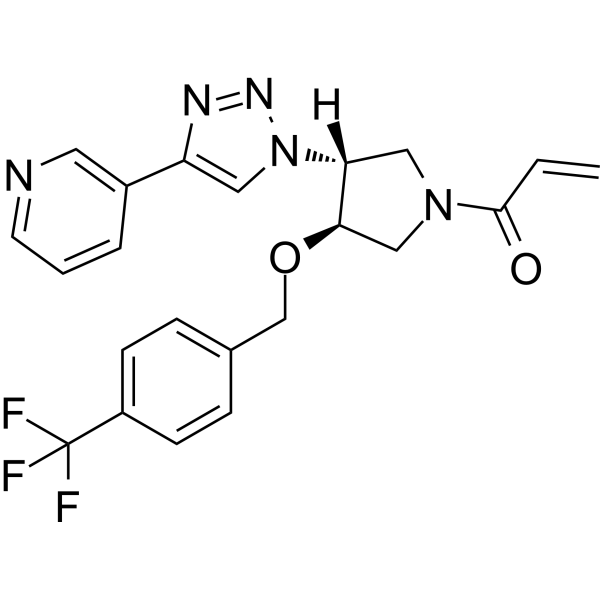
MYF-03-69
 0 ImagesSynonyms: TEAD-IN-3
MYF-03-69 (TEAD-IN-3) is a covalent and irreversible TEAD inhibitor with IC50s of 385, 143, 558 and 173 nM for TEAD1, TEAD2, TEAD3 and TEAD4. MYF-03-69 disrupts YAP-TEAD association, suppresses TEAD transcriptional activity (IC50 = 56 nM) and up-regulates apoptosis gene BMF. MYF-03-69 selectively inhibits mesothelioma cancer cells with defective Hippo signaling. MYF-03-69 can be used for the study of malignant pleural mesothelioma (MPM).

-
OPN-9652
 0 Images
OPN-9652 is a potent, orally active, and covalent TEAD inhibitor (MSTO-211H TEAD IC50 = 0.005 µM) targeting the central palmitate binding pocket of TEADs. OPN-9652 reduces TEAD-dependent reporter activity and expression of TEAD targets (CTGF and CYR61). OPN-9652 resensitizes drug-tolerant SOX10 KO cells to BRAFi + MAPKi. OPN-9652 delays the onset of tumor resistance to BRAFi + MEKi from minimal residual disease (MRD) in a BRAF mutant A375 xenograft mouse model. OPN-9652 can be used for melanoma research.
-
AZ'4331
 0 ImagesCat. No.: HY-189200CAS No.: 3006101-94-3
AZ'4331 is an orally active pan-TEAD family inhibitor, with an IC50 of 0.381 μM against TEAD1, 0.020 μM against TEAD2, 0.014 μM against TEAD3, and 0.031 μM against TEAD4. AZ'4331 slows cell cycle progression. AZ'4331 exerts effects in cancer xenograft models with dysregulated Hippo pathway. AZ'4331 can be used to study cancers with altered Hippo pathways, including mesothelioma, head and neck squamous cell carcinoma, and EGFR-mutant non-small cell lung cancer.
-
M3686
 0 ImagesCat. No.: HY-170764CAS No.: 2738550-24-6
M3686 (Compound 29) is a potent, selective TEAD1 inhibitor with an IC50 value of 51 nM. M3686 also shows weaker binding activity on TEAD3. M3686 potently inhibits cell viability against YAP-dependent NCI-H226 cell line with an IC50 value of 0.06 uM. M3686 shows strong anti-tumor effects in the NCI-H226 xenograft model.
-
TEAD-IN-21
 0 ImagesCat. No.: HY-178098
TEAD-IN-21 is a potent and orally active pan-TEAD inhibitor with an IC50 of 3 nM. TEAD-IN-21 effectively inhibited the proliferation of Huh-7 cells. TEAD-IN-21 selectively downregulates TEAD-dependent downstream genes. TEAD-IN-21 achieves tumor regression in a liver cancer-derived tumor xenograft mice model. TEAD-IN-21 can be used in the research of hepatocellular carcinoma (HCC).
-
LC-TEAD01
 0 ImagesCat. No.: HY-183728
LC-TEAD01 is a potent covalent transcription enhancer-associated domain (TEAD) inhibitor with an IC50 of 116 nM and a Ki of 0.132 μM. LC-TEAD01 disrupts the TEAD-YAP interaction and inhibits TEAD-dependent transcriptional activity. LC-TEAD01 suppresses the proliferation of NF2-deficient cancer cells. LC-TEAD01 inhibits tumor growth in NF2-deficient xenograft models. LC-TEAD01 can be used in studies related to NF2-deficient malignant pleural mesothelioma.
-
OPN-9643
 0 ImagesCat. No.: HY-179559CAS No.: 2866423-06-3
-
EA-C15
 0 ImagesCat. No.: HY-179440
EA-C15 is a potent and selective TEAD inhibitor with an IC50 of 0.34 μM. EA-C15 covalently binds to the TEAD palmitoylation site, blocks palmitoylation and transcriptional activity, and inhibits YAP-dependent cancer cell proliferation and YAP-TEAD target gene (CTGF and CYR61) transcription. EA-C15 can be used for cancer research.

-
VT102
 0 ImagesCat. No.: HY-182673CAS No.: 1119382-90-9
VT102 is a TEAD1 inhibitor with a human IC50 of 391 nM. VT102 inhibits auto-palmitoylation, attenuates YAP/TEAD1 interaction, reduces expression of TEAD target genes, and inhibits YAP-mediated luciferase reporter activity. VT102 exerts weak cell growth inhibitory activity in cancer cells. VT102 can be used for the research of cancer.
-
TEAD-IN-23
 0 ImagesCat. No.: HY-179395CAS No.: 3074990-47-6
TEAD-IN-23 (Compound 22) is an efficient pan-TEAD inhibitor with an IC50 of 10 nM. TEAD-IN-23 exhibits potent anti-proliferative activity in both NCI-H226 and MSTO-211H. TEAD-IN-23 causes complete tumor regression in the MSTO-211H xenograft tumor model. TEAD-IN-23 can be used for the study of mesothelioma and hepatocellular carcinoma.
-
GNE-2181
 0 ImagesCat. No.: HY-187181CAS No.: 2933893-78-6
GNE-2181 is an orally active, blood-brain barrier-penetrant pan-TEAD transcription factor inhibitor, with IC50 values of 13, 26, 61 and 17 nM against TEAD1, TEAD2, TEAD3 and TEAD4, respectively. GNE-8021 allosterically disrupts the TEAD-YAP/TAZ interaction and inhibits TEAD-mediated oncogenic transcriptional programs via the Hippo signaling pathway. GNE-8021 suppresses YAP-driven tumor cell growth. GNE-2181 inhibits the growth of intracranial tumor models in vivo. GNE-2181 can be used for research on brain metastasis of lung cancer.
-
LC-TD-05
 0 ImagesCat. No.: HY-183753
LC-TD-05 is a non-covalent inhibitor of TEAD1, TEAD2 and TEAD4, with IC50 values of 116.6 nM, 168.7 nM and 68.3 nM, respectively; it shows weak activity against TEAD3, with a human IC50 of 1261.0 nM. LC-TD-05 induces apoptosis in hepatocellular carcinoma cells. LC-TD-05 can be used for the research of hepatocellular carcinoma.
-
YAP/TAZ-TEAD-IN-3
 0 ImagesCat. No.: HY-186022CAS No.: 2714434-41-8
YAP/TAZ-TEAD-IN-3 is a YAP/TAZ-TEAD interaction inhibitor with an IC50 of 1.8 nM. YAP/TAZ-TEAD-IN-3 can be used as a TEAD1 ligand to construct PROTACs, such as PROTAC TEAD degrader-2 (HY-186021).
-
pan-TEAD-IN-1
 0 ImagesCat. No.: HY-159912CAS No.: 3027484-09-6
pan-TEAD-IN-1 (Compound 3) is an orally active pan-TEAD inhibitor targeting the palmitoylation site of TEAD, disrupting its interaction with the coactivators YAP/TAZ, thereby suppressing the transcriptional upregulation of oncogenes (e.g., Ctgf and Cyr61) in the Hippo signaling pathway. pan-TEAD-IN-1 exhibits excellent activity with a luciferase IC50 of 0.36 nM and an H226 cell IC50 of 1.52 nM. It also shows favorable pharmacokinetics (AUC0–∞ = 228.7 μg/mL·min, T1/2 = 183.9 min). In TEAD-dependent xenograft mouse models, pan-TEAD-IN-1 significantly inhibited tumor growth, showing promise for research in TEAD-dependent cancers.
-
VT101
 0 ImagesCat. No.: HY-182672CAS No.: 65194-64-1
-
DC-TEAD3in03
 0 ImagesCat. No.: HY-147209
DC-TEAD3in03 is a subtype-selective and covalent TEAD3 inhibitor with an IC50 of 0.16 μM. DC-TEAD3in03 exhibits the inhibitory activity on TEAD1/2/4 reduced by more than 100 times. DC-TEAD3in03 has the IC50 for TEAD3 of 1.15 μM in the GAL4-TEAD reporter gene experiment in cells, and it does not interfere with the β-catenin pathway. DC-TEAD3in03 reduces the growth rate of the zebrafish tail fin. DC-TEAD3in03 can be used to study the proportional growth of appendages in vertebrates.

-
TEAD-IN-24
 0 ImagesCat. No.: HY-180514CAS No.: 3034813-75-4
TEAD-IN-24 (Example 65) is a TEAD inhibitor. TEAD-IN-24 exhibits anti-cancer activity against non-small cell lung cancer.
- 1



