



YAP Degrader
- 1
-
H122
 0 ImagesCat. No.: HY-172113Purity: 98.33%
H122 is a PROTAC degrader for TEAD that degrades TEAD1 with a DC50 of 3 nM. H122 exhibits good affinity to TEAD2, TEAD3, and TEAD4 with Ki values of 2.0, 3.6 and 1.6 nM, respectively. H122 relies on binding to TEAD1 and CRBN, functional E3 ligase activity, and a functional proteasome for degradation.H122 induces degradation of TEAD3 and forms a ternary complex with TEAD4 and CRBN/DDB1 to mediate degradation.H122 downregulates expression of Myc target genes. H122 exhibits antitumor efficacy in MSTO-211H mouse xenograft models.H122 can be used for the research of malignant mesothelioma.
-
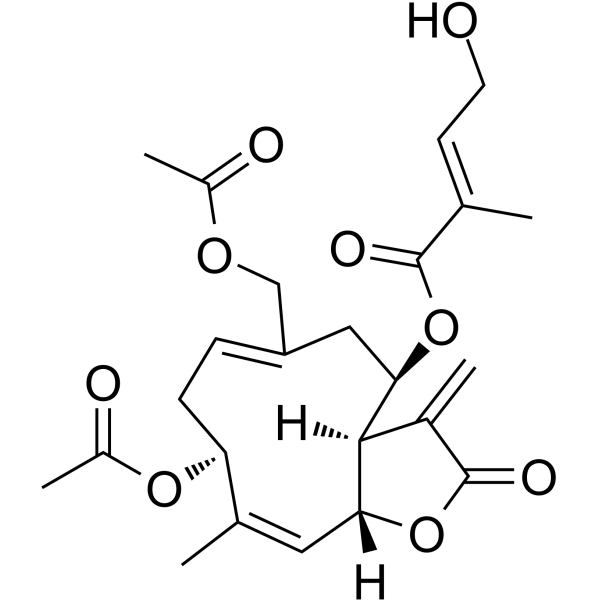
Eupalinolide A
 0 Images
Eupalinolide A is a Yes-associated protein (YAP) degrader and HSP70 inducer. Eupalinolide A inhibits osteogenic differentiation of tendon-derived stem cells (TDSCs). Eupalinolide A induces autophagy in hepatocellular carcinoma cells via activating the ROS/ERK signaling pathway. Eupalinolide A protects PAM212 cells from UVB-, Menadione (HY-B0332)-, or heat shock-induced apoptosis. Eupalinolide A alleviates trauma-induced heterotopic ossification (HO) of Achilles tendon and inhibits growth of MHCC97-L and HCCLM3 hepatocellular carcinoma xenograft tumors in mice. Eupalinolide A can be used for the study of traumatic heterotopic ossification of tendons and hepatocellular carcinoma.
-
PROTAC TEAD degrader-1
 0 Images
PROTAC TEAD degrader-1 is a TEAD2 degrader and antiproliferative agent with selective activity toward TEAD2 relative to other TEAD family members. PROTAC TEAD degrader-1 relies on CRBN and the proteasome system for TEAD2 degradation; disruption of CRBN binding attenuates this activity. PROTAC TEAD degrader-1 decreases expression of YAP target genes CYR61 and CTGF. PROTAC TEAD degrader-1 can be used for the research of NF2-deficient cancer.
-
KG-FP-003
 0 ImagesCat. No.: HY-186117CAS No.: 3066008-42-9
KG-FP-003 is a highly potent, selective, and durable TEAD PROTAC degrader (TEAD1 DC50 = 6 ± 4 nM, TEAD2 DC50 = 68 ± 15 nM, TEAD3 DC50 = 12 ± 5 nM, TEAD4 DC50 = 7 ± 5 nM). KG-FP-003 promotes ubiquitination and degradation of TEAD. KG-FP-003 exhibits anticancer activity against mesothelioma and ovarian cancer.
-
TEAD ligand 4
 0 ImagesCat. No.: HY-181592
TEAD ligand 4 is a TEAD PROTAC ligand. TEAD ligand 4 can be conjugated with E3 ligase Ligand (HY-181591) and linker to synthesize PROTAC TEAD1/IAP degrader (HY-181590) .
-
HC278
 0 ImagesCat. No.: HY-185230CAS No.: 3096503-40-8
-
PROTAC TEAD1/IAP degrader-1
 0 ImagesCat. No.: HY-181534
PROTAC TEAD1/IAP degrader-1 (Compound A232) is a selective TEAD1 and cIAP1 PROTAC degrader, with DC50 values of 14 nM and 270 nM, respectively. PROTAC TEAD1/IAP degrader-1 promotes the ubiquitination and degradation of TEAD1 and cIAP1. PROTAC TEAD1/IAP degrader-1 downregulates the expression of the TEAD-dependent gene CTGF. PROTAC TEAD1/IAP degrader-1 exhibits anticancer activity against mesothelioma.
-
PROTAC TEAD1/IAP degrader-3
 0 ImagesCat. No.: HY-181590
PROTAC TEAD1/IAP degrader-3 is a TEAD1/IAP PROTAC degrader. PROTAC TEAD1/IAP degrader-3 recruits the cIAP1 and XIAP E3 ligases to form a ternary complex, drives proteasomal degradation of TEAD1, and triggers autoubiquitination and proteasomal degradation of cIAP1. PROTAC TEAD1/IAP degrader-3 inhibits cell proliferation. PROTAC TEAD1/IAP degrader-3 regulates Hippo pathway activity by downregulating CTGF gene expression in a TEAD-dependent manner. PROTAC TEAD1/IAP degrader-3 is applicable to the research of mesothelioma.
-
TEAD degrader-1
 0 ImagesCat. No.: HY-184179CAS No.: 3103984-17-1
TEAD degrader-1 is a potent FBXO22-mediated molecular glue degrader of TEAD, with a 24 h DC50 of 1.0 nM. TEAD degrader-1 binds reversibly and covalently to FBXO22 C326, assembles a functional ternary complex, and mediates proteasomal degradation of TEAD. TEAD degrader-1 exhibits high selectivity for the Hippo pathway and specifically downregulates only TEAD and its downstream target proteins. TEAD degrader-1 is applicable to research related to malignant pleural mesothelioma and non-small cell lung cancer.

-
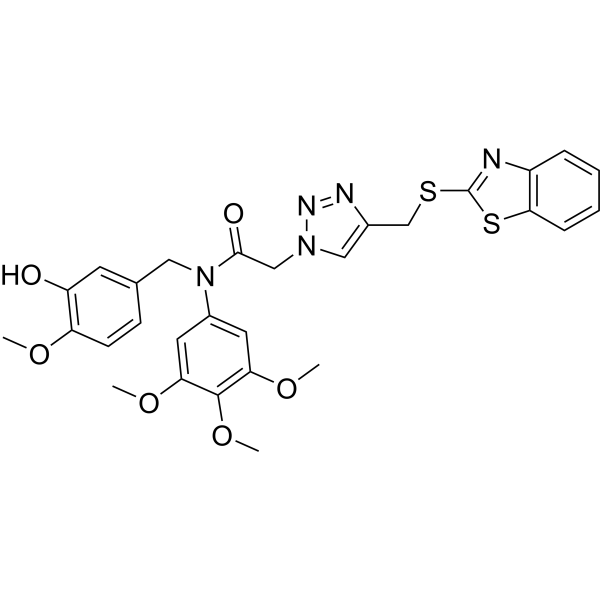
Tubulin polymerization-IN-58
 0 ImagesCat. No.: HY-162126CAS No.: 3027015-30-8
-
PROTAC TEAD degrader-2
 0 ImagesCat. No.: HY-186021CAS No.: 2918762-17-9
PROTAC TEAD degrader-2 (Compound 31) is an efficient TEAD1 PROTAC degrader with a DC50 of 0.6 nM. PROTAC TEAD degrader-2 inhibits the YAP/TAZ-TEAD interaction, with a IC50 of 1.8 nM. PROTAC TEAD degrader-2 exhibits significant selective inhibitory activity against YAP-dependent cancer cells and effectively suppresses the transcriptional activity mediated by YAP. PROTAC TEAD degrader-2 can be used for research on mesothelioma and glioma.
-
PROTAC TEAD/IAP degrader-1
 0 ImagesCat. No.: HY-181594
PROTAC TEAD/IAP degrader-1 is a TEAD/IAP PROTAC degrader. PROTAC TEAD/IAP degrader-1 is also a specific and Nongenetic inhibitor of apoptosis protein (IAP)-dependent protein eraser (SNIPERs). PROTAC TEAD/IAP degrader-1 recruits cIAP1 to form ternary complexes, induces ubiquitination, proteasomal TEAD1, TEAD4 degradation. PROTAC TEAD/IAP degrader-1 inhibits TEAD transcriptional activity, reduces CTGF expression, and reduces cell proliferation. PROTAC TEAD/IAP degrader-1 can be used for the research of mesothelioma.
-
PROTAC TEAD1/IAP degrader-2
 0 ImagesCat. No.: HY-181537
PROTAC TEAD1/IAP degrader-2 is an IAP-harnessing TEAD1 PROTAC degrader, with a DC50 of 170 nM against TEAD1 in NCI-H2052 cells. PROTAC TEAD1/IAP degrader-2 exhibits moderate antiproliferative activity in Hippo pathway-dependent mesothelioma cells. PROTAC TEAD1/IAP degrader-2 inhibits the expression of CTGF, but with a weaker effect than the TEAD inhibitor VT-107 (HY-134957). PROTAC TEAD1/IAP degrader-2 can be used in mesothelioma-related research.
-
TEAD ligand-Linker Conjugate 3
 0 ImagesCat. No.: HY-181607
TEAD ligand-Linker Conjugate 3 (the blue structure + black structure of A536 in the literature) is a conjugate of a TEAD1-targeting ligand and a linker. TEAD ligand-Linker Conjugate 3 can be coupled with an IAP ligand (HY-181531) to form an IAP-recruiting bifunctional protein degrader (IPD) (HY-181594), also known as a SNIPER degrader. This TEAD SNIPER simultaneously binds to the TEAD1 palmitoylation pocket and the BIR3 domain of cIAP1 to form a ternary complex, efficiently inducing the ubiquitination and degradation of both TEAD1 and cIAP1 (DC50=110 nM, Dmax=51%; IC50=122 nM for cIAP1). TEAD ligand-Linker Conjugate 3 and its synthesized SENIPER molecule can be utilized in research on Hippo pathway dysregulation-related diseases, such as NF2-mutant tumors.
- 1



