



Antibiotic
Antibiotics are a class of secondary metabolites produced from microorganisms, animals or plants. Some of them exhibit anti-bacterial, anti-fungal, anthelmintic, anti-tumor or immunosuppressive activities with a wealth of structural classes such as β-lactams, macrolide and polyether. As major sources of antibiotics, streptomycetes, penicillium and marine organisms produce a wide variety of commercially important polyketide compounds including the well-known macrolide, polyene and polyether antibiotics with wide range of activities. Antibiotics such as penicillin, cephalosporin, streptomycin, and tetracycline can be used in the treatment of human and veterinary diseases. However, antibiotic resistance is also a growing threat to global public health.
Antibiotic Isoform Specific Products
-
Antibiotic
(2774)
View all products
-
Aminoglycoside
(46)
View all products
-
Glycopeptide
(20)
View all products
-
Lipopeptide
(7)
View all products
-
Macrolide
(76)
View all products
-
Oxazolidinone
(16)
View all products
-
Quinolone
(101)
View all products
-
Tetracycline
(42)
View all products
-
β-lactam
(199)
View all products
All Product Categories
-
Antibiotic Related Products (3536)
Related Products (3536)

-
Related Compound Screening Libraries (1)
-
Antibiotic Isoform Comparison
-
(Rac)-Moxifloxacin-d4
 0 ImagesCat. No.: HY-66011BSCAS No.: 2512220-27-6Synonyms: (Rac)-BAY 12-8039-d4 free base(Rac)-Moxifloxacin-d4 ((Rac)-BAY 12-8039-d4 (free base)) is deuterium labeled (Rac)-Moxifloxacin. (Rac)-Moxifloxacin ((Rac)-BAY 12-8039 free base) is the isoform of Moxifloxacin Hydrochloride (HY-66011), which is an oral 8-methoxyquinolone antimicrobial for use in the treatment of acute bacterial sinusitis, acute bacterial exacerbations of chronic bronchitis, and community-acquired pneumonia.
-
Gilvocarcin M
 0 ImagesCat. No.: HY-129306CAS No.: 77879-89-1Gilvocarcin M is an antibiotic and can be isolated from S. gilvotanareus. Gilvocarcin M is active against S. aureus at a concentration of 32 µg/ml and inhibits growth of KB cells with the IC50 of 0.52 µg/ml. Gilvocarcin M intercalates into bacteriophage PM2 DNA.
-
Arylomycin A1
 0 ImagesCat. No.: HY-N13952CAS No.: 459844-19-0Arylomycin A1 is a lipohexapeptide antibiotic against Gram-positive bacteria.
-
Heptaibin
 0 ImagesCat. No.: HY-N14685CAS No.: 291311-47-2Heptaibin is a peptaibol antifungal antibiotic. Heptaibin has the activity against Gram-positive bacteria (MIC is 8 μg/mL) such as Staphylococcus aureus and fungi (MIC is 13-32 μg/mL) such as Aspergillus, Candida albicans and cryptococcus neofordii, and it has moderate anti-Rhabditella pseudoelongata activity (MIC is 50 μg/mL).
-
Azithromycin-d5
 0 ImagesCat. No.: HY-W653875Azithromycin-d5 (CP-62993-d5) is the deuterium labeled Azithromycin (CP-62993) (HY-17506). Azithromycin is a macrolide antibiotic useful for thestudy of a number of bacterial infections.
-
Cefpodoxime Proxetil-d6
 0 ImagesCat. No.: HY-N7101S1Synonyms: U-76,252-d6; CS-807-d6Cefpodoxime Proxetil-d6 (U-76,252-d6) is deuterium labeled Cefpodoxime Proxetil. Cefpodoxime proxetil is an orally administered broad spectrum third-generation cephalosporin. Cefpodoxime proxetil has anti-bacterial activity. Cefpodoxime proxetil binds to penicillin binding proteins (PBPs) which inhibits peptidoglycan synthesis, finally results in interfering bacterial cell wall biosynthesis.
-
Norfloxacin hydrochloride
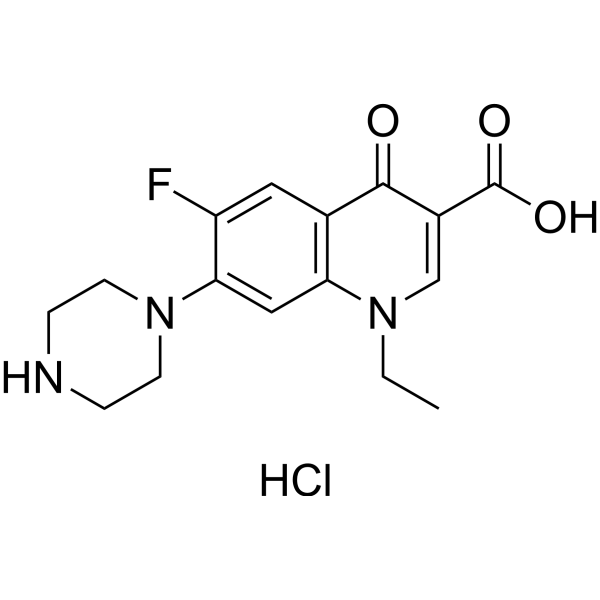 0 ImagesCat. No.: HY-B0132ACAS No.: 68077-27-0Synonyms: MK-0366 hydrochlorideNorfloxacin hydrochloride (MK-0366 hydrochloride) is a broad-spectrum antibiotic that is active against both Gram-positive and Gram-negative bacteria, which functions by inhibiting DNA gyrase.
-
Avibactam free acid (Standard)
 0 ImagesCat. No.: HY-14879RCAS No.: 1192500-31-4Synonyms: NXL-104 free acid (Standard)Avibactam (free acid) (Standard) is the analytical standard of Avibactam (free acid). This product is intended for research and analytical applications. Avibactam (NXL-104) free acid is a covalent and reversible non-β-lactam β-lactamase inhibitor which inhibits β-lactamase TEM-1 and CTX-M-15 with IC50s of 8 nM and 5 nM, respectively[1].
-
Tuberactinomycin A
 0 ImagesCat. No.: HY-108190CAS No.: 33103-21-8Tuberactinomycin A is a basic cyclic peptide antibiotic and a group I intron RNA splicing inhibitor, with an IC50 of 10 μM against the G-binding site of bacteriophage T4 group I intron RNA. Tuberactinomycin A exerts antibacterial effects by acting on the initiation and elongation steps of bacterial bacteria ribosomes to inhibit prokaryotic protein synthesis. Tuberactinomycin A competes with guanosine cofactors for binding to the G-binding site of group I intron RNA, forms electrostatic interactions with the RNA backbone, and inhibits the self-splicing of bacteriophage T4 td and sunY group I introns, and its inhibitory activity depends on Mg2+ concentration. Tuberactinomycin A can be used in studies related to bacterial infections.
-
Polyoxin E
 0 ImagesCat. No.: HY-N14208CAS No.: 22976-87-0Polyoxin E is a nucleoside antifungal antibiotic and has significant effects on rice sheath blight.
-
MM 47755
 0 ImagesCat. No.: HY-125163CAS No.: 117620-87-8Synonyms: 8-O-Methyltetrangomycin; 6-Deoxy-8-O-methylrabelomycinMM 47755 (8-O-Methyltetrangomycin; 6-Deoxy-8-O-methylrabelomycin) is an antibiotic with antibacterial activity. MM 47755 can be isolated from Streptomyces.
-
Cefprozil monohydrate (Standard)
 0 ImagesCefprozil monohydrate (Standard) is the analytical standard of Cefprozil monohydrate (HY-B0458). This product is intended for research and analytical applications. Cefprozil monohydrate is a second-generation cephalosporin type antibiotic. Cefprozil monohydrate exhibits broad-spectrum antibacterial activity, and is orally active. Cefprozil monohydrate can be used for the study of pharyngitis, tonsillitis, otitis media, and uncomplicated skin infections.
-
Fusaricidin B
 0 ImagesCat. No.: HY-N16657CAS No.: 189757-88-8Synonyms: LI-F 04bFusaricidin B (LI-F 04b) is a lipopeptide biosurfactant. Fusaricidin B can be isolated from the culture broth of Bacillus polymyxa KT-8. Fusaricidin B exhibits activity against Gram-positive bacteria (especially Staphylococcus aureus FDA 209P and Micrococcus luteus IFO 3333), but its activity is weaker than that of the mixture of Fusaricidin C and D.
-
Clavariopsin B
 0 ImagesCat. No.: HY-N14961CAS No.: 227083-48-9Clavariopsin B is a cyclic depsipeptide antibiotic. Clavariopsin B shows antifungal activity for Candida albicans IFO 0583, Candida albicans ATCC 10231, Aspergillus niger AJ117374, Aspergillus fumigatus AJ117190, Aspergillus fumigatus JCM1739 with MIC values of 8, 8, 16, 4, 4 μg/mL, respectively.
-
Antibacterial agent 285
 0 ImagesCat. No.: HY-174852CAS No.: 2797056-04-1Antibacterial agent 285 (Compound 3) is a cephalosporin antibiotic. Antibacterial agent 285 has significant antibacterial activity against gram-negative bacterium with MICs of 0.125-0.5, 0.125-0.5 and 0.125-2 μg/mL for carbapenem-resistant Acinetobacter baumannii (CRAB), Klebsiella pneumoniae (CRE) and Pseudomonas aeruginosa (CRPA), respectively. Antibacterial agent 285 can be used for bacterial infection research, such as complicated urinary tract infections (cUTI) and kidney infections.
-
Rifamycin S (Standard)
 0 ImagesRifamycin S (Standard) is the analytical standard of Rifamycin S. This product is intended for research and analytical applications. Rifamycin S, a quinone, is an antibiotic against Gram-positive bacteria (including MRSA). Rifamycin S is the oxidized forms of a reversible oxidation-reduction system involving two electrons. Rifamycin S generates reactive oxygen species (ROS) and inhibits microsomal lipid peroxidation. Rifamycin S can be used for tuberculosis and leprosy.
-
Paldimycin A
 0 ImagesCat. No.: HY-108191CAS No.: 101411-70-5Synonyms: Antibiotic 273a1αPaldimycin A (Antibiotic 273a1α) is an antibiotic derived from Streptomyces paulus, primarily targeting Gram-positive bacteria. Paldimycin A exerts its antibacterial effects by interfering with bacterial protein synthesis and cell membrane function.
-
2-Hydroxygentamicin B1
 0 ImagesCat. No.: HY-N14703CAS No.: 78874-51-82-Hydroxygentamicin B1 is a 3 aminoglycoside antibiotic with anti-Gram-positive and negative bacteria activity.
-
Moxifloxacin-d5
 0 ImagesCat. No.: HY-66011AS5CAS No.: 1092356-43-8Synonyms: BAY 12-8039-d5 free baseMoxifloxacin-d5 (BAY 12-8039-d5 (free base)) is deuterium labeled Moxifloxacin. Moxifloxacin is an orally active 8-methoxyquinolone antimicrobial for use in the treatment of acute bacterial sinusitis, acute bacterial exacerbations of chronic bronchitis, and community-acquired pneumonia.
-
Rifamycin sodium (Standard)
 0 ImagesCat. No.: HY-B1907RCAS No.: 14897-39-3Synonyms: Rifamycin SV sodium (Standard)Rifamycin (sodium) (Standard) is the analytical standard of Rifamycin (sodium). This product is intended for research and analytical applications. Rifamycin sodium (Rifamycin SV sodium) is an orally active ansamycin antibiotic. Rifamycin sodium inhibits DNA-dependent RNA synthesis. Rifamycin sodium has antibacterial activity against Mycobacterium tuberculosis. Rifamycin sodium interferes with hepatic bile acid metabolism. Rifamycin sodium has anti-inflammatory effects. Rifamycin sodium can be used in the study of Mycobacterium tuberculosis, Bacteroides fragilis infection, and Lipopolysaccharide (HY-D1056B3)-induced inflammation.



